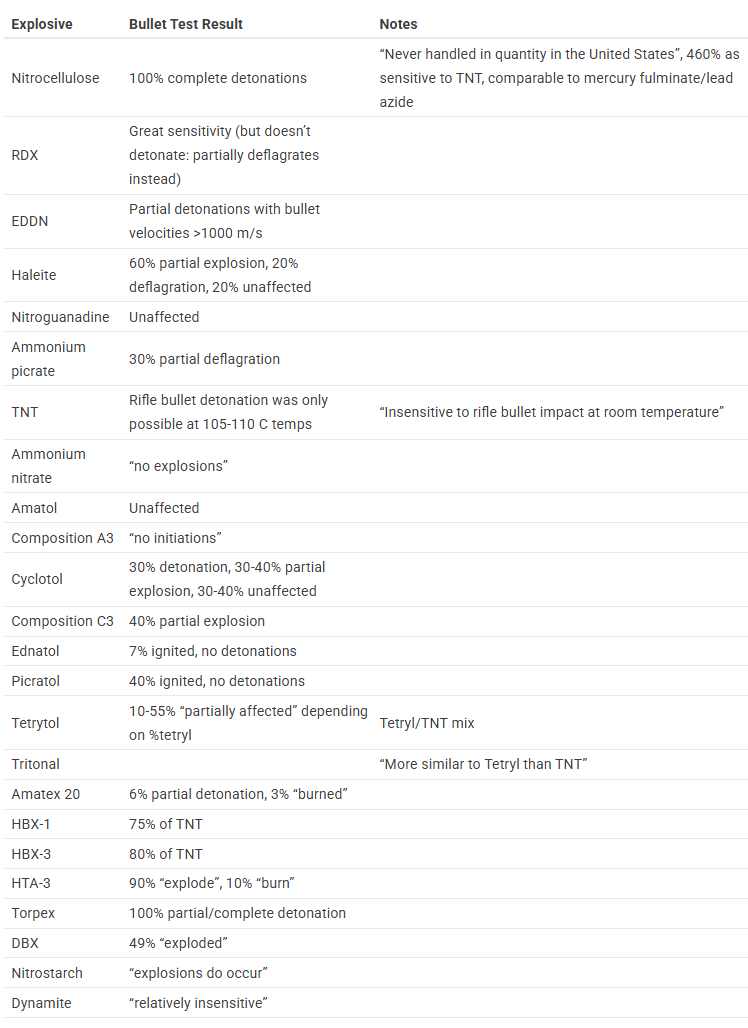
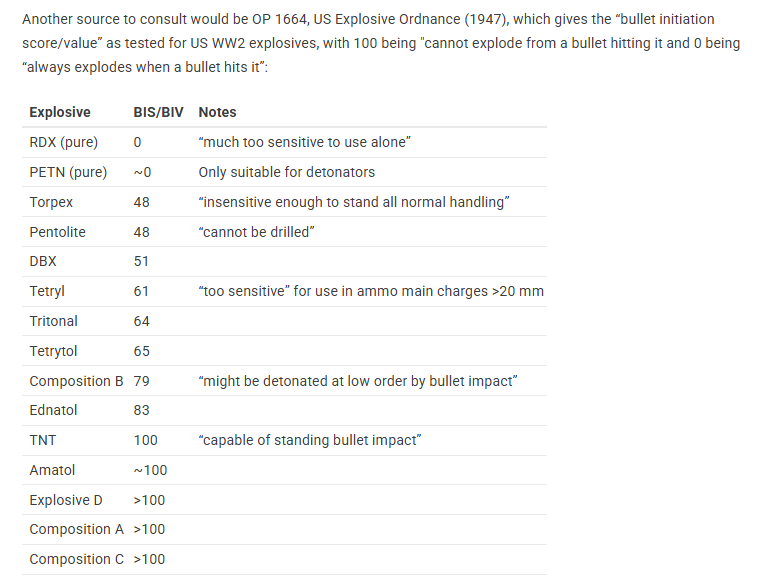
Explosives in bombs are extremely phlegmatic - that means that they are unable to explode due to concussions and need specialized fuses to detonate - that’s why they are called secondary or tertiary explosives.
In oder to ignite any of these explosives you need to add energy - either by a fuse or things like heat or pressure above a certain threshold. In theory even a pure AP round can detonate a bomb as they produce heat whilst penetrating the bomb casing and transfer heat and motion energy when slowing down - this depends on the needed amount of “extra energy” to detonate the bomb.
So whilst it is technically not impossible that a HMG or cannon shell might be able to hit, penetrate AND to transfer the needed amount of energy to detonate the explosive filler, the probability of this happening irl is extremely low, but not impossible.
WT simply increases the chances to hit bombs AND to explode them to fantasy values as it is a video game.
Gaijin modelled “bomb racks” on aircraft because they wanted to add mid air interception to bombs/rockets, seeing how it is common in modern conflict with CIWS systems and they didn’t want to make an exception on planes that haven’t dropped their bombs yet.
The problem of course is that like 90% of changes aimed towards high tiers, in ends up also affecting lower tiers.
And since this was aimed towards ground battles %100, air battles also had to get it.
Your gepard may still do the fancy “munition interception”, but try that on a M16 MGC and that bomb is flying straight towards your proximity.
This “feature” only beat down bombers even further.
If you want it still for “bomber balance”, maybe even add ammo racking belts on aircraft weaponry.
Yes, its the speed of combustion needs to accelerate to supersonic not the initiator strictly BE supersonic, but for what should be obvious reasons people use high explosives that are far more stable and do require not just supersonic detonators but multistage, when is the last time you heard of an artillery shell filled with nitro-glycerine?
yes, but its a MASSIVE increase, beyond the fact that the concussion needs to be enough to cause compression heating to beyond ignition temp. as you mentioned
Shockwave radius increases at the cube root of explosive mass, requiring half a stick of dynamite in the explosive mix to initiate will take 4 full sticks to detonate from 1 meter, 32 at 2 meters and 128 at 4 meters.
Yeah, this is the only change that they should explore.
Vary the probability of bomb detonation by round size and type. The bomb filler would also have quite an impact but I also imagine the capacity of the bomb would also change things quite a bit. Something like the 4000lb “cookie” on a Lancaster would probably be more vulnerable than a 1000lb MC bomb with a fairly thick bomb casing.
Though that does sound like a lot of modeling for something quite niche.
Honestly… I dont think it really changed anything. Heavy bombers still fall apart at the slightest breeze, their bomb loads being vulnerable just makes epic looking explosions, it didnt create any new weakspot that can be exploited, because the bomber probably would have died already
Thickness of bomb casings are not related to an era - the thickness is the result of the desired effect as wall thickness determines the effect of the bomb - so the perfect mix of pressure / shock wave and the splinters from the casing.
You see this in-game with sea mines: High TNT output when dropped on a base, but low destruction radius vs ground targets - just based on the fact that splinters make no sense in an underwater explosion as your main weapon is pressure.
I am aware of that, instead, I was looking at it more from the standpoint of more modern fillers that are likely more stable and less prone to accidental detonation.
The German “schrage musik” was only 20mm, but I’m not even fully convinced they where really intended to detonate bombs so much as exploit a blind spot in the bomber formation defenses, especially as they where mostly deployed on nigh fighters that would be intercepting Lancasters that didn’t have the B-17s ball turret for belly defense.
but there dose need to be a minimum amount of either kinetic or explosive energy required to detonate bombs, I don’t think a fully realistic calculation is necessary or worth the processing it would likely take to do accurately/ realistically, just but a minimum kinetic/ explosive energy requirement then scale up the chances of detonation from there.
My schadenfreude would miss watching the A2D-1s vaporize from their own 4000lb bomb after one hit from a tank MG if I’m being completely honest, but it’s a real issue in all modes.
But you are correct that it’s a lesser issue for bombers given their current damage model.
I was purposefully dumbing it down in my initial response just to point out a flaw in OP’s logic, i wasn’t expecting it to turn in to a long detailed discussion.
Depends on what bomb, what filler and from what era (e.i how thoroughly mixed the filler is and things of that nature). A bomb from early ww2 is going to be much more sensitive (and likely wont even be tertiary) compared to a modern bomb that might not ever explode due to being hit by a projectile. Your statement is to broad.
100% agree.
I agree with the general idea, but again a bit to broad statements, it will depend on several factors.
I’m just using that as a hyperbolic example. I’m just saying that there will be differences in how a early ww2 filler reacts compared to a 2020’s modern bomb filler. One might explode from a 20-30mm while the other might never explode even if hit with a 120mm APFSDS. It will depend.
I know War Thunder does to some degree have the explosive types listed for bombs but i don’t know if there are any mechanical differences or if it just means that they are all simulated as their TNT equivalent amounts and work the same.
Still possible though, and an HE shell that hits and explodes at the surface of a 1cm thick bomb shell might be enough depending on the filler.
Lots of replies talking about how it’s realistic for some bombs and not others, and I only ask now that, if this is the case that different explosives are more or less sensitive to shock/incendiary, why is it OK for Gaijn to have modeled them all as if they are equally likely to detonate from a 7.62 sneeze? I’m not saying to remove the mechanic entirely, but the number of times where I have been blown up by my own bombs in air RB by a guy spraying some rifle rounds at me from over a kilometer away is silly.
the main difference to me is that if I get my wing or tail shorn off close enough to the base, I may still be able to lob out a 4k lb. bomb and kill it. If the bomb itself is what killed me, then obviously not’s not happening.
"Cooking off " from temperature as some have described, takes time - a relatively large amount of time since bombs - casings + explosives - are quite large and take time to heat up.
Generally bombs are encased in substantial steel housings. Even 4000lb “cookies” had 7.9mm walls (mild steel I presume) - in a clylindrical shap - not too much to penetrate for an actual AP round of 50cal or higher, but lots of opportunity for a grazing hit, or a tumbling projectile if already penetrating other aircraft structure.
Are they modelling model bomb casing thichknesses and impact angles correctly? I am doubtful!
IMO for the purposes of a game like War Thunder this mechanism is nonsense short of a direct hit by a large calibre shell onto a bomb - and the game would lose nothing at all if it were left out!
I’m not an expert on the topic, but tritonal for example, would require a detonator instead of just burning. At most making the bomb inert if hit, but not exploding midair destroying the entire aircraft.
Also, in some fuses (I know this from some handgrenades), the fuse containing a primary and secondary high explosive to get the main explosive to go off are physically separated until the fusing cycle is activated and runs in the proper sequence.
So the primary (the one with the highest explosive speed) detonating before being moved into place to be able to trigger the secondary which then triggers the main charge would result in a dud.
That’s exactly to prevent any possibility of a premature detonation of the grenade, e.g. when hit by small arms fire or shrapnell.
I don’t know too much about bomb fuses, but could imagine similar mechanisms implemented there as well.
I don’t think the kinetic energy of an AP round could ever trigger a bomb’s main charge. Even the explosion of a HE shell would not be enough - you’d need the higher explosive speed of a primer charge to set it off, and when the HE shell detonates, that’s already gone that moment and cant penetrate the (quite heavy and thick) steel shell of a bomb and trigger the main charge there.
It would be quite a freak coincidence that a shell would hit exactly the primer to have it go off and trigger the main charge of the bomb. If this would have happened in the frequency it has in WT, the history books would be full of such cases, yet I know not of a single one.
(Just as I’ve not heard of a single case where an ATGM was machine gunned down by a tank before impact - but in WT it’s so easy to do that sometimes one can fire all missiles at a tank that all magically get intercepted by a valiant tank commander with his 50-cal…)
The point is we have the filler types because the game defines them, and none of those fillers had a tested BIS value that would support in-air high-ordering. This was a standard test of explosives and the amount of energy transferred and what it does (deflagration, etc.) is well defined in public sources Gaijin has access to.
Bombs being destroyed, broken apart, rendered inert, by projectiles hitting them? Sure. Bombs blowing up with full force in the air or on the rack? Never happened. Not once. Purely a War Thunderism and Rule of Cool. It makes the game dumber and more arcadey than it needs to be in all modes. But there’s no point in debating it as something that “could” actually happen.
Goes the same way like using strategic nukes to win an already won battle, annihilating both friend and foe and literally making the whole battle completely useless…