- Yes
- No
- 1966 configuration (2 × twin 40 mm Bofors L/60)
- 1968–1969 mine warfare configuration (1 × twin 40 mm L60 Bofors + helicopter deck + minesweeping equipment)
- 1979–1980 modernization (1 × single 40 mm L60 Bofors + 4 × M2 Browning + hangar)
- 1982–2021 final configuration (6 × M2 Browning + helicopter facilities + NATO command ship)
- Multiple configurations (as separate refits or vessels)
- Premium/Event version (one of the configurations)
- Other (please comment)
- No/negative
Huge credit to @Thomas_Belgium for not only helping me with information but also co authoring this suggestion (in all honesty he did a supermajority of the work) and much better than my initial suggestion.
History
History
Development
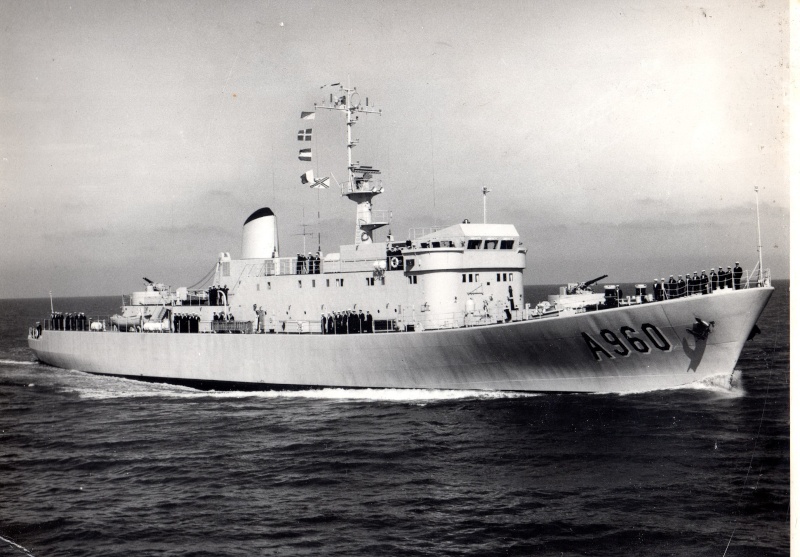
The A960 Godetia was the first major warship to be entirely designed and built in Belgium after the Second World War. During the early 1960s, the Belgian Navy required a modern vessel capable of replacing the aging support ships Kamina** and De Gerlache, both of which had reached the limits of their operational lives. Rather than simply constructing another replenishment ship, Belgium opted for a far more versatile design that could serve simultaneously as a command ship, logistical support vessel, fisheries patrol ship and floating headquarters for mine countermeasure operations.
Construction began at the Boelwerf shipyard in Temse on 15 February 1965. The ship was launched on 7 December 1965, christened by Madame Moyersoen, wife of the Belgian Minister of Defence, and commissioned into the Belgian Navy on 23 May 1966.
Named after the flower Godetia, the ship also commemorated the Flower-class corvette HMS Godetia (K226), which had been manned by the Belgian-crewed Royal Navy Section during the Second World War. Her motto, More Majorum (“According to the customs of our ancestors”), reflected this historical connection.
Unlike previous Belgian naval support ships, Godetia was conceived as a true multi-purpose support platform. Besides providing fuel, ammunition, spare parts and provisions to minehunters and patrol vessels, she carried workshops, medical facilities, a dental clinic, an operating theatre, accommodation for staff officers and trainees, and extensive communications equipment that enabled her to direct large mine-countermeasure operations.
Service history
Throughout her 55-year career, Godetia rarely attracted headlines, yet she became one of the busiest and most valuable ships in the Belgian Navy.
During the 1960s and 1970s she regularly undertook North Sea fisheries protection patrols, representation cruises, cadet training voyages and goodwill visits throughout Europe, the Mediterranean and the Atlantic. She frequently visited ports such as Lisbon, Tunis, Reykjavik, Las Palmas and Alicante while representing Belgium abroad.
As NATO increasingly emphasized mine warfare during the Cold War, Godetia gradually evolved into the Belgian Navy’s dedicated command and logistical support ship for mine countermeasure flotillas. From her onboard planning rooms and command facilities she could coordinate multiple minesweepers or minehunters while simultaneously providing maintenance, supplies and medical assistance.
The ship also proved useful for a variety of unusual missions. In 1985, for example, she transported a preserved Junkers Ju 52 aircraft back to Belgium for the Royal Army Museum. During numerous overseas deployments she delivered humanitarian aid to African nations while simultaneously serving as a training platform for Belgian naval cadets.
Following the end of the Cold War, Godetia continued to play an important role within NATO. She served several times as flagship of the Standing NATO Mine Countermeasures Group 1 (SNMCMG1), participated in multinational exercises including Arctic Archer, Beneficial Archer, Northern Coast, Quick Response, and supported humanitarian and defence diplomacy missions throughout West Africa.
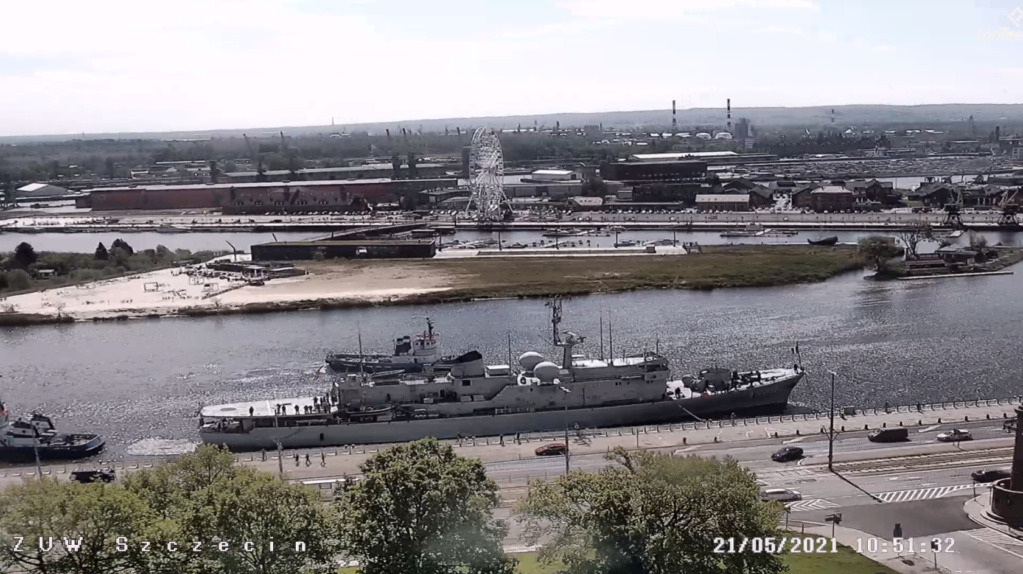
Her final operational deployment came in 2021, once again serving with SNMCMG1 before returning to Zeebrugge for the last time. After 55 years of uninterrupted service, Godetia was officially withdrawn from service on 1 July 2021, making her one of the oldest active naval vessels in Europe. She departed Belgium for dismantling later that year, bringing to an end the career of one of the Belgian Navy’s most recognizable ships.
Design
Design
Godetia was designed primarily as a command and logistical support ship, rather than a combat vessel. Her relatively large hull housed workshops, storage spaces, command facilities, medical rooms, accommodation for nearly one hundred crew members and additional personnel, allowing her to operate independently for extended periods while supporting flotillas of smaller ships.
A distinctive feature of the design was its flexibility. Over her long service life the ship underwent several major refits that substantially changed both her appearance and equipment.
When commissioned in 1966, Godetia carried two twin-mounted 40 mm Bofors guns, one positioned forward and one aft. These provided a respectable level of self-defence while retaining sufficient deck space for logistical operations.
By the late 1960s, operational priorities shifted towards mine warfare support. The aft Bofors mount was removed and replaced by a helicopter landing deck, while reels for minesweeping cables were installed, allowing the ship to support minesweeping operations more effectively.
A major modernization between 1979 and 1980 further transformed the vessel. The remaining twin 40 mm mount was replaced by a single 40 mm Bofors, supplemented by four M2 Browning .50 calibre machine guns for close-range defence. At the same time, a small helicopter hangar was added and the flight deck enlarged, enabling the ship to permanently embark and maintain an Alouette IIIB helicopter rather than merely providing a landing platform.
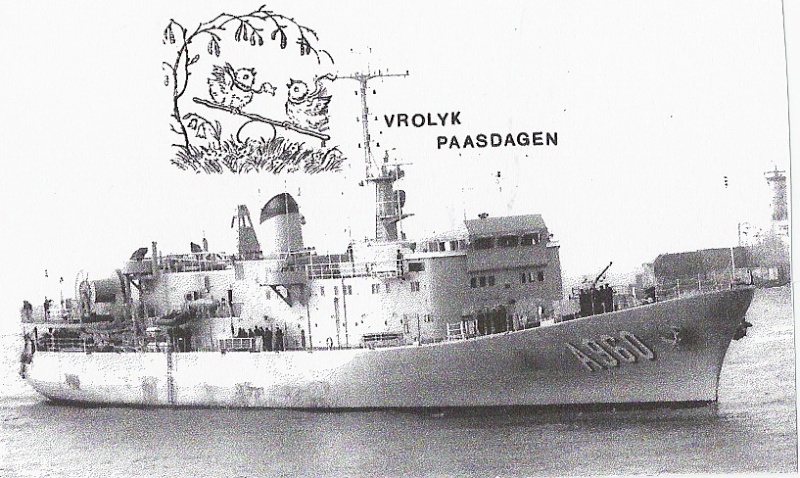
Video of the 1980 fit.
A further refit in 1982 completed the transition away from traditional gun armament. The remaining 40 mm gun was removed and replaced by six M2 Browning machine guns (four fixed, two temporary ones), reflecting the ship’s increasingly non-combat logistical and command role, mostly for Pirate deterent use. During later refits in 1990–1992, 2006 and 2009, the propulsion plant, communications systems and mine warfare equipment were modernized, culminating in the installation of a mine avoidance sonar while the obsolete minesweeping cable equipment was removed.
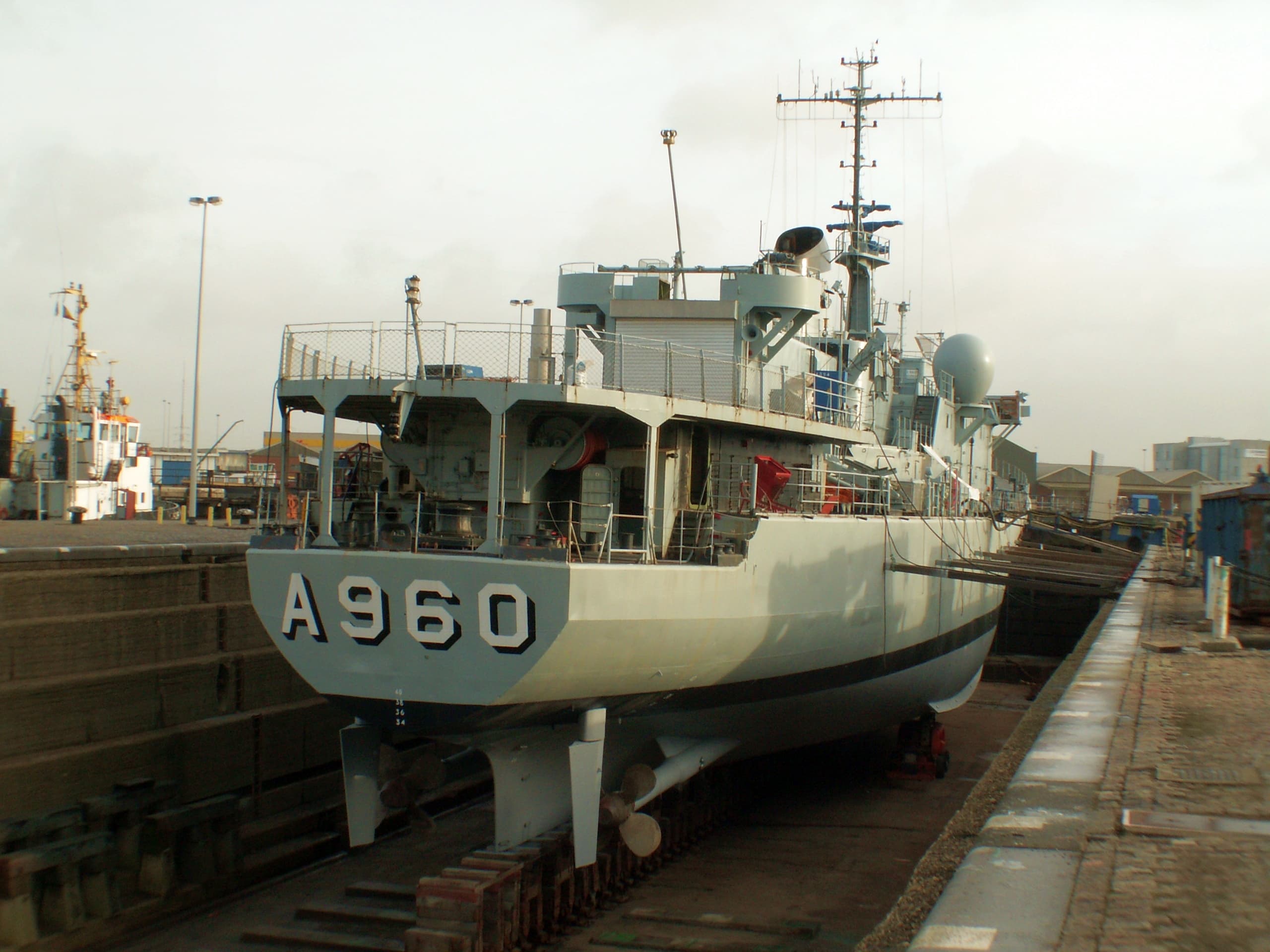
Specifications
1966 – As Commissioned
Specification Detail Type Command and logistical support ship Displacement 1,700 t standard / 2,500 t full load Length 91.84 m Beam 14.0 m Draught 3.47 m Propulsion 4 × 1,350 hp high-speed diesel engines, 2 controllable-pitch propellers Power 5,400 hp Maximum speed 18 knots (33 km/h) Range 6,000 nautical miles at 15 knots Crew 92 (8 officers, 29 NCOs, 55 enlisted) + accommodation for ~40 trainees/staff Main Armament 2 × 2 40 mm Bofors L/60 Aviation None Role Command ship, logistics support, fisheries patrol, replenishment 1968–1969 Mine Warfare Configuration
Specification Detail Displacement ~1,700 t standard / 2,500 t full load Speed 18 knots Crew ~92 + embarked staff Main Armament 1 × 2 40 mm Bofors L/60 (forward) Secondary Armament — Aviation Helicopter landing deck (no hangar) Mine Warfare Equipment Minesweeping cable reels installed Role Mine warfare support and command ship 1979–1980 Modernisation
Specification Detail Displacement ~2,000 t standard / 2,500 t full load Speed 18 knots Crew ~92 + embarked staff Main Armament 1 × 1 40 mm Bofors L/60 Secondary Armament 4 × 1 12.7 mm M2 Browning Aviation Enlarged flight deck and permanent hangar for 1 × Alouette IIIB Mine Warfare Equipment Minesweeping support facilities retained Role Command, logistics and mine warfare support 1982–2021 Final Configuration
Specification Detail Displacement 2,500 t full load Length 91.84 m Beam 14.0 m Draught 3.47 m Propulsion 4 × 1,350 hp diesel engines, 2 controllable-pitch propellers Power 5,400 hp Maximum speed 18 knots (33 km/h) Range 6,000 nautical miles at 15 knots Crew 92 + accommodation for approximately 40 additional personnel Main Armament 6 × 1 12.7 mm M2 Browning (.50 cal) (normally four permanently mounted, two fitted when required) Aviation 1 × Alouette IIIB helicopter (hangar and flight deck) Sensors Navigation radar, communications suite, mine avoidance sonar (after 2006/2009 refit) Mine Warfare Equipment Command facilities for MCM groups (minesweeping gear removed during the final refits) Primary Role NATO mine countermeasure flagship, command ship and logistical support vessel
References:
Marine Belge. (n.d.). A960 Godetia. Godetia2
Belgian Federal Government. (2007, January 12). BNS Godetia. https://news.belgium.be/nl/bns-godetia
MarineTraffic. (n.d.). BNS Godetia (MMSI 205204000) vessel details. https://www.marinetraffic.com/en/ais/details/ships/shipid:107352/mmsi:205204000/imo:0/vessel:BNS%20GODETIA
Servimed. (2021, July 1). Afscheid van de Godetia. https://2021.servimed.be/?p=1153
VRT NWS. (2021, June 25). Marineschip de Godetia stopt met varen: “55 jaar dienst, dat is ongezien”. Marineschip de Godetia stopt met varen, twee bemanningsleden ten huwelijk gevraagd tijdens afscheid | VRT NWS Nieuws
KW. (2021, June 25). Stad Oostende neemt afscheid van het kranige oudje A960 Godetia. Inloggen
Kustwacht. (n.d.). A960 Godetia. Marineschip Godetia in de strijd tegen piraterij | Kustwacht
Belgian Defence. (2013, April 19). Godetia zal anti-piraterijopdracht steunen in Golf van Guinea. https://www.mil.be/nl/artikel/godetia-zal-anti-piraterijopdracht-steunen-golf-van-guinea/
Op Stoapel. (n.d.). Godetia. Met pijn in het hart: Godetia |