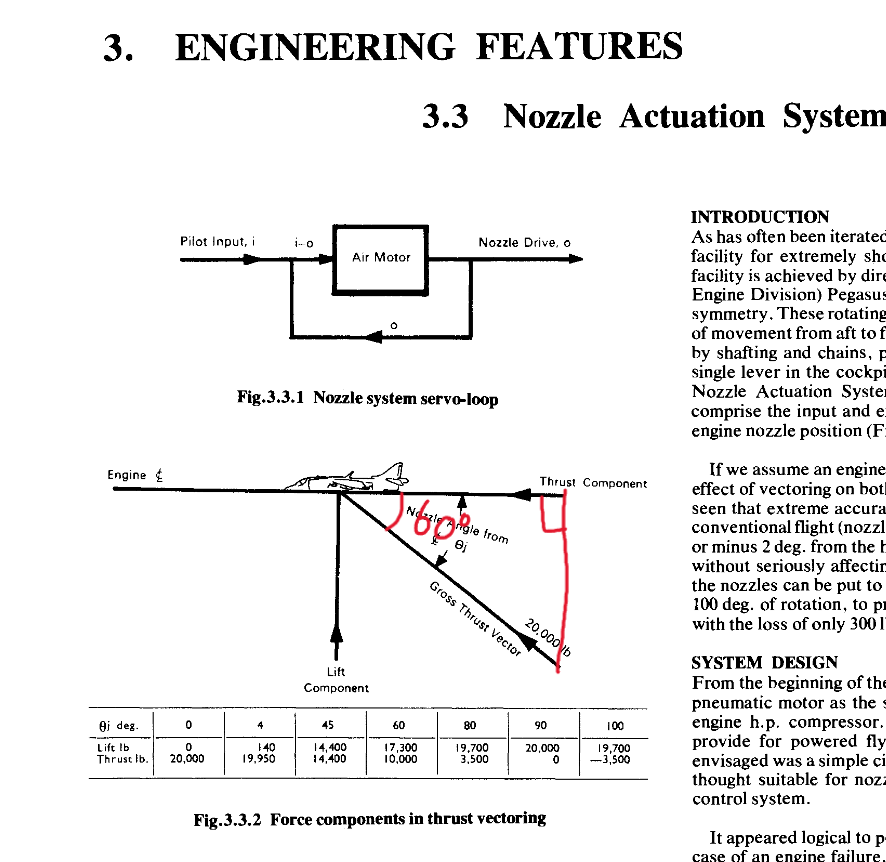
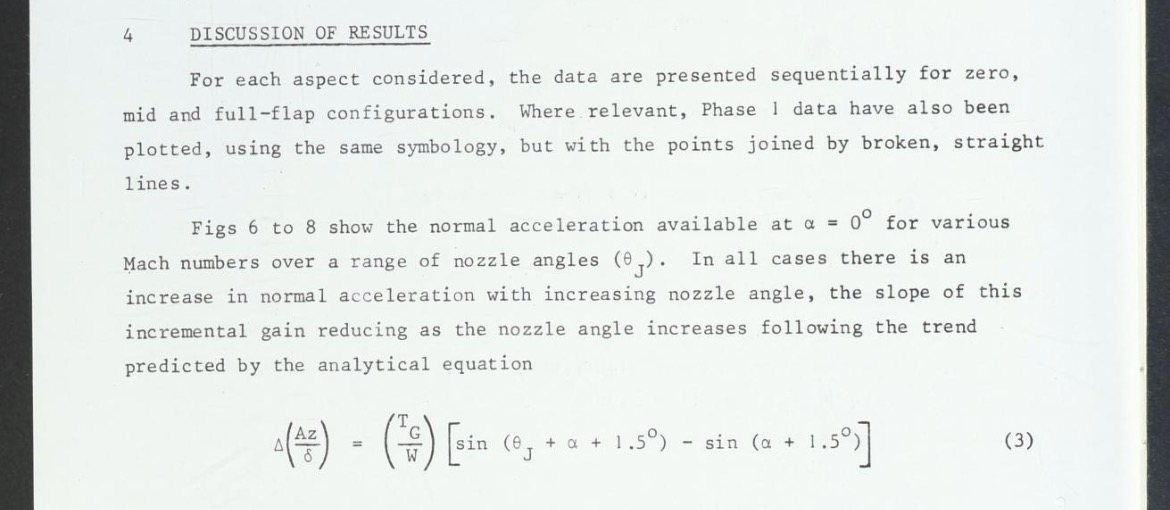
This is completely hilarious at your expense BTW.
This is what you tried to justify. BTW the COS(60) is not .5 its -.95
The COS(60 degrees) is .5 and it is used in commonly in equilateral triangles being Adj side over Hyp
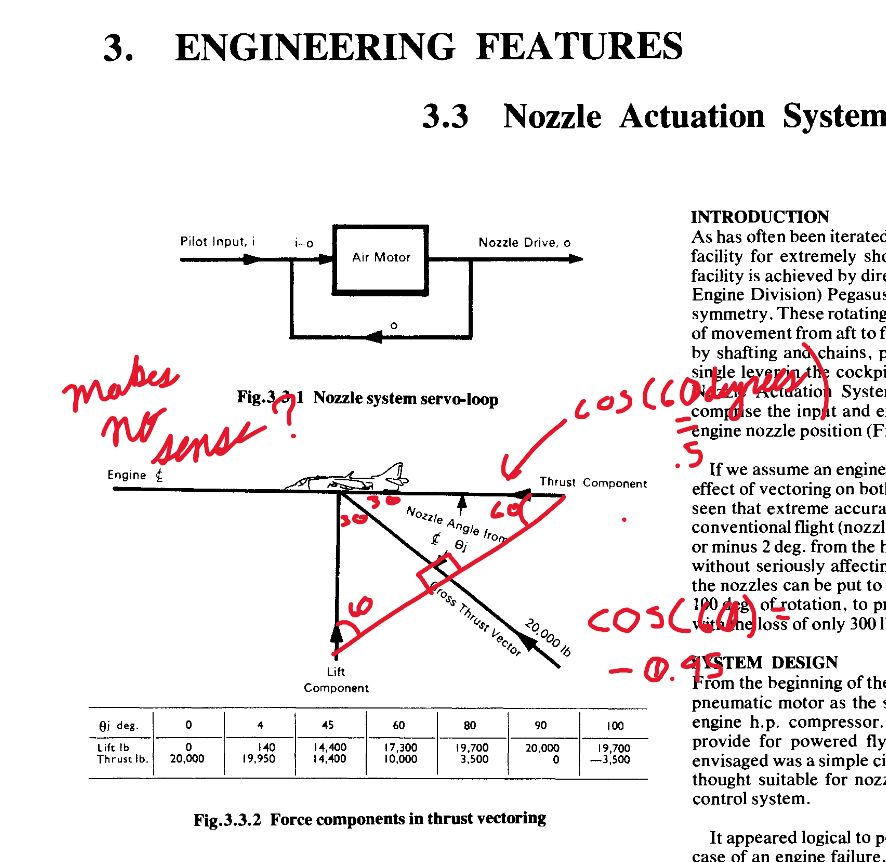
This is what it should look like
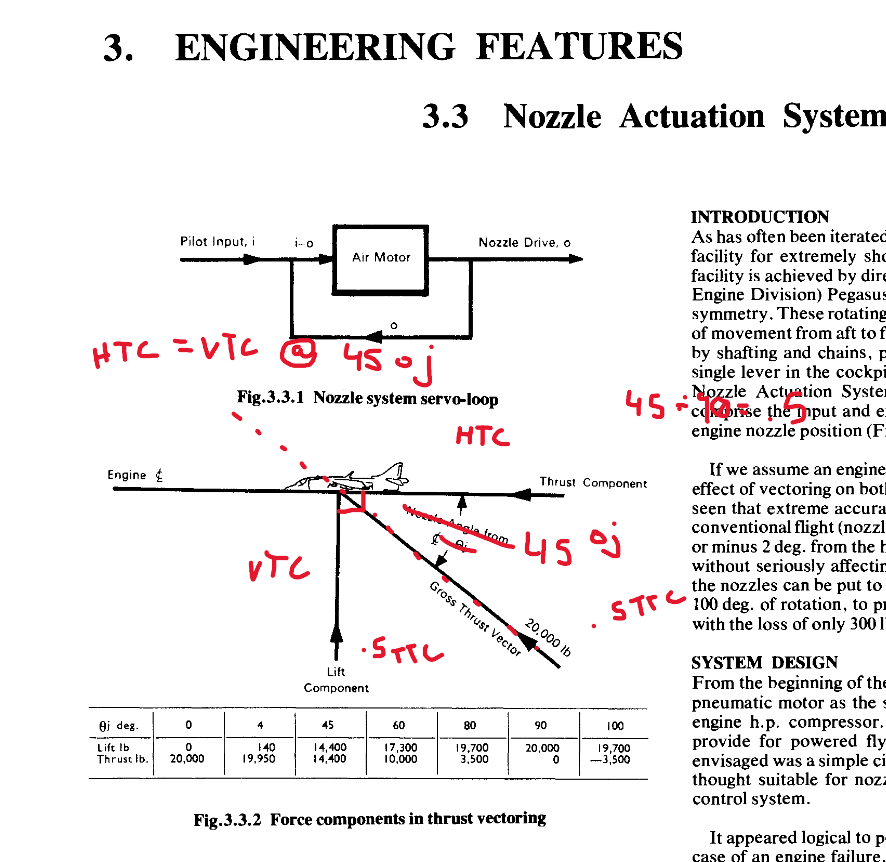
You’re misreading him. one thrust vector being 50% of the gross does not automatically mean that the other remaining thrust vector is also 50% because that’s not how trigonometry works.
It’s not simple addition.
It never needed to be trigonometry
certainly not the COS(60 degrees) as that is completely unrelated to the HTC and the VTC
It is by nature, it’s not something to debate in this specific case, it logically follows.
To know where i should start my explanation, have you studied Linear Algebra or know how vector additions and vector lengths work?
COS (60 degrees) is the furthest possible thing from relevant
In-fact simply dividing the nozzle angle by 90 gives an approximate HTC and VTC split within a few percentile.
I’ll ask again:
This is also wrong, you’re probably accidentally using radians instead of degrees
1 Like
Nice catch but I was waiting for him to see that.
It is - btw I saw lol
Could you please answer my question? or don’t you want an explanation?
Yes back in Uni haven’t done it in a while but its still there albeit rusty.
Cool, so then i assume you know that a resultants length is not the sum of the lengths of the component vectors?
Vectors have magnitude and direction and can work together to create resultants.
so naturally if you are going to have a vertical vector and a horizontal vector there is a resultant vector that comes from the relationship between the vertical and horizontal. The resultant force will change depending on the angle that these vectors meet. As well as how much more magnitude one has over the other.
Simply plugging in the COS(60 degrees) is not going to result in the correct answer for this case
Precisely.
So if you have one vertical vector with length 2 ( v=(2,0) ) and one horizontal vector of length 2 ( u=(0,2) ) their resultant would not have the length 4, it would have the length of the vector w=(2,2) which in this case would just be sqrt(2^2 + 2^2) ≈ 2.83
And in this case its horizontal and vertical so they ALWAYS meet at 90 degrees. Meaning that simple sine/cosine math works just fine. Because the resultant will always be the hypothenuse of the two vectors right angle triangle.
2 Likes
Yes its already known that sine in particular is what is used to determine the final vector regardless.
If you recall what I said earlier simply dividing the nozzle angle by 90 to get the approximate resultant vector.
This holds up and will only result in a small percentile change when compared to the correct vector (60 degree nozzle angle approximation is only 3% different then the corrected math) and magnitude. As the resultant vector does not have any of the Pythagorean math added too it. Seeing as the resultant is actually the Hypotenuse of the 2 vectors if they meet at 90 degrees.
I did this so its just easy for anyone to get an approximate answer.
It was completely unnecessary to dive into any of this to find an average to begin with. (There was also a chart that told him exactly what the thrust split was for the selected nozzle angle)
So again slapping COS(60) into a calculator because the nozzle angle was 60 degrees isn’t correct. Seeing at the vector of the nozzle angle at 60 degrees it no longer acts horizontally and vertically.
The problem isn’t about vector addition, its that the guy just took the horizontal component of thrust and started calculating with it, ignoring the vertical component and its effect on the aircraft. Maybe I’m missing something too, but it looks far from the truth.
Yes, and if you do the math for every angle of that chart the thrust resultant is always 20,000 lb
Yes it does? How does it not?
very simply
seeing as he based the Trig on the 60 degree vector and not considering that the plane is not acting on a flight path 60 degree rotated nose upwards.
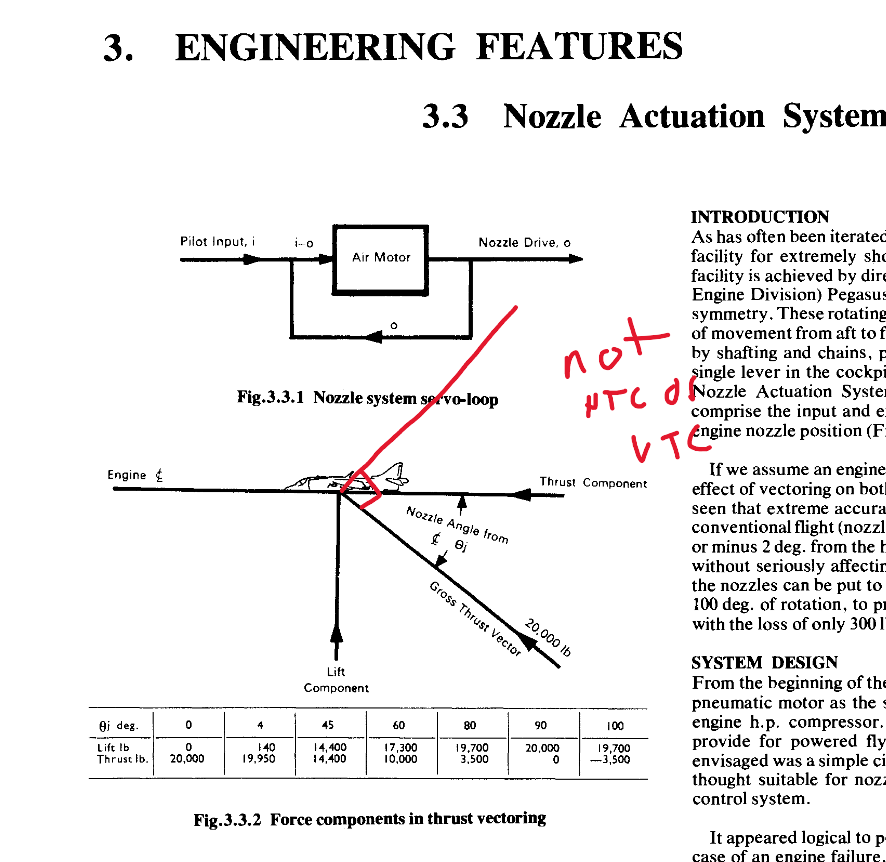
Your putting the angle in the wrong place.