What angle is wrong?
You said at 60 degrees the vertical and horizontal components are equal
Its actually equal at 45 degrees and at 60 more thrust is going down then aft
Read it again and read it slower. Where did I say that?
No, he said that at 60° the horizontal component of the thrust will be .50 of the total
The cosine of 60° is 0.5
Okay, but why are you only considering the horizontal component of thrust for an aircraft that is also in a turn?
Yes, literally what I just said.
cos60° = 0.5
sin60° = 0.866
U multiply those by the total thrust and u get the horizontal and vertical components respectively. They don’t have to sum the total thrust. Not even if u use 45° do they sum the total thrust, even if the components are equal
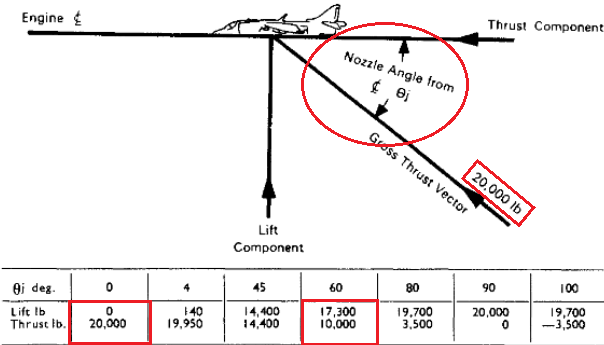
10,000lb of horizontal thrust is what proportion of 20,000lb? You can use your calculator for this problem.
1 Like
Right but the relationship doesn’t play out like that IRL
As he is implying that basic trigonometry is enough to determine all the factors in the calculations of vectored thrust propulsion.
Its not that simple - FAR from it. The relationship between the Net thrust and the component of Gross thrust added to the overall thrust changes.
So instead of 60 degrees creating a point of equilibrium it is actually 45 degrees.
You didn’t even use that initially lmao you used the gross thrust figures and decided to divide it in half for a given 60 degrees of nozzle angle.
I corrected you and said no its actually 45 0j and an equal split at 45 degrees and now you tried to backtrack to make it seem like you didn’t make this mistake.
I’m not holding that against you its just as simple as you tried to simplify something that basically can not be simplified.
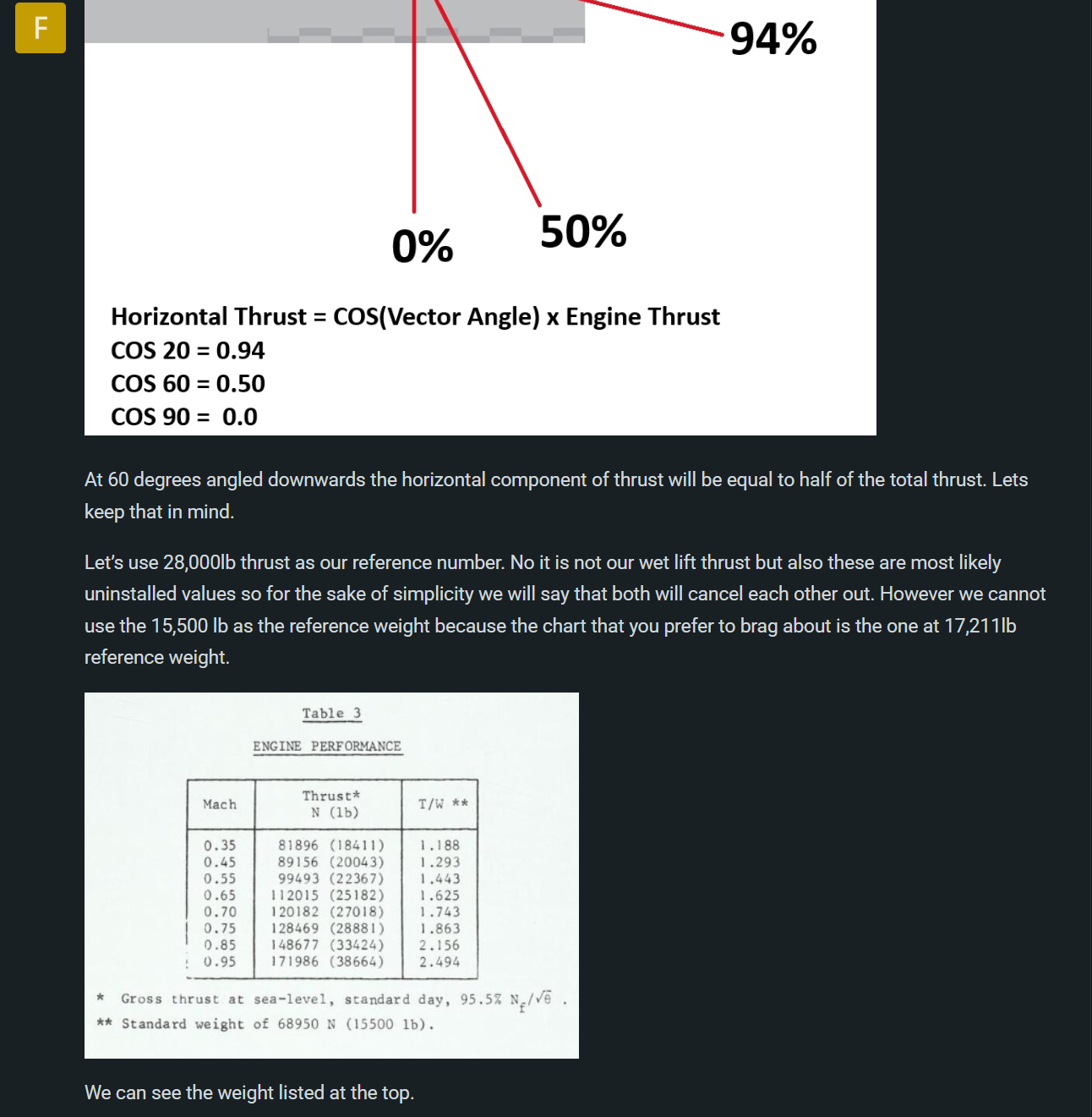

there we go again
2 Likes
Well, I suppose he was trying to simplify but yes the component of thrust acting vertically would also be pushing the aircraft into the turn.
There was no mistake. I used dynamic thrust values instead of static values.
Congratulations, you still used the incorrect nozzle angle to represent a 50/50 power split.
Regardless it’s not that big a deal.
What is your opinion on this?
Ring a bell?
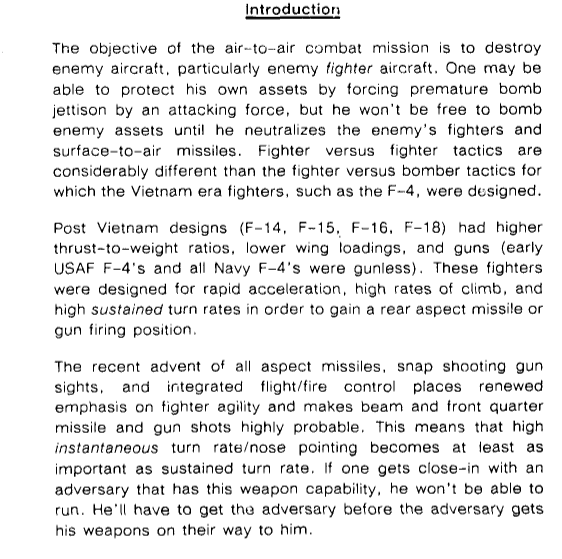
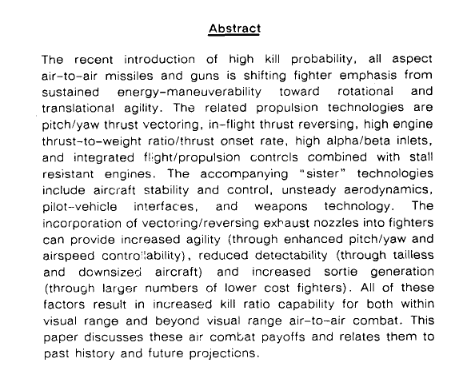
An Aircraft with adequate sustained turn performance, the ability to rapidly decelerate to its best cornering velocity, and the ability to maintain controlled flight right down to very low airspeed and point the nose virtually anywhere relatively quickly. Its also impossible to lock this aircraft with a heat seeking missile during a high aspect pass, as the wing is hiding the jet exhaust and the front nozzles are cooling the turbine exhaust nozzles.
You can disagree with me all you like about what is considered important aspects, would be funny to see you disagree with what the professionals are saying.
The Sea Harrier is a brilliant combination of almost all the good parts of a fighter aircraft.
I used the correct one. The function to calculate horizontal thrust is the same one in the document. Once again you are looking and misunderstanding it. You can run the same function for the other angles and it will give you the same output. This is basic math and you have failed to comprehend it.
Ohh really?
You claim 60 degrees of nozzle angle is 50/50 here it can be seen that 10,000 lbs is the Horizontal thrust component and 17,300 is the lift thrust component.
That’s a total thrust of 27,300 lbs meaning that 36.6% of the total thrust remains aft while 63.3% of the total thrust is vectored downward.
So quite literally your baseline value of 50/50 for 60 degrees of Oj is incorrect
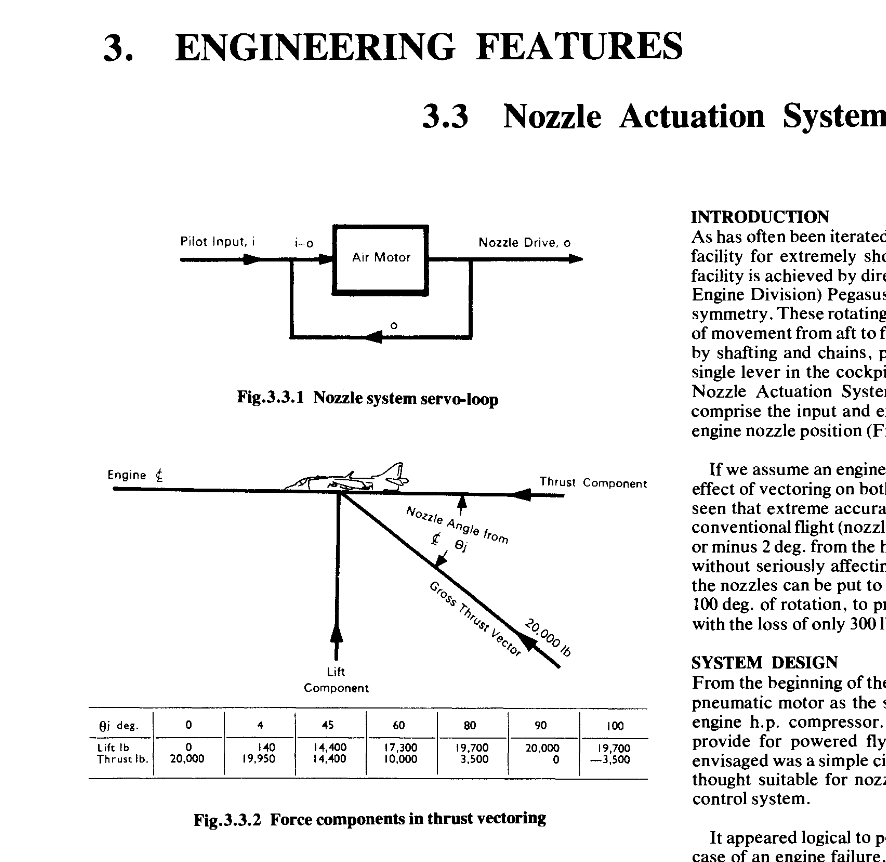
I warned you about this ages ago, I told you, you can not apply basic aerodynamic principles to an aircraft that more often then not does not abide by basic aerodynamic principles.
Here you are now, doubling down on somethings that’s just obviously wrong. You tried to apply basic trigonometry for whatever reason to what would need to be advanced vectored jet propulsion mathematics.
Hey man, at least when I mistranslated the Flanker document I owned up to that and educated myself on that aircraft.
What percent of 20,000 is 10,000?
The engine is not making 20,000 lbs in this scenario 20,000 lbs is no longer the TTC (Total thrust component)