- Yes
- No
- North Korea sub-tree in China
- United Korea tree
- Other
- I said no

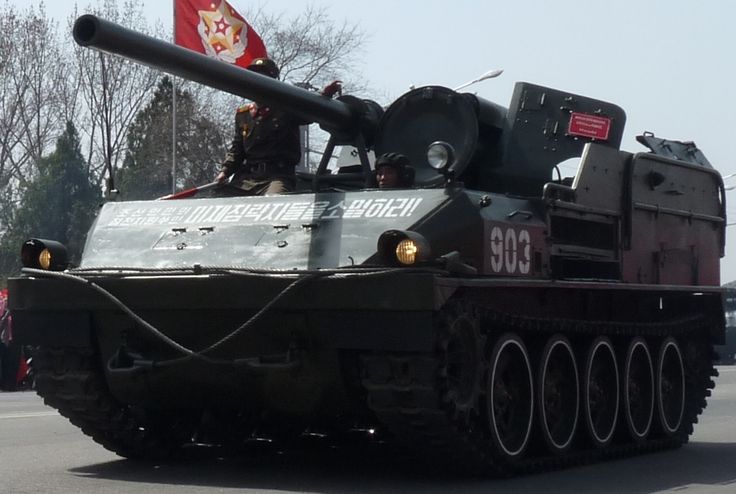
TL;DR: North Korean domestically-produced tank destroyer, armed with a non-turreted 100mm cannon, on an artillery-tractor (ATS-59 / ‘Tŏkch’ŏn’) chassis
History
During the Korean War, the Korean People’s Army (KPA) was primarily equipped with T-34-85s, alongside SU-76 SPGs. These were used to great effect at the start of the war, but were very quickly outmatched by UN / US armoured vehicles. The SU-76s remained in service after the war, alongside smaller numbers of SU-100s, and even smaller numbers of ISU-122s — likely obtained from the Chinese PVA. The KPA was also armed with very large numbers of towed artillery (and MRLs), which, prior to the 1970s, constituted virtually all of the country’s artillery. In the late 1960s and well into the 1970s, the KPA underwent a large-scale modernisation program. Part of this program surrounded the development of self-propelled artillery, which was sorely lacking from the KPA’s arsenal.
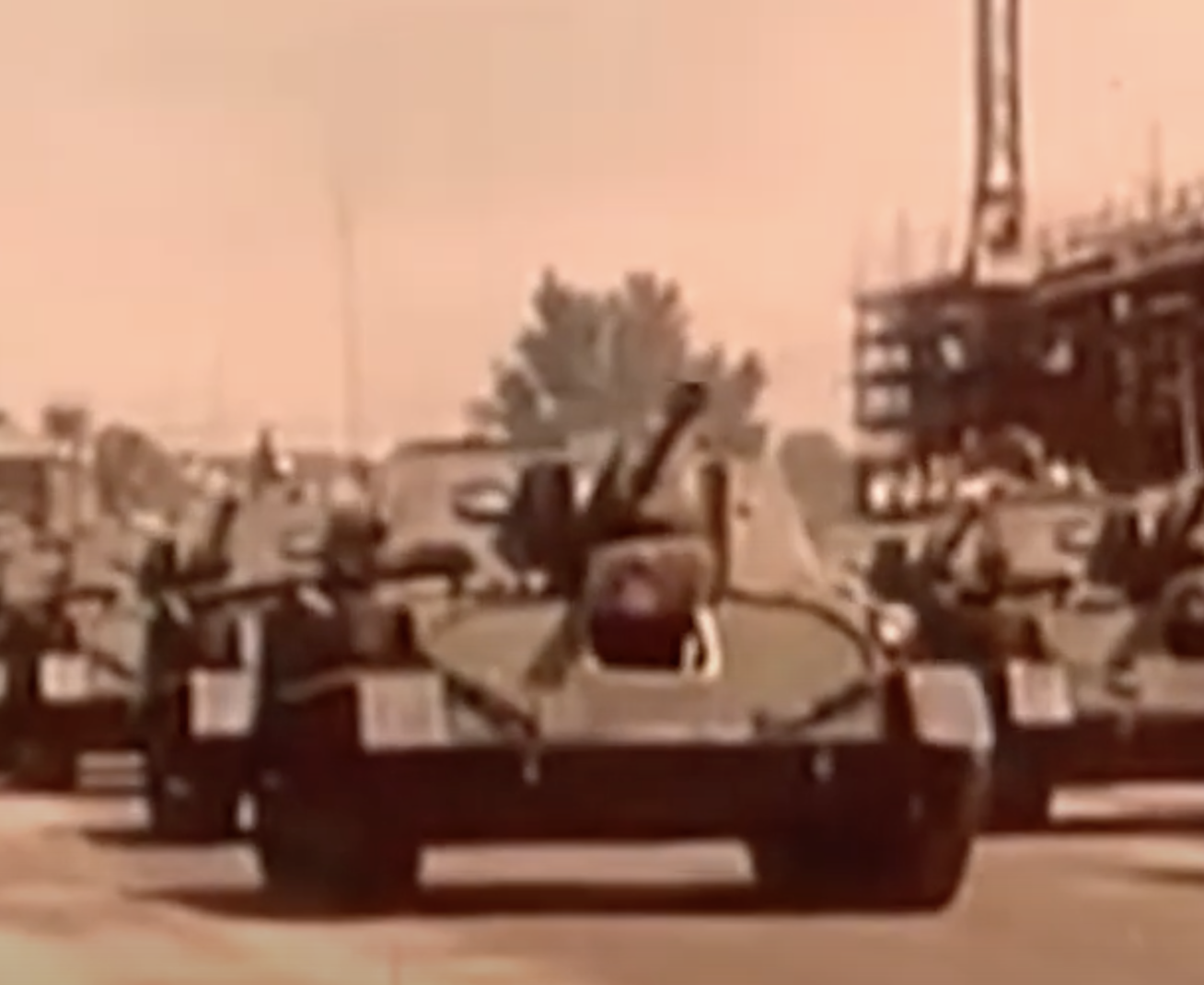

1. SU-76s and; 2. SU-100s during parades
The first attempts at this were made in the late 1960s, when a 152mm D-20 and modified 130mm M-46 (with the muzzle-brake of the SM-4-1) were mounted on a Soviet ATS-59 artillery tractor chassis. These did not enter production, but did pave the way for a number of very successful designs. Production began in earnest in the 1970s, with the development of five separate SPGs (alongside a few other vehicle types) on the aforementioned ATS-59 chassis — these are collectively called the Tŏkch’ŏn (Tokchon) by the US DoD, although this name does not appear to official. The first vehicle was first built in 1972, and was armed with a domestically-produced 152mm howitzer, based on the Soviet D-20, but fitted with a new muzzle-brake. The second was built in 1974, and was armed with an open-turreted 130mm M-46 (modified as above). The third was likely built around the same time (1974–75), and armed with the same 130mm M-46 cannon, but without a turret. The fourth was built in 1978, and armed with a domestic 122mm cannon, based heavily on the D-74. The fifth was built sometime in the 1980s, and was armed with the same 152mm howitzer as the first type, but in a fully-enclosed turret.

SPGs at the KPA Exhibition of Arms and Equipment in Pyongyang. The five vehicles along the front row, from closest to camera to furthest are the: 1972 152mm SPH; 1978 122mm SPG; 1974 130mm SPG; 1973 170mm SPG (Chuch’ep’o); 1983 170mm SPG (Chuch’ep’o)
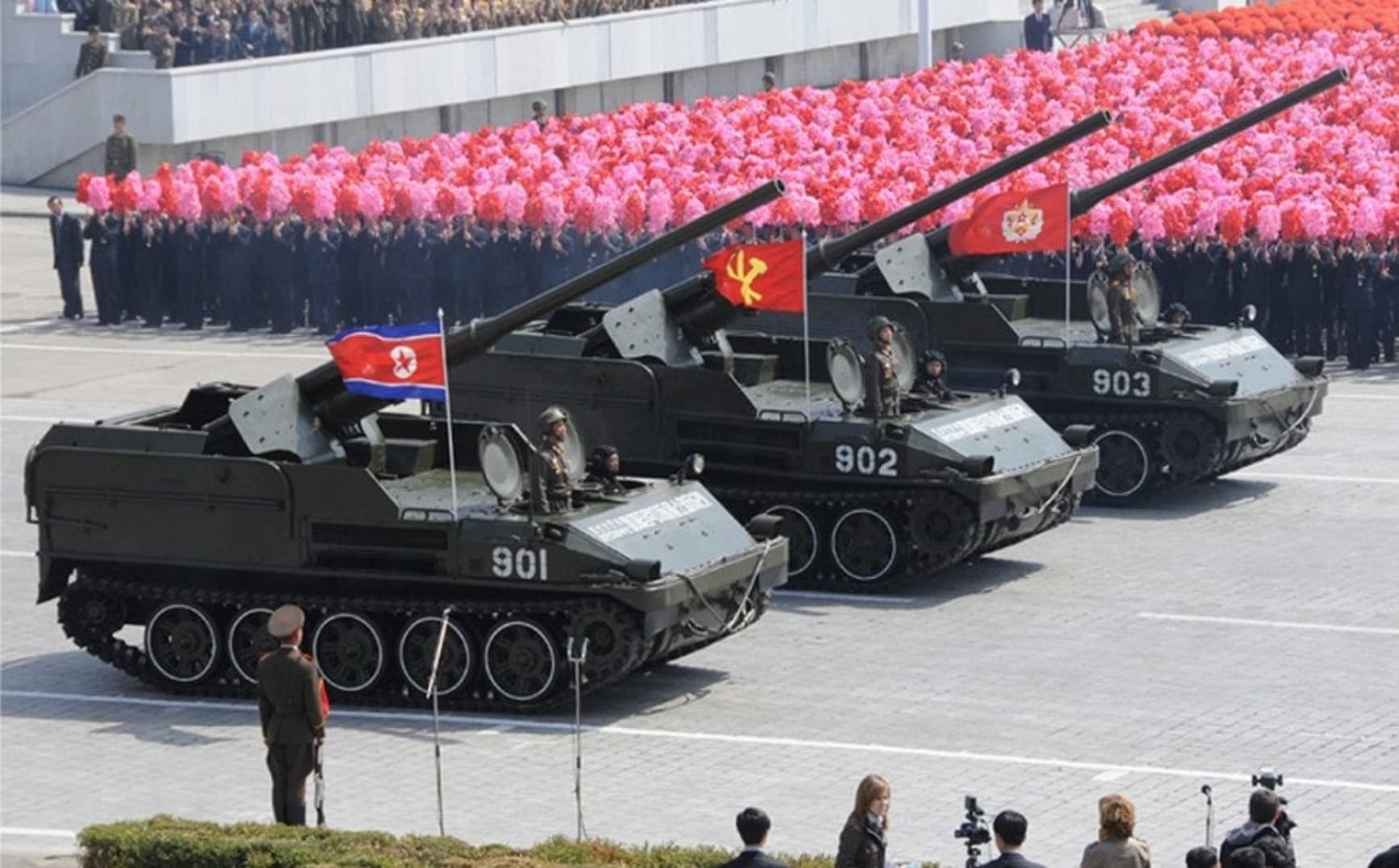
Alongside these five SPGs, a few other variants were produced, namely an SPAA vehicle, built no later than 1978, and a tank destroyer, armed with a 100mm cannon. The focus of this suggestion is on the latter. The US DoD ascribes the name ‘M1972’ to this design. The official KPA designation is unknown — I have given it the name ATS-59 (100mm) here. The vehicle’s origins are confusing — most sources will claim it was built around 1972, and armed with the 100mm BS-3 or D-10, or a local derivative. However, the scarce information that does exist, combined with all known footage of this vehicle, seems to contradict both of these.
Firstly, the production date of 1972 seems to stem from a visit to the KPA Exhibition of Arms and Equipment, where 100mm- and 103mm-armed tank destroyers are on display. The 103mm TD was (according to the signs on display) built in 1972, and the 100mm-version in 1974 — both, however, on the chassis of the 323 APC. The limited imagery of the exhibition also shows that these are the only tank destroyers present, and thus the production date of 1972 appears to be erroneous. Secondly, the gun on the ‘M1972’, as seen during its many parade appearances, very closely resembles the Romanian A407 (M1977) 100mm anti-tank gun, and not either of the Soviet ones.
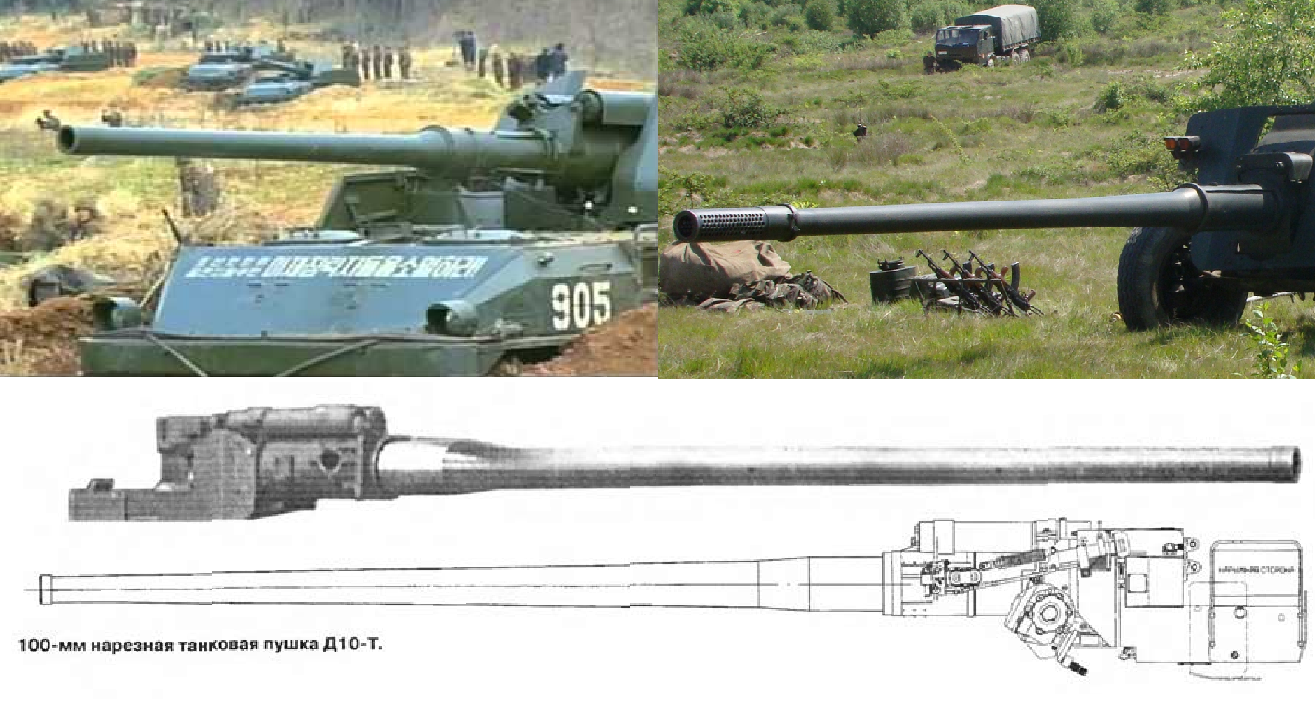
Comparison of the gun on the ATS-59 (100mm), the towed 100mm A407, and the 100mm D-10T. The similarities with the A407 are very clear, although on the tank destroyer, the gun shield is different and is positioned further back, and it lacks the muzzle brake, along with some other slight modifications
Romania and North Korea had close relations during this period, and North Korea is known to have imported Romanian cannons and produced some domestically. It is therefore plausible that the 100mm A407, whilst not reported, could have entered limited production in North Korea, sometime in the late 1970s (it may also be possible that the A407 was a joint development between the two countries, although there is less evidence for this). The ATS-59 (100mm) was therefore likely produced in the late 1970s / early 1980s. Its official name, following the known naming scheme, is likely [year]-model 100mm self-propelled direct-fire gun [[year]년식 100mm 자행직사포], shortened as [year] 100mm TD.
Note on Naming Scheme
North Korea split their self-propelled guns into three main categories:
- Self-Propelled ‘Direct-Fire’ Guns [자행직사포], e.g. the 100mm-armed ATS-59- and 323-based vehicles
- Self-Propelled ‘Level-Fire’ Guns [자행평사포], e.g. the 1974 130mm SPG, and the 1983 170mm SPG
- Self-Propelled ‘Curved-Fire’ Guns [자행곡사포], e.g. the 1978 122mm SPG, the 1972 152mm SPG, and the Chuch’e 107 155mm SPG
I have chosen to translate them as follows:
- Self-Propelled ‘Direct-Fire’ Guns → Tank Destroyer (TD). A more literal translation would be Self-Propelled Anti Tank Gun (SPATG), but this is not commonly used
- Self-Propelled ‘Level-Fire’ Guns → Self-Propelled Gun (SPG)
- Self-Propelled ‘Curved-Fire’ Guns → Self-Propelled Howitzer (SPH)
The ATS-59 (100mm) has been seen frequently in parades, from at least 1992 onwards. Like many of the SPGs in the same family, it has been seen with MANPADS — two crew members at the rear of the cabin carry shoulder-mounted 9K310 Igla-1s. This configuration was first seen during the parade on April 25th, 1992, celebrating the 60th anniversary of the Korean People’s Army. It has also been seen once with an upgraded fire control system, notably including a laser rangefinder, for which a separate suggestion exists.
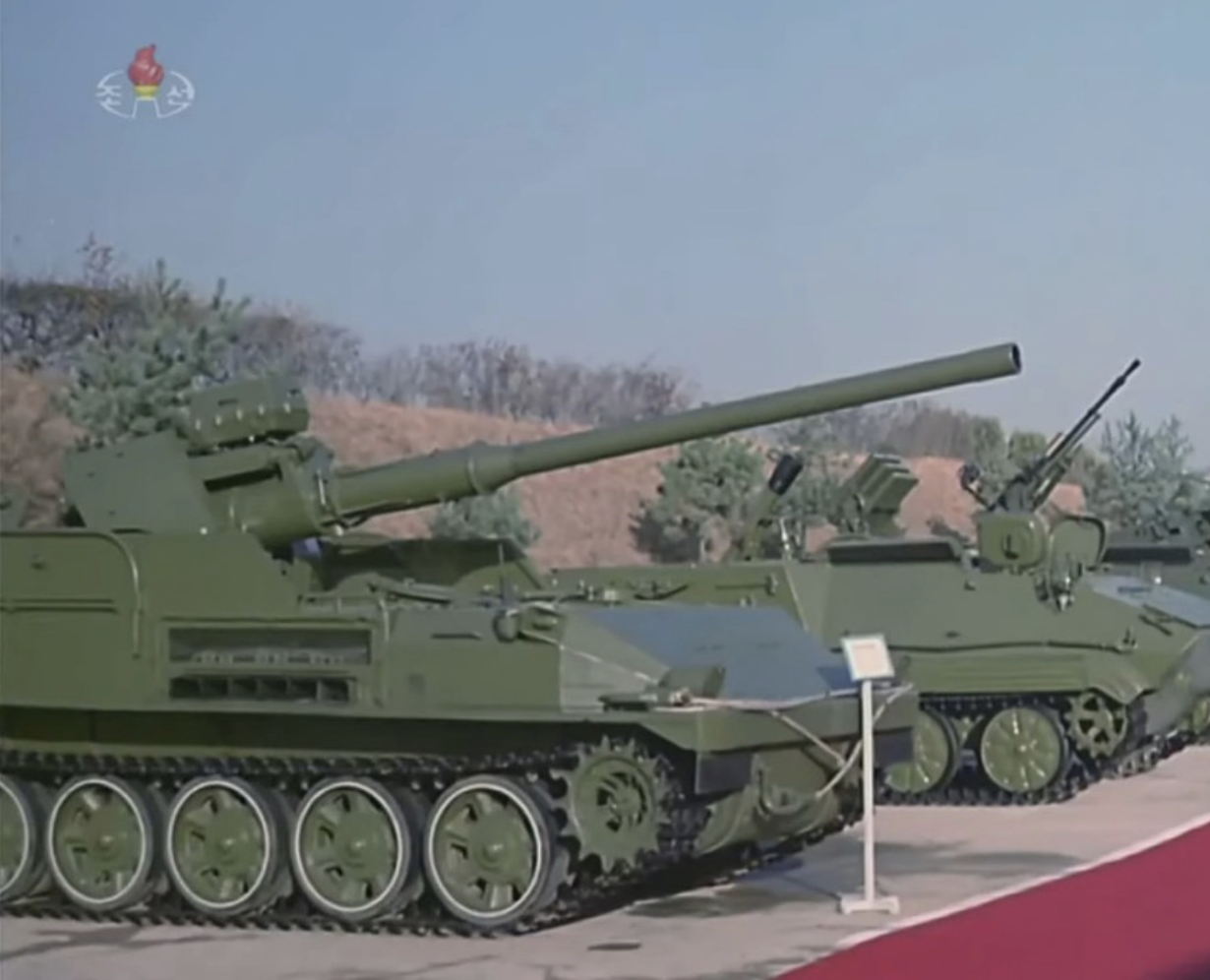
ATS-59 (100mm) with a laser rangefinder
Characteristics
The ATS-59 (100mm) is (likely) armed with a domestically-produced and slightly modified 100mm A407. This cannon fires standard 100x695mmR shells at the same muzzle velocity as the D-10T and other 100mm guns. The exact ammunition used by North Korea is unknown, but likely consists of imported / domestically-produced Soviet and possibly Chinese rounds. It is unknown if North Korea have designed their own 100mm rounds. BR-412 APHE penetrates 218mm @ 0° @ 10m, BR-412B APHEBC penetrates 218mm @ 0° @ 10m (with better performance at range and at angles), and BR-412D APCBC penetrates 239mm @ 0° @ 10m. The gun can also fire APCR rounds, like BR-412P, which penetrates 224mm @ 0° @ 10m, APDS rounds like 3BM-8 (336mm @ 0° @ 10m) and Type 59 APDS (361mm @ 0° @ 10m), and HEAT-FS rounds like 3BK-5 (380mm @ 0°), 3BK17M (390mm @ 0°) and Type 73 HEAT-FS (390mm @ 0°). Due to its otherwise poor characteristics, however, the ATS-59 (100mm) would likely be limited in-game to APHE rounds, and maybe even APCR rounds, as an equivalent to the SU-100. It is unknown how many rounds could be carried.
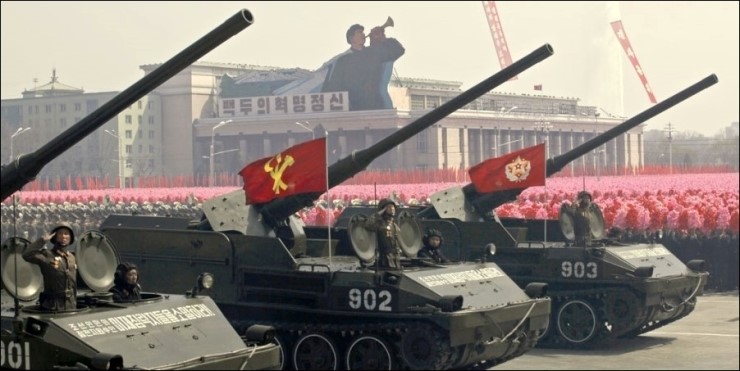
ATS-59 (100mm) during the April 2012 parade, celebrating the Day of the Sun — the birth anniversary of Kim Il Sung
The 100mm A407 has a reported rate of fire of 7-15rpm. As fitted to the ATS-59 (100mm), due to somewhat limited room, this will likely be reduced to anywhere from 5–8rpm. 4 crew members are typically seen during parades, although the vehicle is, much like the ATS-59-based SPGs, operated from outside with more crew. If mounted the same as the standalone cannon, the gun can elevate from -5° to +37°, and traverse 54° horizontally total (-27°/+27°).
Some vehicles have been seen armed with MANPADS — two crew members are situated at the rear of the turret, with shoulder-mounted 9K310 Igla-1s. The 9K310 fires the 9M313 missile, an IR-guided missile with a range of 5km and a ceiling of 2.5km. It has a top speed of 570m/s — it is overall similar to the 9M39 Igla, but with slightly worse performance.

ATS-59 (100mm) during the 1992 parade, with two 9K310 Igla-1 MANPADS
The ATS-59 (100mm) is based on the ATS-59 chassis, but the superstructure has been heavily modified. The cab has been removed and replaced by sloped armour, with the driver’s position appearing to have been lowered slightly. The hull has been opened up in the rear 2/3rds of the vehicle. It has thin armour plates around the rear cabin. The overall armour is thinly-armoured, presumably less than 10–15mm all around, unlikely to resist much more than small arms fire.
The ATS-59 is fitted with an A-650 V12 diesel engine, producing 300hp @ 1700rpm. It is impossible to verify if the engine fitted to the ATS-59 (100mm), and the other ATS-59-based SPGs, is the same, although it seems likely. The exhaust and engine deck appear to be unmodified. The ATS-59 has a top speed of 39km/h. It weighs 13.5t — unladen. Like most other details, once again, the weight of the ATS-59 (100mm) is unknown. A rough calculation would put the weight at around 14.5t, given the weight of the cannon (~1.4t, based on D-10 weight), ammunition, and modifications to the hull. This would give the vehicle a power-to-weight ratio of roughly 20.7hp/t.
Conclusion
The ATS-59 (100mm) would be an excellent addition to a future United Korean tech tree, as a mid-tier tank destroyer. It would overall be similar to the SU-100, albeit with significantly less armour, a larger profile, a potentially faster rate of fire, and possible access to better ammunition. It would therefore go well at BR 6.0.
Specifications
Armament
- 100mm A407 (mod.)
- Unknown ammunition capacity
- Ammunition
- BR-412 APHE
- 218mm @ 0° @ 10m
- BR-412B APHEBC
- 218mm @ 0° @ 10m
- BR-412D APCBC
- 239mm @ 0° @ 10m
- BR-412P APCR
- 224mm @ 0° @ 10m
- OF-412 HE
- 27mm @ 0°
- 3D3 Smoke
- (also compatible with various HEAT-FS and APDS rounds)
- BR-412 APHE
- Vertical Guidance
- -5°/+37° (estimate)
- Horizontal Guidance
- -27°/+27° (estimate)
- 2x 9K310 Igla-1 launchers
- 9M313 SAM
- Guidance
- IR-guided
- Range
- 5km
- 2.5km ceiling
- Speed
- 570m/s
- Guidance
- 9M313 SAM
Armour
- Hull
- Unknown — likely <10mm all around
- Gun Shield
- Unknown — likely <10mm
Mobility
- Speed
- 39km/h
- Weight
- ~14.5t (estimate)
- Engine power
- 300hp, ~20.7hp/t (estimate)
Other
- Crew
- ~4–6 (6 if with MANPADS)
Images


Sources
Spoiler
The Armed Forces of North Korea — On the Path of Songun. Stijn Mitzer and Joost Oliemans.
무장장비관 견문록(2) 고속기동전과 전면타격전의 주역들:자주시보
- This author grossly over-exaggerates the capabilites of North Korean equipment, but has visited the KPA museum in Pyongyang and — seemingly accurately — reported the names of vehicles / equipment
Tun antitanc calibru 100 mm model 1975/77 - Wikipedia
100mm D-10 | Weaponsystems.net
https://www.youtube.com/watch?v=FhqtO02cChs&list=PL1Jld3pEbEp45EVBaoFPcWiQZgKs_DdL0&index=16&t=2794s