I was in a 12.0 match in an M1A1 and got penned on the turret side face by a BMPT APDS round. The game says it has 81mm of pennetration. The side of the abrams turret has over 300mm of armor protection, how does this make any sense if the round isnt either broken or defying physics

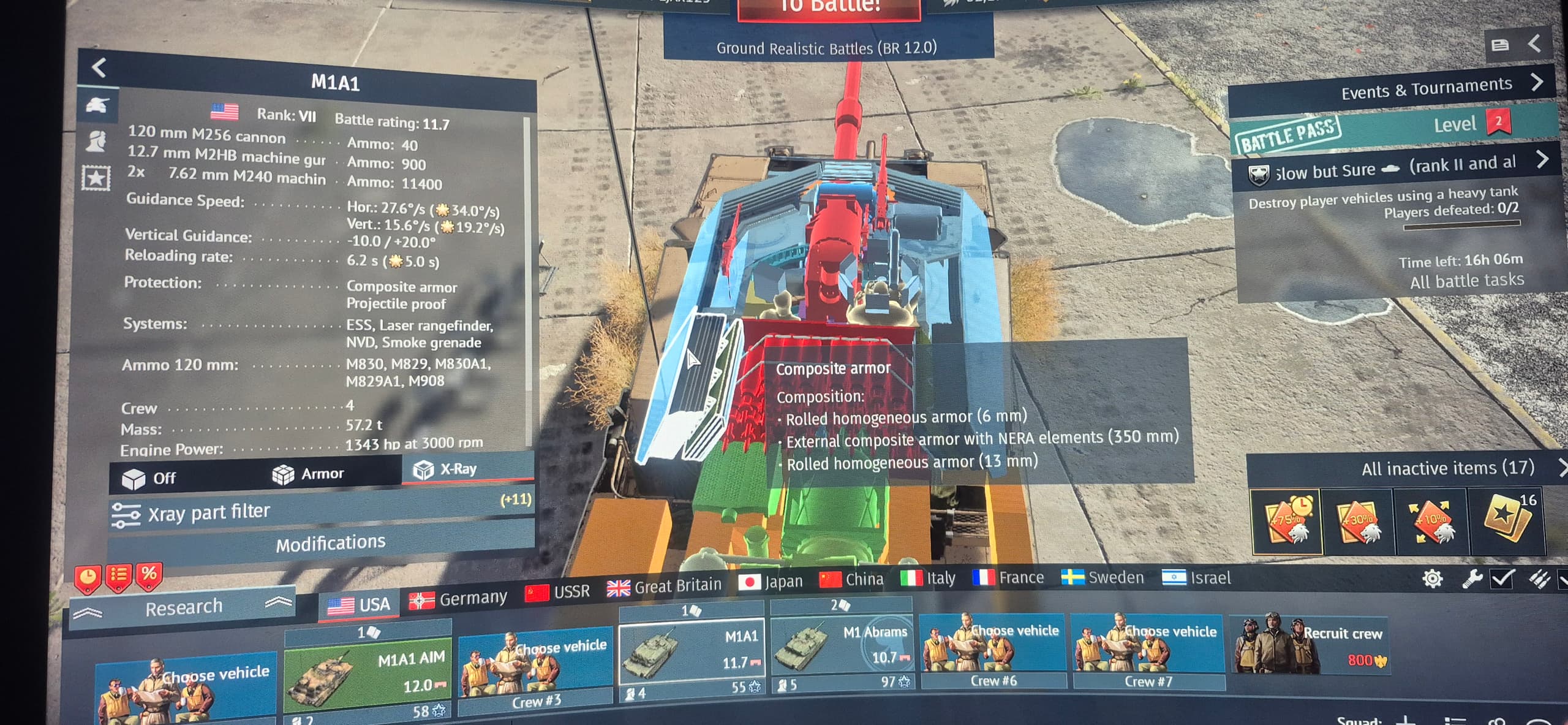
NERA protects mainly against chemical rounds (HEAT) and offers less armor value against kinetic rounds like APDS.
1 Like
The raw “300 mm turret armor” figure is not necessarily the value that the shell is checking. In your Protection Analysis screenshot, the selected BMPT 30 mm APDS is shown with 70 mm equivalent protection at a 21° angle. That is already below the round’s listed penetration of roughly 81 mm at 100 m, before considering range and exact impact geometry.
Schubi’s NERA explanation is directionally reasonable, but the exact result still depends on the specific turret cell, composite layout, projectile state and impact angle. Please provide:
- the exact BMPT variant and firing range;
- the server replay with a timestamp;
- the precise hit location, ideally with Protection Analysis using a square side shot and a second test at longer range.
A direct in-game screenshot is preferable to a monitor photo because the tooltip and impact point are easier to verify. If the same point is penetrated under a controlled 90° shot with the same ammunition, that would be meaningful evidence for an armour-model or hit-registration report. Without that A/B test, this may be expected composite and angle behaviour rather than a physics violation.
Official references:
When WT says the turret has over 300mm of armour, it doesn’t mean 300mm of armour protection. Various composites have different levels of protection against kinetic projectiles. For that of the side of the Abrams turret, it’s primarily designed to defeat CE projectiles, not KE projectiles.
It’s important to remember that when it comes to armour protection, the heavy lifting is still done by steel. The composite materials do a lot of work to increase the effectiveness of said steel, but when dealing with relatively thin armour plates behind a large mass of composite it tends to almost always favour CE protection.