maybe i’m buggin but was looking at the Thai A-7 earlier and I’m pretty sure I remember H/I band on the B-10
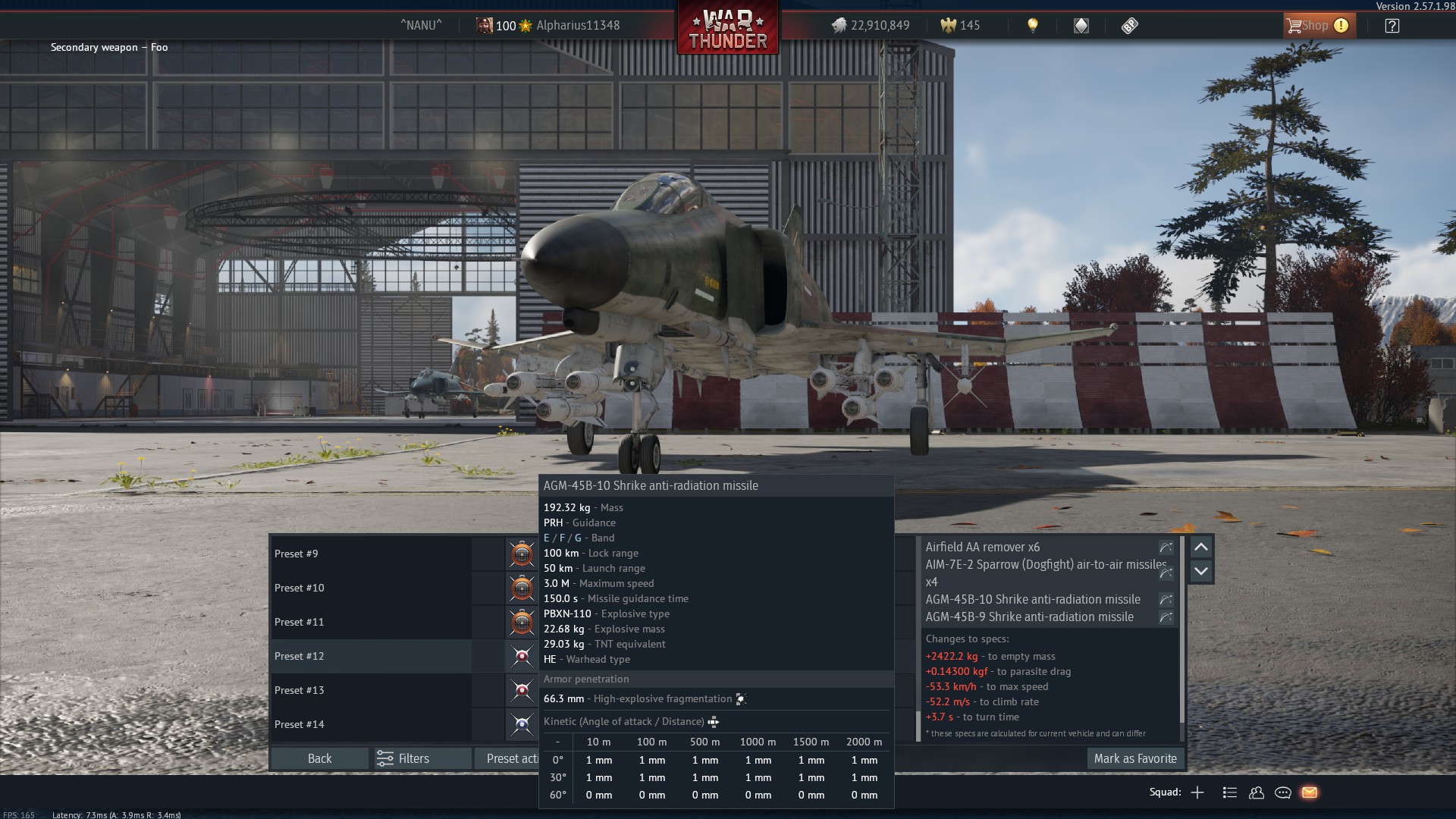
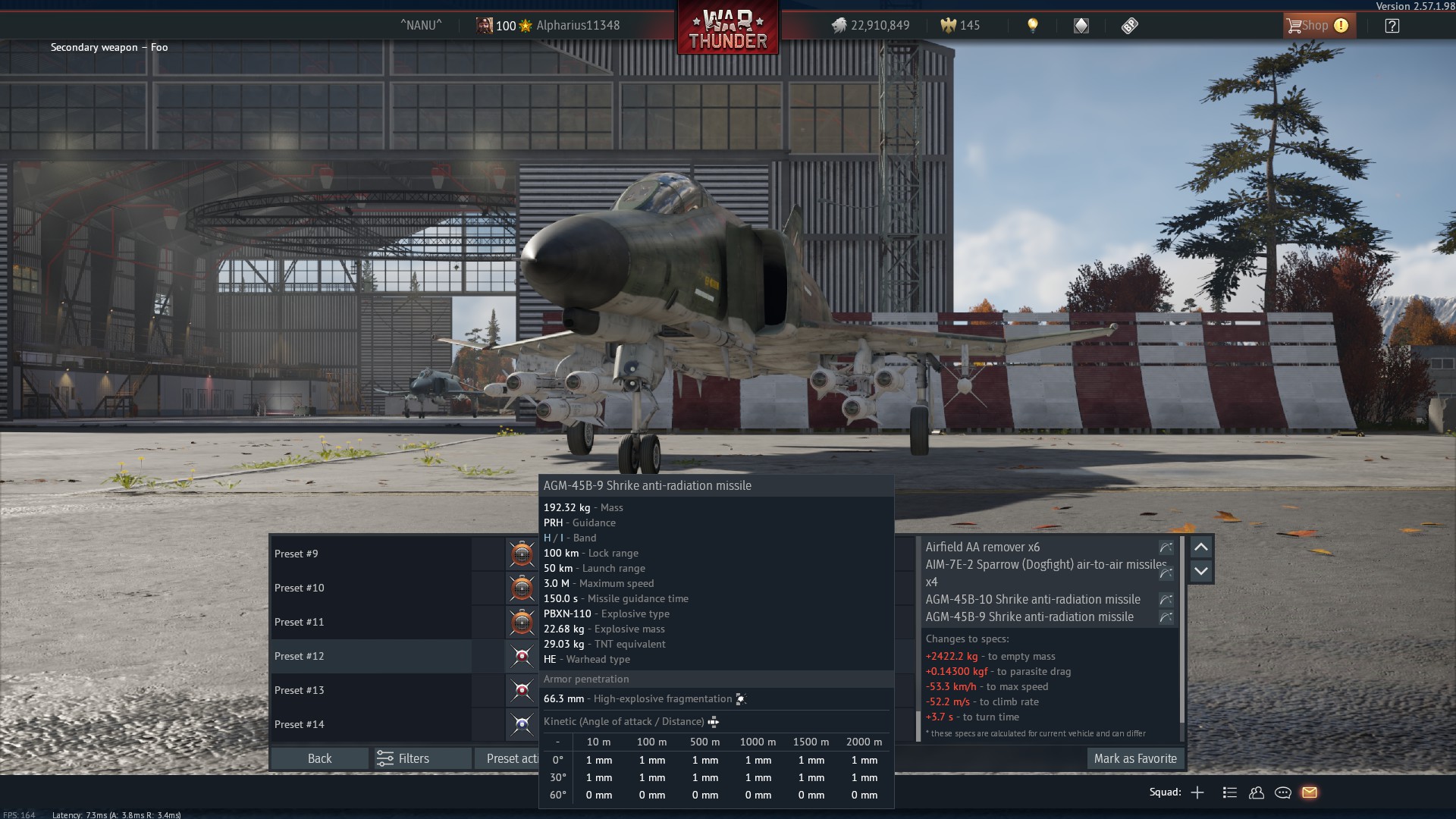
my bad must have been thinking of B-9
-10 seeker is 2-6 GHz, which barely even approaches H band, and so it wouldn’t even reach I band
It had J band in the datamine before live
1 Like
the only source ive seen for this is the heatblur wiki (which is made for DCS)
and there are other sources that are similarly credible that give it a wider band range
no it did not
as long as its been in the files it was E, F, G, H, I
and the datamines for this change only say removing H and I bands not J

1 Like
The image I provided indicates this, here’s a higher res ver of the one I posted before


I could’ve easily misremembered I band as J band, my bad.
1 Like
oh, ive never seen a version of this that is legible before
so thank you
Yeah I got it from the wiki page cause, I though there was higher res ver, when my compatriots were discussing about AGM-45 when it came into the datamine again it was posted in @Nostalgistic server
Will raise the question though, are museum exhibits accepted as usable bug report material?
Always though such was not the case unless it is components / vetted measurements of a vehicle / piece of equipment itself on display.
Shame overall though since there is accessible info on the AGM-45A manual wise, but none on the B and even less on the seeker manuals.
I would wager such is why the STARM is not present either given how little seems to be known about it’s seeker in general.
I don’t know
I think AGM-78B has a broad band seeker of at least 1-18 GHz (D, E, F, G, H, I,J), AGM-78A has the -3 of the AGM-45 (E, F).
Only one plane in the game can get it, and that is A-6E, we’d have to wait for F-105G and/or F-4G
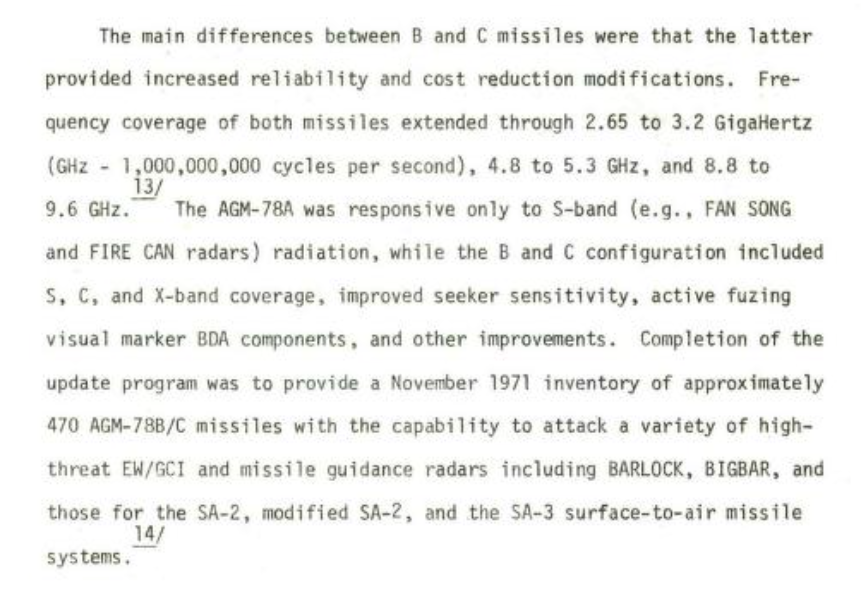
The frequency coverage of the seeker is known:
1 Like
I imagine they would typically be counted as secondary sources at best. However in this case you could potentially argue that:
- With China Lake being the people who built it their official museum is probably more authoritative than a typical museum
- It’s (IIRC) the only ‘reliable’ source with that much info so it is better than the alternative (nothing).
Will have to see.
I have a grand need for the SEAD thud.
So question on that too, is that statement that all 3 makes, the B, C and D, all have a wide band seeker of more or less E through I, or claiming that the B C and D each have separate band coverage. The latter makes little sense given that was not the design goals of the C and D.
Of course, hence my question, as while China Lake is quite the authority on missilery, gaijin has always been at arms length with any museum displays, regardless of who made them.
As a aside, it is quite a bit funny to me that in theory, the best ARM until the AARGM-ER / SiAW that the US, and to a greater extent, the NATO block countries, is the AGM-78D given it has a terminal optical seeker and that characteristic amazing standard missile flight performance.
HARM and Shrike just have too much drag to be that relevant which is sad. For Reference the shrike and harm are about 50% and 30% less aerodynamically efficient in game compared to the RIM-66 currently which is quite funny.
This is the wording of the source he linked to. I would take that to mean that the B & C both have a single wideband(ish) seeker covering those bands.
1 Like
Are you sure about that?
What?
currently in game the RIM-66 (the missile STARM was built off) has theoretically better kinematics than AGM-88
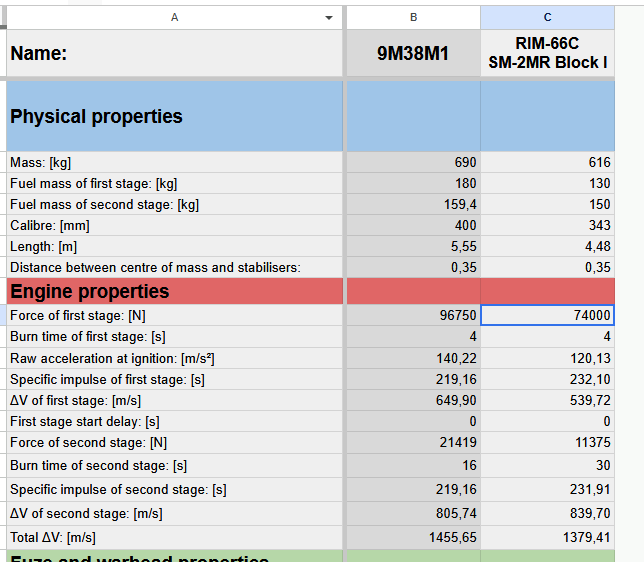
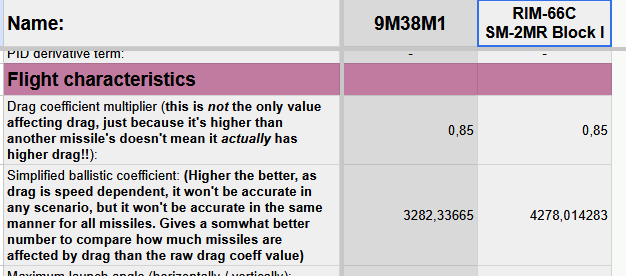
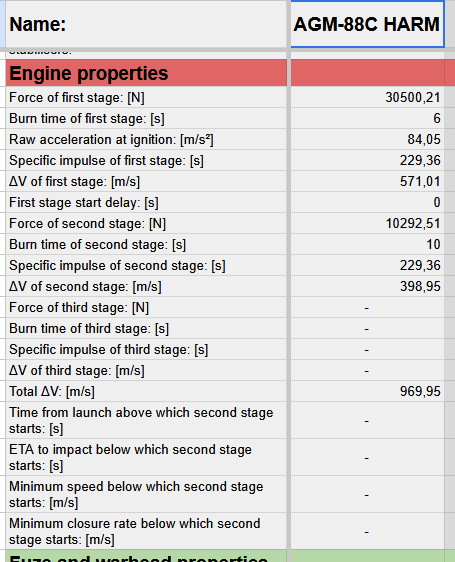
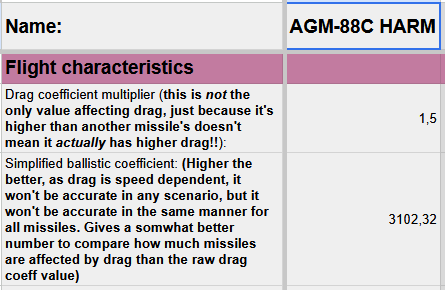
with both higher Delta V and lower drag
however it has a much lower maximum speed, so it would be less effective than AGM-88 is for close range which is whats most important in game right now

1 Like
yes
look at the ballistic coefficients (why I included them)
Ah yeah the line “While the B and C configuration included S, C and X band coverage” so its additive to the band coverage. Wording made it seem like it was a AGM-45 moment where separate seekers were made for separate bands.
Alpharius already covered it well.
For what its worth, even then I’d wager the STARM would be superior as the HARM has rather pitiful acceleration at low alts / close range, same with the shrike. By comparison, the RIM-66 comes off ships like its a HAWK, and its already well known that the HAWK motor on the Fakour 90 has excellent performance at all ranges.
Updated this with the first half of the AGM-45 series