Merkava Mk. 1
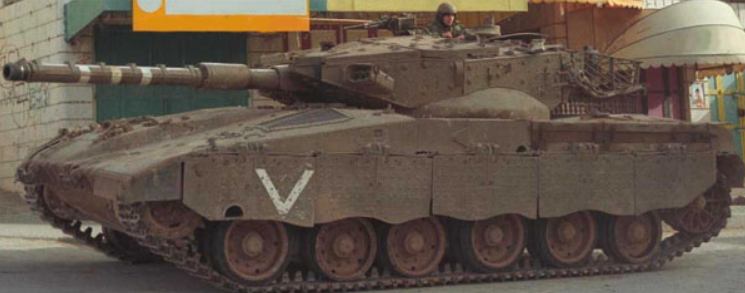
Manned by a crew of four, its main armament is the 105mm M64 L71A tank gun, firing APDS, HEAT, HESH, Phosphorous and APFSDS ammunition.
Secondary armament is a 7.62mm coaxial machine gun inserted into a vertical armoured slit. A second LMG is mounted on the commander’s turret and a third on the loader’s hatch. These can be used for close-in combat as well as against low-flying aircraft.
The driver’s compartment is located on the left side of the vehicle’s power pack, this being isolated from the crew compartment by an armour-plated wall. The driver can move to the rear by lowering the backrest of his seat.
The fighting compartment extends the whole width of the hull and the turret turntable is located on the hull floor plate, supported by rollers so that they rotate together, carrying the turret crew 360º either with the aid of hydraulic power or manually. The hydraulic pack, Xenon searchlight and ammunition for machine guns, as well as grenades and other explosive devices, are located within the turret’s spaced armour compartments, isolating them from the crew.
The commander is provided with an access hatch and protective cover, with his observation and aiming sights located close over the turret roof, allowing all-round, buttoned-down observation. The hatch may be raised manually to allow open observation while providing overhead armoured umbrella protection by the hatch cover.
An access hatch for the loader/operator is provided on the left-hand side of the turret roof.
The rear part of the vehicle forms the stowage compartment for the bulk of the main gun ammunition, which is stored in heat resistance containers, loaded by the rear access door into side bins, tied with fasteners. The rear door, opening up-and-downwards with a rapid control lever, enables easy entry and exit by the crew. CBR and battery compartments are housed to the left and right of the rear access door in spaced armour-walling boxes. Panniers, into which flexible fuel tanks are fitted, are mounted on each side of the hull over the tracks, adding anti-chemical penetrator protection.
Additional hull protection is by side plates consisting of detachable skirting plates. Clean air free of solid and liquid contaminants, is drawn into the vehicle’s interior by an electric fan through two filters mounted at the rear of the hull. A scavenging system extracts fumes from the open cartridges of the main and coaxial guns.
The fire control system includes L\P sight for the gunner, commander’s panoramic peri telescope, ballistic computer, ballistic drive, azimuth indicator, elevation quadrant and searchlight.
The turret control system includes hydraulic power pack, gunner’s control assembly, commander’s control assembly, turret traversing mechanism, elevating mechanism and supper-elevation actuator. The stabilization system is an add-on kit.
Protection and Survivability
Added protection by engine positioned front and spaced armour compartments, including self-sealing fuel containers, casted nose armour, spaced armour protection from side and by armoured equipment compartments and flexible fuel tanks.
Reduced fire hazards by heat resisting ammunition containers stowed at rear.
Well-shaped and reduce height front hull and small-target projecting turret front, shaping slightly downwards for added front protection.
Flexibility
Because of the front-mounted power pack with its resultant rear space, the Merkava Mk. 1 tank can used to function in several primary and secondary roles:
Main Battle Tank (MBT): primary role
Infantry carrier: secondary role
Command vehicle: secondary role
Ambulance: secondary role
As for the primary role, its function as a Main Battle Tank allows it to move and fight in its natural surroundings - the modern, fire-covered battlefield, with maximum protection and survivability in this role, it operates as a first-class tank-destroyer, using its main armament to achieve first-round hits with the assistance of the highly-effective fire-control equipment and optical systems provided for commander and gunner. Its low silhouette and well-shaped armoured hull and turret design enable it to operate well under cover on the battlefield.
In its secondary role as an infantry carrier, the Merkava Mk. 1 provides a unique solution to the problem of its own protection over closed or infantry and tank-killer infested terrain; it also has the ability to transport infantry groups to vantage points over fire-covered ground with maximum protection. However, in order to carry up to six men in the rear compartment, part of the ammunition has to be restored in the turret or unloaded before embarkation.
As the vehicle is excellently protected by CBR equipment, transportation of infantry over infested areas may be crucial to their survival, in the absence of other suitable vehicles.
Last but not least, the capability to take on bailed out tank crews under fire is an extremely powered morale-raiser on the battlefield, and can rapidly restore precious tank crews to action, during the most critical periods of a battle.
The operation of forward and tactical headquarters and forward command groups, under effective cover, enables commanders at all levels to reach clear and timely decisions during a mobile battle when up-to-date information is at hand. Under modern combat conditions prevailing, and working within stringent communications limitations, this command system maybe the only feasible solution.
The Merkava Mk. 1 offers such a solution without any serious modification being necessary; if time permits, additional radio equipment could be installed.
Finally, a most important, battle-proven point is the use of the rear compartment for the battlefield evacuation of wounded. The ability to put casualties under cover rapidly, and possibly rendering professional first aid, can increase the survivability rate by a high percentage.
During the Lebanon War (1982) Merkava Mk. 1 tanks were the spearhead of most of the armoured columns. On the coastal road, Merkava Mk. 1 tanks led the forces from Rosh Hanikra, through the dense RPG and SAGGER armed PLO positions on the coastal road, north to Sidon , Damur, and Beirut . Clashing with anti-tank weapons at a distance of only a few meters during roadside ambushes, the tanks suffered many hits, with little effect on their performance. Some partially penetrated the armour protection but could not harm the crew. The casualties suffered by the Merkava Mk. 1 crews in this area were also shrapnel and small arms fire, inflicted outside the tanks.
In the eastern sector, Merkava Mk. 1 formations led the armoured thrust in a combined arms operation aimed at destroying the Syrian forces in the Beka’a. The full scale war against the Syrians began only on the third day of fighting. Engaging all types of modern AT weapons, the Merkava Mk. 1 withstood the battle excellently; although it sustained many hits, being at the spearhead, this caused only temporary disablement of some of the tanks. The suffered hits from both HEAT and APFSDS of various caliber’s, AT missiles of both Eastern and Western origin, RPG, etc. (One Merkava Mk. 1 was set on fire by PLO near Khaldeh). Some of the hits disabled parts of the engine, as expected by the designers, but, with the assistance of other tanks and field maintenance crews, disabled Merkava Mk. 1 tanks were returned to the field in record time! The highly accurate fire control system enabled to the gunners to engage targets at long ranges. Accurate high speed ammunition like the APFSDS proved its lethality at these ranges. (APFSDS) range was specified by the manufactured as 5000m.) The climax of the Merkava Mk. 1 fighting in the eastern sector was the short (but highly publicized) clash with the Syrian T-72 tanks (Syrian 73 rd Brigade) in the area near Kabelias. The Syrian tanks were engaged by the Merkava Mk. 1 and ATGMs at long ranges, later closing to medium and short combat range. Hits were identified in the Syrian formations immediately as the Merkavas opened fire. As the Merkava Mk. 1 were able to engage their targets from long range, the T-72 were hit on the impenetrable front side, and immediately caught fire.
In summing up the combat experience of the Merkava Mk. 1 deployment in the Lebanon War, one can highlight the following aspects:
-
Protection and survivability: the tank proved the concept of emphasis on protection in the modern battlefield. Compared to other types, the Merkava Mk. 1 's safety factor was substantial.
-
Firepower: The modern systems introduced with the Merkava Mk. 1 tanks allowed the crew to engage target at long ranges with first round hits.
-
Mobility: The mountainous land capes in the central and eastern sectors allowed the Merkava Mk. 1 to demonstrate its high mobility in cross country and high slopes, good visibility from the turret proving a positive factor.
-
Maintenance: The Merkava Mk. 1 's easy access to internal systems proved effective in the maintenance works done on the battlefield, adding to the tank’s combat presence.
The first Merkava Mk. 1 tanks were supplied to the IDF in April 1979, nearly nine years after the decision to produce the Merkava Mk. 1 tank was taken. The Merkava Mk. 1 tank has been designed in accordance with experience gained from IDF armored battles in all Israel’s wars since the Sinai Campaign (1956).
The Merkava Mk. 1 is unique in its basic concept, common to all generations of the Merkava Mk. 1, according to which armor and survivability of the tank are its basic features. The tank’s protection is based on all-round spaced ballistic armor, and deployment of the tank systems around the crew, thus utilizing basic elements and systems of the tank to protect the crew and ammunition, in addition to their specific functions. The most striking example of this concept is placement of the power pack (engine and transmission) at the front of the tank.
Other factors contributing to the Merkava Mk. 1’s survivability are:
- Low profile when in firing position
- Elimination of flammable materials from the crew compartments
- Storage of main gun ammunition under the turret ring, well to the rear of the hull, in heat-resistant containers
The Merkava Mk. 1 tank participated with a high degree of success in Lebanon War (1982) when the war started Israel had 200-300 Merkava Mk. 1 tanks. The Merkava Mk. 1 proved superior to the Syrian T-72 MBT (then the Soviet’s newest tank).
Production of Merkava Mk. 1 continued up to 1983, when the IDF Armor Corps began to receive the
Merkava Mk. 2 tanks.
Lessons learned from the operation of the Merkava Mk. 1 tanks were applied to the Merkava Mk. 2 tanks, mainly in the following:
- Improved mobility
- Improved fire control system
- improved special armor
- Internal 60mm mortar
The production of Merkava Mk. 2 tanks continued until the end of 1989, at which time Merkava Mk. 3 t tanks started to come off the production line.
Merkava Mk. 2
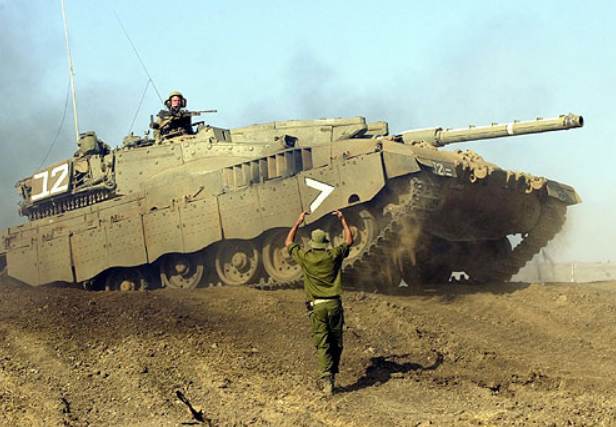
The Merkava Mk. 2 was designed long before the Lebanon War (1982). In fact, Merkava Mk. 2 was designed as early as the late 70s, when the first model (Merkava Mk. 1) entered service.
Improvements for the new type included:
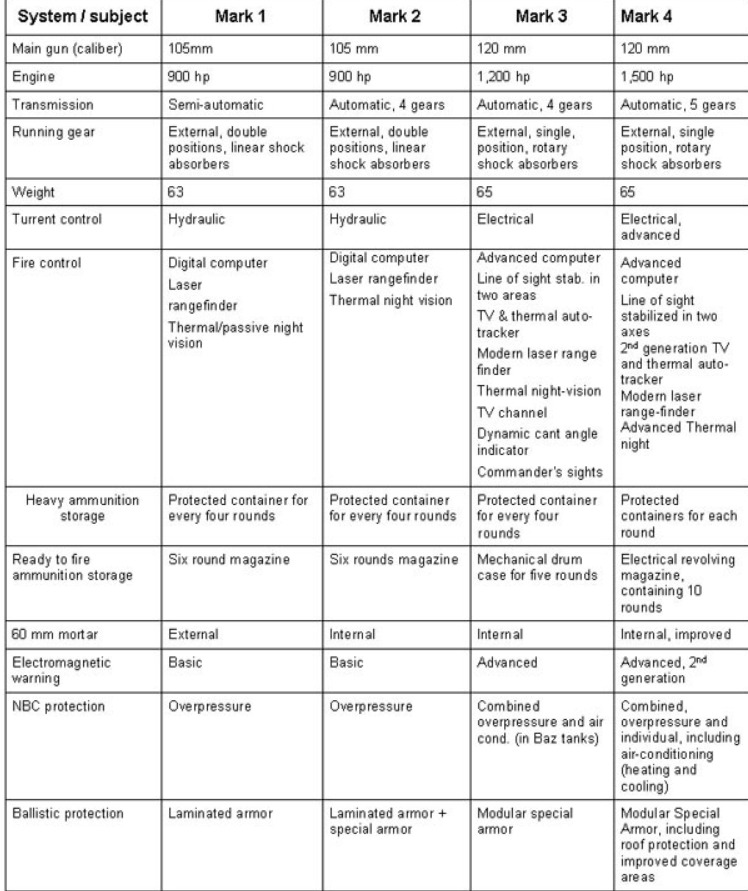
- Automotive systems: upgrading the engine with either a gas turbine or an upgraded diesel engine. The suspension system has also been improved, allowing for even better cross country mobility at higher speeds. This suspension is probably of a pneumatic type. The modified powerplant and automotive system, for which specific information has not yet been released, gives the new Merkava Mk. 2 an overall improvement in mobility.
- Fire control system: new advanced night fighting equipment was added to the tank, probably locally manufactured types. These include probably the commander/gunner sights, and driver’s night vision.
- Protection: New armour technology was designed and developed in Israel for the Merkava. The experienced accumulated in the development stage was enhanced by new ideas and developments and now the Merkava tanks are equipped with armour plates offering the best protection available by such means. Added protection is given by external means such as the redesigned skirts and spaced armour.
- Gun: Many experts are already predicting the end of the 105mm era. To meet the demands of the future, new types of the Merkava (Mk. 3, etc.) will probably mount a larger caliber gun, 120 mm or similar, to scope with the increasing threat. In the meantime new developments in ammunition can get the best from the existing 105 mm guns.
Merkava Mk. 3
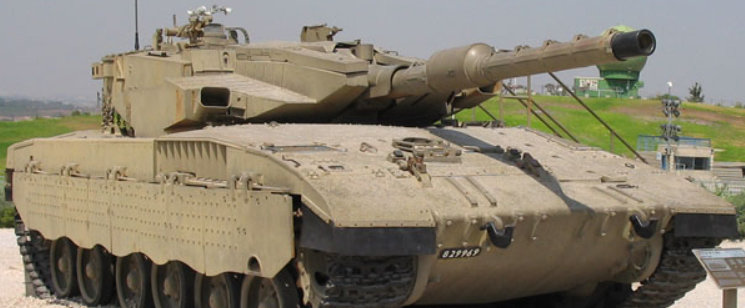
IDF started to use the Merkava Mk. 1 tanks in late 70’s in mid 80’s Merkava Mk. 2 started to enter the service with its improved fire control, armor and 60mm mortar been added. In the 90’s Merkava Mk. 3 started to enter the service
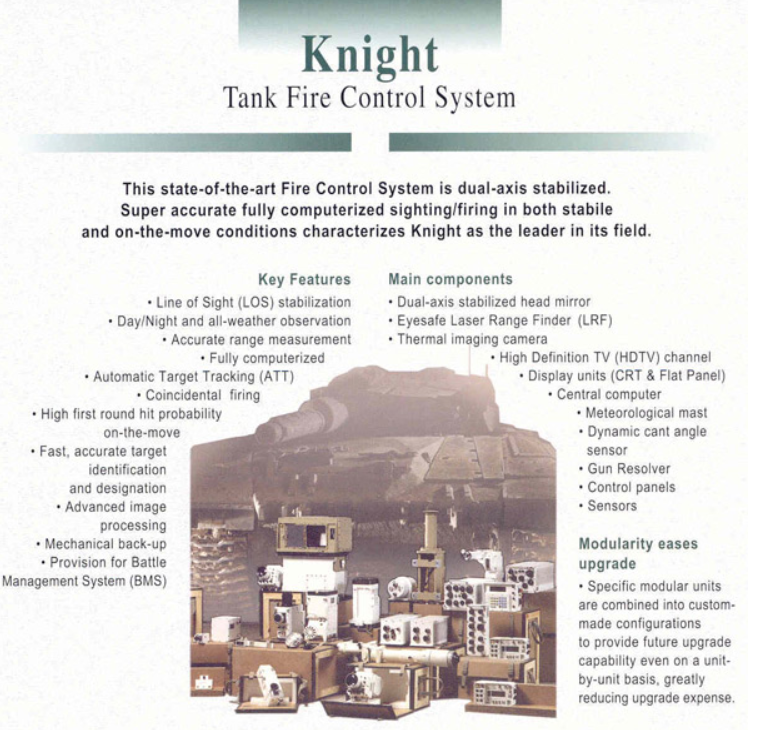
Models
Merkava Mk. 3D
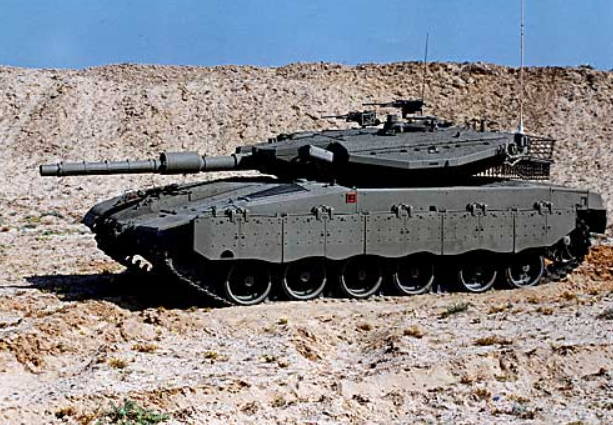
Merkava Mk. 3A
First model of the Merkava Mk. 3 tank
Merkava Mk. 3B
Merkava Mk. 3A with improved armor.
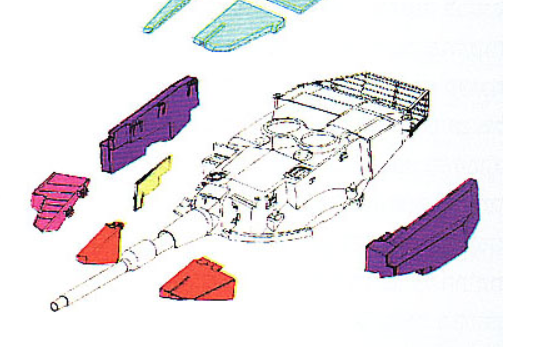
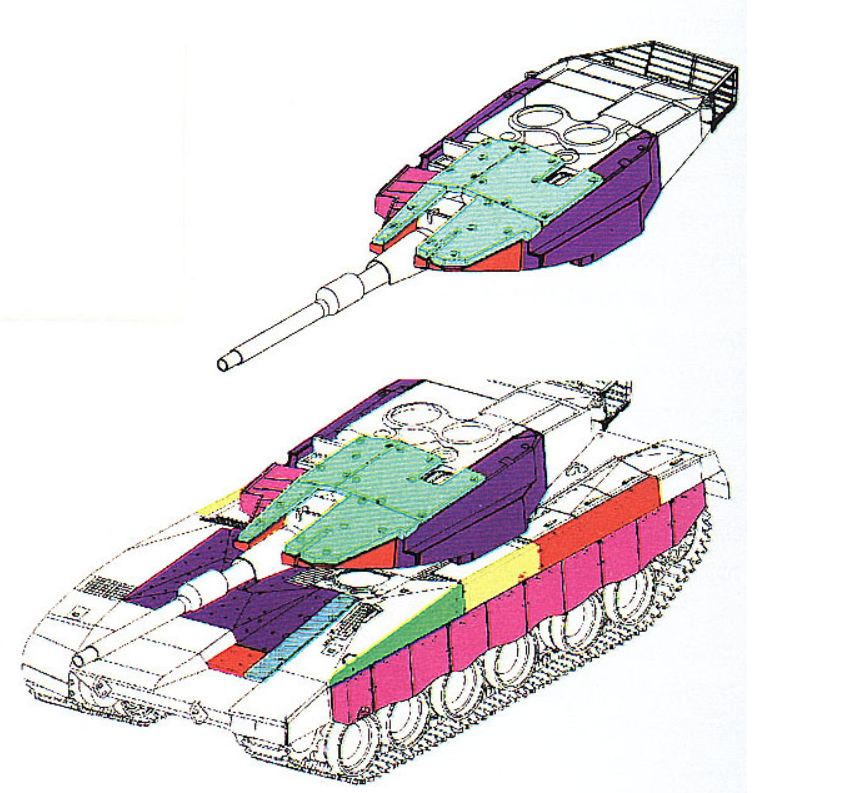
Merkava Mk. 3 Baz
Merkava Mk. 3B with Knight Mk. III (Baz) advanced fire control system, from Electro Optics Industries (EL-OP) and Elbit Ltd, provides the tank with the ability to engage moving targets while on the move (an automatic target tracker), and significant improvements in ballistic protection.
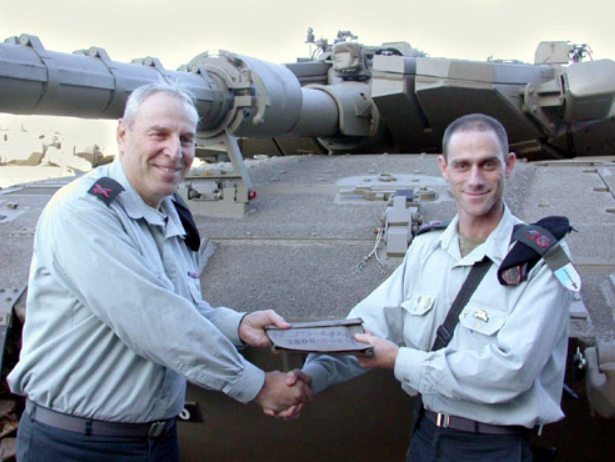
02 January 2003
The last “Merkava 3” tank to be produced, was presented today (2 Jan.) in a special ceremony held I one of the IDF’s Technological and Logistics Directorate bases.
The newer model “Merkava 4” will soon be operational in the Armor Corps.
In the photo: Brig. Gen. David Angel, head of the “Merkava” project, awarding tank documents of the last “Merkava 3” tank, to a Division Commander of the Armor Corps, Lt. Col. Zafrir Orpaz.
Merkava Mk. 4
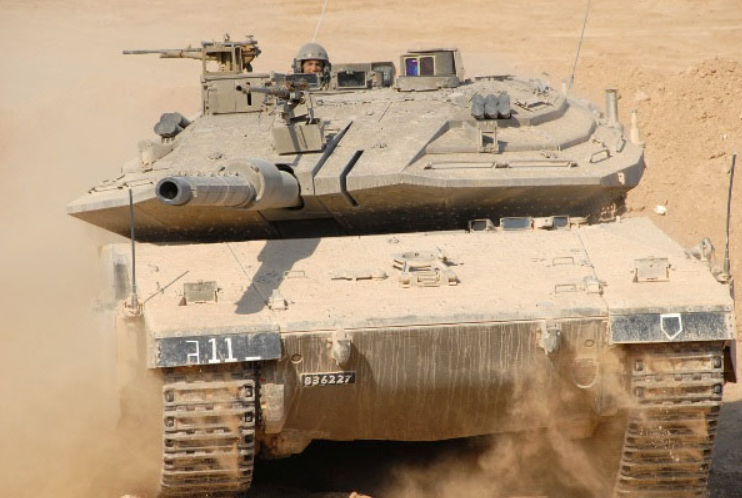
IDF Armor School Preparing To Train The First
“Merkava Mark 4” Tank Crew
March 13, 2003
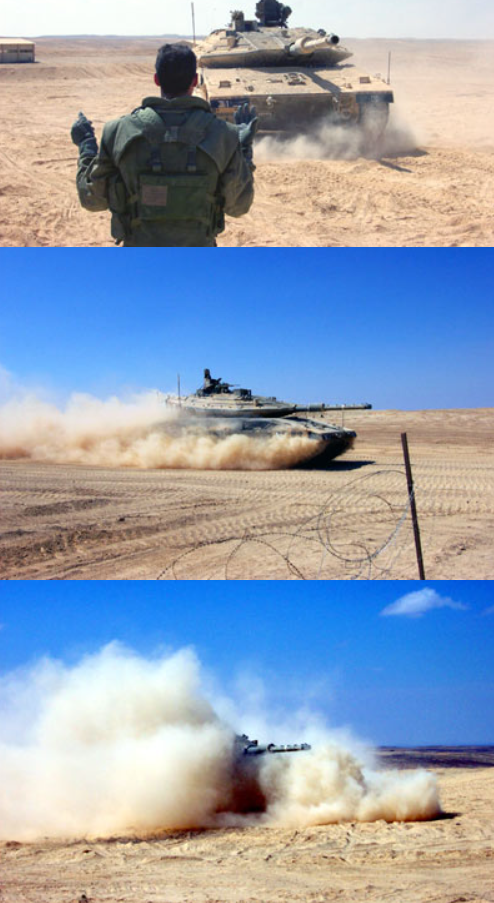
Instructors at the IDF Armor School are preparing to train the first IDF “Merkava Mark 4” tank crew members.
The “Merkava Mark 4” crew will undergo standard basic training, followed by a specialized tank course to acquire a proficiency in the following areas: communications, driving, and artillery.
After completing the above-mentioned courses, the crew enters the final phase of training, during which they will learn how to function as a team, platoon, and company.
source:https://israeli-weapons.com/