(poll at bottom)
Introduction
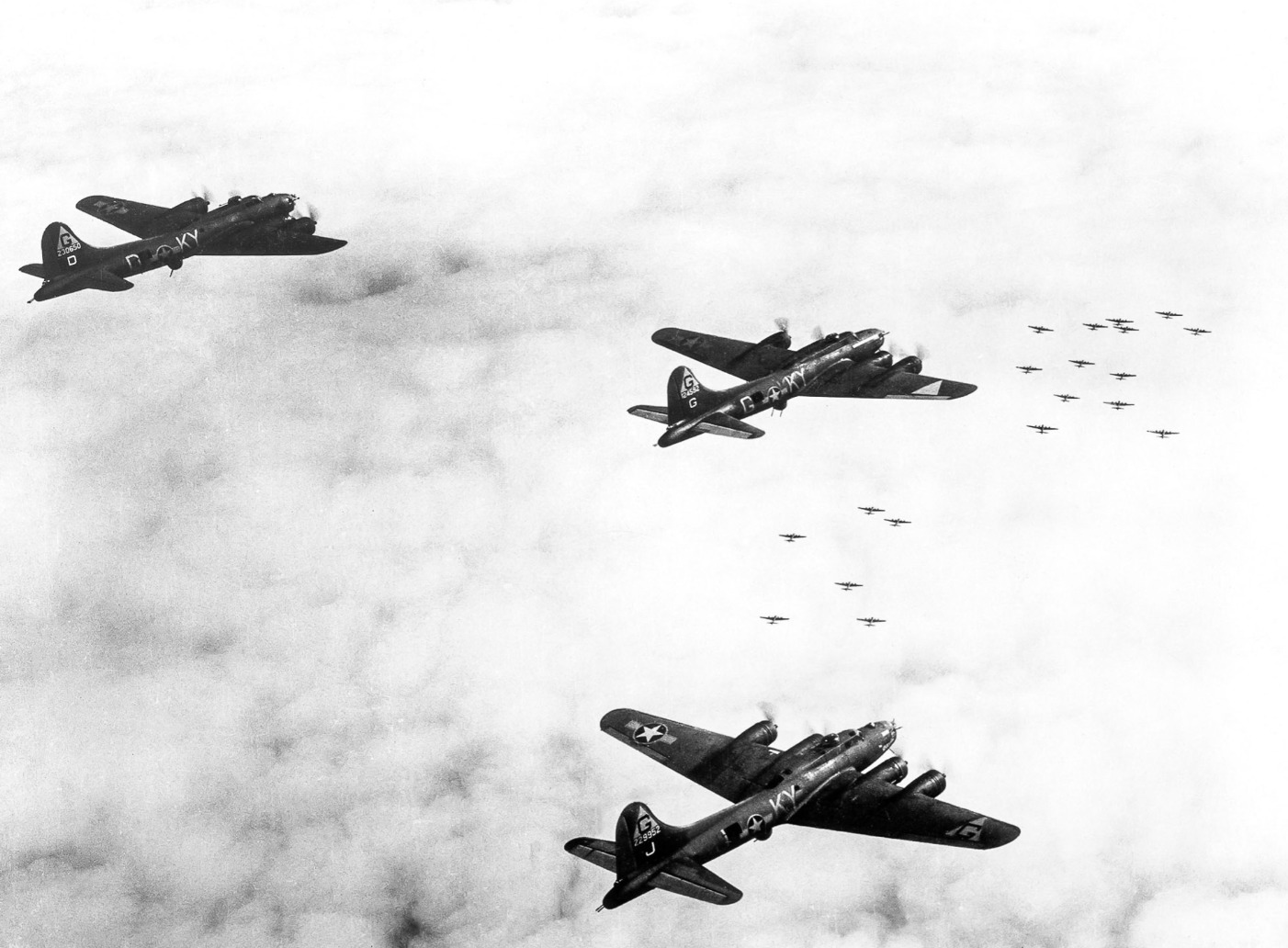
During the Second World War, bombers were used to great effect by a number of air forces, but especially the USAAF and RAF. The success of bombers came not from individual aircraft being immune to enemy air defenses, but by bombers being used in mass numbers and tight formations to overwhelm enemy defences. With the… controversial bomber survivability update recently I’d like to propose a more substantial, balanced, and historically accurate fix to the problem of bombers- give them an element.
Historical Overview
It’s simple common sense that a lone bomber or disorganized group of bombers would be more vulnerable than a coordinated formation. The details of this formation varied from country to country, year to year, and raid to raid, but generally a bomber formation would consist of progressively larger nested units, allowing for a clear chain of command and effective coordination at multiple levels. The smallest such unit typically consisted of 2-6 aircraft, while the entire raid could have hundreds of aircraft.
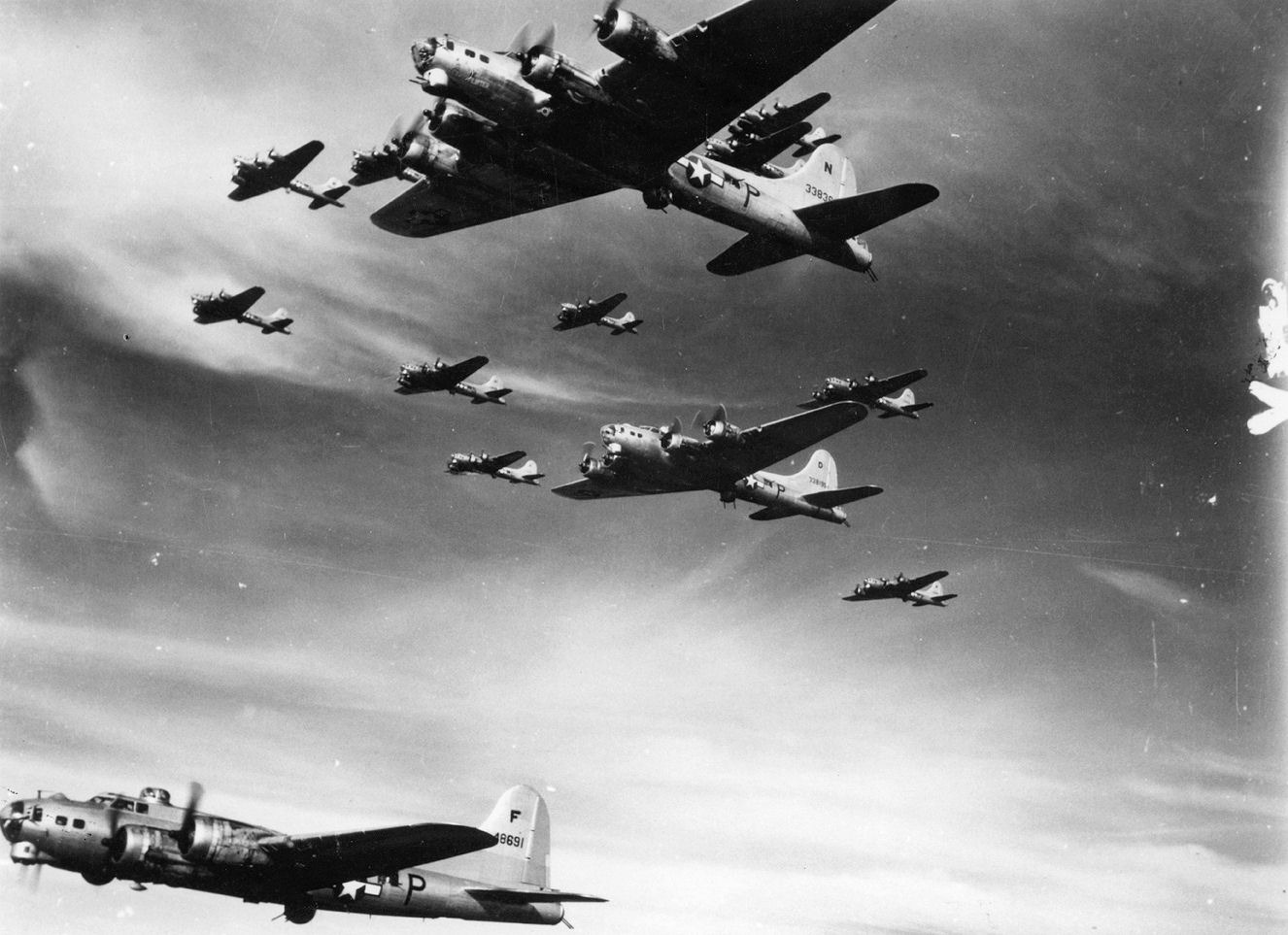
For the US Army Air Force (USAAF), bombers were initially (from August 1942) flown in spread-out six-aircraft squadrons, intended to protect from anti-aircraft fire. However, these formations were extremely vulnerable to interceptors and by September the formation was changed, with three-aircraft elements flying in close formation to provide overlapping defensive fire. Three elements would form a squadron, and two squadrons would form a group. From then on, the element would be the basic building block of all bomber formations. By December, the two three-element squadrons would be replaced by three two-element ones for better positioning in 3D. In 1943 formations were tightened up once again with rearrangement of squadrons and groups to provide better overlapping fire between these larger formations, and finally in January 1944 the final formation configuration would be created with four-element squadrons (12 aircraft) arranged in a tight “combat box”. This formation would be the standard through the end of the war.
An American bomber “combat box”. Three aircraft form an element, four elements form a squadron, and three squadrons form the combat box, or group. Multiple groups would fly in waves to form the bomber stream

How It’d Work
Now, historically formations varied from air force to air force, unit to unit, time to time, and mission to mission. In-game, however, I believe it would be best for simplicity and for balance that this mechanic be applied uniformly across all bombers it applies to.
- In air battles, bombers would spawn with a pair of AI “wingmen”.
- These aircraft would be identical to the player aircraft- same type (obviously), with the same modifications, armament, skin, and decals.
- What counts as a bomber? Generally, an aircraft with a bomb sight. I think this is the simplest way to include all the level bombers while excluding strike aircraft, heavy fighters, and dive bombers that don’t need this mechanic and also wouldn’t really benefit from it.
- These aircraft would follow the player-controlled aircraft in chevron formation. The specific dimensions of this formation can be tweaked, but for reference standard USAAF spacing placed the following aircraft 80ft (~24m) outside the lead aircraft and 130ft (~40m) behind it.
- The gunners of the AI aircraft would automatically engage nearby enemies, as turrets do when not manually controlling them.
- When the player opens/closes their bomb bay, the AI aircraft would do the same.
- When the player drops ordinance, the AI aircraft would drop the same amount.
- When the player aircraft is shot down or the player J’s out, they would switch control to the next aircraft in the formation, and then the third.
- Any kills, bombing tonnage, hits, or other scoring actions performed by the AI would be credited to the player. So your wingmen won’t be stealing your kills.
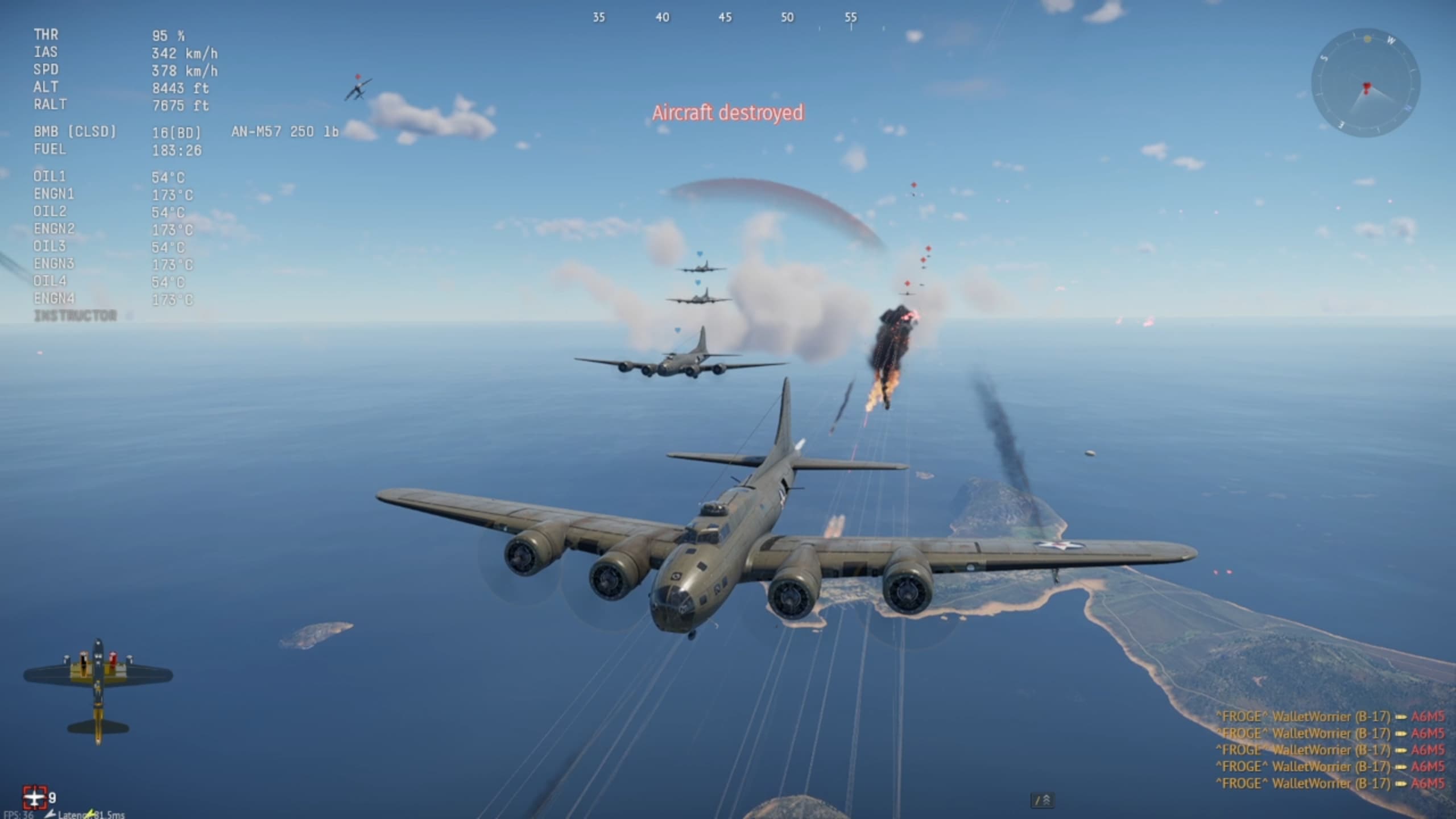
This mechanic is already mostly modelled in-game- the oft-forgotten single-player modes have AI wingmen already!
Single missions like “Flying Fortress” already have many of the suggested mechanics implemented- AI wingmen the follow in formation, engage enemies, and the player switching control upon death. The only lacking mechanic is these aircraft following the lead aircraft in opening/closing the bomb bay and dropping oridinance
Potential Impacts
- Much greater defensive capabilities for bombers, with overlapping fire from multiple aircraft. Especially if defensive fire range is increased to a more appropriate value, bombers would become a significant challenge to attack without being lit up. And a full squadron working together? Good luck!
- Bomber players would have essentially three lives. If one bomber or two go down, that’s still a loss that will leave the player more vulnerable and reduce their potential bombing score. But it’s not back to the hangar, yet.
- Larger impact of bombers on battles. With essentially three times the ordinance per player, true bombers won’t be carrying basically the same load as some much faster attackers or even fighters, especially at the higher BRs. This means bombers can be more viable and impactful in battle, and not outperformed by some fighter with napalm. Plus, this could mean more and hardier bombing targets could be introduced for these bombers!
- More targets for interceptors and heavy fighters. Often there are more bomber-hunter aircraft than there are bombers to hunt. This results in these interceptors having to fight over the few potential bomber kills, or face fighters against which they are completely outmatched. With this proposed mechanic, instead we could see groups of interceptors working together to take down these groups of bombers instead of fighting over one.
- Aura. One bomber rough, three bombers is tuff. And with a full squad of four players you can have a full squadron of 12 aircraft? Now that’s peak.
Me 'n the boys on our way to bomb the D point
- Yes
- No