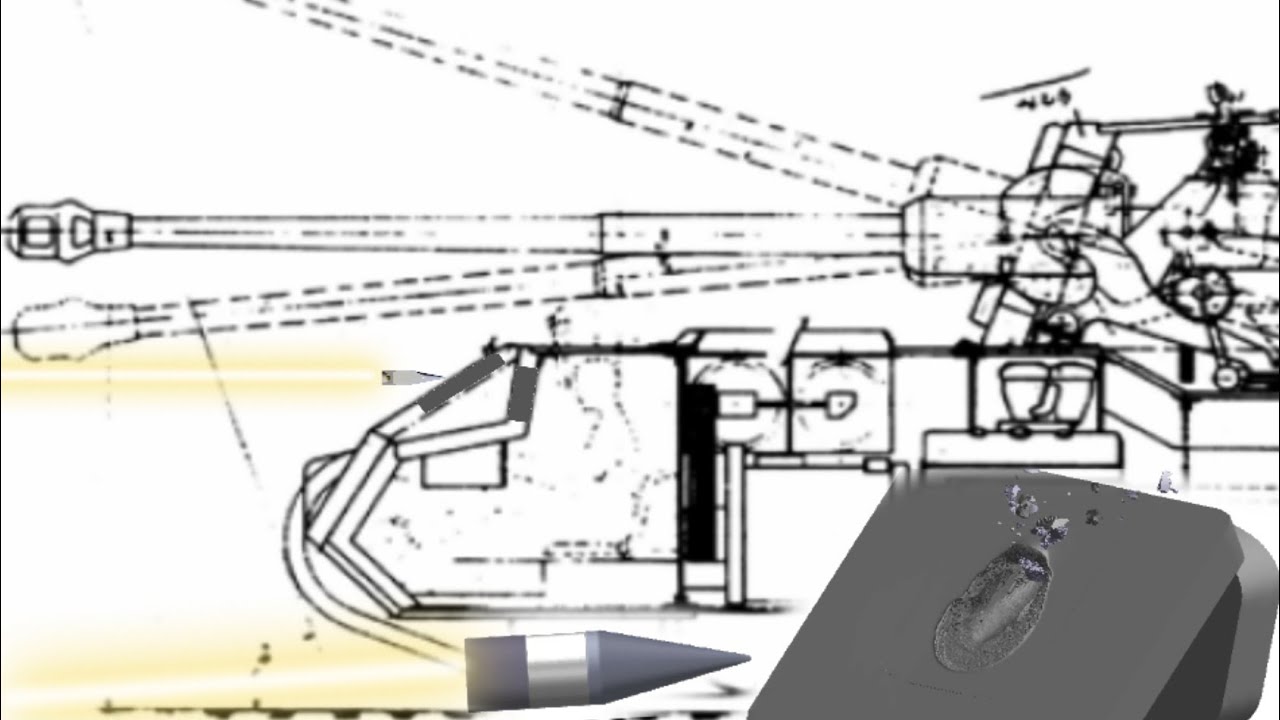
As you can see, during the initial penetration impact phase, the steel base section stays intact, pushing on the core until it hits the plate surface. And then a small portion of the carrier base breaks off and follows the core through the hole.
On the other hand, that also somewhat explains why those earlier HVAP/APCR rounds would be worse against sloped armor than an APDS round. As at angles above ~50-55° that base section would get deflected off the base off the core much sooner.
I believe the later rounds like M319, and M332 also benefit somewhat from the base piston effect as well, due to how the carrier is designed, even though the base is aluminum alloy.
Dejmian also made this simulation, using a supercharged M93 round versus a hypothetical armor set up of the Ferdinand using slopped spaced armor rather than 2 plates of armor stuck together.
One thing I want to point out is that according to him these armor plates are 80 mm at 55 degrees followed by 100 mm at 9 degrees. M93 just about managed to penetrate the first plate.
Obviously, this is just a simulation, so it’s not proof of anything, and this is being fired at a supercharged velocity. But I do remember something about the British figuring out that 17 pounder APDS needed over 3410 ft/s (1040 m/s) of velocity to defeat a Panther upper glacis. It seems that M93 follows that closely (and M93 has a very similar core to 17 pounder APDS, only slightly larger by 0.5 mm and heavier by around 0.02 kg) .
It could be that late war US APCR rounds follow a slope armor performance much more similar to early APDS rounds than what “WW2 Ballistics: Armor and Gunnery” states. This might be because navy criterion requires set amount of mass to pass through the plate, so penetrations like this weren’t considered? But I’m just throwing ideas out.
Wait so the M26E1 should fire APCR at a slightly higher speed?
If so, can a bug report be made on it? Not only the speed but also the name, since in game it’s just called “HVAP shot”. I feel like the ammunition names of the M26E1 could do with some love.
(Edit: I also am interested in the source since I always like expanding my library of knowledge)
Genuinley dont understand why gaijin made the shell penetration so bad and shatter so violently overcommon in such ammo, conveniently not allowing other shells prone to shattering to have the same mechanic
Remember, they don’t play their own game so they don’t even understand clearly how badly they’ve ruined alot of stuff in the game, though they’ve also made it pretty clear they don’t care either way.
Never. Changing bullet damage would fix a lot of the game’s issues and make it possible to rebalance most tanks in a more historical manner, but it would be a job for the developers that doesn’t generate any financial benefit. An update with 20 new vehicles, 8 of which are premium, is always better than fixing the game’s real issues without generating any financial benefit.
I think the TM-1907 and later documents are simply wrong when the put in protection criteria. I personally wonder if the later documents misprinted things.
As you point out, all of the graphs are the same. However the striking velocities do not comport with protection criteria. The document “final report on penetration” (or whatever its called I don’t have it at hand atm. ) lists various Army limit ballistic limits as well as some navy and protection ones. The velocities lists for Army protection are lower than what is stated on the TBMv3/v2 and 1907 charts. So that would seem to imply rather strongly that the later documents are just misprints.