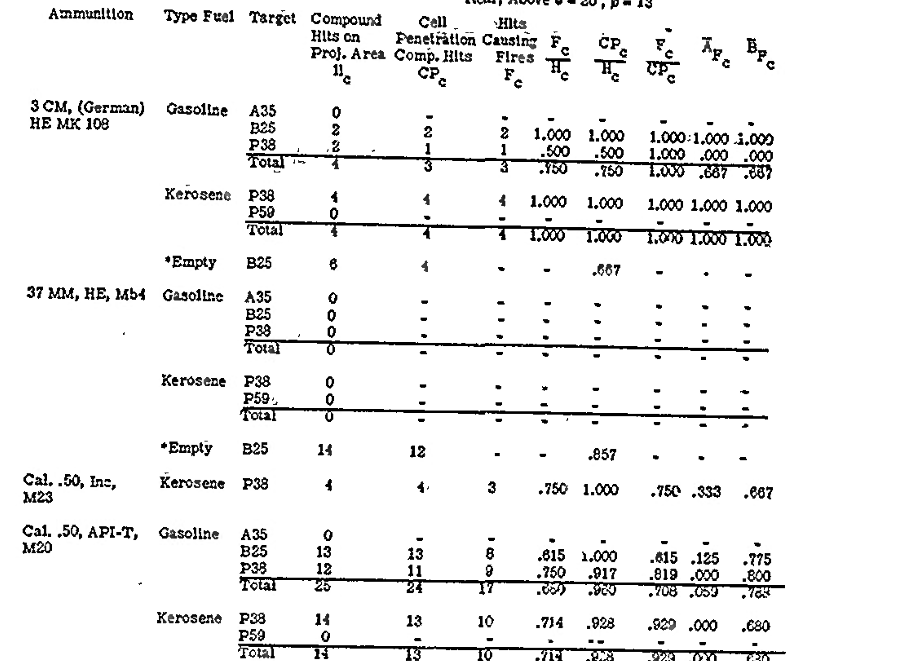
An early jet engine is not a good example for how effective incendiary weapons should be against props. Planes like the Me 262 were notorious for catching fire very easily, often not even due to incendiary effects, but general damage or overstress of the engine. This example can work for describing the rounds’ effects against early jets, but not against props.
I will also say again that if you’re going to give such good damage potential to the US .50 cals, then they will almost certainly need to be nerfed to their historical spread and range to compensate.
This specifically states that fragmentation slashed the fuel line in the jet engine. Like, this isn’t an engine getting too hot and catching alight. It’s hot fragments slashing a fuel line causing a fire.
what I was initially getting at, I wasn’t even talking about it catching things on fire. But surprise at the very fact fragmentation can do that and rip sizable chunks considering it’s just a .50. Basically. There’s little doubt to say that it isn’t high explosive in some way. Looking back at it, I wouldn’t want the current M23 to have a HE effect anyway
Kerosene is hard to light up, whole point of M23.
Now for the normal API and API-T
Give M8 API and M20 it’s realistic fire chances.
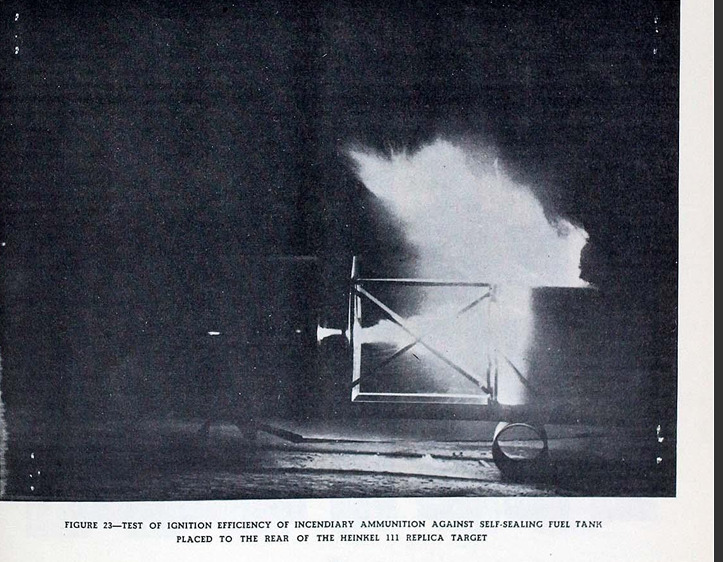
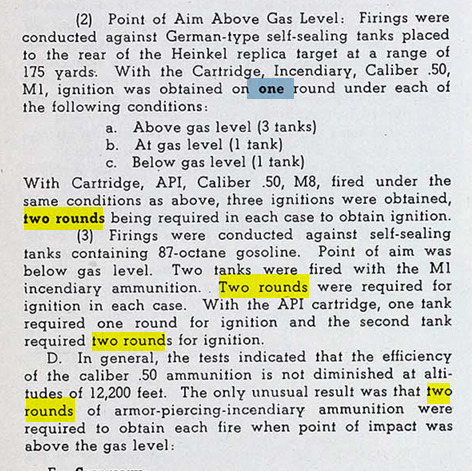
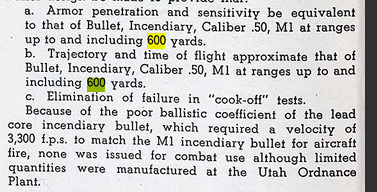
Up to around 600 yards. It took around 2 rounds to light a fuel tank on fire on average with API. Up to 1000 yards M1 incendiary took around 5-6 rounds on average to light a fuel tank. So you can gradually decrease incendiary capability up to around probably 7-8 rounds for M20 and M8 beyond 550 meters. Effectively quadrupling the amount of rounds required.
Didn’t cannons already get a huge buff this update? They added realshatter to more cannon rounds. Bunch of Youtubers were hooping and hollering about it.
And similarly, given the already hilariously-high fire-starting chance of M20 API-T on US .50cals, why aren’t pure incendiary bullets that have more filler starting fires even more often than that?
Actually the M20 APIT has been nerfed and its fire multiplier has been reduced to 10 which is the same as M8 API and other 12.7mm API (the API for Brezin UB and MG131).
What we need may be a more specific fire damage model, that some instant hit fire should be less-damaging and player may gets a chance to put it out by diving to a higher airspeed. Currently if the fuel tank is hit, with even a 99.9% integrity but as long as a fire erupts, you are certainly toasted unless the fuel tank burns out.
(Looks like there is a variable related to put fire out in a dive, but the mechanism seems never used)
At the same time the 20mm HE should also get nerfed, otherwise it would be unfair for 50cals which really relies on setting a fire to achieve a kill.
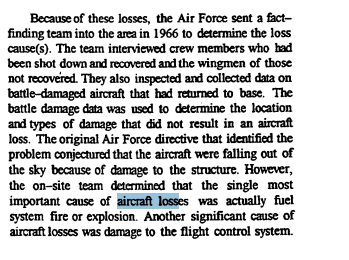
Fires are meant to basically be guaranteed kills. The biggest loss of aircraft is from fire damage and second place was control linkage damage.
Even Air force brass had the war thunder player mindset that planes went down over structural damage. .
When a fire starts, hydrostatic shock causes a fuel tank rupture, the liquid, incompressible tries to escape from the tiny hole the bullet makes and forces it’s way out. Of course, a thin piece of alumunium can’t withstand a bunch of liquid trying to jet out at once, so the tank has a rupture within it. Granting a bigger hole. Fuel tank dumps it’s contents into wherever the fuel tank sits. Wing, fuselage whatever and then begins, if there is enough incendiary, the tank will then go off. The inside basically becomes a fiery oven and just burns the plane down. You can’t “set it out.” because it’s internal. The fire that you see come out of the aircraft are the flames venting out of the bullet holes. Kinda like fire spewing out of a window in a housefire.
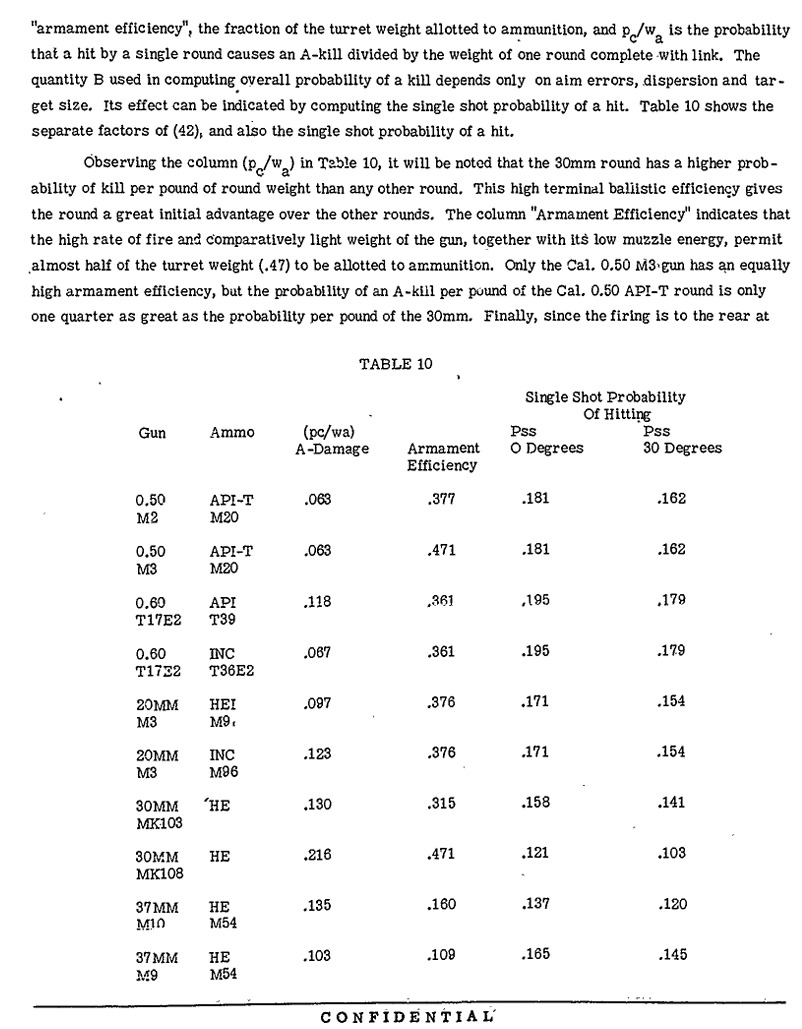
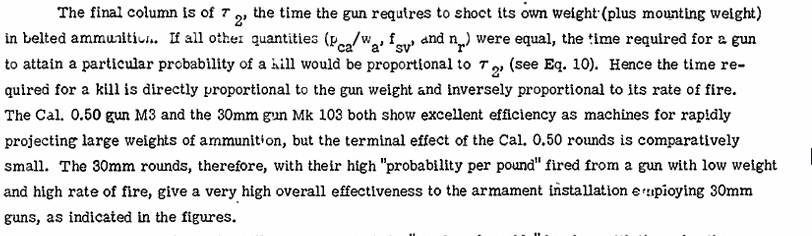
M3. Fifty cals are actually super efficient, and the .60 caliber gun is roughly similar to .50 M3 in performance. It honestly explains why jets moved onto M3 .50 instead of adopting .60 cal. and from some positions the time to kill with .50s is actually really close to 30mm. even surpassing 20mm at times. Especially when you consider they were actively trying to improve m23 throughout the Korean war.
Even the report states as such. .50 ties with 30mm as the most efficient round at that time period.
It explains why the U.S. stuck with it and it correlates with Mig 15 pilots also reporting that their planes went down when .50s struck control linkages.
I’d imagine what make it difficult to get kills with .50s was due to the fact that you had a giant jet engine in the way, the M23, designed to fight against jet aircraft, while effective had issues cooking off. I’m 99% sure if the M23 cook off issue could’ve been ironed out, it would’ve be ridiculously powerful at the time. I’d imagine the U.S. would’ve stuck with .50 equipped sabres. The aircraft vulnerability document states they didn’t do much testing with the M23 besides the fact that while it is better than M20 API-T (going by the data) it’s behaves as a midway point between the .60 caliber and .50 API-T While carrying the benefits of being able to fit in M3 .50s
Cannons did get a huge buff, and I consider it an inelegant solution to the previous issues.
Regardless of the strength of cannons, if you’re going to give a massive buff to the lethality of .50 cals on the grounds of historical accuracy, then their spread and range will also need to be adjusted for historical accuracy.
No, fires are very likely to take out a plane but only when they don’t extinguish themselves.
Somehow you are under the impression that one freaking 12.7mm M1 Incendiary bullet is going to mark the end of a He 111.
Here’s the deal:
Fuel can be ignited inside or outside a tank.
The slip stream can extinguish external fires.
External fires can’t be extinguished, if the fuel powers rapidly out of the tank, either due to damage or from being non-self sealing.
Internal fires can’t be extinguished by the slip stream but need a constant supply of oxygen.
Which brings us to the part where the fuel tank needs to be severely damaged for oxygen to enter.
US fighters lighting planes on fires and destroying them didn’t do so with a 1-2 hits.
They fired 6-8 .50cals, that tumbled on impact leaving wide gashes into fuel tanks, that would eventually lead to both internal and external fires, that marked the end of a plane.
There’s one US report that basically said for a bullet to cause a lethal fuel fire the round has to go in one side and exit the other.
In that case you have a high pressure opening in the front and a low pressure opening in the back thats going to suck oxygen right through the tank, supplying oxygen for a fire that won’t extinguish unless with fuel tank extinguishers.
They linked fuel fire intensity right to the chance of causing a fire.
.60cal rounds are so fast that they even pierce a full tank, of the right size, so a .60cal is waaaay more likely to cause a lethal fire in a single hit than a .50cal. And the same goes for 20mm Incendiary shells.
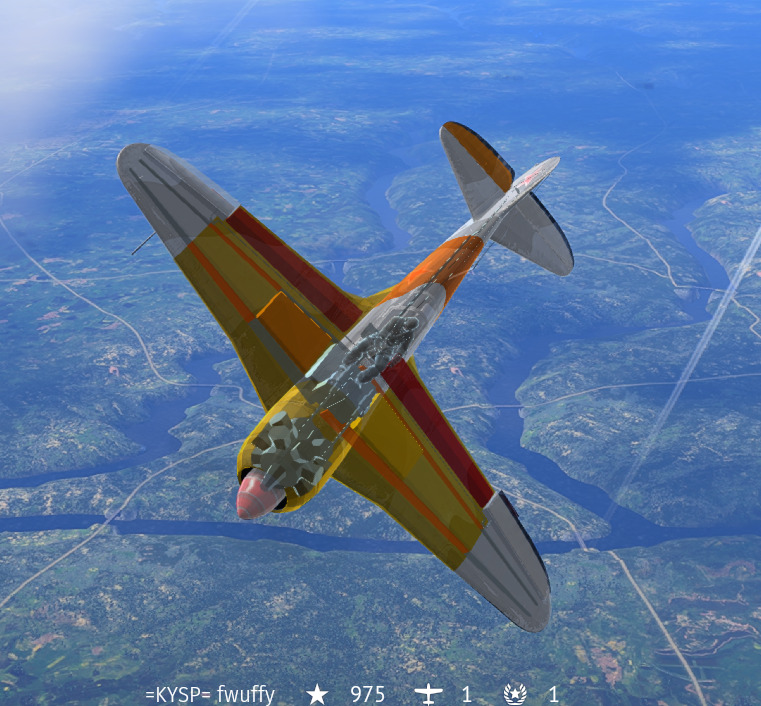
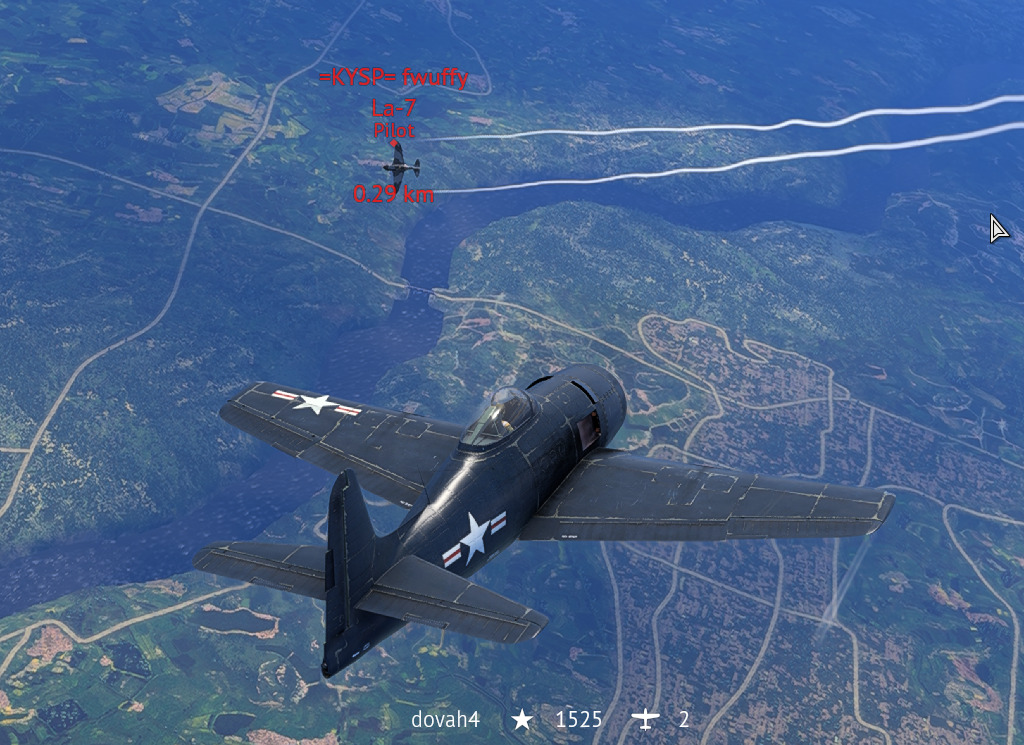
B-17 been hit from MK-108 fired by Me-163, a big fire flashed on the portside wing tank, but quickly went out. The plane actually survived and returned to base.
Ki-84 been hit by a burst of 50cals fired by F6F, a fire was set but quickly went out in a dive. The pilot was presumably dead as the aircraft went into an inverted spiral and there was fire came out from the cockpit.
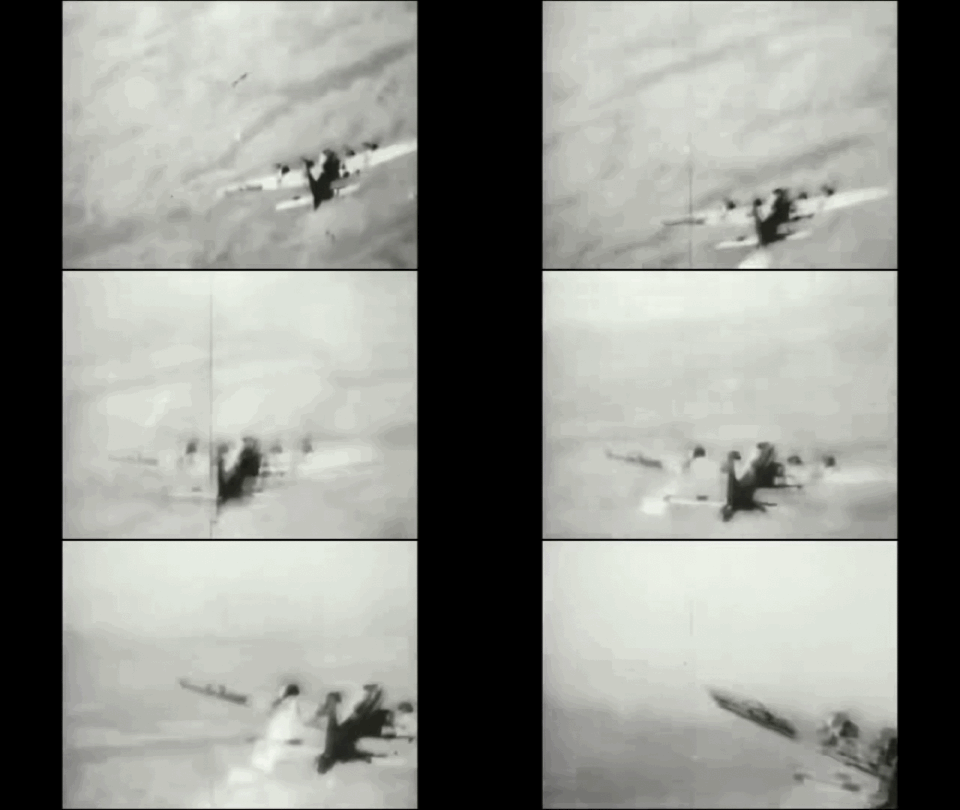
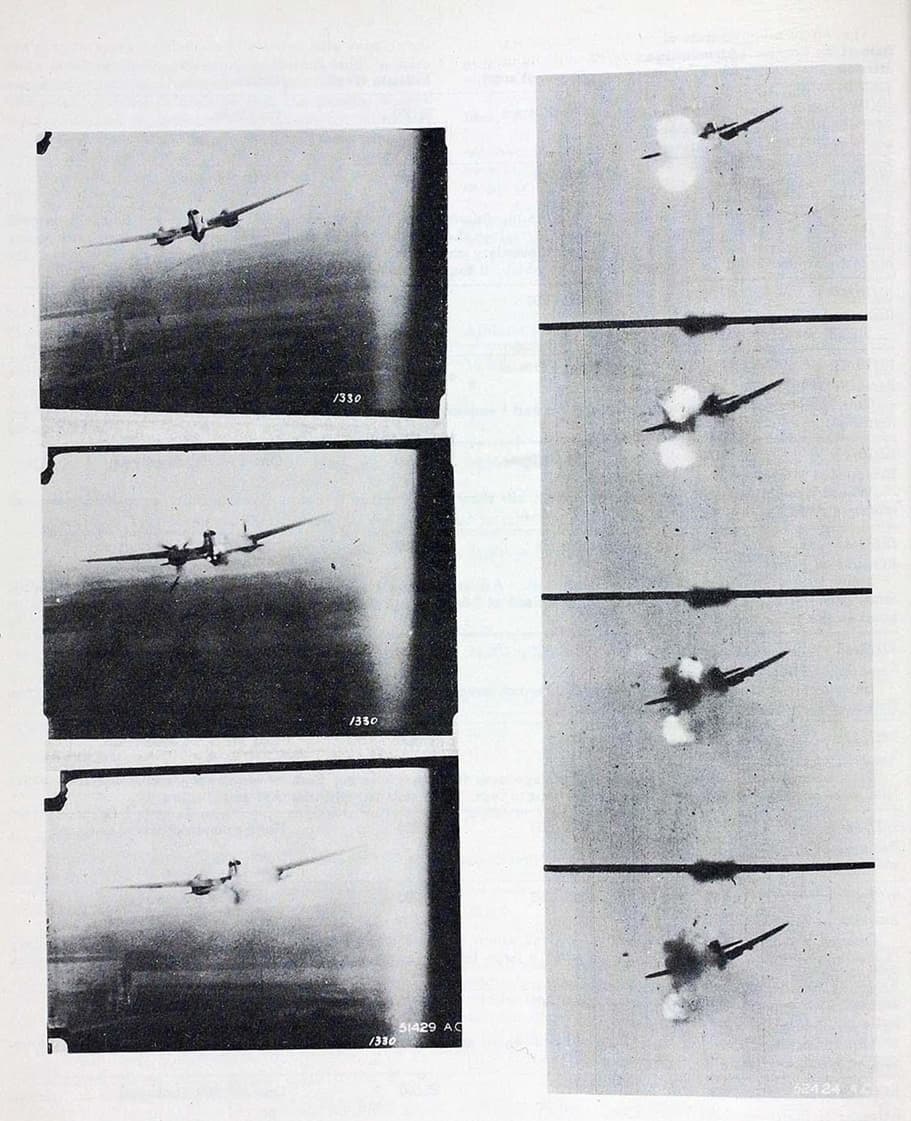
There are also plenty of records and gun cam footages show the aircraft fire that goes on and off repeatedly. So clearly a fire that was not so catastrophic as modelled in-game should have a chance to put off.
IL-2 1946 had modelled this, the aircraft fire can be either escalated or degraded between different fuel damage levels: smoke(Level 3)/small flash fire(Level 4)/clear fire no smoke(Level 5)/huge flame (Level 6, also the degree of every fuel fire been modelled in WarThunder) and Explosion(Level 6+), depending on altitude, airspeed, elapsed time, aircraft tank parameters and randomness.
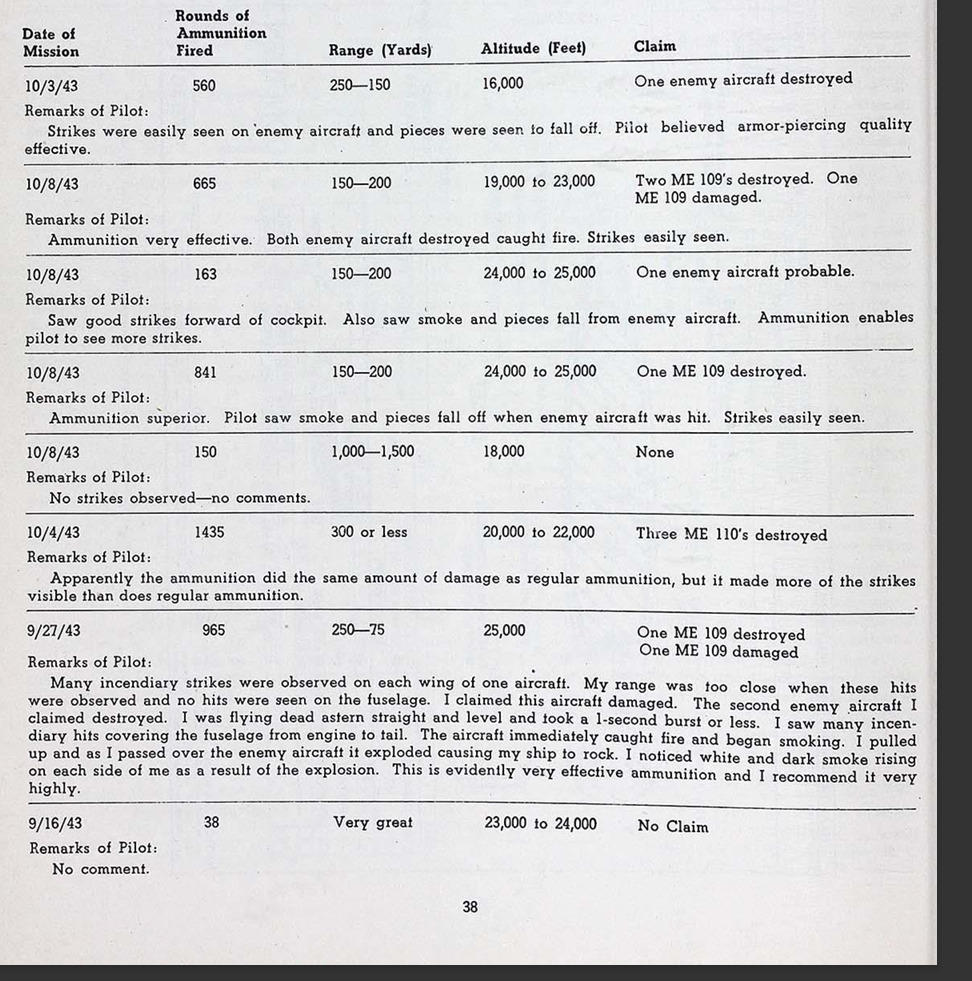
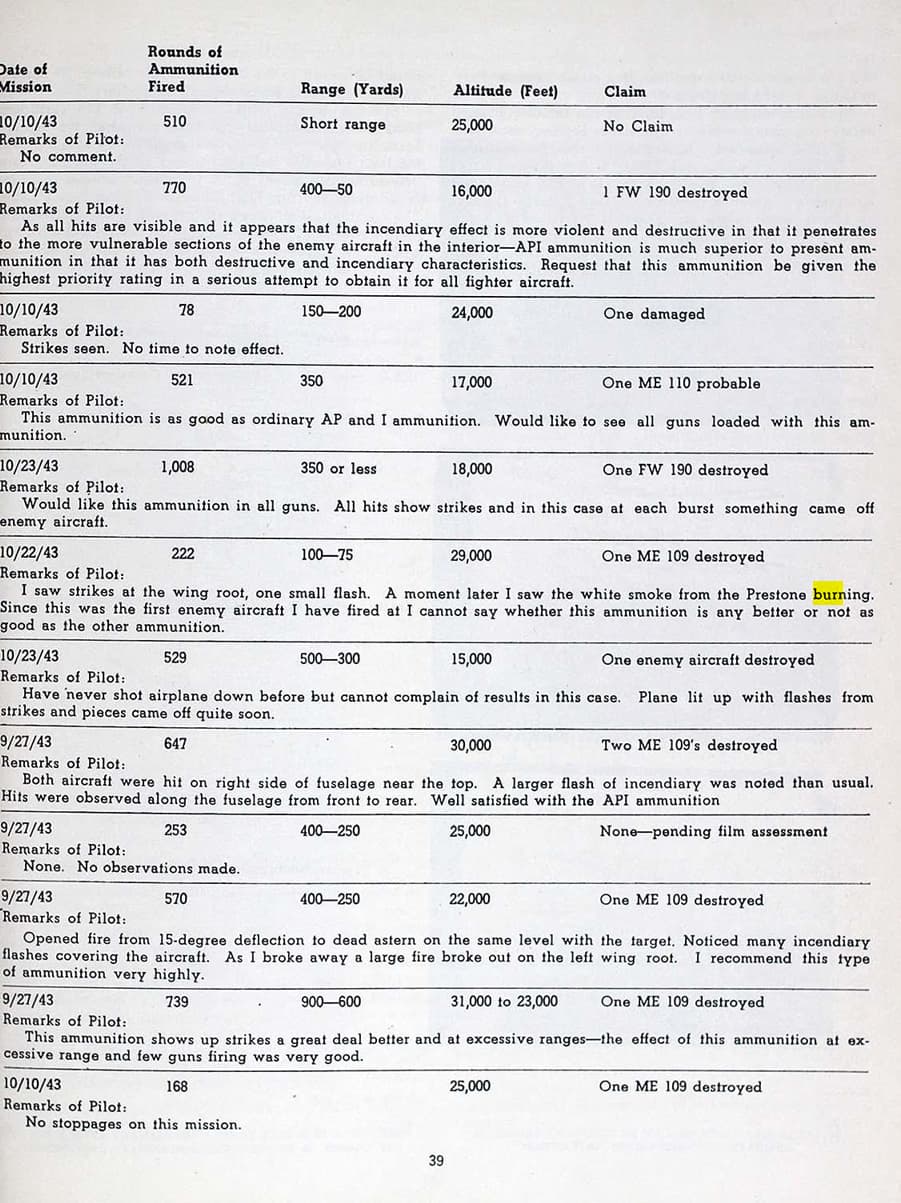
Indeed there were lots of 1-shot fire produced by 50cal in real life, also famous Hamilton “One-Slug” McWhorter got his name from it, but the fire should not always becomes instantly catastrophic as in-game and sometimes would require time to grow stable.
If struck with the tipping straight as possible? Yes, it could. M1 in development had a keyholing issue as the boat tail caused yaw instability. After flattening out the base, the round was much more reliable in that regard to ensure proper penetration of a fuel tank.
This is not considering compounding shots of .50s where fuel is being readily leaked into the wing or fuselage of the plane, at which point a second shot is highly likely for another fire.
If the round properly impacts and penetrates the tank as shown in the testing photos.
It’s possible to survive, but it seems like surviving a fuel fire is an exception and not the norm
And considering throughout the war that Germany and Japan ran self-sealing fuel tanks that didn’t have as thick rubber lining for it’s self-sealing fuel tank.
Unlike aircraft like the B-25 where around 23% of the fuel tank’s capacity was taken up by the self-sealing liner.
Doesn’t 30mm HE have some incendiary element in it?
All above I agree with. But I don’t think A6Ms should be able to regularly put out fires or Fw-190s doing something similar. As that’s the case of the fuel just instantly vaporizing in game . It should be emulated that fires should go out in such a manner as stated above. Not because gaijin causes all the fuel to vanish into thin air within seconds.
Reduce AP’s ability to cause super structure damage to aircraft besides the flight controls. That way you can’t saw someone’s wing off by just shooting empty space. You’ve instantly nerfed .50 structurally by a crap ton, where the only way to do superstructure damage is to smack modules and light things on fire.
Because currently. I smacked this dude’s gas tank in a dog fight at around 500 meters away and this dude just swallows up my shots with no fire.
Now of course. If we don’t want to touch stats? Sure. That’s fair.
Air target’s belt for U.S. .50s. which replaces the API in stealth API-T and/or custom convergences to allow the U.S. planes to have a better range at which to hit targets. Because getting into brawls with a convergence of 300m is way different than getting into a brawl with a convergence of 500m. So why not allow U.S. planes to converge each gun at different ranges like IRL? (And with countless other aircraft too.)
Last I remember it was always 10 - much larger shells with far more incendiary filling had “OnHitMultFire” (or w/e the code designation for fires is, I don’t remember exactly) had considerably lower values for the same parameter. Like MK108 incendiary was set to 6, despite being fifteen times bigger in incendiary amount.
It would be hard to balance and make sense of it when the 30mm incendiary mixture was white phosphorous. Which is very slow burning. Make it too effective instantly and then it wouldn’t make sense as a WP round.
Have players suddenly burst into flames much later or suffer cumulating structure damage after 5 minutes would probably be hard to implement and not worth it for gaijin.
Also, gaijin just hates incendiary in general because they’re all wild card rounds that range from acting as HE rounds, to API rounds, to both, to weird stuff like the 30mm WP as mentioned above. And so programming each individual type of incendiary would be a pain and not worth the effort in their eyes.
Reduce AP’s ability to cause super structure damage to aircraft besides the flight controls. That way you can’t saw someone’s wing off by just shooting empty space. You’ve instantly nerfed .50 structurally by a crap ton, where the only way to do superstructure damage is to smack modules and light things on fire.
This is a very fair suggestion, though as KillaKiwi has said somewhere (not sure if here or not) planes would probably need more modules modelled for that to be fair for the .50 cal, as there’s currently a bit mor empty space inside most aircraft than there realistically would be. Thus, I’d still sooner turn to spread and range debuffs first, and structure debuffs after evaluation.
Doesn’t 30mm HE have some incendiary element in it?
It had some degree of thermite in it, which I usually see listed as 140 grams. I’m not sure exactly how that much thermite would burn under those conditions, but I wouldn’t be terribly surprised to hear that the fire in that video was the immediate incendiary effect of the thermite rather than a fire started within the plane itself.
I agree in that more modules would need to be added, but I think even if you added it now. Trading AP damage for super high flame chances, you can make one more addition that would probably mitigate the issue of “nothing there to hit.”
Adding the feature for custom convergence for each gun. For a hypothetical. In a P-51D. I can set each gun to different ranges. Having a flat fan of fire.
Two guns: 300m
Two guns: 400m
Two guns: 500m
Because each gun is able to light someone on fire instantly, it would maximize the ranges you could make these shots. The other guns out of convergence will rake the wings for any fuel tanks.
The only 30mm WP round would be Japanese Navy 30mm Incendiary, which has some explosive on top to burst open the shell, after which the WP will rapidly burn and pour out the front, while the projectile travels through the airframe.
That WP isn’t going to stay inside the aircraft for more than a few seconds before it burns up completely.
Functionally its works like any other incendiary shell but it will cause a lot more damage to a fuel tank than smaller rounds. So one hit is all takes.
He is talking about 30mm Mineshells, which contained aluminum dust to mainly boost the pressure and cause more structural damage.
But it also created a fireball that could ignite fuel.
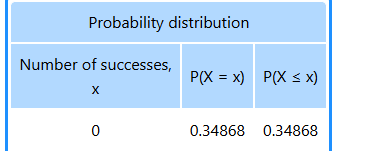
Has anyone actually calculated the theoretical fire chances of .50 based off the stats? I haven’t washed up on math, but wouldn’t a binomial distribution work here for probability?
I plugged the number in for a single success in a calculator. I’m working from a binary so the other successes don’t matter. You’re either on fire or you’re not.
Wouldn’t this mean that after 10 rounds hitting a fuel tank you have a 65% chance to start a fire?
That’s actually extremely low when you consider that you’ll sometimes only have 1-2 rounds hitting a target.
Search reports I’ve included in previously discussions, those reports available on DTIC showed test results on chances of gas/kerosine fuel fire caused by M8. M20. M23 from various angle, distance, altitude.
Again IRL conditions would be way more complicated than in the Lab, which is why early conclusion of “M1/M8 causes fuel fire in average slightly more than one shot” may not hold solid from the observation of gun cam footages.

 .
.