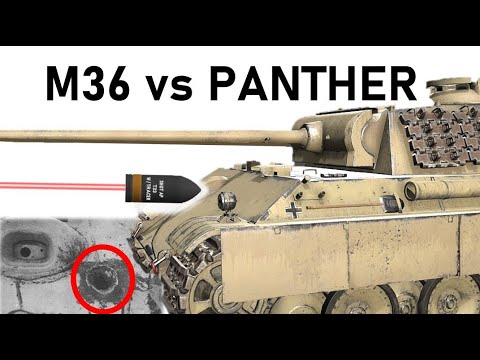
According to Nicholas Moran (“The Chieftain”), this Panther was seemingly hit first by 5 APDS rounds.
To demonstrate this, an impromptu test firing was conducted at Balleroy, in Normandy, against a captured Panther tank. US First Army was provided with a British 17pdr, with new APDS (discarding sabot) ammunition. There was no formal report or minutes written from this test firing. However photos of the results were routed through US field commanders in Normandy. The results were summarized in a subsequent report:
… in firing conducted by First U.S. Army at Balleroy on 10 July 44, 5 rounds were fired at the front plate of a Panther tank at 700 yards. Examination of pictures of this firing indicates that the first round struck the mantlet, the second between the track and the nose plate, the third at the junction of the nose and glacis and penetrated. The fourth and fifth were fair hits on the glacis and both penetrated.
Panther before additional shots cracked the plate

Not only does it explain the seemingly smaller holes, but it also explains why they are so “all over the place”, as APDS for the 17 pounder was notoriously inaccurate.
The hit marked with an arrow that says “17 pounder” is more likely to have been a normal AP round. But not only was the armor of this Panther of seemingly lower quality (after all, catastrophic failure after relatively few rounds), but the upper glacis had already been hit and penetrated by APDS rounds. The hit marked with “17 pdr” seems to coincide with a crack which would back this up further.
All that said, I heavily doubt normal AP rounds would go through an undamaged Panther glacis that isn’t of low quality, and generally allied documents agree.