- Yes
- No
 Ye-152M - MiG-21 on Viagra
History
In the late 1950s, Soviet air defense planners were facing a nightmare scenario: American nuclear bombers and high-altitude spy planes flying higher and faster than anything ground-based air defenses or standard MiG fighters could touch. The answer from Mikoyan-Gurevich OKB-155 was simple in concept and brutal in execution build a pencil-thin, rocket-like tube around the largest jet engine available, attach a pair of tiny delta wings, and sling long-range radar-guided missiles onto the tips. This vision gave birth to the Ye-150 heavy interceptor family, a lineage that culminated in the experimental Ye-152M .
To understand the Ye-152M, you have to look at the sheer scale of what Mikoyan was attempting. Up until that point, Soviet fighters like the MiG-19 and early MiG-21 variants were lightweight, short-range dogfighters. The Ye-150 line was the polar opposite: a massive automated interceptor designed as part of the Uragan-5 (Hurricane-5) integrated defense system. Ground controllers were meant to guide the plane via datalink straight to the target’s vector, where the airborne radar would lock on and launch heavy missiles from miles away, all while traveling above Mach 2.5.
The heart of this monster was the Tumansky R-15 turbojet. It was a brute-force engine built primarily out of stainless steel to survive the brutal thermal kinetic heating of high-Mach flight. In its early years, the R-15 was notoriously temperamental and prone to catastrophic failure; engine lifespans were often measured in single-digit flight hours rather than hundreds. Despite these teething issues, the early single-engine prototypes, designated Ye-152-1 and Ye-152-2, proved that the basic concept possessed terrifying speed.
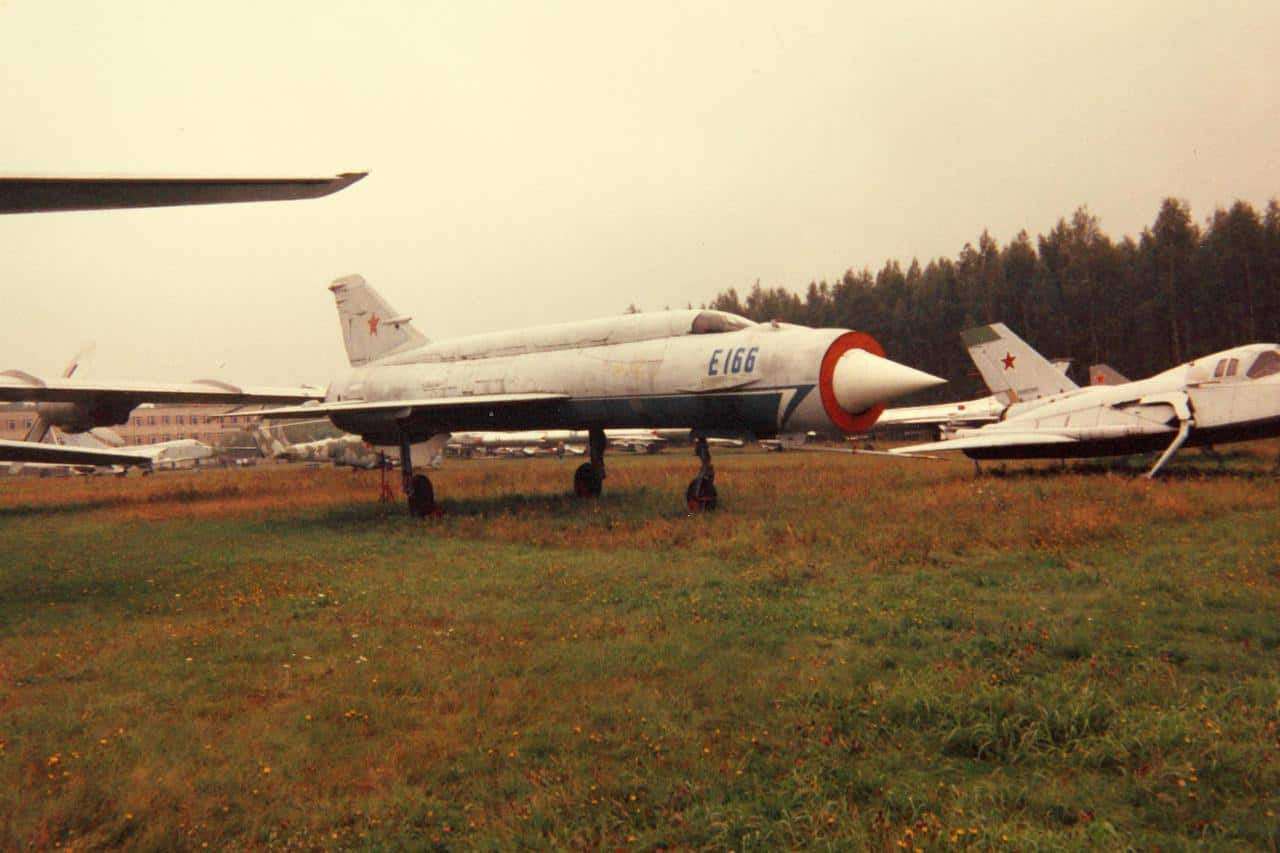
Ye-152M preserved as ‘E-166’
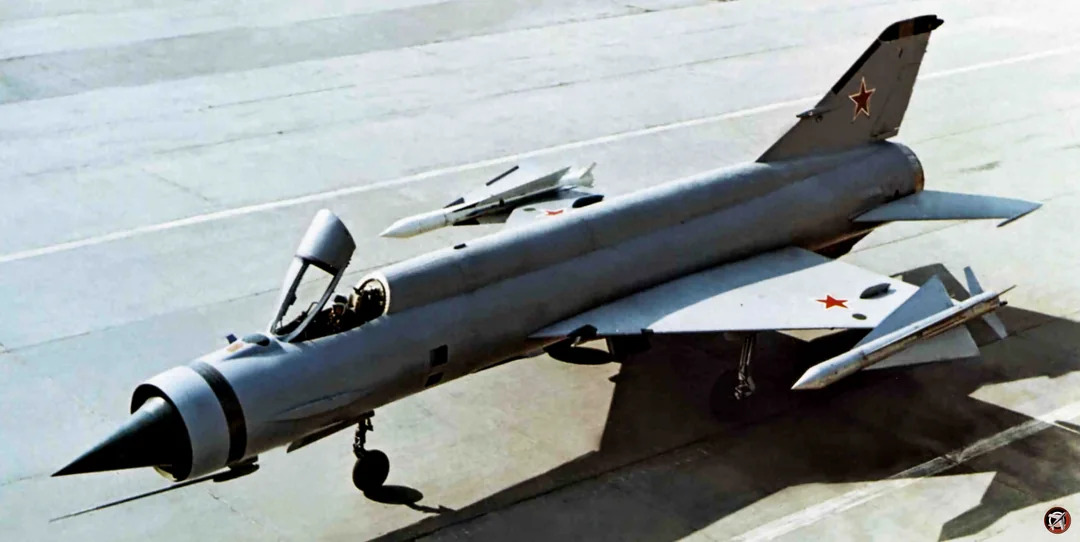
As test flights progressed, OKB-155 returned the second prototype (Ye-152-2) to the factory for a massive overhaul. This reworked configuration was initially designated the Ye-152P before evolving into the definitive Ye-152M configuration. The engineers added a prominent dorsal spine running along the top of the fuselage from the rear of the cockpit canopy all the way to the vertical stabilizer. This fairing housed control linkages and three additional fuel tanks totaling over 1,760 liters of aviation fuel a critical upgrade, given that the thirsty R-15 engine swallowed fuel at an astronomical rate.
The Ye-152M was also fitted with an improved R-15B-300 engine featuring a variable convergent-divergent nozzle, a forward-hinged canopy blending cleanly into the new spine, and provisions for canard foreplanes on the forward nose section to aid pitch authority at high angles of attack. Its primary punch was supposed to come from two massive Bisnovat K-80 (R-4) radar-guided missiles mounted directly on specialized launcher rails at the wingtips.
However, putting giant, heavy missiles on the outer tips of a thin delta wing created a severe engineering headache. During high-speed wind tunnel testing and flight evaluations, aerodynamicists discovered violent aeroelastic flutter. The weight and drag of the K-80 missiles caused the wingtips to twist unnaturally at high dynamic pressures. This twisting induced unpredictable oscillations that destabilized the missile’s trajectory the moment it left the rail. Mikoyan designers tried everything to solve it from testing deep underwing pylons to proposing angled wingtip extensions but the fundamental structure of a single-engined small-delta airframe couldn’t cleanly carry the bulk required for next-generation weapons.
While these structural and aerodynamic challenges were being fought on the ground, the Soviet propaganda machine used the program to project air dominance overseas. In 1961 and 1962, the sister aircraft (Ye-152-1) set multiple official World Air Records with the FAI, reaching speeds of 2,681 km/h (Mach 2.5+) and horizontal flight altitudes above 22,600 meters. To keep the true nature of their secret interceptor hidden, Moscow registered the aircraft under the fake cover designation “Ye-166” . Western observers were left guessing, often misidentifying photographs of the Ye-150 series as production fighters like the “MiG-23”.
By 1963, the geopolitical and technical landscape had shifted. The Soviet Air Defense Forces selected the twin-engine, long-range Tupolev Tu-128 to patrol the vast northern frontiers. More importantly, the Mikoyan bureau realized that a single R-15 engine could not provide the combined range, payload capacity, and radar power needed to counter modern high-altitude reconnaissance threats. The single-engine heavy interceptor concept was officially canceled, and OKB-155 pivoted its focus toward a bold new twin-engine, twin-tailed platform: the Ye-155.
Though the Ye-152M never fired a missile in anger or entered serial production, it was far from a failure. It served as the ultimate testbed for the exact building blocks that created the legendary MiG-25 “Foxbat”. The twin R-15 engines, the Smerch radar system, the steel thermal construction, the large dorsal spine architecture, and the heavy R-40 missile development all traced their direct lineage straight back to the lessons bought by the Ye-152 program.
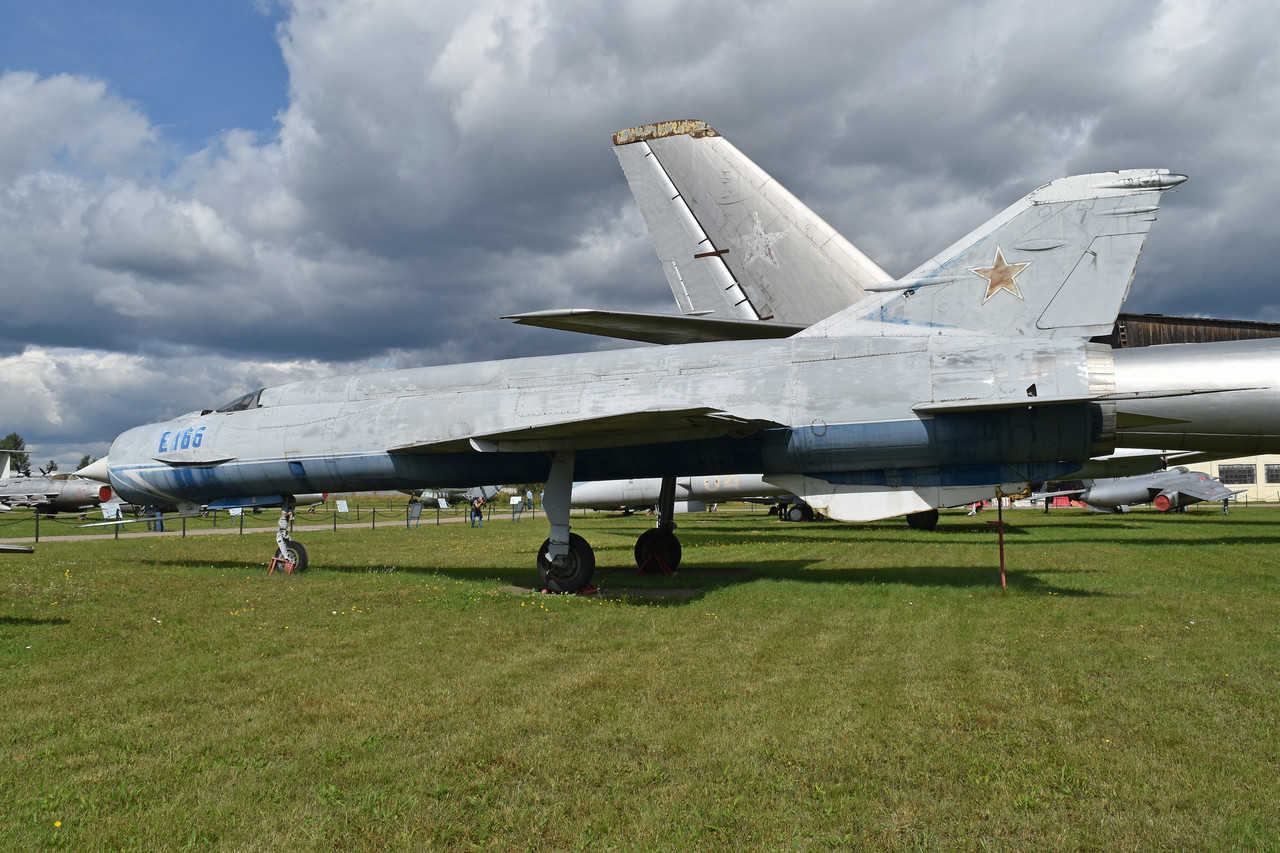
Ye-152M preserved as ‘E-166’
Specifications
General Characteristics
- Crew: 1
- Length: 24.65 m (80 ft 10 in) including nose pitot probe
- Wingspan: 8.79 m (28 ft 10 in)
- Height: 4.21 m (13 ft 10 in)
- Wing Area: 34.02 m² (366.2 sq ft)
- Empty Weight: 10,900 kg (24,030 lb)
- Gross Takeoff Weight: 14,350 kg (31,636 lb)
- Fuel Capacity: ~5,960 liters internal fuel (expanded via the enlarged dorsal spine fairing)
Powerplant
- Engine: 1x Tumansky R-15B-300 single-shaft turbojet with afterburner
- Dry Thrust: 66.7 kN (15,000 lbf / 6,800 kgf)
- Thrust with Afterburner: 100.1 kN (22,500 lbf / 10,210 kgf)
Performance
- Maximum Speed: 2,681 km/h (1,666 mph / Mach 2.52) achieved; design theoretical limit ~ Mach 2.8 at high altitude
- Service Ceiling: 22,670 m (74,376 ft)
- Maximum Range: ~1,470 km (913 miles)
- Initial Rate of Climb: 250 m/s (49,200 ft/min)
- Wing Loading: 422 kg/m² (86.4 lb/sq ft)
Armament & Avionics
- Targeting System: Uragan-5B integrated datalink defense system coupled with early developmental models of the Smerch radar
- Hardpoints: 2x specialized wingtip launcher rails
- Missiles: 2x Bisnovat K-80 (R-4) radar-guided or infrared-homing heavy long-range air-to-air missiles
- Guns: None