Aim260 has been in production. For years. The AF has about 400 the navy is 300~ I believe
So AIM-260 has entered service or is it still under testing?
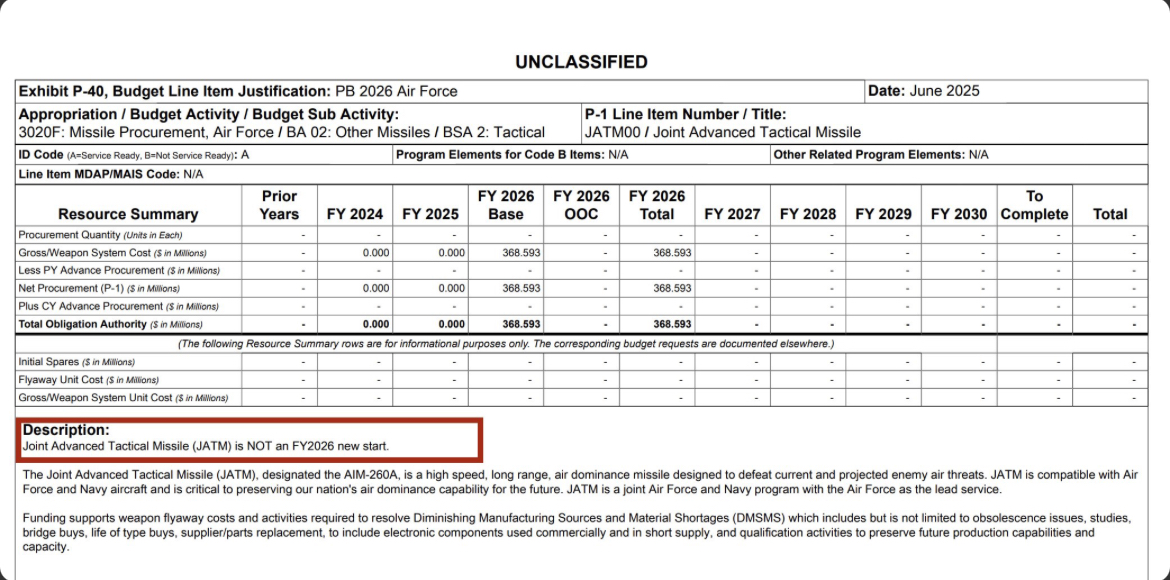
It’s slated to enter service this year according to a recent funding document
It’s been Type Classified, and likely reached EOC, but not yet IOC. Entry to service is normally considered the IOC date.
That’s good to know.
Yea it’s straight up ready to enter service
The ID code is A stating it’s service ready
300~ just for the airforce
1 Like
There is one redeeming thing in what he said there. That the GNSS feature they gave to it will apparently allow it to hit the target as long as the shooter plane can keep radar lock even if the AIM-120D cannot see the target anymore in terminal guidance?
Which isn’t the case for the AIM-120C in game. Once the missile onboard radar activate, guidance from the plane is not taken into account.
If this is true, this will make the AIM-120D really powerful since AESA radars are super hard to notch and you’ll have to notch both the plane radar and the missile.
1 Like
So a fox 1 and fox 3 combined together
Yeah. If they truly make the AIM-120D like that, we might actually be back AMRAAM bros. F-18E will be splendid.
I’m pretty sure it’s easier to notch the MICA than it is notching the AESA radars. And we all know how annoying it already is to defeat the MICAs
That would be good. Hopefully it’s maneuverability won’t be same as 120C
Will be the same, but flight profile is different apparently. It loft more or something? That’s how it achieves higher max range alongside the battery life. So it should hit a target at 20-25km range faster during terminal dive, making it harder to evade.
1 Like
That sounds good. But what will happen if aircraft radar is notched? Does it have 2 seperate guidance system? If its a yes then how does it know that either one of the guidance is actually tracking target
I guess there might be a priority system to which I have no idea about
Has anyone got further info on this GNSS guidance
1 → Plane radar guides missile to target until the radar of the missile turns on.
2 → If the radar of the missile loses target, it asks the plane for updated coordinates until it can reacquire or it hit target.
3 → If the radar of the plane has also lost target, the missile can calculate the expected flight path of the target plane using the last information it has about it and will fly there automatically with search radar on, trying to reacquire.
AIM-120A/B/C do not have step 2. These are deaf to any further instruction from the plane after step 1. That’s also why they’re super easy to evade as long as you change direction. If you were going down, go up and the missile will continue on an empty expected flight path, and so on.
1 Like
This is exactly how IOG+DL works and has been working in game for years. When missile seeker doesn’t see valid targets in area indicated by IOG, it continues to fly with it hoping it will find out. All datalink does is updating target location for IOG, which gets even quicker for AESAs
However, to meet this “missile seeker doesn’t see valid targets” criteria you need notching and low flying target. Notching, so missile needs to turn off Doppler filter to even try to track, while low flying means any released chaff is hidden by ground clutter.
The moment notching target flies high enough for ground clutter to not overwhelm chaff radar return and target flies slow enough to not trigger angle gating, missile will bite into chaff as usual.
Only novelty that could be added there is ability for datalink to reconnect, which… may or may not result in funny, given only missiles with datalink reconnect ability in game are SARH and they WILL change targets when you reconnect datalink on different target.
1 Like
That’s not at all what I talked about.
I think you didn’t understand my post correctly, and/or didn’t watch the video of the dev. For every ARH in the game right now, once the seeker inside the missile activates at about ~10km, the missile stops receiving additional correction from the plane, EVEN if the plane has a solid lock on the target and the missile loses sight of target. The missile is effectively deaf to any further information coming from the plane.
Datalink in WT is only relevant during the time between missile launch and missile seeker activation.
If translation of BVVD is correct, AIM-120D will change that, which mean you have to notch both the missile and the launcher because the two will overlap during the terminal phase. And that’s super strong with AESA.
2 Likes
No. As long as datalink channel remains open, indicated via vertical line over TWS/radar contact will WILL receive IOG updates and act upon them WHEN missile seeker loses track of the target and isn’t decoyed by chaff. Easily verified in test flight with any F-16 with ARH missiles, as F-16 radar still have regular Pulse radar mode to continue track, IOG of the missile will remain glued to the Mig15 even when it notches as it does its circles on the map. In the same scenario, missile without datalink will start drifting off target.
Actually, premium Ja37DI also can work as proof of concept, while switching from solid track to IRST also maintain datalink. Going from TWS to STT will break datalink though.
1 Like
If that was true, maintaining a hard lock all the way on a target wouid make ARH un-notchable except that’s not how it works. You can maintain a hard lock and still have your missile miss. I don’t think you realize how unavoidable missiles would be in-game with AESA everywhere if they worked the way you think they do.
like ffs, I’ve had it happen recently. Hard lock on a plane 15km away, he notched, evaded my AMRAAM. Yet hard lock was never broken. If what you said was true, I should have hit him.
You’re mixing up ARH and SARH. SARH receive datalink information all the way. ARH stops receiving datalink information when their own onboard seeker activate and work only with their own IOG+their own seeker from there.
2 Likes
Then how do you explain this? From 2:00 to 3:00, so one minute
What you’re asking for it missile to compare own seeker with info received from launching aircraft, in event there’s discrepancy, use aircraft info. And that is absent from the game, while BVVD merely recites current datalink implementation.
Missile flying with IOG, even with STT/AESA TWS updates is still not very accurate. It can fly close enough to trigger proxy fuse, but doesn’t mean it will.
2 Likes
Easy. onboard IOG. When the missile loses track of the target, it automatically flies to the expected interception point. The target in the video stayed on course so the missile simply flew to its expected position and locked again.