History
The Cutlass aircraft originated from a US Navy requirement issued on June 1, 1945, for a new carrier-capable day fighter. The Navy sought an aircraft capable of speeds up to 600 mph and operations at altitudes of up to 40,000 feet.
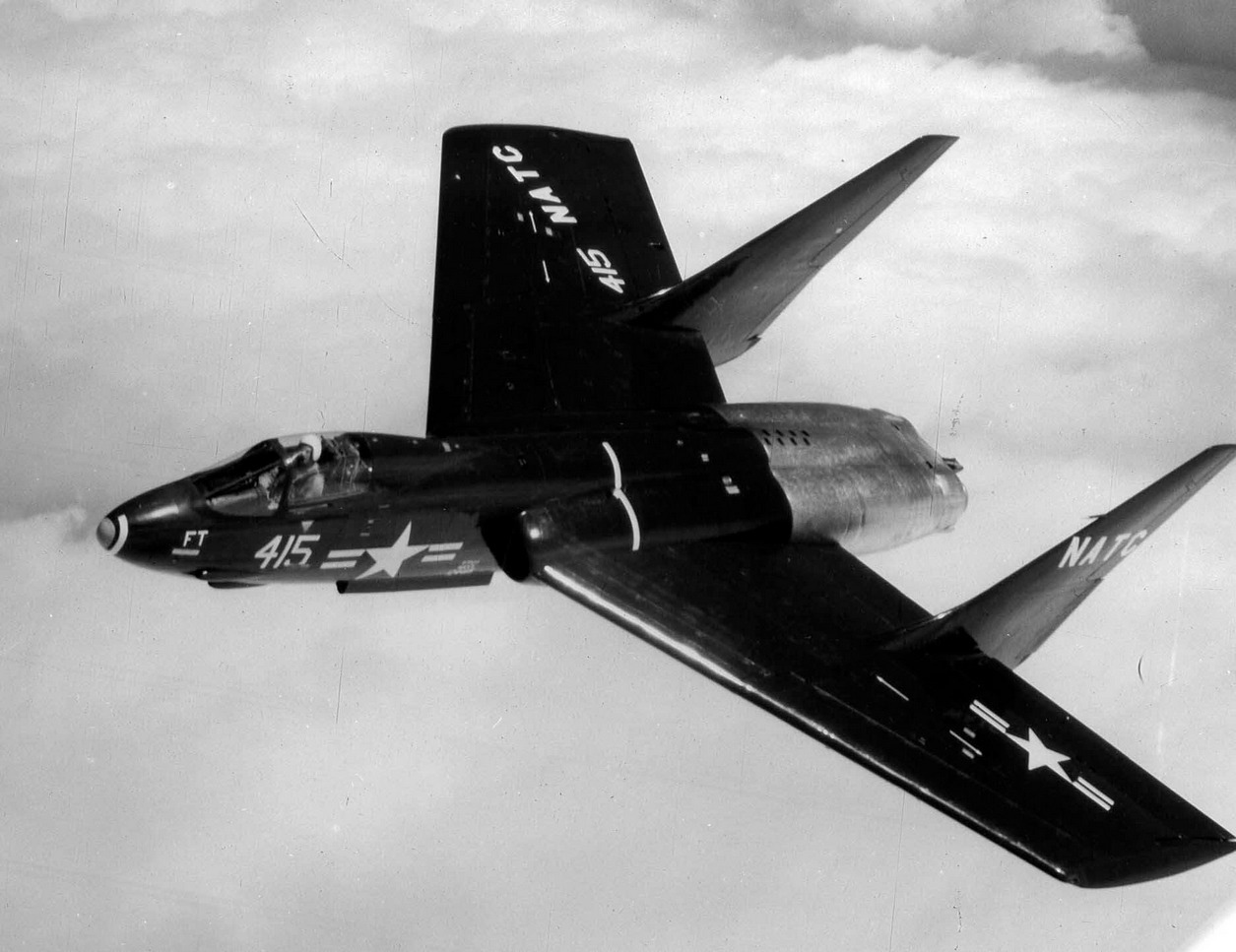
Chance Vought responded with a radical and unconventional design. The aircraft featured a tailless configuration with broad-chord, low-aspect-ratio swept wings and wing-mounted vertical stabilizers on either side of a short fuselage, creating a semi-tailless twin-engine jet fighter. The cockpit was positioned forward to maximize pilot visibility. Designated V-346A by Vought, the aircraft would eventually become the F7U Cutlass. It was also the last aircraft project overseen by Rex Beisel, the designer of the legendary F4U Corsair and numerous other Vought aircraft dating back to 1922.
Sources suggest that the design was influenced by German aerodynamic research and engineers from companies such as Messerschmitt and Arado, although Vought officially denied any direct association.
Bids for the Navy competition were due in April 1946. By the deadline, twelve designs had been submitted by six manufacturers: Vought, McDonnell, North American, Curtiss-Wright, Martin, and Douglas. The Vought V-346A was selected as the winning design on June 25, 1946, and received the designation XF7U-1.
The Navy immediately ordered three XF7U-1 prototypes. These aircraft were powered by two Westinghouse J34 turbojet engines, which would later become one of the program’s greatest weaknesses. The first prototype rolled out in September 1948 and completed its maiden flight in Maryland. Although the aircraft reached a maximum speed of 625 mph, several significant issues were encountered during the flight.
Following the initial flight-testing program, the Navy named the aircraft Cutlass and awarded Vought a production contract for 14 F7U-1 aircraft using the same powerplant. During the subsequent two years of testing, all three XF7U-1 prototypes would be lost in accidents.
The first production F7U-1 was completed on March 1, 1950, and deliveries began in June of that year. These aircraft were primarily intended for carrier suitability testing. Testing concluded in August 1951, but none of the fourteen F7U-1s built between 1950 and 1952 were accepted for operational service. The Navy was dissatisfied with the aircraft’s underpowered J34 engines, poor cockpit visibility, and overall performance.
As a result, F7U-1 production was terminated, and the Navy sought an improved version of the aircraft. On September 23, 1949, Vought received a contract for 88 F7U-2 Cutlasses, though this program was later canceled because of continuing engine-development problems. After seriously considering terminating the entire Cutlass program in 1951, the Navy instead chose to fund development of the F7U-3. The lack of suitable alternatives and the introduction of more powerful steam catapults aboard aircraft carriers were the reasons the Cutlass program was to be continued.
Although the F7U-1 never entered operational fleet service, the aircraft remained useful as a training platform. All surviving F7U-1s were employed as trainers while the improved F7U-3 entered frontline service.
During the summer of 1951, Vought persuaded the Blue Angels to evaluate and demonstrate the F7U-1 as part of a promotional effort for the Navy’s newest fighter. Two F7U-1 airframes were assigned to the team for solo demonstration duties during the 1952–1953 airshow season, while the remainder of the squadron continued flying the F9F Panther.
The arrangement proved short-lived. Only six airshows featured the F7U-1 before persistent maintenance issues forced its withdrawal. Pilots and ground crews found the aircraft generally unsatisfactory. Problems were reported, including landing gear failures, hydraulic-system malfunctions, and even in-flight engine fires.
Following its final Blue Angels demonstration at NAS Memphis in Millington, Tennessee, the F7U-1 was withdrawn from flight duties and relegated to use as a maintenance training airframe.