History
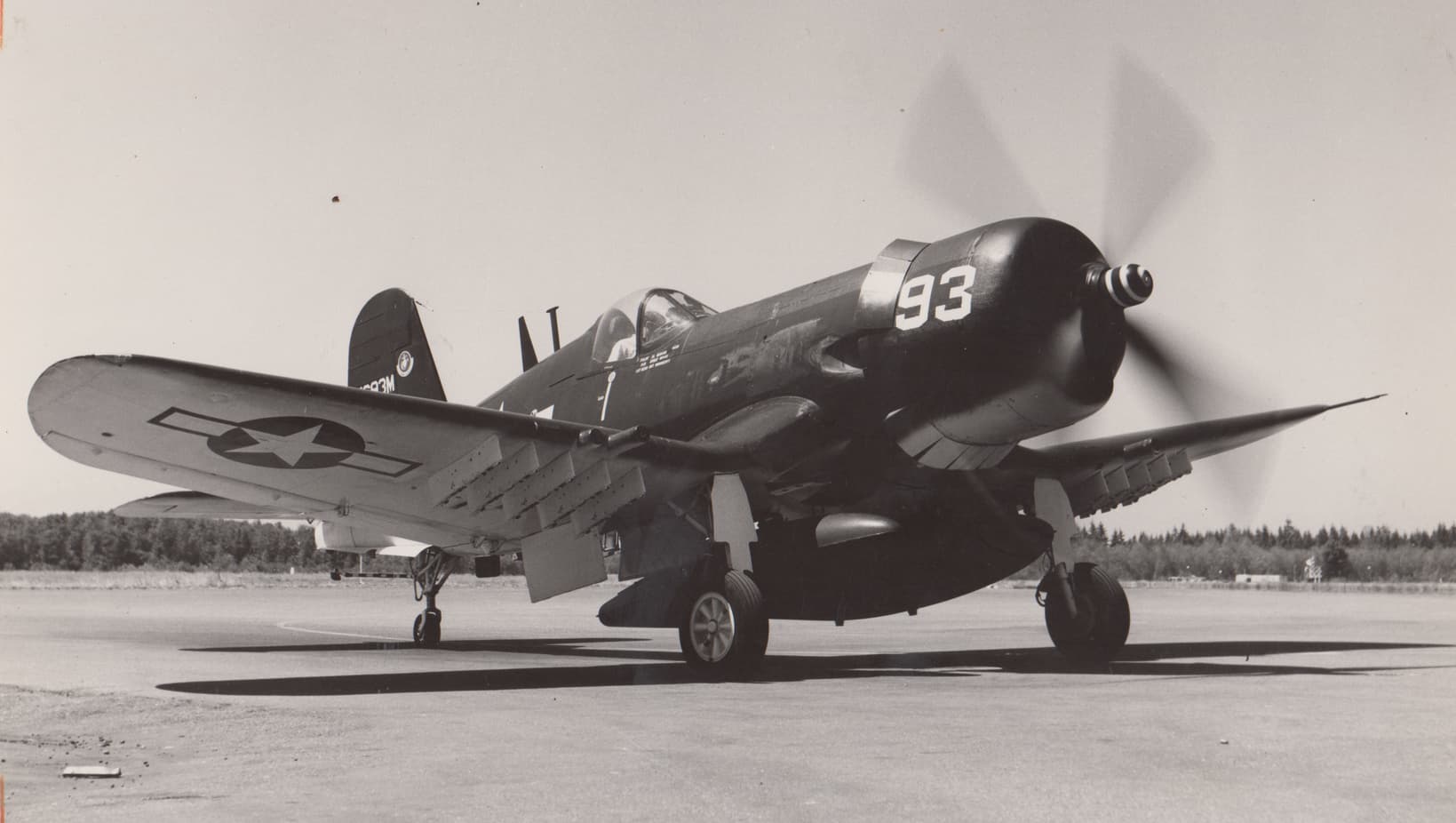
The F4U-7 was the final Corsair variant to be produced, exclusively for France. This variant was essentially the result of an F4U-5 fuselage mated to an overhauled F4U-4 two-speed, two-stage Pratt & Whitney R-2800-18W engine. It shared the armament of the AU-1, as the F4U-7 was given five pylons under each outer wing section. It retained two pylons under the center wing section and a centerline station as well.
Ninety-four F4U-7s were manufactured at Vought’s Dallas (Grand Prairie) factory, and the first of these made its maiden flight on July 2, 1952. It was built specifically for a foreign customer with a specific mission in mind. The customer was the French Navy, and the mission was Indochina, where France had been fighting insurgents and Communist rebels in its Asian protectorate since 1946.
French naval aviators transitioned to F4U-7s at NAS Oceana, Virginia, in October 1952. Deliveries of the 94 aircraft through the Military Assistance Program were concluded by the end of January the following year. During their operational service, the French F4U-7s flew from land bases and the aircraft carriers Lafayette, Arromanches, and Bois Belleau. They participated in conflicts in Indochina, the Suez Canal, and Algeria. The final French F4U-7 Corsairs served with Flotille 14F and were phased out in late 1964, being replaced by the French-operated Vought F-8 Crusader.
A small number of F4U-7s were returned to the US through either private or government acquisitions, and this is where the very special F4U-7 with BuNo. 133693 came through rare circumstances.
According to sources, the F4U-7 with BuNo. 133693, along with some other F4U-7s, returned to the US Navy at NAS Norfolk, Virginia, in 1964 for the time being. They were to receive maintenance, which was completed by 1967. For reference, all F4U-7s carried US Navy Bureau numbers 133652 through 133731 and 133819 through 133832, so the F4U-7 with BuNo. 133693 was the 42nd of 94 F4U-7s produced at Vought’s plant in Texas. This aircraft had previously participated in conflicts in Indochina and the Suez Canal, and possibly in Algeria as well.
Lynn Garrison, the representative and owner of The Air Museum of Canada in Calgary, Alberta, purchased the F4U-7 with BuNo. 133693 in the summer of 1967. With authorization from the US Navy, Lynn was permitted to fly the F4U-7 in US markings alongside US Navy jet fighters, such as the F-8 Crusader, at US Navy Naval Air Stations, likely for air shows and perhaps ceremonial events.
Garrison moved to California, where he founded the American Aerospace and Military Museum in Pomona, California, and the F4U-7 remained under the new entity from 1968 to January 1, 1970. It was again sold to a private owner, Bob Guilford, who named the F4U-7 Blue Max and raced the fighter for the next 17 years.
In 1976, Blue Max’s bold markings were covered in an overall dark blue scheme in preparation for her role in Black Sheep, with Steve Rosenberg at the controls. On August 19, having flown just three sorties for the cameras, Blue Max suffered a catastrophic engine failure that ended her Black Sheep career.
On May 10, 1987, Marshall Moss took a well-deserving female air show volunteer for a ride in Blue Max near San Diego, California. While performing low-level aerobatics, the Corsair crashed in an inverted attitude, tragically killing Moss and his passenger, ending this F4U-7’s career for good.