History
Long before the first F4U-1 made its maiden flight, in November 1941, the US Navy had expressed an interest in a night fighter version of the Corsair. This variant would be fitted with a radar used for aerial intercepts at night to counter the possibility of an increased nighttime threat from reconnaissance and attack by enemy aircraft.
The first production F4U-1, BuNo. 02153, was modified to become the XF4U-2 prototype after making its initial flight.
The Bureau of Aeronautics suggested that fifty Corsairs be pulled from the Vought production line, but once the US entered the war against Japan, the production of conventional fighters was so critical that the Navy did not want to disrupt an assembly line exclusively for night fighters. Therefore, only thirty-two Corsairs were sent to NAF for conversion, all of which were Vought-produced Birdcage F4U-1s.
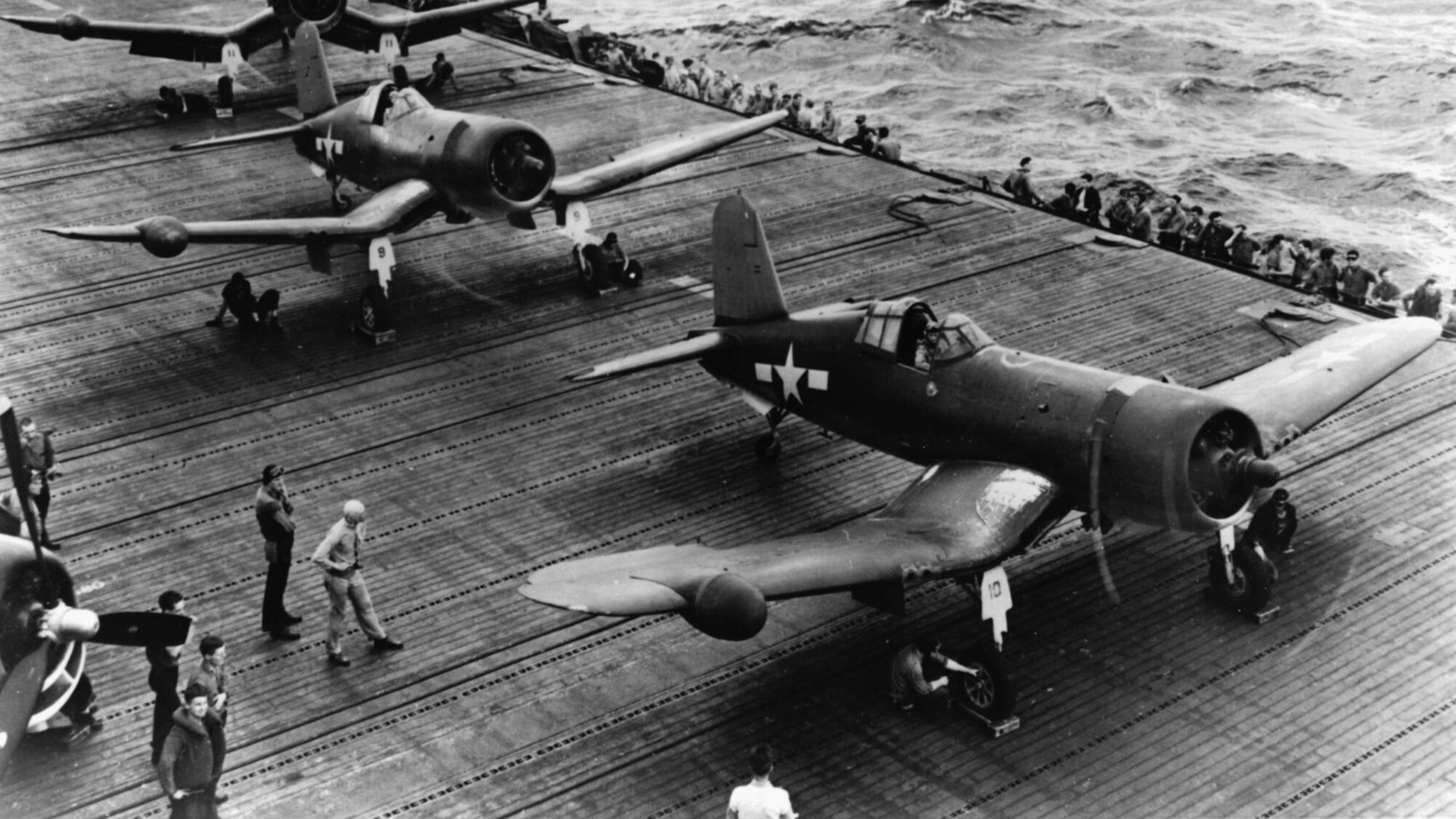
NAF fitted an air-intercept radar radome on the starboard wing and deleted the outboard .50 caliber gun installation to help balance the weight of the radome and its contents. Inside the radome, it housed a hand-built radar set designated AIA: Airborne Intercept (Model) A. Furthermore, the remaining five .50 caliber guns’ ammunition load was reduced to 250 rounds each to keep the weight of the night-fighter equipment balanced.
NAS Quonset Point, Rhode Island, made the final changes to the radar and associated equipment. Cockpit changes included the addition of a small radar scope mounted in the middle of the instrument panel. Lighting was modified for night flying, and a radio altimeter system and radar beacon transponder were installed. Armor plating was added for the radio compartment, and a small generator air scoop was installed on the starboard side of the fuselage forward of the cockpit.
An additional two Corsairs were later modified in the field by VMF(N)-532, bringing the total number of F4U-2s to thirty-four. All of the F4U-2s had their exhaust stubs modified by elongating them to minimize the exhaust flame and preserve the pilot’s night vision.
Night Fighting Squadron 75 (VF(N)-75) was established on April 1, 1943, at NAS Quonset Point, becoming the first night-fighter squadron in Navy service. The unit received six F4U-2s in June 1943 and began their training. The unit departed for the Pacific and flew its first night patrol mission on October 2, 1943, after arriving at Espiritu Santo in the New Hebrides on September 11, 1943, with just six F4U-2s ready for operational night-fighting missions.
The unit made history on October 31-November 1, 1943, when an F4U-2 spotted a Betty bomber by its exhaust flames and made its first successful radar-guided interception, shooting the Betty down over New Georgia Island. VF(N)-75 was credited with a total of seven night victories while flying F4U-2s in World War II.
Two other squadrons also flew the F4U-2 aircraft: VMF(N)-532 and VF(N)-101. The VMF(N)-532 Corsairs began their successful night-fighter patrols around Bougainville, and on November 13, 1943, they made the first successful enemy aircraft interception by a Marine Corsair night fighter. After the capture of Roi Island in the Marshalls in early 1944, 14 F4U-2s of VMF(N)-532 arrived from Tarawa to help defend against night intruders. Some F4U-2s went to Engebi Island on Eniwetok as a defense force. Not only did VMF(N)-532 use their F4U-2s for night intercepts of Japanese aircraft, but they also made night bombing and strafing attacks against enemy ground targets. On June 30, 1944, these Marine F4U-2s began using their radar in mapping mode for night-bombing missions, with the first target being Wotje Atoll. They would pick out a surface feature on the radar scope and then head for the target to strafe.
On January 9, 1944, four F4U-2 night-fighter Corsairs of VF(N)-101 went aboard the USS Enterprise (CV-6) to become the first F4Us assigned to a carrier for operational deployment. At the same time, another small detachment of F4U-2s joined the USS Intrepid (CV-11) during the first Truk strike in February 1944. The F4U-2 was made nearly as safe for carrier landings as the F6F. VF(N)-101 scored a total of at least five kills without losses before leaving these carriers in July 1944.
F4U-2s served the Navy and Marines with exceptional service until late 1944, with the last F4U-2s phased out in January 1945, when they were replaced with F6F-3N and F6F-5N night fighters equipped with the more capable AN/APS-4 and AN/APS-6 radars, respectively. These F4U-2s pioneered night-fighter tactics, and the lessons learned were carried on during the Battle of Okinawa, when Marine F6F Hellcats destroyed 68 Japanese aircraft during night patrols. The F4U-2 also paved the way for the successful F4U-5N and F4U-5NL Corsair night-fighter versions in the Korean War.