This is a work in progress that will be submitted once completed
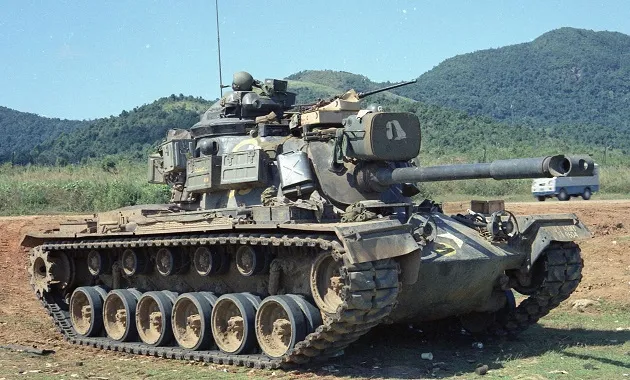
TLDR: An upgraded M48 that has a better engine, less explosive fuel, and an additional .50 on a pintle mount, the AN/VSS-1 Xenon spotlight, (potentially) external equipment/stored items that can offer a very slight amount of extra protection, and Night vision for the gunner and driver.
History
The M48 Patton was developed in the early 1950s to replace the M47 and address the growing threat of Soviet armor during the Cold War. It featured a new hemispherical cast turret and a redesigned hull that improved ballistic protection over earlier designs. When it entered service in 1952, it was the first American medium tank to centralize the driver’s position and eliminate the hull machine gunner, reducing the crew to four men. Early versions, such as the M48 and M48A1, were hindered by technical problems, including a very short operational range and a complex stereoscopic rangefinder that was difficult for crews to operate effectively under pressure.
During the mid-1950s, the M48A2 was introduced to solve the range issues by using a fuel-injected gasoline engine and larger fuel tanks. However, these gasoline-powered models remained highly flammable and dangerous if the hull was pierced. To fix this, the military developed the M48A3 conversion in the 1960s. Instead of building brand new tanks, older M48A1 and A2 models were rebuilt with the AVDS-1790-2A diesel engine. This upgrade significantly increased the tank’s range and safety, making it the primary version used by American forces when they deployed to Vietnam.
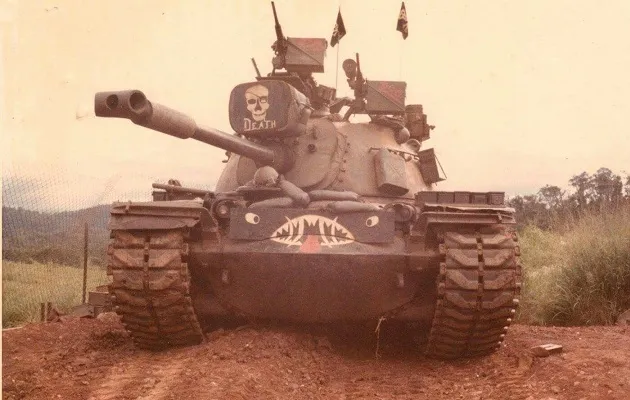
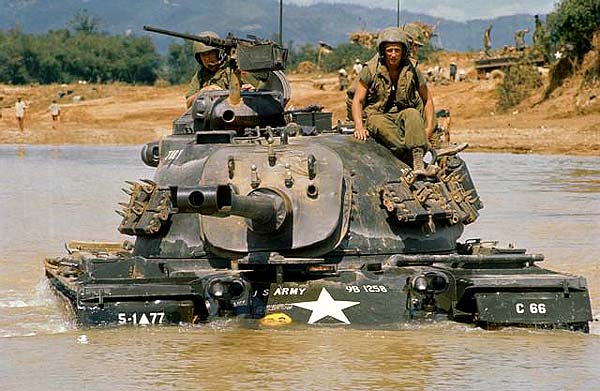
American M48A3s arrived in Vietnam in 1965 with the U.S. Marine Corps and were later joined by Army armored units. In the dense jungles and rice paddies, the tank took on a role far different from the tank battles envisioned for Europe. It became a “jungle buster,” using its 52-ton weight to plow paths through thick vegetation for infantry units. The M48 was also highly valued for its ability to survive landmines that would destroy lighter vehicles and for its 90mm gun, which was devastating against enemy bunkers and sniper positions during convoy escort missions.
As the United States began withdrawing troops under the “Vietnamization” policy, many M48A3s were turned over to the Army of the Republic of Vietnam (ARVN). The ARVN tankers, who had previously used the much lighter M41 Walker Bulldog, found the Patton to be a significant upgrade in terms of protection and firepower. During the 1972 Easter Offensive, ARVN M48 crews proved their skill by engaging and destroying North Vietnamese T-54 tanks at long ranges. Despite their successes in individual battles, many of these tanks were eventually lost or captured during the final North Vietnamese push in 1975.
By the end of its frontline service in the Vietnam War, the M48 had bridged the gap between the post-WWII era and the modern main battle tank. It proved that heavy armor still had a place in unconventional warfare and served as the technological foundation for the M60 series that followed. The transition from the M48 to the M48A3 represented a critical evolution in tank design, prioritizing crew survivability and operational endurance through the shift to diesel power.
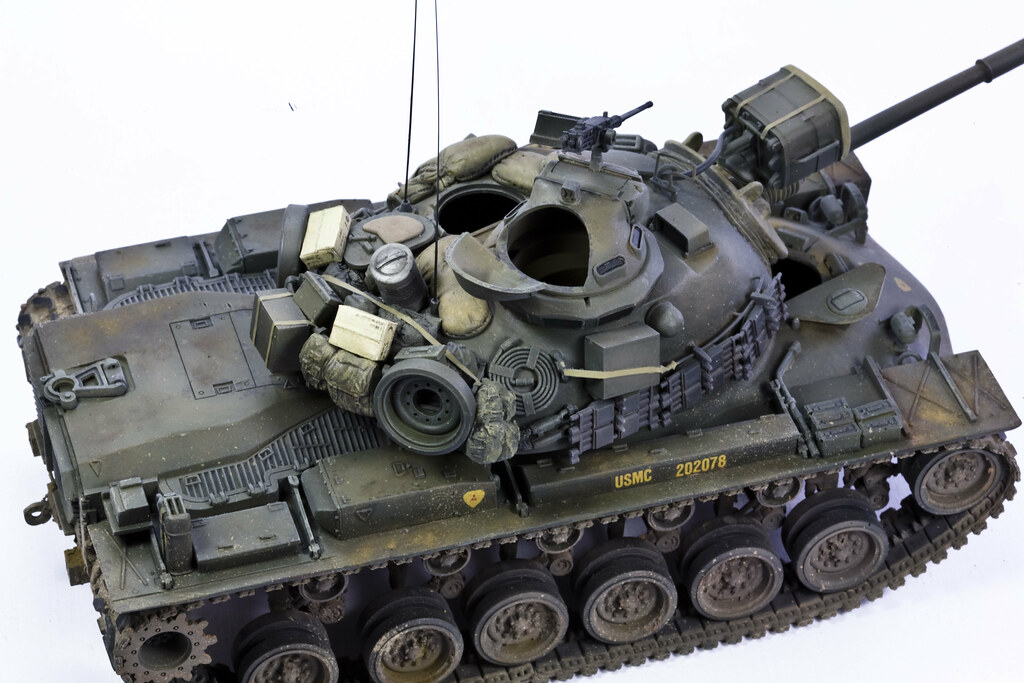
In the field, U.S. crews frequently modified their M48s to better suit the specific threats of the Vietnam environment. Because the Viet Cong and NVA used RPGs extensively, crews often piled sandbags onto the turret and front hull to act as a form of improvised armor. While the ballistic benefits were sometimes debated by engineers, the extra weight was seen as a necessary trade-off for the peace of mind it gave the crew. Furthermore, many units welded extra steel plates to the underside of the tank to protect the driver and ammunition from the powerful pressure-plate mines often buried in the roads.
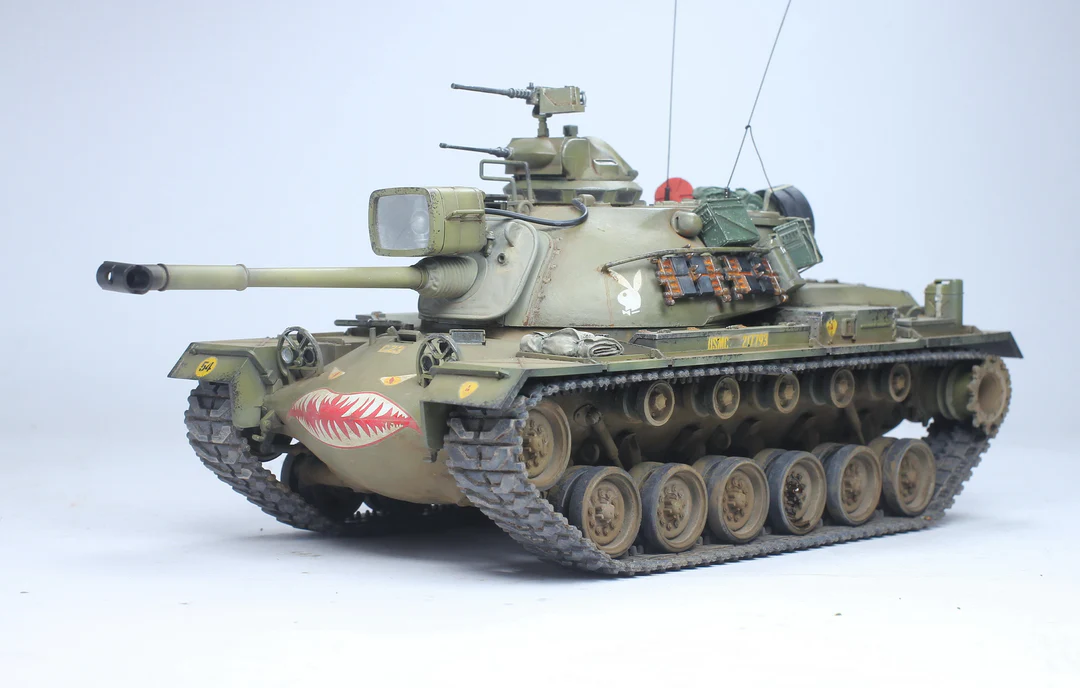
Crews also focused on improving the tank’s visibility and secondary firepower. The standard M1 commander’s cupola was notoriously cramped and difficult to see out of when the hatch was closed, so many commanders chose to mount their .50 caliber machine gun on a pedestal on top of the cupola rather than inside it. This gave them a 360-degree field of fire and better visibility, even though it left them more exposed to small arms fire. Additionally, the crew occasionally mounted an M60 machine gun on the tank.
Additionally, the installation of a large Xenon searchlight above the main gun became standard, allowing crews to illuminate the battlefield at night with either white light or infrared, which was essential for defending perimeters against night attacks.
Vietnam war upgrades
As the war in Vietnam went on, the M48A3 was updated with several practical improvements to help it survive the jungle. One of the most important changes was adding a raised ring with small windows underneath the commander’s hatch. Before this, commanders often had to pop their heads out of the hatch to see what was around them, which made them easy targets for snipers. With the new ring, they could see in every direction while staying protected inside the armor. Engineers also strengthened the metal guards over the headlights and the engine covers so they wouldn’t get crushed or overheated when the tank was plowing through thick trees and heavy bamboo.
Inside the tank, the controls were simplified to make it easier to drive through narrow, muddy trails. The older steering wheels were replaced with a more responsive steering bar that gave drivers better control in tight spaces. To cope with the intense heat and dust of the Vietnamese highlands, the engine’s air filters were redesigned to prevent fine red dust from clogging the motor and causing it to stall. They also made a massive searchlight a standard feature on top of the main gun. This light could shine a regular beam or an invisible infrared light, allowing the crew to spot enemy movements in total darkness and defend their positions more effectively against night attacks.
Stats
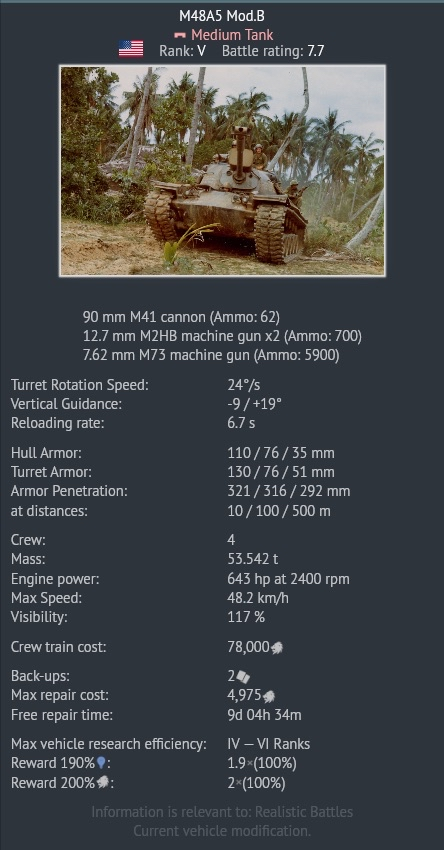
Thanks to @Ayrek2023 for helping with the stat card!
stats are shown in their best crew configuration without any additional armor
Crew: 4
ammo count: 62 (16 round ready rack)
Engine HP: 643hp at 2400rpm
Max speed: 30mph (48.2kph)
weight: 107,000lbs (53.542 tons)
Power-to-weight (Hp/ton): 14.02
Traverse: horizontal: 24 dps, vertical: 4 dps
vertical limits +19/-9
hull armor: 110/76/35
turret armor: 130/76/51
max pen:
M82(APCBC): 185mm
M332(APCR): 321mm
M431(HEATFS-T): 320
Main gun: 90mm M41
Secondary:
.50 M2HBx2 (cupola and externally mounted) ammo: 700 (600 regular+100 externally stored loadin in the pintle-mounted M2HB)
.30 M73 x1 (Coax) ammo: 5900

Extras
I’m thinking about also suggesting some special voice lines for this and it’s premium brother but haven’t fully decided yet. Here’s some examples:
We got VC all around us!
Where’d that Charlie go?
Swat that Charlie down!
Sources
Patton Tanks in Vietnam – Mike's Research
Arsenal | Patton M-48A3
90mm Gun Tank M48 Patton 48
- yes
- no