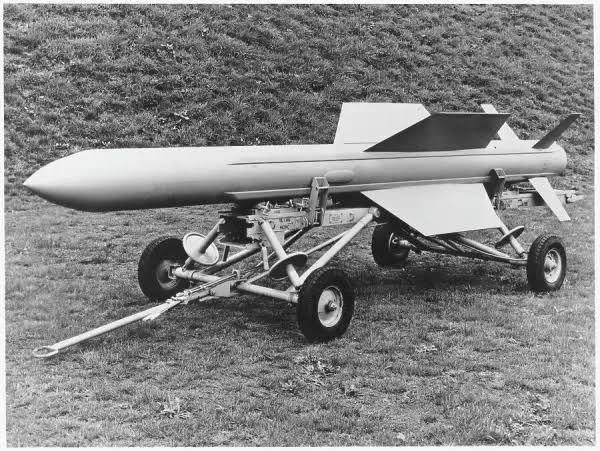
Vickers Red Dean WTV.4
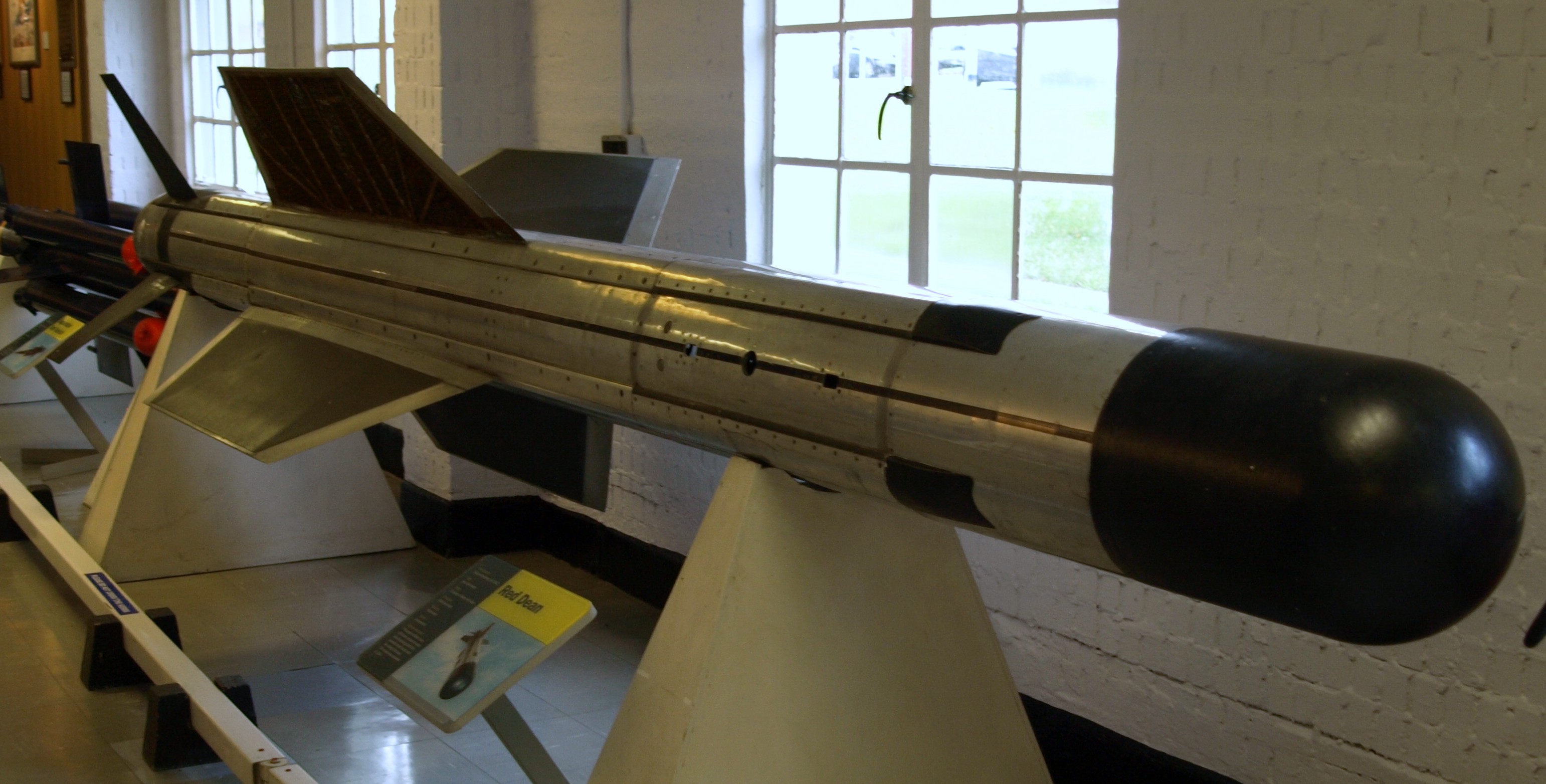
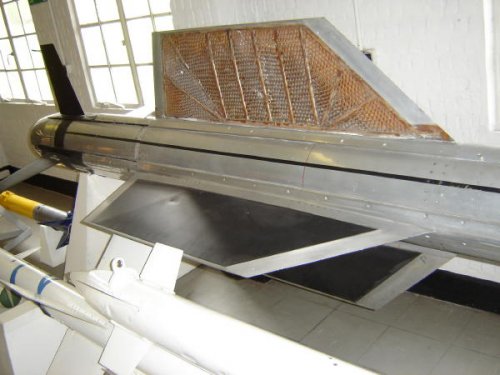
Red Dean WTV.4 on display at RAF Midlands, Shropshire
- Yes
- No
Overview
The Vickers Red Dean was a British missile from the 1950s meant for the task of shooting down enemy bomber aircraft. Notably it was one of the earliest missiles to use active radar homing guidance, though this technology would greatly weigh down the missile and limit how small it could be. Eventually it was cancelled in 1956.
None of this was written with AI.
History
The missile that came to be known as the Red Dean was born out of a request from the Royal Aircraft Establishment that asked for an active radar homing missile with a large warhead, for the purpose of countering the Soviet Tu-4. Early proposals included a ramjet, but the conditions for it to be effective were too tedious to attain.
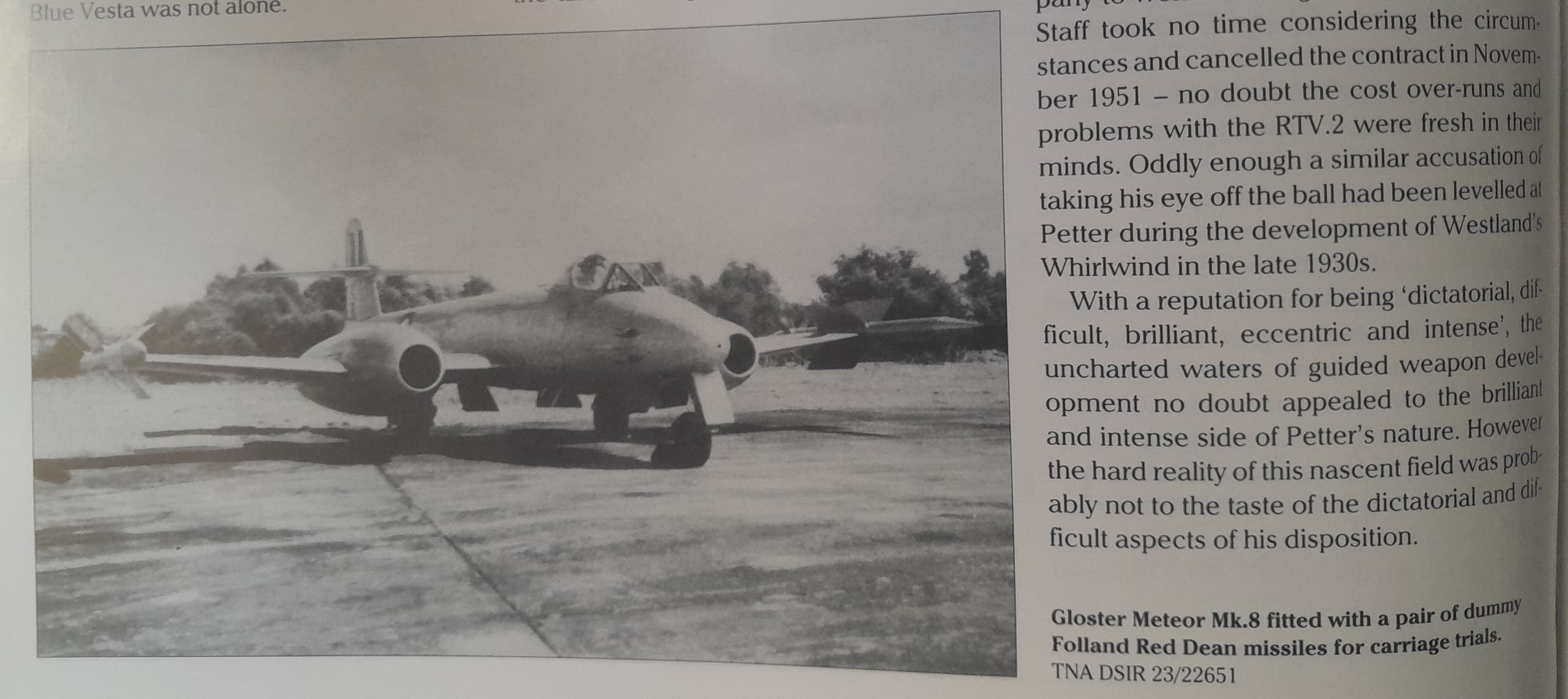
Initially the contract was won by Folland, who had managed to procure a test vehicle and dummy missiles. However, the missile quickly gained weight in evolving designs, and designer “Teddy” Petter - who would have much preferred to work on his lightweight fighter project, the Folland Midge (later Gnat) - lost interest, writing to the Royal Aircraft Establishment that Folland wasn’t suitable for such a large project. Folland dropped the project in November of 1951.
Vickers took over and the development contract was passed onto them in 1953, although they started their research in 1952. In 1955, the official requirement was made, Operational Requirement 1105, which described an “active radar homing all-round attack weapon system operating on collision course tactics.” Their initial iteration of Red Dean weighed in at 272 kg and powered by a Buzzard rocket motor rated for 6,750 lb. By the end of the project’s lifespan, this missile had evolved significantly.
Initial tests were delayed because the X-band radar for the Red Dean, being developed by General Electric Company, ran into several roadblocks due to the complexity of the machine. Eventually, guidance tests began with the WTV.1, which was scaled down by 40% and launched from the ground using three Demon motors. WTV.2 was full scale and also ground-launched - by now the missile was significantly larger at 4.9 meters long and it weighed a hefty 603 kilograms. This massive increase in size warranted the replacement of the Buzzard motor for the Falcon, rated at 14,000 lb. Unfortunately, the new motor did little to improve the range, which was a measly 7.4 km.
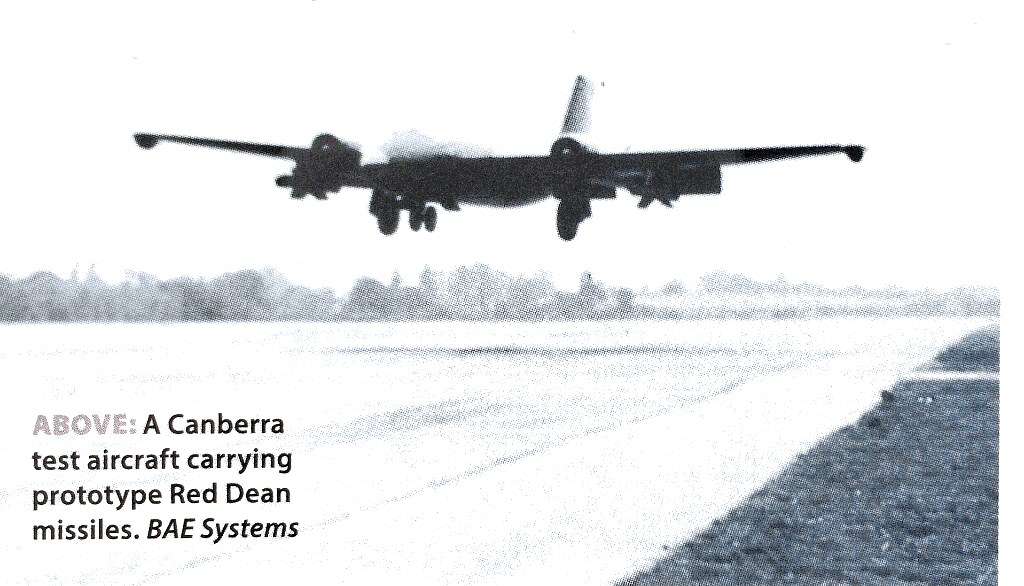
The first Red Dean tests began with simple carriage and jettison tests from Canberra B.2s. The first airborne tests of the Red Dean - now at WTV.4 - were also carried out by Canberra B.2s, WD956 and WD942, which were fitted with AI.18 air interception radars. Two variants of WTV.4 were tested, these being the 4C with GEC’s seeker and the 4E with the proximity fuse. The second live fire test did not go smoothly, as the missile initially failed to detach from the wing after the motor activated due to an incorrectly oriented shear pin. Thankfully, the aircraft was able to recover.
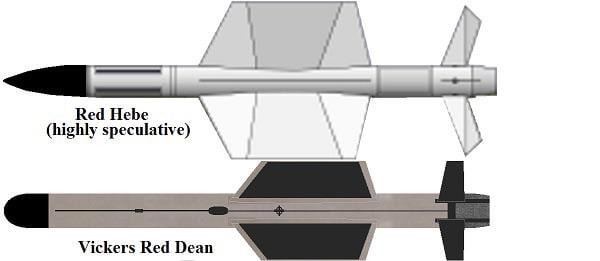
By late 1955 the issues with the WTV.4’s weight were compounding and Vickers attempted to remedy this by replacing the ARH seeker with a SARH. This became what would have been WTV.5, which was much lighter due to not needing such bulky equipment in the missile, at a weight of 181 kg. The design was very much alike the proposed Red Hebe, however, much alike Red Hebe, it seems no physical example was produced.
It was eventually decided that the Red Dean wouldn’t be fit for service, as the materials that made it meant the machine wasn’t effective at supersonic speeds, which clashed with the need for a missile compatible with upcoming supersonic aircraft like the Hawker P. 1103. This resulted in its cancellation in June 1956. Consideration for Red Hebe was present but was axed due to the changes brought around by the 1957 Defense White Paper, never progressing past paper designs.
Stats
Red Dean WTV.4
Mass: 603kg
Length - 4.90m
Warhead - 45kg
Over-G - unknown, estimated 8 GsEngine - Falcon (14,000lb / 62Kn)
Burn time - 2s
Range - 7.4 km
Max speed - Mach 2.2Guidance system - X-band ARH seeker
Design overview
The Red Dean had a rounded warhead, and the wings were mounted in the middle of the missile with fins at the back. Notably, the motor was also placed in the middle to improve center-of-mass. The wings were a cropped delta shape, then referred to as “mach tips”. In flight, shortly after the motor burnt out, movement of the fins was limited to maintain as much speed as possible.
Potential carriers
The way I see it, there are two or three options, two of which involving a Canberra.
Option one:
The Red Dean is added to the ingame Canberra B.2, via a modification that installs an AI.18 radar onboard, weighing the aircraft down to allow for the missiles.Option two:
A separate Canberra B.2 variant is added, perhaps the WD956 mentioned prior, as a premium or event vehicle, and does not carry any bombs, making the Red Dean its primary armament.Option three:
The missile is added to the arsenal of the Sea Vixen FAW. 2, as it already has the AI.18 radar set, as well as a more agile platform which the Red Dean could benefit from.
- On the ingame Canberra B.2, as a modification adding the AI.18 radar set
- On a separate Canberra B.2 as an event or premium vehicle
- On the Sea Vixen FAW. 2
Why I think it should be implemented
I believe the Red Dean will offer a unique gameplay experience for those who are fans of early missile combat. It also feels especially relevant in its role as a bomber-killer, due to the recently buffed bomber damage models making planes like the Tu-4 (which it was intended to shoot down!) a nuisance at best to eliminate. Red Dean is also a notable addition in that it’d be the earliest Fox-3 in the game.
Sources
https://www.secretprojects.co.uk/threads/vickers-red-dean-red-hebe.3789/
British Secret Projects: Hypersonic, Ramjets & Missiles (2007) - Tony Buttler & Chris Gibson
Pictures
WD956 carrying the Red Dean missiles.
Red Dean compared with the proposed Red Hebe.
The fins of the Red Dean were made in a honeycomb-style construction which hurt its supersonic performance.
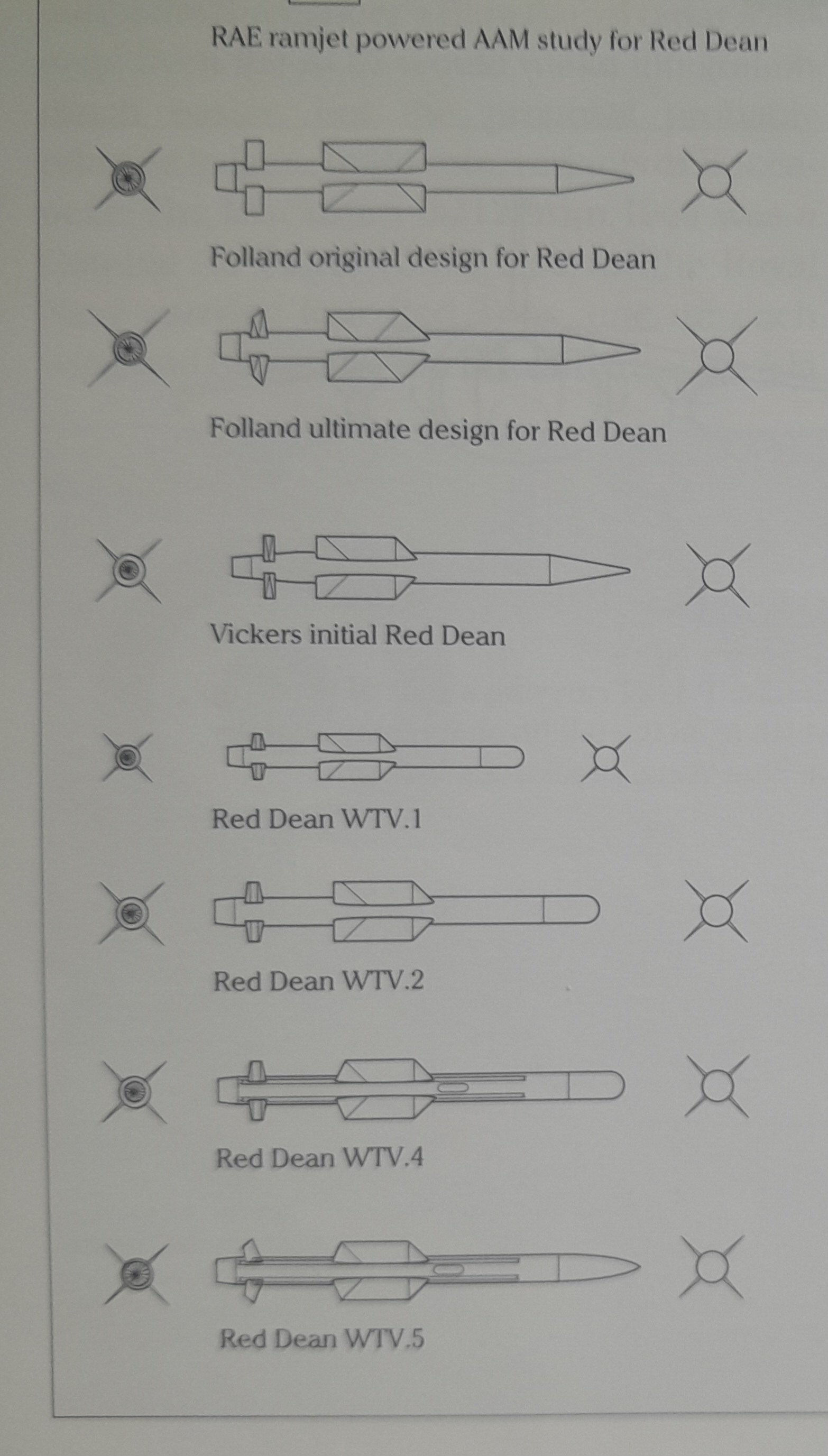
A chart of Red Dean variants and relatives.
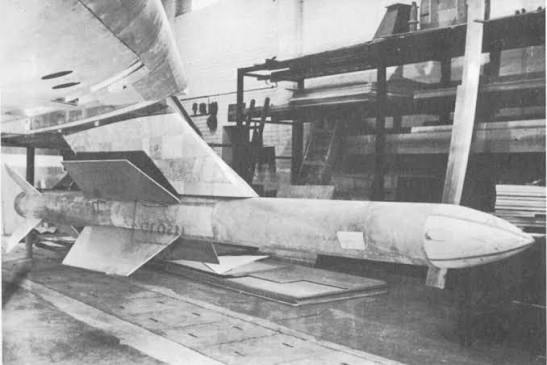
The Red Dean pre-prototype from Vickers.
Dummy Folland Red Deans fitted on the wingtips of a Meteor F.8.
Red Dean on the wing of a Canberra.