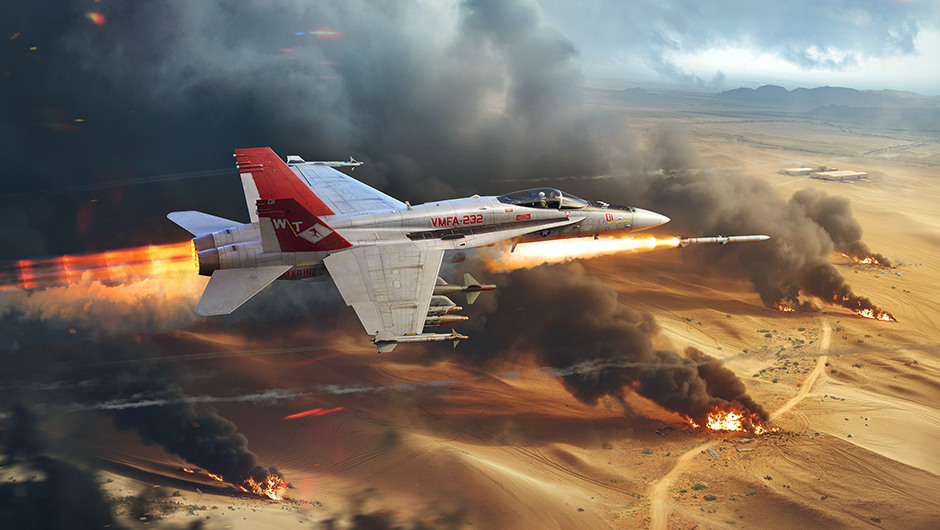
A direct hit on an aircraft’s fuel tank by the high-explosive warhead of an air-to-air missile (or equivalent munition) will now always cause the fuel tank to detonate.
F/A-18 (all variants) — a bug that caused CCRP to not display on the HUD in the cockpit if the POI was outside of the HUD view area has been fixed.
Locations and Missions
Eastern Europe, Maginot Line — a bug that caused the minimaps to be semi-transparent has been fixed.
Patch notes reflect only key changes, meaning they may not include a complete list of all improvements made. Additionally, War Thunder is constantly being updated and some changes may not require an update. Changes reflected in patch notes are formed by taking reactions and requests of the community from thebug reporting service, forums and other official platforms into account. Bug fixes and changes are implemented in order of importance, for example a game-breaking bug will be worked on and implemented sooner.
On the C-130, the fuel tanks are filled with fire-retardant foam that really works, at least to prevent fuel tank explosions. During the Falklands War, an Argentine C-130 was hit by an AIM-9L Sidewinder fired by a British Sea Harrier causing a fire between #3 and #4 engines. The plane did not go down. Sea Harrier made at least two 30mm gun passes. The plane did not go down. Almost out of ammo (1st Sidewinder fell short, apparently locked on outside of range), the Sea Harrier flew around for a beak to beak gun run on the cockpit. NOW, the C-130 went down, no explosion in the wing.
During the 1983 Grenada assault, many of the USAF C-130’s took battle damage from Cuban AAA, mostly resulting in through and through hits. We didn’t lose a single airplane and I never heard of ANY wing fires.
The McDonnell Douglas/Boeing C-17 pumps its fuel tanks full of NEA (Nitrogen Enriched Air) continuously so there is no vapor space to enable a fuel explosion. While few C-17’s have suffered notable battle damage, none has resulted in a fuel tank fire or explosion. Despite determined efforts by our enemies, the greatest risk to the C-17 has always been and remains other friendly aircraft. One close call was so close, the only way both crews knew about it (both aircraft were blacked out at night) was they each saw the interior cockpit lighting of the other’s instruments.
I do not know the specifics of many fighter aircraft but I find it hard to believe we only took those necessary combat precautions with aircraft designed to, as much as possible, avoid hostile fire. At the very minimum, I would expect bombers to have defenses built in to prevent fuel explosions.
The biggest weakness in any of these aircraft is the hydraulic reservoirs (and that only if at least a large portion of hydraulic fluid is first vaporized) and the LOX (Liquid OXygen) bottle. A direct hit to the LOX bottle and the plane is gone. Due to the proximity of the bottle to the crew (the plane doesn’t need LOX but the crew does), that usually means the crew is also gone. Hydraulic fluid can and will burn and the only way to stop it is shutting off the applicable pumps (or all) and letting it burn itself out. If the hydraulic reservoir is hit, there is no way to shut off the supply and aircraft survival is unlikely.
That’s not how that works. Diesel doesn’t just explode on impact. Well, clearly Gajin thinks it does despite it literally being used as armor in tanks.
I think it’s only fair to address a known exception to this foam working to suppress explosions and that is electricity. Many years back, a C-130 was flying low level and hit a power line stretched across a valley. The airplane was dragging 7 miles of cable. With that much assymetric drag, the airplane was going down but it remained under control. However, the cable was cutting into the wing and apparently made contact with live wires, introducing electricity into the wing fuel tank, boom, wing-off light. No one survived although a controlled crash seemed possible until it lost that one wing low to the ground.