Although it’s from Wikipedia it makes sense.
Former Leopard 2 commander told me that some Leopard 2A5 still had the original fire control system but since that one isn’t in production anymore, instead of repairing it, it gets replaced by the most modern Attica FCS.
It would be nice to have Type 90 represent the initial version in 1990’s whilst Type 90B would represent a Type 90 from 2010’s with newer refitted modern thermal sights
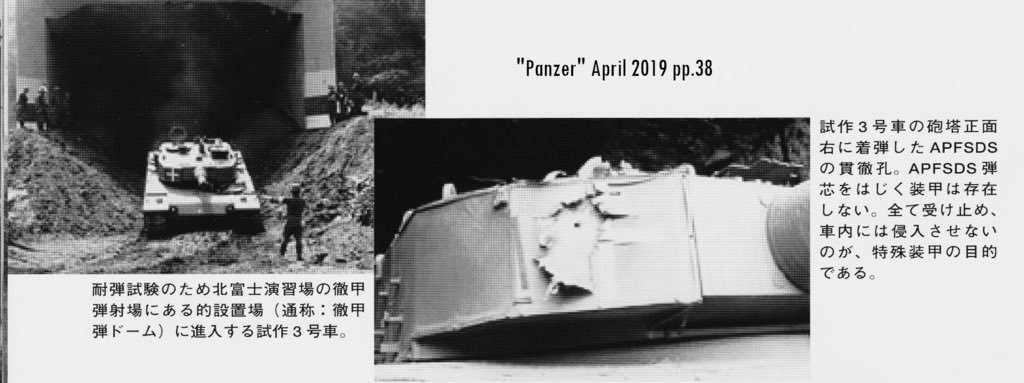
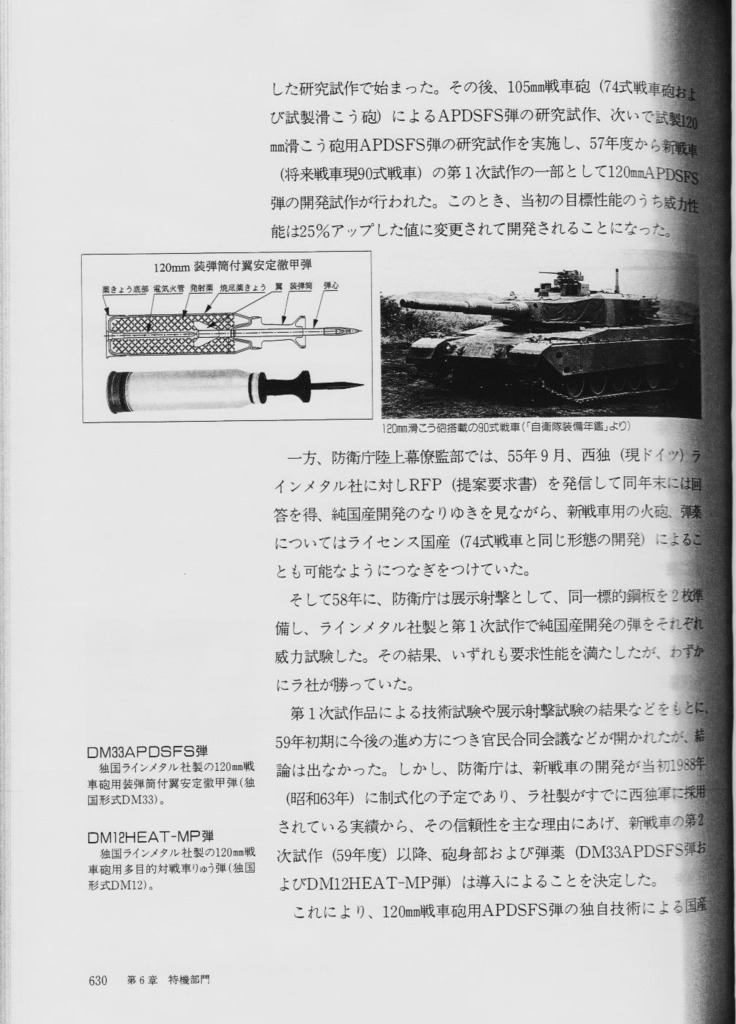
Prototype #3 (99-0043) was released to the press on August 28, 1987, so it is quite possible that DM33 was used since the bulletproof test was probably conducted after this.
I have heard that the tank’s protective capability is designed for performance redundancy and includes future firearms and ammunition.
Extremely doubtful
For 670mm LOS composite to stop 120mm DM33 at 250m [1634m/s)
(510mm tungsten rod weighing 4.3kg)
You’d need 479mm KE protection vs apfsds
Let’s just say that… even Leopard 2A5’s C-Tech with 750mm LOS of composite didn’t achieve that, never mind with 670mm LOS on Type 90 turret.
I highly doubt Germany started throwing around their brand new best round as soon as it was introduced in 1987 to everyone else. When the DM33 was introduced in 1987, it was the best and highest penetrating round in the world. Considering when Type 90 was designed and the fact that STC-2 prototype came in 1986, I don’t see how it’s armour would have been designed to defeat the worlds most powerful apfsds a year later when the DM33 was introduced.
When you look at the total weight of Type 90 turret composite, the idea of it being way superior than C-Tech is just absurd. Type 90 turret composite armour in total weighs only 1380kg.
Challenger 1 achieved 480mm KE protection on its turret front, however despite its light and weak side armour and on top of that weak frontal hull armour rated 300mm KE (that is if we ignore that huge thin lower plate) that tank still ended up being 62 tons heavy.
Additional info for 1st point.
B-Tech offers roughly 0.467x KE
C-Tech offers roughly 0.600x KE
In order for Type 90’s 670mm LOS of composite to offer 479mm KE, it would need 0.715x KE and yeah… you’ll quickly come to realise, well damn they must of used DM23.
Germany did the exact some thing giving Sweden prototype DM53 to test in their MBT program and the Leopard 2 IMP was able to defend against it (the most power apfsds at the time).
You keep saying STC-2 was used in the test. It was STC-3 which was used after finishing mobility trials.
Just flat out comparing weight doesn’t mean anything when the Leopard 2 has 2 massive side modules of armor. The Type 10 nearly doubles it’s composite weight from 4t to 8t with it’s proposed side armor modules that are only rated against 30mm Mk258.
The CR1 was still using old rubber steel composites at the time while the Type 90 was the first tank to use a SiC CERMET.
Also before you said the Leopard 2 has 450KE with C-Tech, but that’s just not true. The Leopard 2A4 cheek has 450KE and it’s using old B-Tech. If you actually look at the 2A5:
This section of armor provides 260mm of protection while being 310mm thick with 230mm of that being composite. Remove the steel protection from that: 35mm1.10 = 39mm + 45mmMRHA1.01 46mm. So 260mm - 85mm KE from the steel plates and 230mm of just the composite is providing 175mm KE protection. The final total comes to… 0.76x KE effeciency for C-Tech! But 0.715x KE for the Type 90 is unrealistic right?
The 750mm LOS hull would offer 570mm KE protection, but it doesn’t does it. It’s just 450mm KE. The Leopard 2A4 side turret isnt C-Tech, it’s steel heavy to get more KE protection with less LOS thickness.
Type 90 turret = 400mm KE protection
Russian tank hull protection after fix
T-72M1 = 340mm KE
T-72B “85” = 425mm KE
T-80BV = 405mm KE
T-80U = 506mm KE
Bottom is 105mm Type 93 APFSDS
The one on the top looks like 120mm DM23
Just because 2nd prototype phase is TKX-0003 to 0006 doesn’t mean it came during 0003, could have been TKX-0004 or later and as I already pointed out, why test against DM33 round when the initial specification requirement was for the armour to withstand a weaker round, like the DM23 which was the most modern during type 90 armour protection designing. If it was designed to defeat DM23, they would test it with DM23.
This means that this round is so powerful that it can defeat T-72B hull without ERA even at 2000m.
T-72B has
215mm thick composite at 68 degrees - 574mm LOS
It’s rated to offer 520-550mm LOS of steel equivalent and DM33 claps 553mm LOS (68) at 2km
LMAO if Type 90 could defeat DM33 whilst being only 5tons heavier than T-72B, but have the height for enough gun depression, length of tank enough for ultra fast autoloader, modern transmission and 1500hp engine at the same time, everyone would be scrambling to know that composite…
Germany would be scrambling for it, literally their 5ton heavier Leopard 2A4 can only stop DM23
Do you know the details of the panzer 68 “Pfeil Pat 87 Lsp: 1450 m/s, L/D 22”? I know it is on another site but it weighs 18.7kg. I couldn’t find anything about it, but in my opinion the closest thing to it is the DM33. But it is 105mm.
Unless you use module specific weight figures, it’s not very useful as a measurement (and even then, weight alone shouldn’t be used to judge complex things).
iirc, the Leo 2a4 was put into service in 1981, which makes it almost a decade older than the type 90. This comparison isn’t very reasonable for things that far apart.
In 2 decades, the type 10 shaved off 6 tons and gained protection in comparison to the type 90 in addition to a better autoloading system, a more complex powertrain, and a large selection of digital capabilities.
I don’t know what you do in your free time, but if you ever pay attention to Formula 1, I’m sure you know that 2 teams of engineers can get completely different results from 2 almost identical looking vehicles.