The 750mm LOS hull would offer 570mm KE protection, but it doesn’t does it. It’s just 450mm KE. The Leopard 2A4 side turret isnt C-Tech, it’s steel heavy to get more KE protection with less LOS thickness.
Type 90 turret = 400mm KE protection
Russian tank hull protection after fix
T-72M1 = 340mm KE
T-72B “85” = 425mm KE
T-80BV = 405mm KE
T-80U = 506mm KE
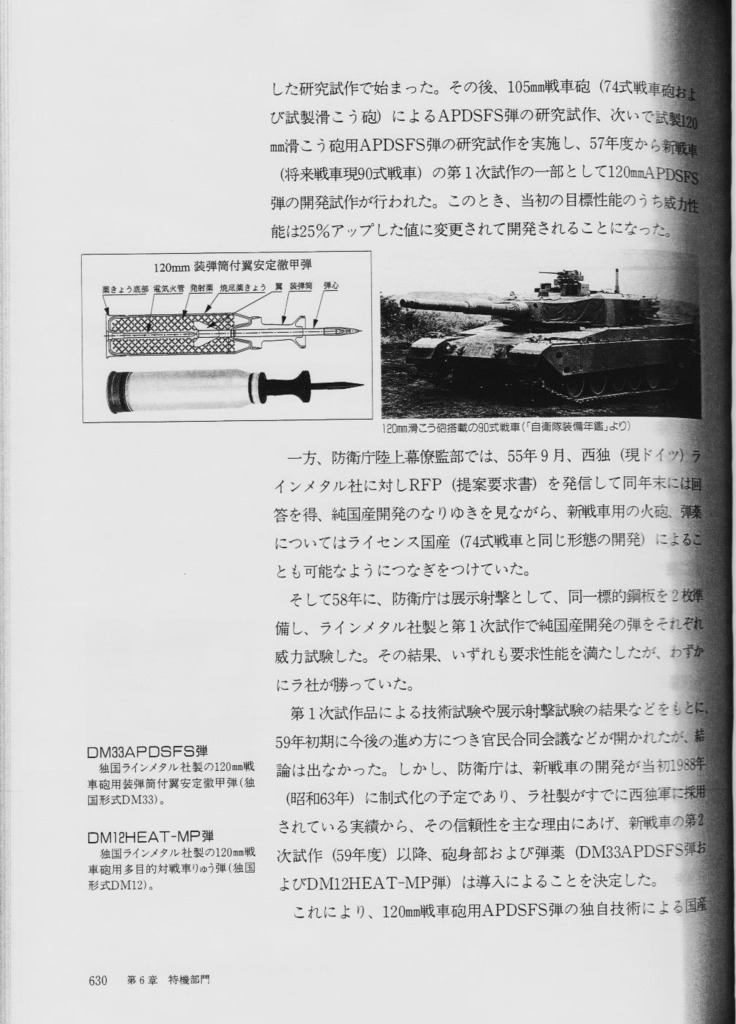
Bottom is 105mm Type 93 APFSDS
The one on the top looks like 120mm DM23
Just because 2nd prototype phase is TKX-0003 to 0006 doesn’t mean it came during 0003, could have been TKX-0004 or later and as I already pointed out, why test against DM33 round when the initial specification requirement was for the armour to withstand a weaker round, like the DM23 which was the most modern during type 90 armour protection designing. If it was designed to defeat DM23, they would test it with DM23.
This means that this round is so powerful that it can defeat T-72B hull without ERA even at 2000m.
T-72B has
215mm thick composite at 68 degrees - 574mm LOS
It’s rated to offer 520-550mm LOS of steel equivalent and DM33 claps 553mm LOS (68) at 2km
LMAO if Type 90 could defeat DM33 whilst being only 5tons heavier than T-72B, but have the height for enough gun depression, length of tank enough for ultra fast autoloader, modern transmission and 1500hp engine at the same time, everyone would be scrambling to know that composite…
Germany would be scrambling for it, literally their 5ton heavier Leopard 2A4 can only stop DM23
Do you know the details of the panzer 68 “Pfeil Pat 87 Lsp: 1450 m/s, L/D 22”? I know it is on another site but it weighs 18.7kg. I couldn’t find anything about it, but in my opinion the closest thing to it is the DM33. But it is 105mm.
Unless you use module specific weight figures, it’s not very useful as a measurement (and even then, weight alone shouldn’t be used to judge complex things).
iirc, the Leo 2a4 was put into service in 1981, which makes it almost a decade older than the type 90. This comparison isn’t very reasonable for things that far apart.
In 2 decades, the type 10 shaved off 6 tons and gained protection in comparison to the type 90 in addition to a better autoloading system, a more complex powertrain, and a large selection of digital capabilities.
I don’t know what you do in your free time, but if you ever pay attention to Formula 1, I’m sure you know that 2 teams of engineers can get completely different results from 2 almost identical looking vehicles.
The Leopard 2 was still using the 1979 2A0 armor and the composite composition was likely finalized in 1976/77. Comparing a prototype to a production vehicle doesn’t make sense since most of the Leo 2 tech was from the 70s the same way most of the Type 90 tech was from the 80s. Being in prototype stage the TKX prototypes were using the most up to date technology.
Also I think you’ve been corrected like 5 times already that the ballistic test vehicle was 0003 not 0002 but you keep saying 0002 anyways
In that case…
B-Tech came in 1979
C-Tech came in 1987
TKX-0002 is 1986
TKX-0003 is like 1986-1987
You need C-Tech equivalent on Type 90 cheeks just to prevent DM23 from penetrating. DM23 penetrates 393mm at 250m, Type 90 cheeks with C-Tech equivalent offer 400mm KE
Nevermind DM33… with 479mm KE at 250m
You’d need D-Tech equivalent for that…
Even Leopard 2A5 with 750mm LOS hull composite + C-Tech doesn’t stop DM33 from penetrating. Again Type 90 cheek composite is only 670mm LOS…
yes, and perhaps this is a similar case for the type 90 vs leo 2a4.
Given that it’s just as classified as the armor on the type 10, I have no doubts that someone at some point in time was trying to figure out the composite. The only reason they wouldn’t be is if they already had something similar (Which most western nations probably did in the 90’s, at least in some stage of development).
Fact of the matter is, when you’re dealing with dense materials 5 tons can come quickly with various trimmings, compromises, and efficient technologies. If the type 10 can shave weight while gaining frontal protection, who says the same can’t be true of the type 90, especially when it’s in comparison to a completely separate team of engineers who are following their own development path.
Also, sorry to call into question the numbers as I know it seems to be your thing, but I have serious doubts as to the accuracy of these calculations. First of all, I highly doubt any precise value can be stated for armor schemes that we don’t even know the exact internal layout of. For all we know, the plates in Type 90 Comp could be at a completely different angle or spacing in comparison to 2a4 Comp. Generally speaking, a rough and imprecise number can be theorized, but there is no way to confirm it (which is why relative statements exist). Trying to put an exact number on classified composite is like trying to calculate the the contents of Schrodinger’s box.