- Yes - In the Tech Tree.
- Yes - Event/BP.
- Yes - Premium.
- No - I would not like to see HMCS Crescent in game.
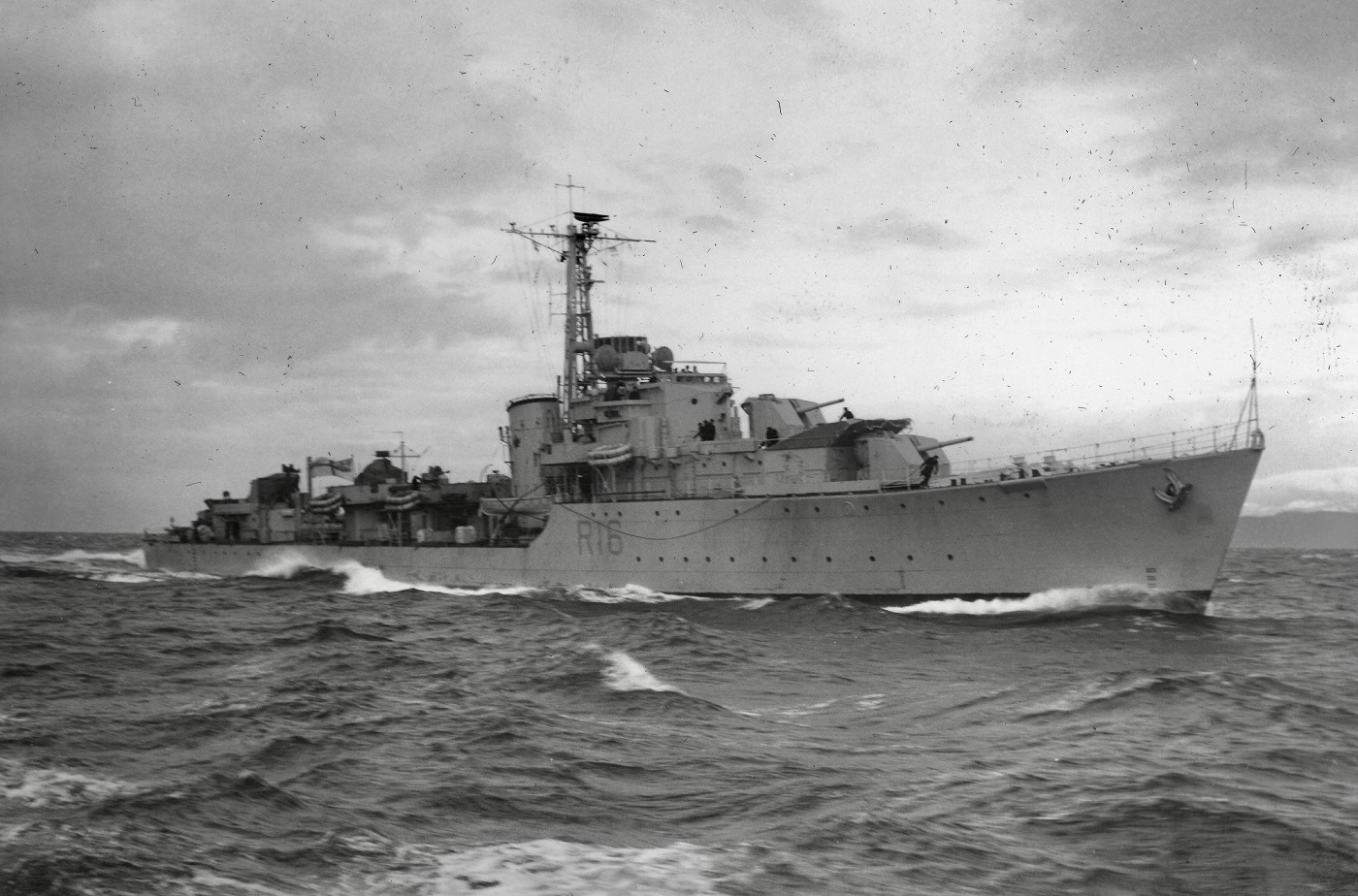
HMCS Crescent at high speed post conversion, (n.d)

Description:
Although the Canadian Government had selected to be loan a full Flotilla (8 vessels) of the Cr-class of war emergency destroyers from the Royal Navy for use within Canada’s contribution to the British war effort in the Pacific before they were actually built and commissioned, only two vessels, HMS Crescent and Crusader, would be delivered to the Royal Canadian Navy (RCN), as Japan would drop out of the war and surrender before any further transfers could occur. The remaining six vessels would remain in the British reserve fleet prioritised for sale to friendly nations.
This suggestion is for the HMCS Crescent as she appeared as a Type 15 Frigatein her 1963 post VDS refit.
HMCS Crescent at sea prior to conversion to Destroyer Escort
History:
Ordered on the 12th of September 1942 along with the other Cr-class vessels, she would be laid down as the HMS Crescent on the 16th of September 1943 by John Brown & Co at Clydebank, Scotland, next to her sister HMS Crusader. She would launch on the 20th of July 1945, however before she would complete and commission, she would be transferred to the Royal Canadian Navy (RCN), she would finally commission on the 10th of September 1945 as HMCS Crescent.
She would leave British waters after working up and trials, leaving for Esquimalt, British Columbia in November. Shortly after her arrival she would be assigned training ship to the HMCS Givenchy on the 29th of November 1945. This would be due to the Canadian Naval Board not seeing an advantage to keeping the Cr-class HMCS Crusader and Crescent commissioned as active warships, as they had plenty of Tribal-class destroyers for fleet duties, and extra commissioned hulls would only increase manning requirements and maintenance costs for no extra capability in peacetime.
During her time on this station she would go on training voyagers with cadets aboard, often with fully commissioned RCN warships. The first of these voyagers would start in January 1946. In these cruises she would often visit friendly ports, she would visit Mexico City, Pearl Harbour, and San Diego. On one of these cruises in April 1948, HMCS Crescent while sailing with HMCS Ontario, the pair would come across an adrift mine, to avoid said mine the Ontario had to make an emergency turn to avoid it, allowing the Crescent following behind to destroy it with gunfire.
Her training role would cease on the 3rd of February 1948, when she would leave for Yangtze, China, as to protect the 150 Canadian civilians living in China at the time, which were under threat due to the then ongoing Chinese civil war. HMCS Crescent would arrive here 22 days after she set off. She would replace the HMS Cossack as she moved to Nanking, her actual station. She would remain here through March 1949, when she suffered one a Mutiny, with 83 ratings locking themselves in the messdecks. This would force the Crescent to retire from her duty in China, being replaced by the HMS Consort. She would then sail to Hong Kong.
She would arrive back home in Canada in November 1949, when she was placed into reserve with her sister, HMCS Crusader, who had been in reserve since she was delivered in 1945.
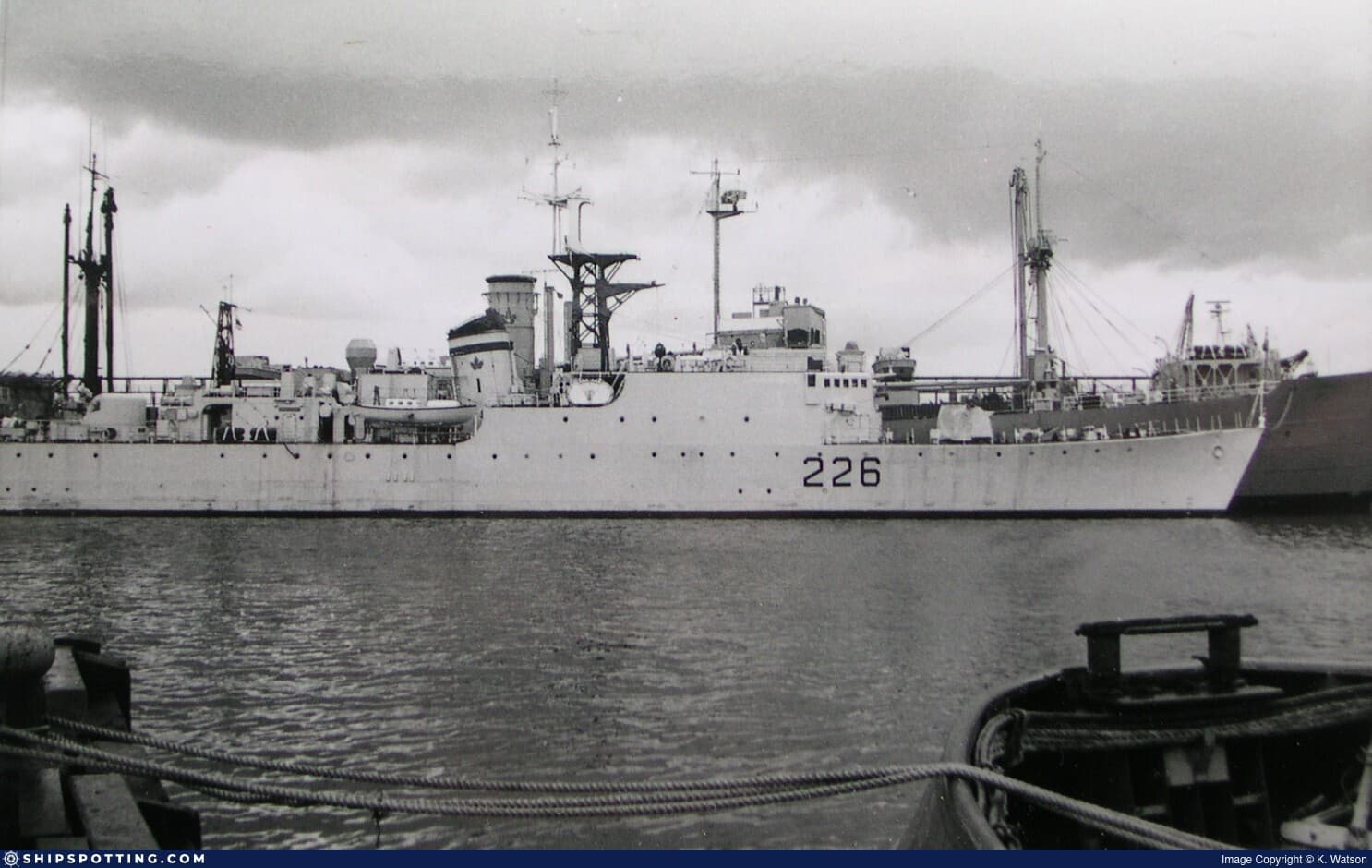
HMCS Crescent post conversion, sitting at Halifax, Canada, (1962)
She would again be rated as a training ship when she recommissioned in September 1950. This would be to replace the HMCS Crusader, who had gone into refit in preparation for the Korean War. She would again take training cruises with cadets. During this time she and Crusader would be permanently given to Canada as a gift from the UK. She would visit the UK on one of these training cruises in May 1951, along with the HMCS La Hulloise and Swansea, then the group would visit Gibraltar and French Riviera before returning home via the Caribbean.
She would continue to undergo these training cruises until 1953, when she would undergo a large refit as to transform her following the British Type 15 Frigate plans. By Canadian naming plans she was to be called a Destroyer Escort, but in British terms she was a Frigate. (Note: I have labelled this suggestion as a Type 15 Frigate for clarity with regards to her purpose.)
These works included stripping her all QF 4.5-inch guns, her 21" torpedoes, reworking her superstructure to be proof against CBRN effects. Replacing the main gun armament was a twin QF 4-inch Mk.XVI with a SPG-34 radar mounted on the gun shield, and the secondary AA armament being replaced with a twin US designed 3"/50 Mk.33. Her depth charge throwers were replaced with two triple Limbo ASW mortars, one each side aft, but also two triple 12.75" torpedo tubes with ASW homing torpedoes. Her AA was supplemented by two single 40mm bofors amidships, one either side of the funnel. Her sensors were also modernised, with electricity generation increased and the masts reshaped. Her pennant was also changed from R16 to 226.
She would recommission from these works on the 31st of October 1955, after trials from January the same year. Her refit would be considered the largest undertaken by a Canadian yard at this point. HMCS Crescent would be the senior ship of the Second Canadian Escort Squadron, where she would undergo ASW training cruises again with other RCN and allied vessels. Unlike her sister, Crusader, the HMCS Crescent would never fight in the Korean War, only ever serving on training roles.
With the success of the Canadian developed Type 199 VDS on the HMCS Crusader, this sonar was refitted to the Crescent in 1959, unlike her sister, she would not have any armament removed to allow this change, as she did not have anything affixed aft. The fitting of Type 199 VDS would be made permanent with the finalisation of trails in 1963. She would only end this service on the 1st of April 1970, when she was paid off at Victoria, British Columbia.
She would be sold to a Taiwanese company in 1951 for scrapping.
| General Characteristics: | |||||
|---|---|---|---|---|---|
| Name: HMCS Crescent | |||||
| Country: Canada | |||||
| Type: Destroyer Escort | |||||
| Class name: Cr-class | |||||
| Year of commission: 1945 | |||||
| Refit: 1960 | |||||
| ----------------------------------------------------------------------------------------------------------------------------------------- | |||||
| Dimensions: | |||||
| Length: 362.75ft (110.5m) | |||||
| Beam: 35.6ft (10.9m) | |||||
| Draught: 10ft 6in (3.2m) | |||||
| Displacement:1,930t | |||||
| ----------------------------------------------------------------------------------------------------------------------------------------- | |||||
| Propulsion: | |||||
| Powerplant: 2x Geared turbines, two shafts, @ 40,000shp (30,000kW) overall | |||||
| Speed: 36kt | |||||
| Endurance: 1,400nmi @ 32kt | |||||
| ----------------------------------------------------------------------------------------------------------------------------------------- | |||||
| Armament & sensors: | |||||
| Compliment: 185 | |||||
| Primary armament: 1x2 QF 4-inch Mk.XVI | |||||
| Secondary armament: 1x2 3"/50, 2x1 40mm Bofors Mk.VII | |||||
| Tertiary armament: 2x3 Limbo ASW mortar, 2x3 12.75" torpedo tubes | |||||
| Radar: Type 293Q, Type 277Q, Type 974, Type 262, Type 1010, SPG-34 | |||||
| Sonar: Type 174 *, Type 162, Type 170, Type 199 VDS |
*: May have been replaced by or supplemented with the Type 199 VDS, unknown if carried from 1961.
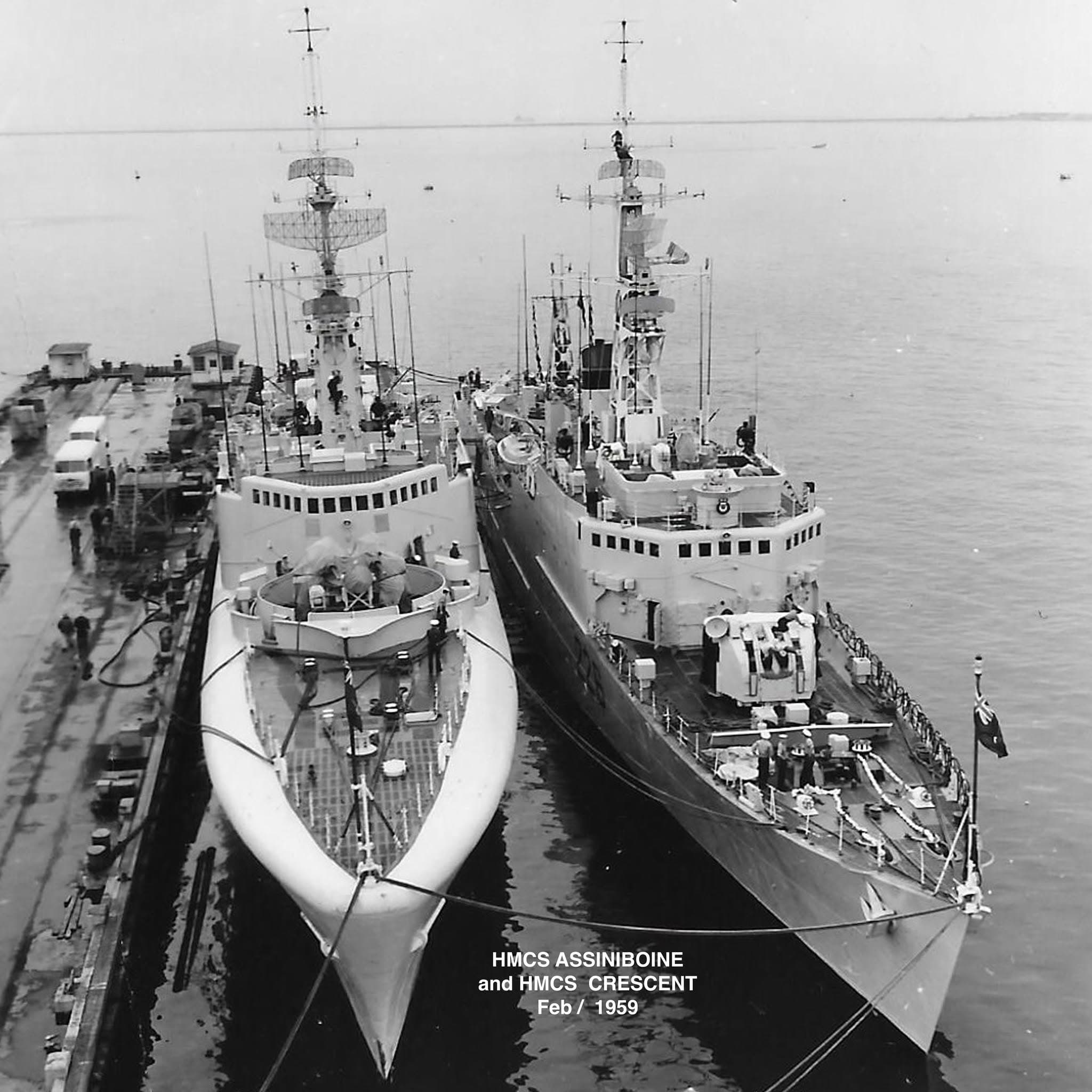
HMCS Crescent (right) docked alongside HMCS Assiniboine (left), (1959)
Sources:
K. Macpherson & J. Burgess (1981) The ships of Canada’s Naval Forces 1910-1981 (pp.162, 219-222)
N.Friedman (2017) British Destroyers & Frigates, the Second World War and After (pp.91-93, 105)
JJ.Colledge & B.Warlow, (2006) Ships of the Royal Navy (p.83)
HMCS Crescent - Wikipedia
HMCS CRESCENT - CFB Esquimalt Naval and Military Museum
https://www.canada.ca/en/navy/services/history/ships-histories/crescent.html
DD 226 HMCS Crescent C-class destroyer Royal Canadian Navy
HMCS CRESCENT R16 / 226 - For Posterity's Sake