- Yes - In the Tech Tree.
- Yes - Event/BP.
- Yes - Premium.
- No - I would not like to see HMAS Warramunga in game.
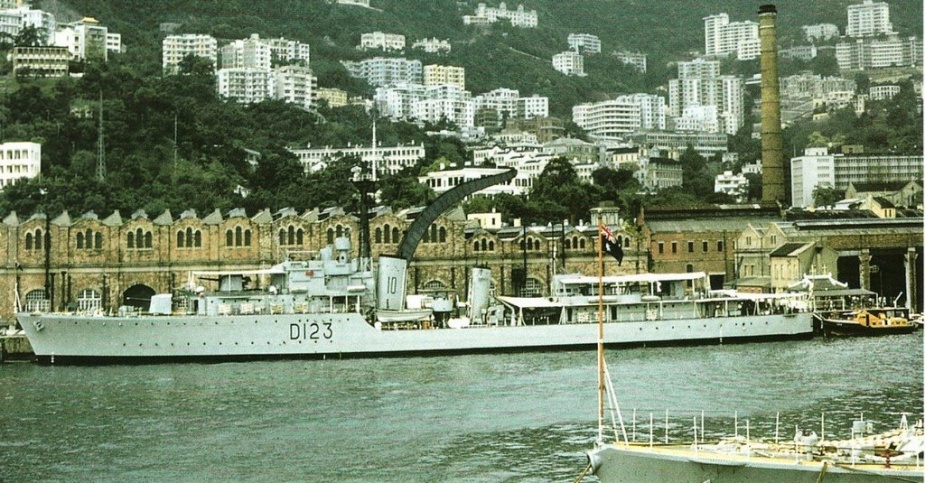
Description:
HMAS Warramunga was one of three Tribal-class Destroyers operated by the Royal Australian Navy during the Second World War, Korean War into the cold war.
The Tribal-class were selected by the Australian Admiralty as to replace their aging V-class Destroyers during fleet operations, as that design was severely outdated and limited in capability. Eight Australian Tribals were ordered, however five would be cancelled due to the RANs acceptance of War Emergency Destroyers on loan from Britain. The first vessel, the HMAS Arunta, would be laid down in November 1939, and the final, HMAS Bataan, in February 1942.
This suggestion is for fit as she converted to a ASW Destroyer in 1954.
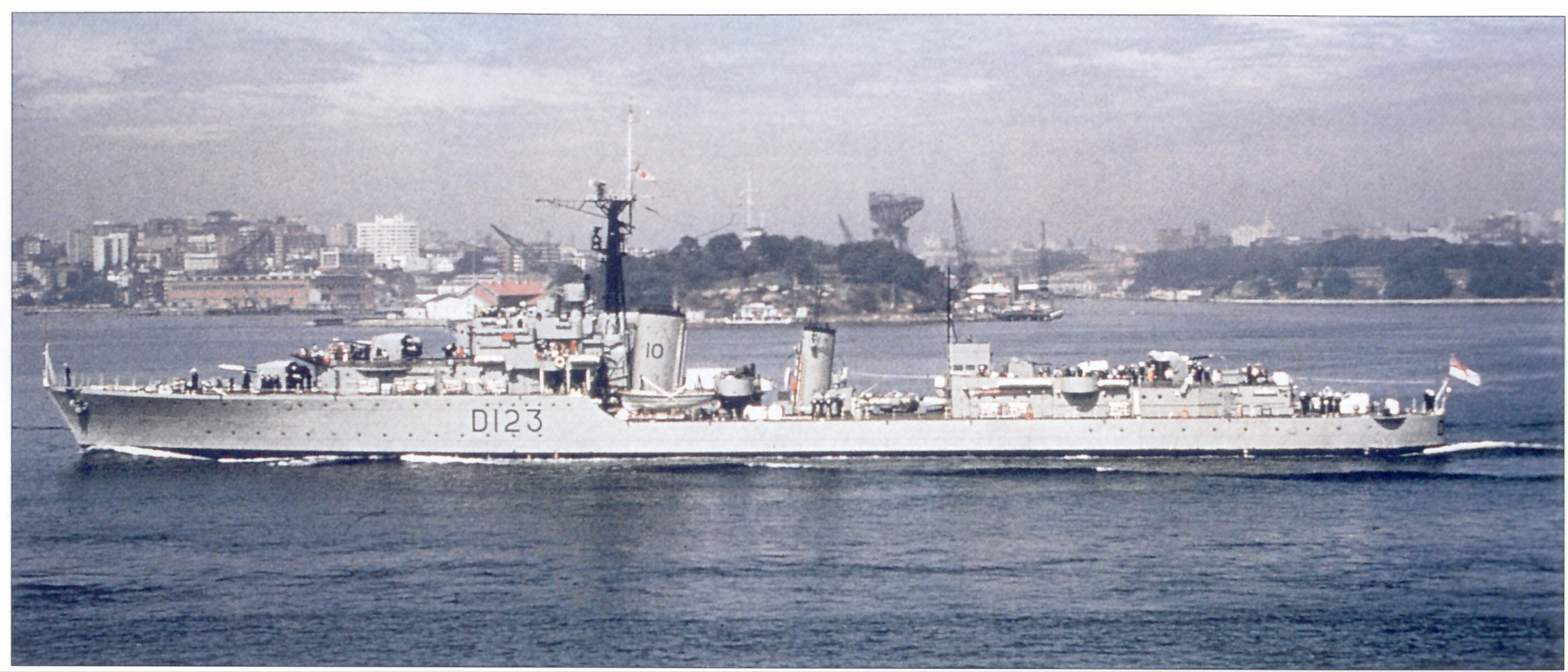
History:
Like all of the RAN’s tribal class, she would be ordered in late 1939 and unlike her sister HMAS Bataan, she would continue as a priority project, being laid down on the 10th of February 1940 by Cockatoo Docks and Engineering Co, Sydney. She would launch on the 7th of February 1942, finally commissioning on the 23rd of November 1942.
Upon commissioning she would continue working up, traveling between Melbourne, Brisbane, and Sydney until the 10th of February 1943, where she was sent to rescue survivors of the torpedoed merchantman, Starr King, then hunt down the sub which had sunk her. She would rescue the survivors, but could not find the enemy submarine. After returning to port, she would escort the damaged USS Portland from Sydney to New Caledonia, as part of that ship’s voyage to the USA for repairs.
On the 19th of April she would join Task Force 74, consisting of HMAS Australia, Hobart, and Arunta, as well as with US Cruisers and Destroyers. This group would exercise in waters around Australia in anticipation of future operations. These exercises mostly consisted of ASW Patrol and escort. She was in refit until the 29th of August for boiler cleaning. After this finished she would continue standard ASW patrols and convoy escort from Sydney.
From the 2nd of November 1943, HMAS Warramunga, Arunta, Australia, Shropshire, as well as the USS Helm sailed for Milne Bay, where after a few days and a visit to the Solomon Islands, they would join the 4th Destroyer Squadron (DESRON 4). This comprised HMAS Arunta, Warramunga and the USS Talbot, Ralph, and Helm. In this Squadron they would bombard shore positions around New Britain and screen the fleet landings at Arawa. She would return to Sydney on the 11th of January 1944, departing again for service with Task Force 74 on the 4th of February 1944.
During this time she would be on/off in service for refit. These mostly consisted of boiler and engine cleaning, but she would gain 4x1 40mm Bofors, replacing the four 20mm Oerlikon mounts on the bridge wings and amidships. She also gained more depth charges and depth charge throwers.
During this period she would escort more convoys, bombard shore positions at Marubian, the Biak area, as well as Yakasui. She would also cover allied landings at the Wakde Sarmi area, Noemfoor, Morotai, Humboldt Bay and Leyte Gulf. The Task Force would come under Torpedo and Dive bomber attacks but she would sustain no damage, she would also sink a Japanese Barge. She would join Task Force 77.1 on the 12th of November, but would leave on the 25th of November for service in the second phase of the Philippines campaign, arriving there in January 1945.
She would continue in this area of operation, following her standard routine of convoy escort, shore bombardment, and covering landings, she would come under air attack many times, under Dive, Torpedo and Kamikaze bombers but would not sustain major damage. By the wars end in August 1945, she sailed for Tokyo Bay, as to recover POWs and Internees, arriving on the 6th of September in Task Force 30.6.2.
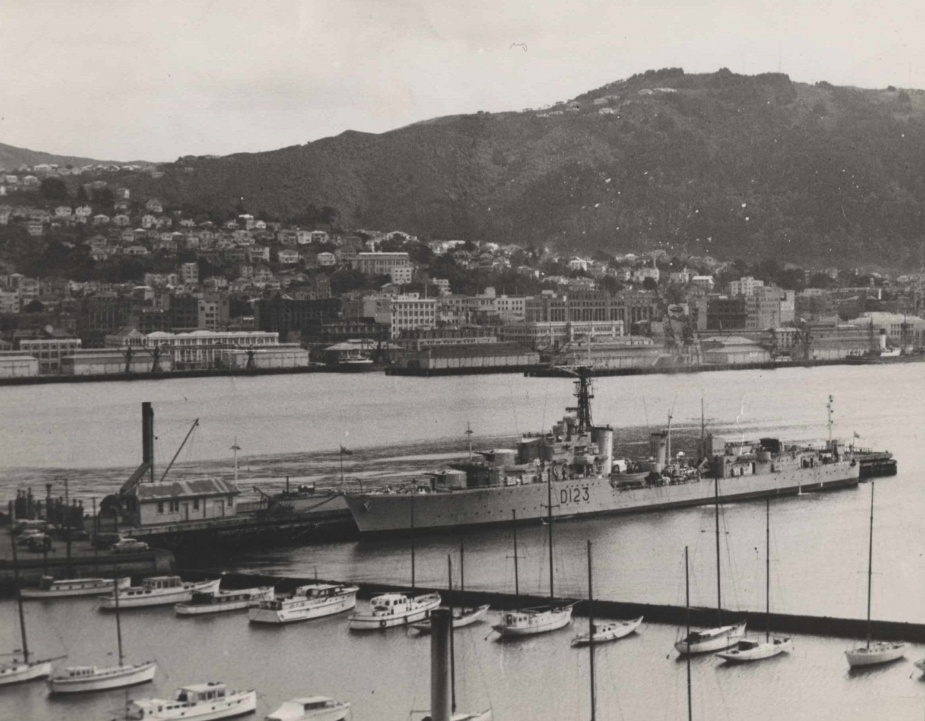
Post war, she would join the Australian Squadron, being the representative for that group in Japanese Waters, but would return to Australia for refit in April 1946. Her service would continue mostly around the SEA and Japan areas on a Far East tour of duty, returning to Sydney on the April 1948. She would visit many South Pacific Ports during this time, mostly in Australia and New Zealand.
She was refitted in April 1946, totally modernising the vessel. She replaced her tripod main mast with a lattice type, and her rear mast was shrunk significantly and moved fore, appearing similar to that of the Battle-class. Her jungle habitability was also greatly improved, allowing for more comfortable service in her expected area of operation. Her quad 40mm Pom-Pom guns was also swapped out for a twin 40mm Bofors Utility mount. This gave her a very heavy AA armament of 1x2 QF 4-inch, 4x1 40mm Bofors, and 1x2 40mm Bofors.
At the beginning of hostilities in Korea, HMAS Warramunga sailed from Sydney, arriving on the 25th of August 1950 escorting HMS Ceylon and Unicorn to Pusan. Her first patrol would start on the 3rd of September, screening carrier operations on the west coast under Task Force 95.11, ending on the 9th of September, but recommencing between the 12th and 21st. This operation included the recapture of Inchon.
She would visit Sasebo, joining her sister HMAS Bataan for bombardment, convoy escort, and blockade duty until the 4th of October, returning to Sasebo on the 8th. During this period she would screen the USS Missouri in Task Force TG 95.2. From November she would join HMCS Cayuga, Athabaskan, and Sioux for patrol off the Yalu Gulf. She would take part in evacuations from Chinnampo, and would screen HMS Theseus before returning to blockade duty in the Yalu Gulf on the 10th of December.
By January 1951 she was assisting the evacuation of Inchon, and would remain harassing the North Koreans with Naval gunfire along with USS Rochester and HMS Ceylon. She would then join Task Force 95.2 off Kangnung for shore bombardment duty. This would continue until April 1951 where she would relieve HMS Black Swan on Blockade duty.
Her main duties in both of her Korean Tours did not deviate, Warramunga would serve in convoy escort, shore bombardment, ASW patrol, fleet screening, and blockade duty in junction with many USN, RN, and RCN vessels. Her place in the Korean war was taken by the HMCS Crusader, with the Warramunga being relieved on the 9th of July 1952. She would return to Sydney on the 12th of August 1952, decommissioning for conversion to an ASW Destroyer.
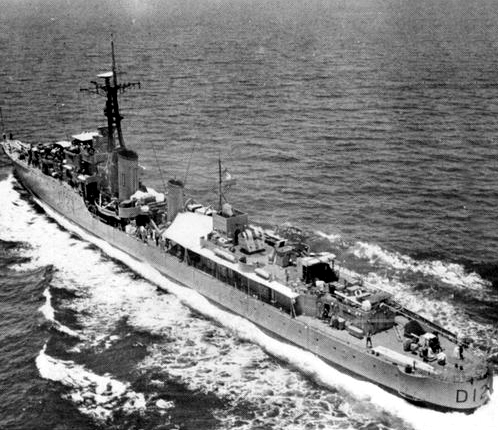
This conversion would be large, losing the twin QF 4.7-Inch mount in X position in exchange for a Squid ASW mortar, her engines were rebuilt, and she received an almost entirely new sensor system, swapping her SC and SG type radars for a single Type 293 set. Her Type 128 ASDIC was replaced by three sets, Type 147, 162, and 164. The Squid Mortar limited the number of traditional depth charges that could be carried from 46 to 30. Two of the DCT were also removed as unnecessary weight. However she retained her AA armament in its entirety.
She would recommission on the 19th of October 1954, but would continue fitting out until February 1955. By the time this work was complete she would join the Far East Fleet for exercises with the Royal Navy. She would remain in the Far East Fleet, as the first ship of the Strategic Reserve Fleet. She would finish here, arriving in Sydney on the 19th of December 1956. During 1957 she would exercise with SEATO, and in 1958 she would rejoin for a second tour of the Far Eastern Fleet’s Strategic Reserve, returning to Sydney on the 3rd of September 1958
Most of her time in the Australian Squadron was naturally spent in Australian Waters, with exceptions of her time in the Far Eastern Fleet and visiting Foreign Nations. However, by 1959 she was paid off in reserve, being sold for scrap in February 1963
| General Characteristics: | |||||
|---|---|---|---|---|---|
| Name: HMAS Warramunga | |||||
| Country: Australia | |||||
| Type: ASW Destroyer | |||||
| Class name: Tribal | |||||
| Year of commission: 1942 | |||||
| Refit: 1954 | |||||
| ----------------------------------------------------------------------------------------------------------------------------------------- | |||||
| Dimensions: | |||||
| Length: 377 ft 1 in (114.94 m) | |||||
| Beam: 36 ft 4.75 in (11.0 m) | |||||
| Draught: 9 ft (2.7 m) | |||||
| Displacement: 1,970t | |||||
| ----------------------------------------------------------------------------------------------------------------------------------------- | |||||
| Propulsion: | |||||
| Powerplant: 3 oil fired boilers, 2 geared turbines creating 44,000 shp (33,000kW) across two shafts | |||||
| Speed: 36.5kt | |||||
| Endurance: 5,700nmi @ 15kt | |||||
| ----------------------------------------------------------------------------------------------------------------------------------------- | |||||
| Armament & sensors: | |||||
| Compliment: 250 | |||||
| Primary armament: 2x2 QF 4.7-inch Mk.XII on mount CP Mk.XIX | |||||
| Secondary armament: 1x2 QF 4-inch Mk.XVI, 4x1 40mm Bofors, 1x2 40mm Bofors on utility mount. | |||||
| Tertiary armament: 1x4 21" torpedoes, 2x1 DCT, 30DC, 1x3 Squid Mortar | |||||
| Radar: Type 293, Type 285p, Type 253P | |||||
| Sonar: Type 147, Type 162, Type 164 |
Sources
Gillett, R. (1983). Australian and New Zealand Warships 1914-1945 (pp.144-146)
N. Friedman (2006). British Destroyers and Frigates, The Second World War and After. (pp.27-28, 227)
D.Stevens (2005). A Critical Vulerability. The impact of the Submarine Threat on Australia’s Maritime Defense 1915-1954. (pp.367-369)
https://seapower.navy.gov.au/history/units/hmas-warramunga-i
HMAS Warramunga (I44) - Wikipedia
HMAS Warramunga, the Second of the Australian Built Tribals 1942 - 1963 - Naval Historical Society of Australia
HMAS Warramunga (I 44) of the Royal Australian Navy - Australian Destroyer of the Tribal class - Allied Warships of WWII - uboat.net
Tribal class Destroyer (1937)
https://www.awm.gov.au/collection/301655z