- Yes - In the Tech Tree.
- Yes - Event/BP.
- Yes - Premium.
- No - I would not like to see Ship name in game.
HMAS Ibis passing through Sydney before decommissioning
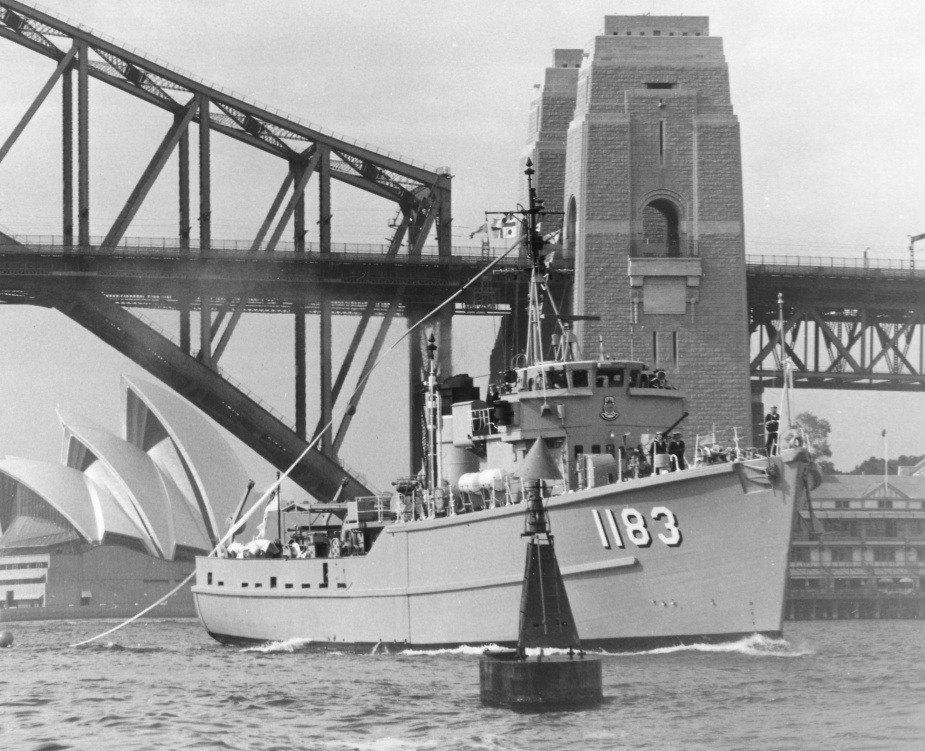
Description:
HMAS Ibis was one of six Ton-class Minesweepers to be acquired by the Royal Australian Navy, and as with the other RAN Ton-class, she would be built for the Royal Navy, then sold to the RAN.
The Ton-class were acquired by the RAN as to replace their aging Bathurst-class corvettes, which had been pressed into minesweeping service from their standard escort duties after the Second World War finished. They would also see service in a gunboat role, however this was secondary to their main purpose as minesweepers to the RAN’s destroyer and frigate fleet.
This suggestion is for the HMAS Ibis as she commissioned into the RAN in 1962.
HMAS Ibis undergoing a replenishment at sea
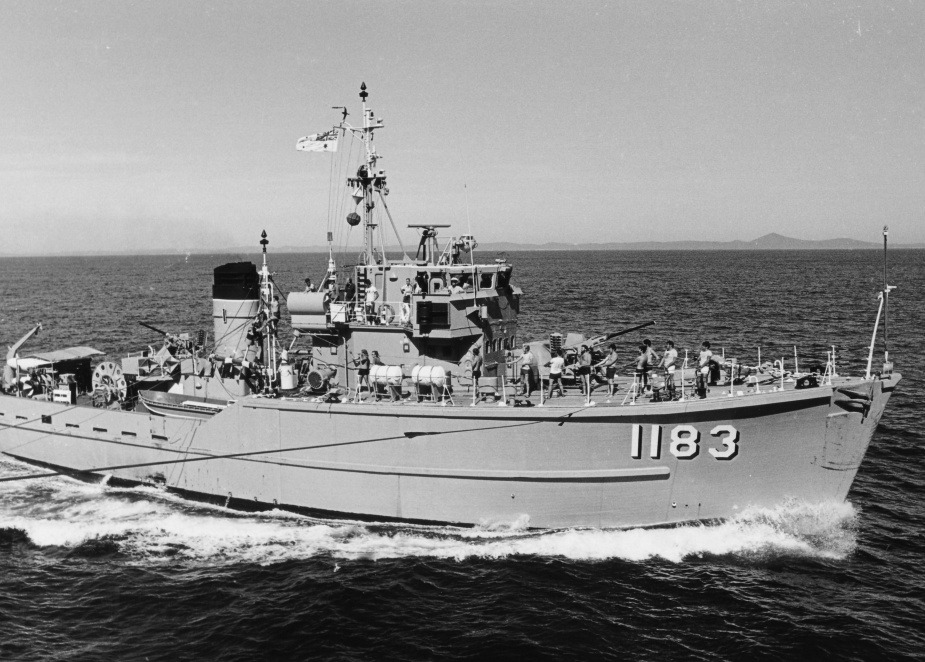
History:
Royal Navy service:
Laid down as the HMS Singleton on the 15th of October 1953 by Montrose Shipyard, Angus, Scotland. She would launch on the 19th of November 1955, fitting out and completing on the 29th of September 1956.
Immediately upon completion she would be put in reserve for sale to a foreign partner. As such she would never commission into the Royal Navy, although she was a brand new ship.
Five vessels of the Ton-class would be selected by the RAN for purchase in 1961, these being the HMS Alacston, and Chediston, as well as the Jackton, Singleton, Somerleyton, and Swanston. The latter four vessels were never commissioned into the RN, all being new builds immediately sent into reserve.
Royal Australian Navy service:
She would be renamed upon purchase, and thus commissioned as the HMAS Ibis on the 7th of November 1962. Upon purchase she would undergo a large refit, swapping her Mirrlees Diesels for Deltics, gaining active stabilisation, enclosing the bridge, and fitting air conditioning.
Upon commissioning she would join the 16th Mine Countermeasure Squadron, which was formed out of all six of the RAN’s Ton-class, they would sail for Sydney, arriving there on the 7th of December 1962. She would initially conduct routine exercises and maintenance around Australian waters until the 20th of September 1963. Where she and her sisters would deploy to Bougainville to clear a channel in the Tonolei harbour. During this deployment they would visit Singapore and Port Moresby.
In early February 1964 she would assist in the search for survivors from the Melbourne and Voyager collision. From the 14th of may she would undergo a refit, as to prepare her for service with the Far East Strategic Reserve, as part of Australia’s contribution in support of Malaysia during the Indonesian Confrontation.
HMAS Ibis passing through Sydney, (n.d)
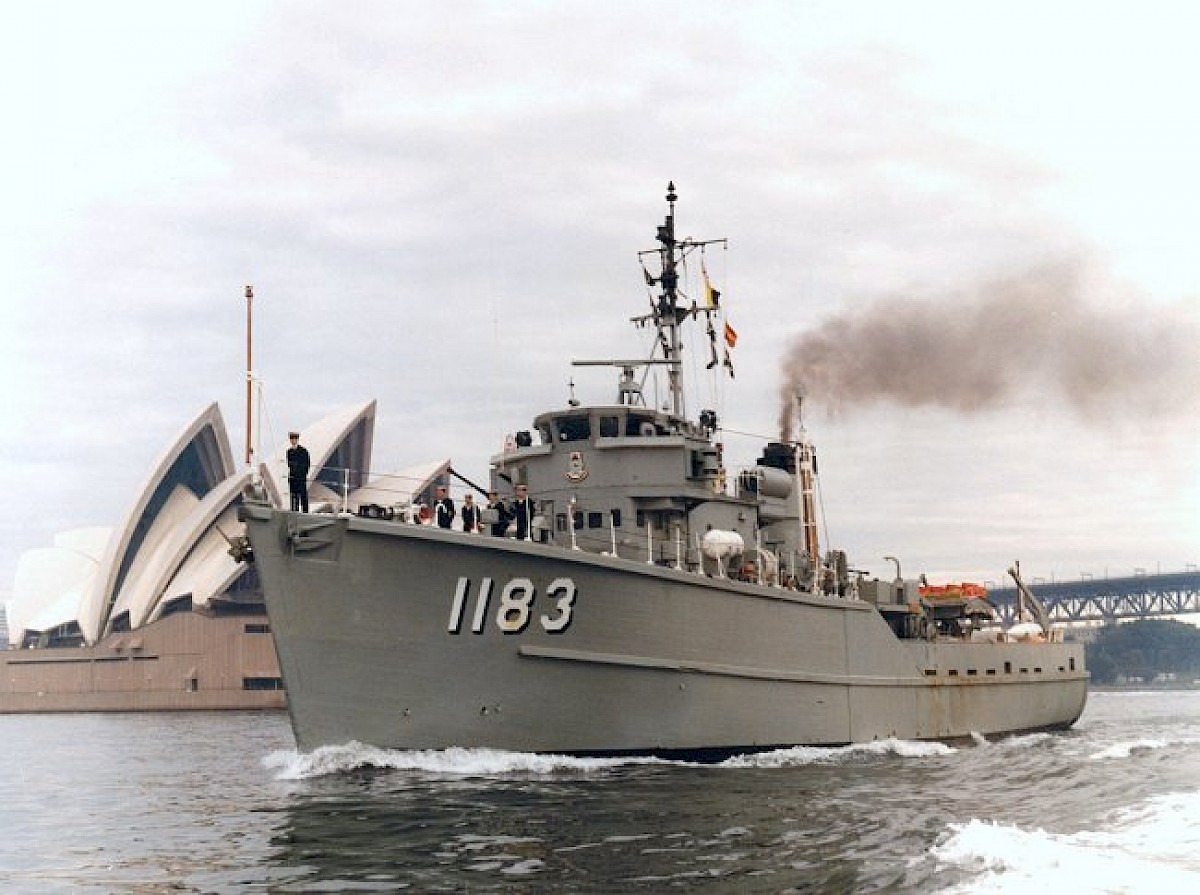
She would leave for this service on the 17th of August 1964 along with her sister, HMAS Teal, as to relieve her other sisters, HMAS Gull and Hawk. During this deployment she would remain on station at Hong Kong or Singapore while not on duty, as to save on cost and resources moving the vessels back and forth between Australia and Malaysia. This approach was also done by the RNZN’s ton-class vessels.
She would return from this duty on the 8th of February 1966. Upon her return she would decommission for refit at Garden Island, Sydney. This would be an entire rebuild, and would last until May that year. She would return to operating in Australian waters, in which she would conduct many mine countermeasure exercises and survey work. In October 1967 the HMAS Ibis and Teal would circumnavigate Australia, returning in December.
On the 15th of January 1968, she would decommission into operational reserve due to a manpower shortage, recommissioning in November 1969 in preparation for a deployment to SEA. She would depart Sydney with her sisters, HMAS Curlew and Teal, on the 30th of April 1970. In this deployment she would take part in Operation CRACKSHOT and BERSATU PADU in company with the Royal Navy, Royal New Zealand Navy, and Malaysian Navy. She would return on the 27th of July for further exercises around Australia. She would again be decommissioned on the 17th of December 1970.
She would recommission from this on the 1st of June 1973, conducting further exercises around the Australian coast, and participating in operation STILL DUSTY. She would assist Darwin in the aftermath of Cyclone Tracy, clearing navigational hazards in the approaches to her harbour. In 1976 she would deploy to New Zealand for exercises. Then in 1977 she again would circumnavigate Australia.
She would again be in refit through 1978, although she did participate in operation LONGEX 78 that year. In 1979 she would take part in operation KANGAROO THREE. Another circumnavigation of Australia was completed in 1980, and in the same year she took part in operation AKARANA, to jointly survey the Australian west coast with the RNZN.
She would continue this pattern of small counter mine exercises, then large scale exercises, then a period of maintenance and refit until her decommissioning on the 4th of May 1984. She was sold in 1985 to be broken up.
| General Characteristics: | |||||
|---|---|---|---|---|---|
| Name: HMAS Ibis | |||||
| Country: Australia | |||||
| Type: Minesweeper | |||||
| Class name: Ton | |||||
| Year of commission: 1962 | |||||
| Refit: 1965 | |||||
| ----------------------------------------------------------------------------------------------------------------------------------------- | |||||
| Dimensions: | |||||
| Length: 152ft (46m) | |||||
| Beam: 28ft (8.5m) | |||||
| Draught: 8ft (2.4m) | |||||
| Displacement: 440t | |||||
| ----------------------------------------------------------------------------------------------------------------------------------------- | |||||
| Propulsion: | |||||
| Powerplant: 2x Napier Deltic @ 3,000hp (2,237kW) ea | |||||
| Speed: 15kt (28kp/h) | |||||
| Endurance: 2,300nmi @ 13kt | |||||
| ----------------------------------------------------------------------------------------------------------------------------------------- | |||||
| Armament & sensors: | |||||
| Compliment: 33 | |||||
| Primary armament: 2x1 40mm Bofors 40/60 | |||||
| Secondary armament: 2x1 .50 M2 | |||||
| Tertiary armament: - nil | |||||
| Radar: Type 1006 Nav radar | |||||
| Sonar: Type 193 Mine-hunting sonar | |||||
| Decoy and ESM systems: - nil | |||||
| Other Systems: Minesweeping gear |
HMAS Ibis during trials soon after commissioning, her armament has been landed
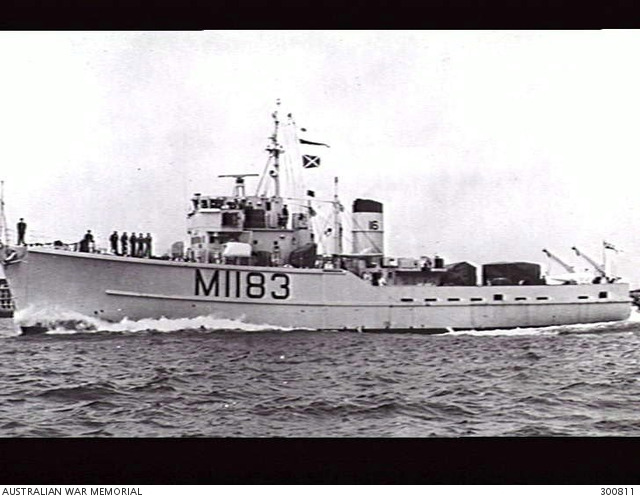
Sources:
Worth, Jack (1986). British Warships Since 1945: Part 4: Minesweepers. (p.78, 113)
HMAS Ibis (M 1183) - Wikipedia
RAN Minesweepers and Minehunters - Naval Historical Society of Australia
HMS Singleton | TON Class Association
https://seapower.navy.gov.au/history/units/hmas-ibis-ii
16th Minesweeping Squadron - Plaque Dedication - Naval Historical Society of Australia