History
Background
USS Ticonderoga (CG-47) with her original Mk 26 launchers, May 1982.
With the US Navy’s authorization for the construction and commissioning of Spruance-class destroyers in the mid-1970s, a number of follow-on ships were planned based on that hull as next-generation guided-missile destroyers, initially designated DDG-47. Authorized in fiscal year 1978, they were intended to serve as a more cost-effective platform for the new Aegis Combat System while utilizing a hull derived from the Spruance class. As the design evolved with expanded combat capability and increased displacement due to the integration of the Aegis system, the ships were redesignated from Guided Missile Destroyer (DDG) to Guided Missile Cruiser (CG) on January 1, 1980, shortly before the keels of USS Ticonderoga (CG-47) and USS Yorktown (CG-48) were laid down. USS Ticonderoga (CG-47) was laid down on January 27, 1980.
The major elements of the AEGIS combat system.
This change in designation led to what became known as the Ticonderoga-class guided-missile cruisers, the first surface combatants equipped with the Aegis system. The system consisted of the AN/SPY-1 radar arrays, the Mk 99 Fire Control System, the Weapon Control System, and the Command and Decision System, all working together to simultaneously detect, track, and engage multiple targets. In the 1980s, this was renowned as the most advanced combat system technology in the US Navy. These ships were capable of performing air warfare, undersea warfare, naval surface fire support, and surface warfare missions, and often served as flagships for Carrier Battle Groups and Amphibious Ready Groups, as well as in escort and interdiction roles. Their Aegis system also proved valuable in ballistic missile defense roles.
Diagram of the Aegis Combat System for Aegis vessels with Mk 41 VLS.
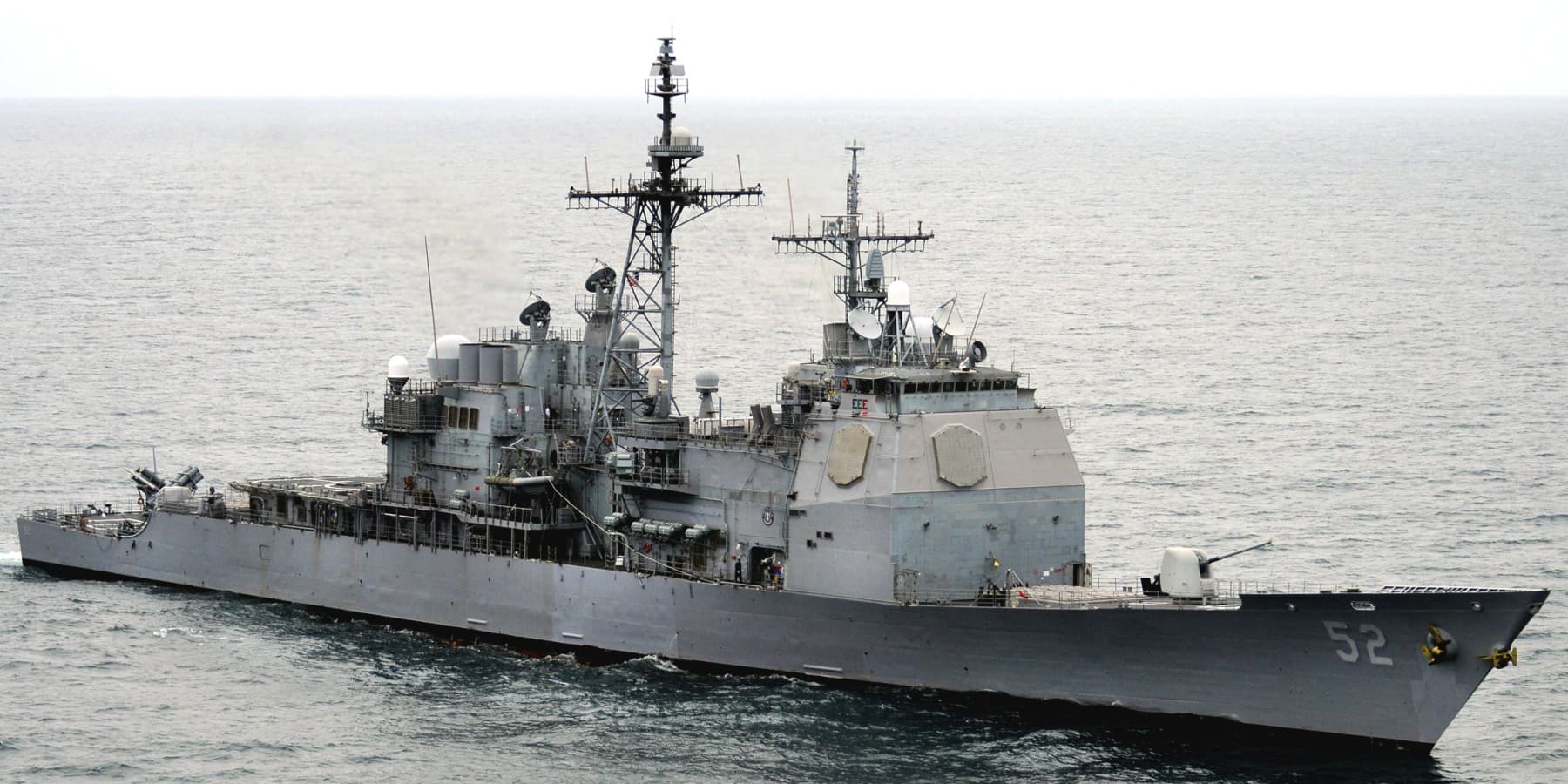
The first five cruisers (Ticonderoga, Yorktown, Vincennes, Valley Forge, and Thomas S. Gates) were completed with two Mk 26 twin-arm missile launchers as their primary armament, capable of firing Standard missiles and RUM-139 ASROC. Beginning with CG-52 and onward, the class was fitted with two Mk 41 Vertical Launch Systems in place of the Mk 26 launchers. This change significantly increased flexibility and missile capacity, allowing the ships to carry and launch a wider range of weapons, including Tomahawk, Standard, Sea Sparrow, and ASROC, with faster response times.
USS Lake Champlain (CG-57) with her Mk 41 VLS, November 2003.
A total of 27 cruisers (CG-47-73) were completed, with the last ships entering service between 1992 and 1994. Throughout the late Cold War and into the post-1991 period, the Ticonderoga-class formed a core component of US surface combat power. They played key roles in operations such as the Gulf War and later conflicts in Iraq, where their Tomahawk missiles were among the first weapons employed.
Early “as-built” configuration of the Ticonderoga-class cruiser.
Over time, the class began to show its age, prompting modernization efforts focused on upgrading computing systems, displays, and hull, mechanical, and electrical components. These upgrades included improvements from SPY-1A to SPY-1B variants, as well as more capable sensors and updated missile systems. Despite these efforts, the design had limited growth potential in terms of weight and power. Combined with rising maintenance costs, this made the ships more expensive to operate compared to newer platforms such as the Arleigh Burke-class destroyer. As a result, plans were made to accelerate the retirement of some Ticonderoga-class cruisers as more capable and flexible Arleigh Burke-class guided-missile destroyers entered service. This was approved by Congress, but it required that some cruisers remain in service, despite the Navy’s intention to retire and replace the entire Ticonderoga-class fleet with Flight III Arleigh Burke-class destroyers.
VLS variant configuration of the Ticonderoga-class cruiser.
This process began with the original five Ticonderoga-class ships, Ticonderoga, Yorktown, Vincennes, Valley Forge, and Thomas S. Gates, which were equipped with Mk 26 launchers and decommissioned by 2005 before eventually being scrapped. Ships that received modernization upgrades remained in service longer, although several VLS-equipped cruisers have since been decommissioned and placed in the reserve fleet. As of 2026, seven vessels remain active in commission, fifteen have been decommissioned and placed in reserve, and five have already been scrapped.
Propulsion
The LM2500 engine is typically installed within a metal enclosure to isolate sound and thermal from personnel and adjacent machinery spaces.
As designed, the Ticonderoga-class cruiser was powered by four gas-turbine General Electric LM2500 engines, each rated at 21,500 shp. These engines provided the ship with a total of 86,000 shp and a top speed of 33 knots. The LM2500 propulsion system was so reliable and successful that it was also used on the earlier Spruance-class destroyers and remained in service on most subsequent US warships through later iterations of the LM2500 family.
Aegis Combat System & Sensors
Left: forward deckhouse. Right: aft deckhouse.
Each Ticonderoga-class guided-missile cruiser has four AN/SPY-1 PESA 3D radar systems installed in light grey octagonal panels on the forward and starboard sides of the forward deckhouse and on the aft and port sides of the aft deckhouse, providing 360-degree coverage. The SPY-1A was the standard radar system initially installed on earlier cruisers, while the SPY-1B was a subsequent development introduced on CG-59 and later ships. Compared to the “A” variant, the “B” variant has an improved antenna better suited for operation in cluttered environments and produces roughly twice the average power of the SPY-1A. Later upgrades for the SPY-1B became available in the late 1990s for CG-59 onward, adding moving target indication capability.
On the forward mast, an AN/SPS-49(V)6 was mounted, which was a two-dimensional, very long-range, all-solid-state radar. It served as a long-range airborne surveillance radar, complementing the AN/SPY-1 system, which has a lower mounting position and thus a reduced radar horizon. When a hostile air target was detected and tracked, two SPG-62 target illuminators for each Mk 26 launcher/VLS were used to illuminate it for engagement by ship-launched SAMs. Later models of the Ticonderoga-class cruisers were retrofitted with the (V)7 and (V)8 variants, offering improved software capabilities.
Above the SPS-49 radar on the forward mast, there was an AN/SPS-55B, which was used as a surface surveillance radar to detect seaborne targets. Later models of the Ticonderoga-class cruisers replaced the SPS-55 with the newer AN/SPS-73 surface search radar.
Above the bridge on the forward deckhouse, an SPS-64(V)9 was mounted; it served as the primary navigation radar and was also used as a secondary surface search radar to detect seaborne targets.
For ASW, an AN/SQS-53 sonar was mounted in the bow below the waterline, with both active and passive operating capabilities. It was a crucial sensor for ASW weapons guidance. With the introduction of the LAMPS upgrade, the ship could also use the AN/SQR-19, a tactical towed-array sonar capable of passively detecting hostile submarines at very long range. Ticonderoga-class cruisers were known to use SQS-53A/B/C variants depending on the batch, with the analog receivers of the AN/SQS-53A/B later upgraded to digital systems using COTS processors as the SQS-53D.
AN/SLQ-32(V)3 aboard USS Lake Erie (CG-70), April 2014.
The AN/SLQ-32 electronic warfare suite was installed, offering improved capability in detecting and providing early warning of hostile emitters and targeting systems.
Armament & Armor
The Mk 45 5-inch/54 caliber gun of USS Thomas S. Gates (CG-51) firing during a fire exercise, July 13, 2005.
The cruisers were initially armed with two 5-inch (127 mm)/54 caliber Mk 45 guns, one on the bow and one aft. The Mod 1 incorporated a major improvement in its ability to select and fire six different kinds of ammunition. The most common type was high-explosive, in either anti-aircraft or high-capacity projectiles. The gun’s rate of fire was 20 rounds per minute in automatic mode.
The Mk 45 guns were controlled by the Mk 86 Gun Fire Control System, a digital system providing naval gunfire control against surface, air, and shore targets, capable of tracking four surface targets, two shore targets, and one air target simultaneously. It is the central subelement of the Mk 34 Gun Weapons System on Aegis class ships, which controls and directs the fire of two 5-inch guns against two tracked targets at once. The AN/SPQ-9A and SPY-1 radar systems were used in a track-while-scan mode to guide the guns against surface and low-flying airborne targets. Cruisers that received the service life extension program replaced the SPQ-9A with the SPQ-9B, offering improvements in engagement range.
Phalanx Block 1 test-firing aboard USS Carl Vinson (CVN-70), February 20, 2003.
Two 20 mm Phalanx CIWS Mk 15 guns were installed for close-range anti-aircraft and anti-missile defense, both located amidships. These were later upgraded to Blocks IA and IB, improving radar, ammunition capacity, rate of fire, engagement envelope, and computing.
USS Vincennes (CG 49) launching a Standard Missile-2 (SM-2) Medium Range (MR) from its deck.
The first five Ticonderoga-class cruisers were fitted with two dual Mk 26 Guided Missile Launching Systems, each capable of carrying 44 missiles, including SM-2MRs and RUM-139 ASROCs. The standard loadout for this configuration was 72 SM-2MRs and 16 ASROCs.
USS Cowpens (CG 63) firing Standard Missiles 2 at an airborne drone during a live-fire weapons shoot, September 20, 20012.
In 1986, the decision was made to equip CG-52 and onward with two 61-cell Mk 41 VLS units instead of the Mk 26 launchers. This increased total missile capacity and expanded the range of munitions carried. In the late 1980s, a typical loadout included 90 SM-2MRs, 20 Tomahawk Land Attack Missiles, and 12 Tomahawk Anti-Ship Missiles. ASROC could not be used with the VLS until the introduction of the RUM-139 VL-ASROC in 1993, which enabled ASROC capability from the VLS. By the 1990s, a typical loadout shifted to 82 SM-2MRs, 32 TLAMs, and 8 VL-ASROCs. Anti-ship Tomahawk missiles were withdrawn from service in 1994.
Modernization programs in the 2000s introduced more advanced missiles, including the RIM-67 Standard ER, RIM-162 Evolved Sea Sparrow, RIM-174 Standard ERAM, and the anti-ballistic RIM-161 Standard Missile 3.
Harpoon missile launching from the USS Shiloh (CG-67) during Valiant Shield exercise 2014
The Harpoon system was also installed, with eight anti-ship missiles in canister launchers mounted at the rear for surface strike capability.
A Mk 38 25mm gun system firing during a live fire exercise aboard USS Vella Gulf (CG-72), September 15, 2008.
Four single 12.7 mm Browning heavy machine guns and two 25 mm Mk 38 Bushmaster guns were added as part of later modernization efforts for close-range defense.
Crew loading Mk 46 torpedo into the Mk 32 torpedo tube launcher aboard Spruance-class USS Leftwich (DD-984), July 1, 1986.
Two triple Mk 32 torpedo tube launchers were installed amidships on either side, used to fire Mk 46 torpedoes against hostile submarines at close range.
Left: Kaman SH-2F Seasprite. Middle: Sikorsky SH-60B Seahawk. Right: Sikorsky MH-60R Seahawk.
The first two Ticonderoga-class cruisers were equipped with the Light Airborne Multi-Purpose System (LAMPS) Block I, which included two SH-2F Seasprite ASW helicopters in an enclosed hangar to extend ASW capability. Not long after, all cruisers transitioned to SH-60B Seahawks with LAMPS III equipment. These helicopters were capable of deploying Mk 46 torpedoes and passive/active sonobuoys to detect and relay information on submerged targets. In the mid-2000s, MH-60R Seahawks with improved avionics and weapons replaced the SH-60B.
Protection and Countermeasures
Ticonderoga-class vessels were fitted with Kevlar armor in critical areas such as magazines, command spaces, missile storage, and radar rooms to protect against fragmentation and small-arms damage. This spall liner, applied over steel bulkheads, reduced secondary fragmentation from nearby impacts. While not designed to withstand large-caliber hits, it overall improved crew survivability.
Trails left by the Mk 245 infra-red decoy round from Mk 36 chaff launchers aboard HMS Bulwark, 2007.
For countermeasures, the ships were equipped with Mk 36 chaff decoy launchers used to defend against anti-ship missiles by generating false targets with chaff cartridges, disrupting enemy guidance and fire control systems. The number and arrangement of Mk 36 launchers varied, but Ticonderoga-class cruisers typically carried between four and eight launchers. Each launcher had six 130 mm tubes arranged in two parallel rows at angles of 45 and 60 degrees to disperse decoys at a speed of 75 m/s.
AN/SQL-25 Torpedo Protection Concept.
The Torpedo Countermeasures Transmitting Set AN/SLQ-25, known as Nixie, was a towed decoy system used to confuse and divert acoustic- and wake-homing torpedoes by emitting simulated ship noise, drawing the threat away from the vessel.