alr ty :)
Why are these images of two different vehicles and one is with camera angle and one without camera angle?
If you’re gonna compare at least compare the same vehicle and with the same settings.
2 Likes
3 degree angle shouldn’t make a difference lol… and its the same side era
2 Likes
You can have zero degree difference and the setting itself will still in some cases result in different maps depending on the vehicle and munition used.
The vehicle shown on dev is a new vehicle, new vehicles are known to have inaccuracies and issues on the dev server. I don’t know if this one does, but it’s still disingenuous to show it like that as if it’s the same vehicle that has changed.
1 Like
just checked dev, its the same on both tanks lol, its just the APS one has better engine cover lol. So its not just a new vehicle thing, its just from the buffs to relikt gaijin decided to impliment.
1 Like
Now actually correct comparison, without Undertaker “forgetting” to turn on vertical angle
Indeed!
Gaijin does a neat job with modules and even base/general metal plating on their remasters; but then they seem SO afraid of touching composite modules that they would rather leave them to rot based on long outdated models and information.
I also just checked both dev and live for the regular T-90M

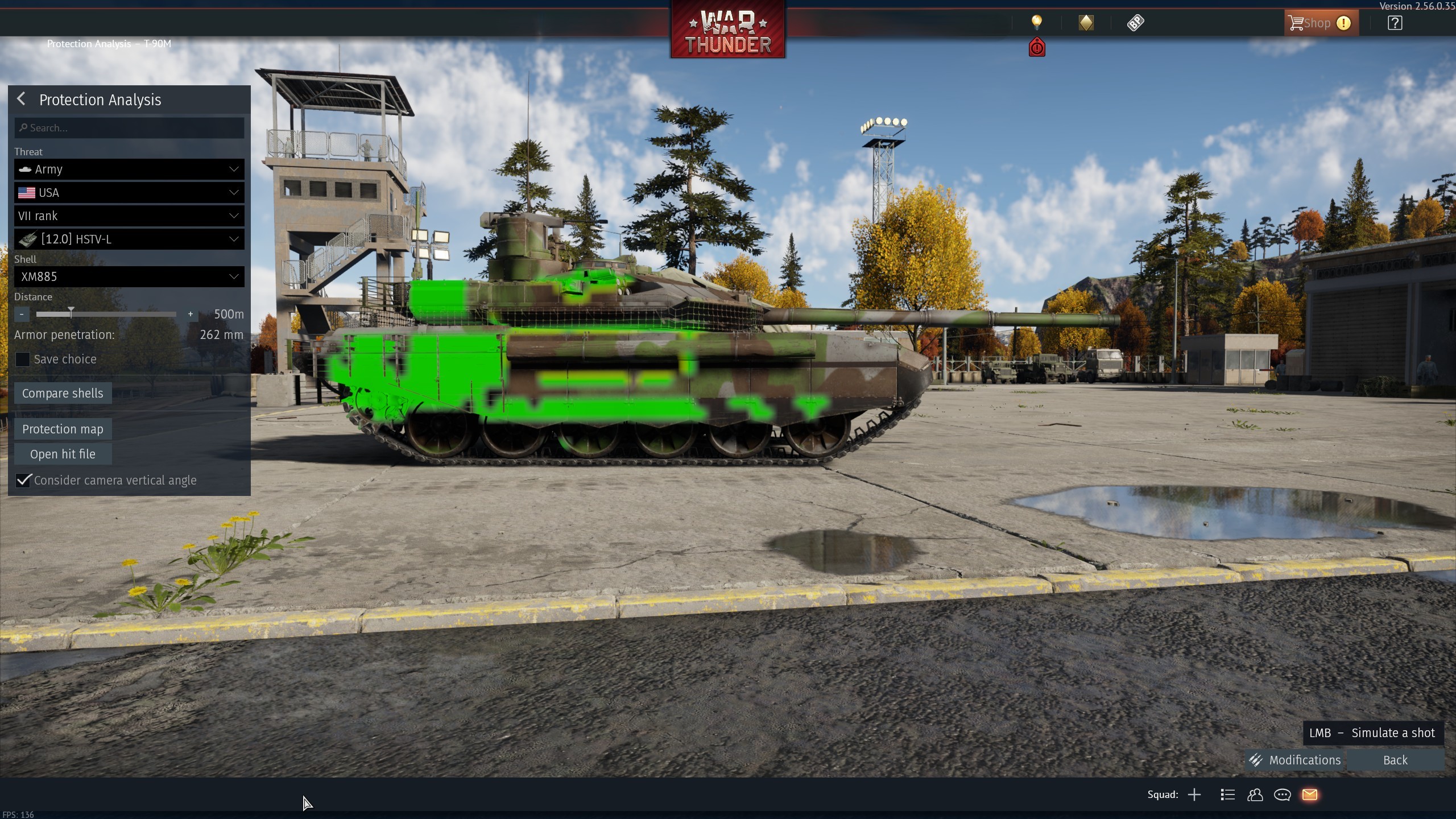
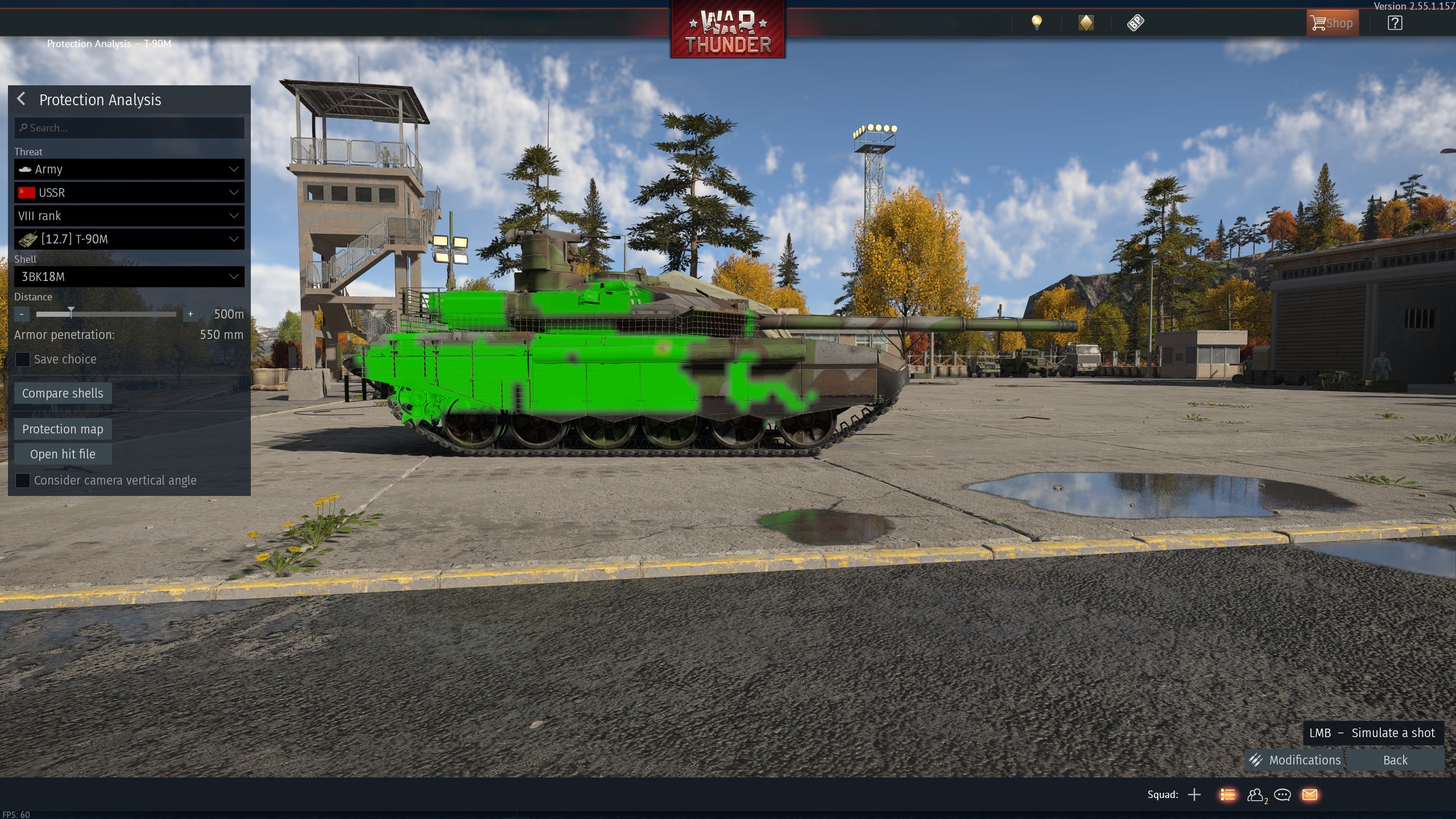
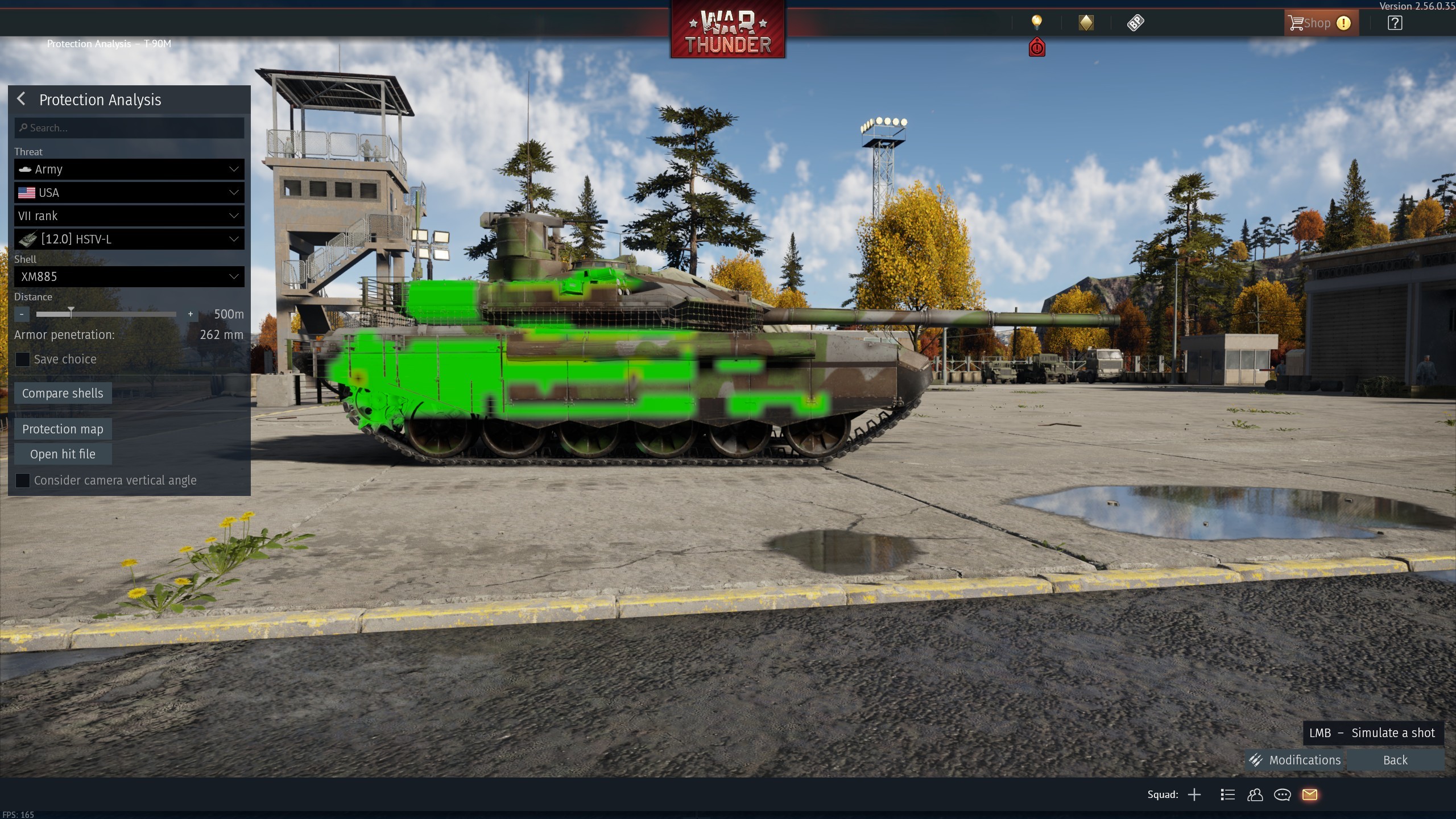
And so scary Relikt buff doesn’t change anything for HSTV-L at least? 3 out 4 are the same
Finally brought it to some kind of historicity as the best tank of the 21st century
the weight of this tank (m1a2 SEPv3) is 73-75 tons, I decided to download the DEV server and saw that it weighs 66 tons for some reason
The joke is that if a tank weighs more than 70 tons, then the armor should be better than the hull and turret, not just the turret
If gaijin doesn’t want to improve the hull armor, then they should at least add anti-fragment armor on the sides (spall Liners)
I’m not even talking about the SEP v1 and v2, these tanks were still in the era of the Iraq War, when there were no powerful guns. They may have realistic armor, but a tank that weighs 75 tons and was released in 2017 should have improved armor in the turret and hull (I don’t believe that +10 tons is just an improvement in the turret armor - that’s ridiculous).
I have just received a really comprehensive message from a quite well cultivated user on Reddit, and also a sweetheart.
I will share it here, for I find it to be a quite constructive contribution to our cause;
Hello SpanishAvenger,
I’ve seen your posts regarding the M1A2 SEPv3 debacle on the main War Thunder subreddit, and I would like to give you some advice that may assist you in your crusade to improve the M1A2 SEPv3 armor. However, I would prefer to give this advice directly to you. The reason being the for lack of a better term, the large crowd of (redacted) who have been attracted to your two posts that would either drown out or twist what I am going to say.
I am an engineering student, and a graduate student at that pursuing a doctorate in aerospace engineering. I have published my first paper in AIAA’s journal of heat transfer, and I am currently working on publishing my second. In this process I have dealt with reviews and scrutiny which remind me strongly of what I have seen in the bug report chains I have read.
First things first, Gaijin does not use the actual values for armor thickness and armor penetration. They use an approximation of these values through the DeMarr and Lanz-Odermatt equations. This is why, especially in the case of APFSDS rounds, values can differ heavily from reality. For example certain figures showing DM53 having in excess of 800mm penetration at 2km in real life compared to in game where it has roughly 650mm at point blank. Importantly, it also applies to armor. Composite armor is not actually modelled in game, instead the armor is treated as a steel equivalent which has modifiers to adjust its performance against KE or CE penetrators. These modifiers are then calculated from educated guesses based on the size, shape, and rough composition of the actual armor using these equations.
Contrary to what some are saying this is done for consistency. NATO countries use a 50/50 rule to determine the penetration of KE rounds, where 50% of rounds fail to pen, and 50% succeed. The Russians use a 80/20 rule where 80% of rounds penetrate. This would result in two different sets of penetration figures for an identical set of penetrators if tested to both standards. By using the approximations, this can be standardized and avoided. For APFSDS, this calculation is dependent on projectile mass, velocity, diameter, and length. Any of the intricacies of segmentations, alternating materials, and tip design and composition is ignored which bypasses the classified portions of the projectile while allowing for a semi-accurate representation of it in this standardized implementation.
Armor is treated in the same manner with the previously mentioned modifiers. Gaijin knows rough layouts, but not the actual compositions. I suspect the factors they are using behind the scenes boil down simply to armor arrangement, composite depth, and composite weight. The X-Ray views always follow this manner. They always show the actual thickness and type of armor for the front and backing steel plates, while the actual composite is given a simple type “NERA” or “Textolite” and a thickness. This is true of essentially every MBT, whether it be large slabs of Chobham on NATO MBT’s or multilayer sandwiches like the T-80b upper plate. This again allows them to model in a semi-accurate representation modern tank armor while ignoring the actual classified portions of it.
So now getting into how this affects you in your mission to improve the SEPv3. You need to prove two things in order to have a proper shot in getting this approved and fixed: a) that the armor was in fact upgraded, and b) by roughly how much it was upgraded.
Now you and your people have already dug up sources definitely showing in testing and congressional budget reports that the hull armor and turret armor were improved. This satisfies point a). However, this does now provide any meaningful actionable data. The improvement could be a 1mm increase in effective KE protection or it could be 1m, we do not know as the source does not specify anything on how the armor was improved. As a result point b) remains unresolved.
The method I have seen you and other people use to try to overcome point b) is the M1A1 armor upgrade from the 90s that was cancelled. I see why this is tempting, as the sources definitively state a 30% increase in KE protection which would satisfy point b). However, this will never work in any capacity. This armor upgrade package is a rejected prototype from the 90s. There is zero indication in any source that is unclassified and available to us which states there is any connection between this M1A1 upgrade and the M1A2C. You would have more luck trying to argue to Gaijin that the M1A2C actually has a diesel engine instead of a gas turbine engine because one of the M1A1 AIM prototypes trialed by Australia had one.
In addition, there is also the source floating around that shows the M1A1 hull upgrade being equivalent to 600 mm of KE protection in comparison to hypothetical versions of the 152mm armed Obj. 195 and Obj. 477. This would also fail for the previously mentioned reasons and the fact that it would be subject to semi classified NATO armor protection standards before Gaijin could use it.
So how do we get past this hurdle? Here is my proposal. There is an image that has been included in some of these reports. This shows a bog standard M1A2 with steel test weights applied to the turret and hull to simulate the weights of the upgraded composites. Most people have tried to use it to claim that there was indeed an increase to the hull composite effectiveness by virtue of the test weight. However, just like the congressional reports, this provides no actionable information, just that there was some kind of upgrade. However, this image can actually be the source of real actionable information. We know the test weights are steel, we know their rough geometry, and we know their rough position. If someone can extract the M1A2 model from War Thunder, and roughly model the test weights, we can calculate the actual mass of them. In addition to this, we know the actual size of these composite armor blocks did not change meaningfully between the M1A2C and M1A2. So if you can measure the actual mass of the test weights from the model recreation, you can file a bug report that shows that a congressional report states upgraded hull and turret cheek composites are present, and from the test weight mass calculations, each turret cheek composite array contains 1200 kg of additional composite material in the same volume and the hull array contains 1000 kg of additional composite material. Granted the numbers I just stated here are educated guesses. This however, gives Gaijin proof of additional armor composite via congressional report, and a rough actionable quantity of how much it is improved via the increase in composite mass in the arrays. This would also fix the issue where the M1A2C does have additional turret armor, delivered entirely by the addition of a 152 mm plate on the face of the turret which corresponds roughly to the weight of the test weights on the M1A2 testbed turret.
The reason why we have to do this boils down to burden of proof. Gaijin has done their own research, and believes the current implementation is accurate. However, we do not believe it is accurate based on the information we have. However, we can’t just simply state the model is inaccurate, we have to prove it is as we are the ones attempting to change it. This method I detailed would be one manner for doing so.
Just ensure that any bug reports contain the congressional reports, accurate weight calculations, include every step showing the reproduction, and only sources pertaining directly to the M1A2 SEPv3. Any other source not related no matter how minor can jeopardize the entire report. If the entire process of weight calculation is not shown it can also jeopardize the report.
Also calmness is key, and emotional or flowery language can torpedo this.
As dry, clinical, and technical as possible while writing the actual report.
regards,
Ivan
29 Likes
That’s a good shout. If we get the Weight of those steel weights, we can see how much weight is added on turret and hull.

9 Likes
Seems like a pretty close idea of how the trunnion and bulkhead bug reports were roughly created, it’s a solid idea backed up by math with known records
4 Likes
That is probably the most reasonable thing i’ve ever seen come out of Reddit in any way shape or form.
14 Likes
US Tons or Short Tons and Metric Tons are different.
2 Likes
Indeed! Receiving this message felt like a blessing, and I feel absolutely flattered that he chose me to deliver it.
6 Likes
Could you please spoiler this? Or at least part of it? It’s a very big wall of text on mobile
Thats really weird, for me the hstvl cannot go through any of the era plats other than the gaps around the actual era part.
You got screenshot of it?
2 Likes