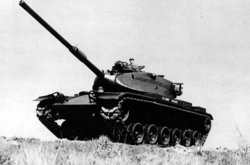
With over 15,000 produced, the M60A1 was the workhorse of the US military for many years. It received numerous modifications and upgrades throughout its service life and saw combat/ use with countries from around the world.
HISTORY
During the Cold War, the US was always making improvements to its tanks, as Soviet armor and weapons improved, so did America’s. This constant improvement eventually led to the introduction of the M48 in 1952, and while the M48 was good for its time, it was quickly rendered obsolete for traditional tank combat after the capture and study of a Russian T54A. It was decided that, to remain in service, it needed to be significantly upgraded in terms of armor and firepower.
The resulting tank was such a radical change to the design that it was given its own designation, and the M60 was created. The M60 was armed with a 105mm M68 cannon and featured improved armor compared to the M48. The upper and lower front plates were now flat, unlike the M48’s curved ones. Compared to the M48’s 90mm, which was a significant improvement over its predecessor, and offered a significant advantage for the new tank in terms of range and accuracy. The M60 was capable of firing APDS, HEAT-FS, HESH, and smoke rounds. However, the M60 kept the same rounded turret shape as the M48 and lacked a stabilizer just as the M48 did.
The production of the M60 began in 1959 at Chrysler’s tank division plant in Newark, Delaware. In 1960, production was shifted to Warren, Michigan. Despite the firepower and fuel improvements of the original M60, the Army was not entirely satisfied with its ballistic protection and turret space. This led directly to the development of the M60A1 in the early 1960s. In 1963, the M60 received a new needle-nosed turret that shifted the gun 5in forward and gave the crew more space within the turret.
The most significant change was the introduction of a completely redesigned, elongated “needle-nose” turret. This new turret featured a sharply sloped front profile that greatly increased the likelihood of deflecting incoming enemy shells compared to the rounded, bulbous shape of earlier M48/M60 designs. Additionally, the new design provided the crew with better ergonomics, more ammunition storage, and improved armor thickness on both the hull and the turret face.
Production of the M60A1 began in 1962 and quickly became the standard frontline armor for the U.S. Army and Marine Corps. However, during this specific early era, the tank lacked a gun stabilization system, meaning the crew could not accurately fire while the vehicle was moving. Gunners had to rely on a traditional optical rangefinder and mechanical ballistic computers, requiring the tank to come to a complete stop to lay its sights and engage a target accurately. This unstabilized M60A1 would remain the baseline configuration for over a decade, serving as NATO’s primary shield in Europe until the dynamic upgrades of the 1970s finally brought add-on stabilization kits to the fleet.
The development and production of the M60A1 main battle tank arose directly from the U.S. Army’s shortcomings with the M60’s ballistic protection and its restricted turret interior space. While the initial 1959 hull design successfully introduced a flat upper front plate and a diesel powerplant, it still used the older, rounded M48-style turret. To address these shortcomings, engineers designed a brand-new, elongated turret designated the T95E7 type. This revolutionary “needle-nose” turret featured a drastically reduced frontal profile and sharply sloped cheek armor, which vastly increased the tank’s kinetic energy deflection capabilities compared to its bulbous predecessor.
With the design finalized, production of the M60A1 officially commenced in October 1962 at the Detroit Arsenal Tank Plant in Warren, Michigan, under the Chrysler Corporation. The transition on the assembly lines was swift, and the Army immediately prioritized these new vehicles for frontline units. Unlike the early production run of the baseline M60, which had been split between facilities in Delaware and Michigan, the M60A1 production was centralized in Warren to streamline the manufacturing of the new turret castings and the integration of updated internal components.
By 1963, the assembly lines were in full swing, and the structural advantages of the needle-nose turret became apparent to the crews receiving them. Shifting the 105mm M68 cannon mounts five inches forward within the new turret architecture had freed up significant physical space inside the fighting compartment. This optimization vastly improved crew ergonomics for the commander, gunner, and loader. Furthermore, it allowed for a substantial increase in ready-use ammunition storage, enabling the vehicle to carry more APDS, HEAT-FS, and HESH rounds into battle than the original 1959 model.
As production moved through 1964, Chrysler focused on refining the vehicle’s manufacturing standards and internal subsystems. The early M60A1s rolling off the line during this period were outfitted with the reliable Continental AVDS-1790-2 diesel engine and a mechanical ballistic computer system linked to a stereoscopic optical rangefinder. Because these mid-60s vehicles entirely lacked a gun stabilization system, precision engineering during assembly was critical.
The gun mounts and turret ring gear had to be machined to precise specifications to ensure the gunner could smoothly lay the sights onto a target once the tank came to a complete stop. In 1972, the M60A1 received a stabilization kit developed by Cadillac Gauge, which was designated M60A1 AOS.
STATS
Armor
(armor layout is completely identical to the M60A1 AOS)
Material: RHA
Hull: 108/70/40
Turret: 230/49/57
Mobility
Weight: 48 tons/ 52 tons combat loaded
Range: 300 miles/ 500 km
Top Speed: 30mph
Engine: Continental AVDS-1790-2 V12, air-cooled twin-turbo diesel engine 750 Bhp
Power to weight: 15.08 bhp/ton
Transmission: Allison cross-drive CD-850-6 (2 forward, 1 back)
Weaponry
Main: 105mm M68 rifled gun
HEAT-FS: M456
APDS-T: M392A2
APDS-T: M728
HESH: M393A2
SMOKE: M416
Traverse: 22.5 degrees a second (360 degrees)
Elevation: 4 degrees a second -10+20
Secondary:
1x coax 7.62 m73 (ammo: 6000) (COAX)
Secondary:
1x Cupola mounted 12.7 M85 (ammo: 900)
Traverse: 22.5 degrees a second (360 degrees)
Elevation: -10/+54 (elevation rate is crew dependant)
Technology
The M60A1 was operated under normal conditions with both infrared and daytime sights and vision blocks; however, night vision at the time required an active infrared source. This was provided By the AN/VSS-1 (AN/VSS-1 Xenon spotlight decoration ). The M60A1 lacked a stabilizer until the AOS, meaning it had to stop, aim its gun, and train it on target before firing. The US military was aware of this shortcoming, so once the stabilization kits were made available, all M60A1s were upgraded with them.
Stabilizer: No
Night Vision: Yes (Driver, gunner, commander)
IR spotlight: Yes
Rangefinder: Yes
LRF: No
IMAGES
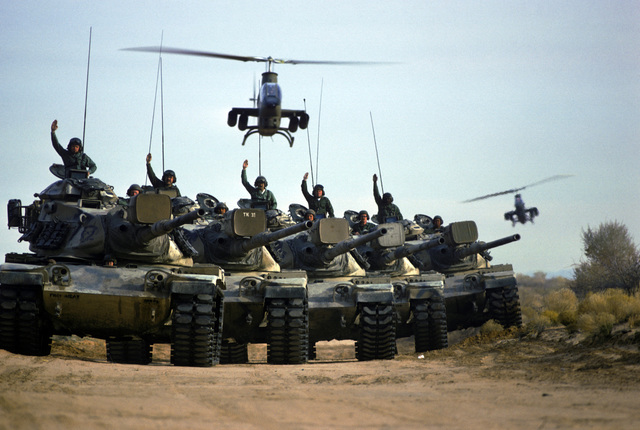
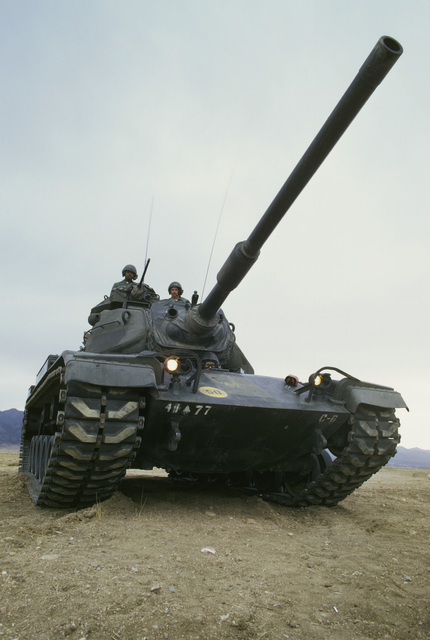
SOURCES
M60 tank - Wikipedia
The U.S. Army's M60A1 Main Battle Tank Summed Up in 4 Words - National Security Journal
105mm Gun Tank M60
Hunnicutt, R.P. Patton: A History of the American Main Battle Tank, volume 1. Navato, CA: Presidio Press, 1984.
1978 Field Gunnery Manual
TM-11-5855-250-12
Osprey New Vanguard 85 - Richard Lathrop, Jim Laurier - M60 Main Battle Tank 1960–91 (2003)
- yes
- no