The Ju 248(Me 263)

I would love to see the Ju 248 in game.
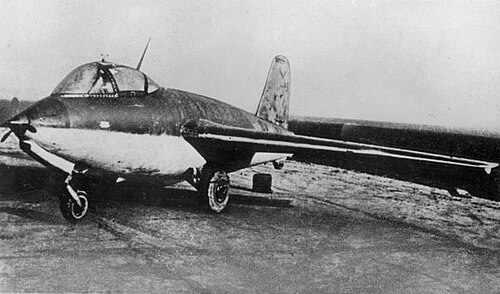
The Ju 248 is a German Jet Fighter and was supposed to be the successor of the Me 163. It never flew but it was completely build and fitted with the engine(HWK 109-509C) in September of 1944. The reason it never flew with it it’s engine is due to a lack of fuel. But between February 8th and 19th, 1945, Karl Wendt, together with the experienced Junkers chief pilot Hans-Joachim Pancherz, completed a total of 13 unpowered gliding flights with the prototype.
Here are some Key Datas
Crew 1
Length 7.89 m
Wingspan 9.55 m
Height 2.70 m
Wing Area 17.80 m²
Wing Loading Empty Weight: 123.6 kg/m²
Max. Takeoff Weight: 298.4 kg/m²
Landing Weight: 147.5 kg/m²
Wingspan 5.1
Empty weight 2200 kg
Maximum takeoff weight 5312 kg
Landing weight 2626 kg (after fuel consumption)
Maximum speed 950 km/h (at 6000 m)
Cruising speed 145 km/h (gliding)
Ascent time to 13,000 m: 3 min
Maximum flight altitude: 16,000 m
Range: 165 km (from 11 km gliding flight)
Engine: Walter HWK 109-509C-4 rocket engine with up to 2355 kp thrust
Armament: two 30 mm MK 108 cannons
Me_263_44217944

Since this jet is not a paper plane but an existing one, it should be added. But
The Me 263 V1 was the only prototype of the series to undergo extensive aerodynamic flight testing. For safety reasons during its initial unpowered glider flights, the aircraft’s newly designed tricycle landing gear was locked in a fixed, extended position. Although a functional twin-chamber Walter HWK 109-509C rocket engine was eventually mounted in the rear fuselage, early balance tests utilized a dummy weight to maintain the correct center of gravity. Technicians used this airframe for crucial aerodynamic research, which included taping wool tufts to the wings to observe airflow patterns in flight. The V1 carried no weapons or combat equipment.

The V2 prototype was completed shortly after the V1 and was specifically built to test the mechanical systems of the aircraft. Unlike the first prototype, the V2 featured a fully functional, hydraulically retractable tricycle landing gear intended for in-flight operation. It was also physically fitted with a real Walter rocket motor to ensure proper weight distribution and systems integration. However, due to mounting wartime delays and the chaotic collapse of the German testing infrastructure, the engineering team never managed to conduct comprehensive dynamic flight tests of the retraction mechanism before the project halted.

The V3 prototype was intended to serve as the definitive production pattern for the planned Me 263 A-1 series, but it remained incomplete in the final assembly shop at the end of the war. It was the only airframe designated to receive a full combat loadout, which featured a planned installation of two heavy 30mm MK 108 autocannons mounted directly into the wing roots. While both the operational rocket engine and the retractable landing gear systems were allocated for this airframe, the rapidly advancing Allied forces prevented technicians from finalizing or optimizing the aircraft for actual flight operations.

When American forces initially moved into the Dessau manufacturing facility, they encountered all three experimental airframes in various stages of abandonment. The Americans chose to destroy the V2 prototype on-site via demolition charges to prevent it from being salvaged. Shortly afterward, a boundary shift placed the factory into the Soviet occupation zone, allowing Soviet forces to capture the flight-tested V1 and the nearly completed V3, along with a full-scale wooden mock-up. Soviet aviation engineers immediately evacuated these captured assets to the USSR, using them as the direct design foundation for their own experimental rocket interceptor, the Mikoyan-Gurevich I-270.

This suggestion is for the Junkers Ju 248 (later designated as the Messerschmitt Me 263), a German rocket-powered point-defense interceptor designed at the end of World War II. Developed as a direct successor to the flawed Me 163 “Komet”, it addressed major safety and operational issues by introducing a proper retractable tricycle landing gear, increased fuel capacity, and a dual-chamber auxiliary cruise engine.
Unlike purely theoretical “Paper Planes,” the Ju 248/Me 263 was completely built, structurally completed with its engine installed, and underwent documented unpowered aerodynamic flight testing. It represents a vital historical link to post-war Soviet rocket aircraft development (such as the I-270).
[spoiler=2. Structural History & Context]
The Ju 248 was born out of the desperate need to fix the fatal flaws of the Me 163 Komet. While the Komet was fast, its landing skid frequently caused spine injuries to pilots, and the lack of a landing gear meant it was a sitting duck on the airfield after fuel exhaustion. Furthermore, it lacked fuel capacity for sustained combat.
Junkers took over the design to implement a deep fuselage redesign, allowing for conventional landing gear and massive fuel storage. Between February 8th and 19th, 1945, test pilot Karl Wendt and Junkers Chief Pilot Hans-Joachim Pancherz completed 13 successful unpowered gliding flights at Dessau. The aircraft proved to have vastly superior aerodynamic stability over its predecessor. When American forces initially moved into the Dessau manufacturing facility, they encountered all three experimental airframes in various stages of abandonment. Shortly afterward, a boundary shift placed the factory into the Soviet occupation zone, allowing Soviet forces to capture the flight-tested V1 and the nearly completed V3.
[/spoiler]
[spoiler=3. Prototype Breakdown (V1, V2, V3)]
Me 263 V1 (Ju 248 Prototyp 1): The only prototype to undergo extensive aerodynamic flight testing. Completed a total of 13 unpowered gliding flights. For safety reasons during its initial flights, the aircraft’s newly designed tricycle landing gear was locked in a fixed, extended position. Although a functional twin-chamber Walter HWK 109-509C rocket engine was eventually mounted in the rear fuselage, early balance tests utilized a dummy weight to maintain the correct center of gravity. Technicians used this airframe for crucial aerodynamic research, which included taping wool tufts to the wings to observe airflow patterns in flight. The V1 carried no weapons or combat equipment.
Me 263 V2: This prototype was completed shortly after the V1 and was specifically built to test the mechanical systems of the aircraft. Unlike the first prototype, the V2 featured a fully functional, hydraulically retractable tricycle landing gear intended for in-flight operation. It was also physically fitted with a real Walter rocket motor to ensure proper weight distribution and systems integration. However, due to mounting wartime delays and the chaotic collapse of the German testing infrastructure, the engineering team never managed to conduct comprehensive dynamic flight tests of the retraction mechanism before American forces chose to destroy the V2 prototype on-site via demolition charges to prevent it from being salvaged.
Me 263 V3: Intended to serve as the definitive production pattern for the planned Me 263 A-1 series, but it remained incomplete in the final assembly shop at the end of the war. It was the only airframe designated to receive a full combat loadout, which featured a planned installation of two heavy 30mm MK 108 autocannons mounted directly into the wing roots. While both the operational rocket engine and the retractable landing gear systems were allocated for this airframe, the rapidly advancing Allied forces prevented technicians from finalizing or optimizing the aircraft for actual flight operations. Soviet aviation engineers immediately evacuated this captured asset to the USSR, using it as the direct design foundation for their own experimental rocket interceptor, the Mikoyan-Gurevich I-270.
[/spoiler]
[spoiler=4. Technical Specifications & Performance Data]
General Characteristics
Crew: 1 (Pilot)
Length: 7.89 m
Wingspan: 9.55 m
Height: 2.70 m
Wing Area: 17.80 m²
Empty Weight: 2,200 kg
Landing Weight (Fuel Exhausted): 2,626 kg
Maximum Takeoff Weight (MTOW): 5,312 kg
Wing Loading (Empty): 123.6 kg/m²
Wing Loading (Max Takeoff): 298.4 kg/m²
Powerplant & Propulsion
Engine: 1× Walter HWK 109-509C-4 liquid-propellant rocket engine
Thrust:
Main Chamber (Max Thrust): 2,000 kp (19.6 kN)
Auxiliary Cruise Chamber (Marschofen): 355 kp (3.48 kN)
Total Combined Thrust: 2,355 kp (~23.1 kN)
Performance
Maximum Speed: 950 km/h (at 6,000 m altitude)
Cruising Speed (Gliding): 145 km/h
Rate of Climb / Ascent Time: Climbs to 13,000 m in 3.0 minutes
Service Ceiling: 16,000 m
Operational Range: 165 km (including 11 km post-power gliding flight)
Powered Flight Endurance: Approx. 15 minutes (utilizing the auxiliary cruise chamber)
Armament (V3 / Production Specification)
Guns: 2× 30 mm MK 108 autocannons mounted in the wing roots.
Ammunition: Estimated 60 rounds per gun (Standard German interceptor loadout).
[/spoiler]
[spoiler=5. Proposed War Thunder Implementation]
Placement: German Aviation Tree, Rank V. It functions as a direct folder-option or successor to the Me 163 B / Me 163 B-0.
Expected Battle Rating (BR): Around 8.0 - 8.3 (Realistic Battles).
Gameplay Style: Unlike the Me 163 B, which suffers severely from its landing skid and lack of a cruise engine, the Me 263 / Ju 248 would feature a reliable tricycle landing gear, allowing standard airfield rearming and repairing. The dual-chamber rocket engine would allow players to turn off the main engine and toggle the auxiliary cruise chamber to conserve fuel, extending tactical longevity in matches. It would balance out its higher weight and slightly altered wing load with vastly better tactical flexibility.
[/spoiler]
[spoiler=6. Sources & Documentation]
Dressel, J., & Griehl, M. (1995). The Luftwaffe Album: Bomber and Fighter Aircraft of the German Air Force 1933-1945. Brockhampton Press.
Green, W. (1970). Warplanes of the Third Reich. Macdonald & Co.
Maloney, E. T. (1968). Messerschmitt Me 163 “Komet”. Aero Publishers.
Ransom, S., & Cammann, H. H. (2002). Jagdgeschwader 400: Germany’s Elite Rocket Fighters of World War II. Osprey Publishing.
Schick, W., & Meyer, I. (1997). Luftwaffe Secret Projects: Fighters 1939-1945. Midland Publishing.
Ziegler, M. (1990). Rocket Fighter: The Story of the Me 163. Arms & Armour Press.
[/spoiler]