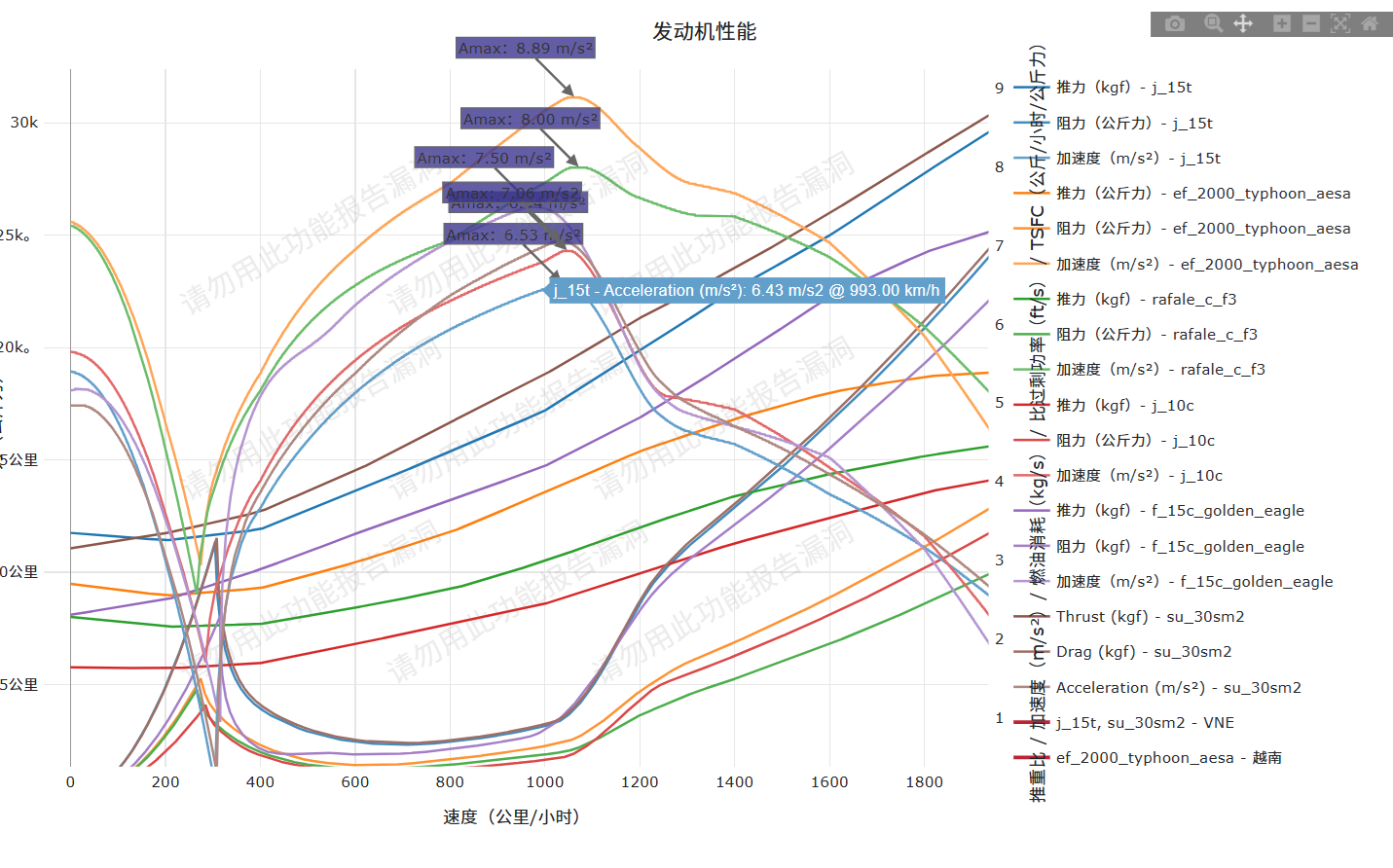
Based on the latest data from the test server on March 3, the WS‑10B engine shows a significant lack of ram effect at high altitudes and high speeds, even performing worse than its predecessor, the WS‑10A. This is inconsistent with the PLA Air Force’s combat doctrine emphasizing high‑altitude, high‑speed beyond‑visual‑range (BVR) engagements.
Take the 7,000‑meter altitude band as an example:
At 0 km/h: twin‑engine thrust of the WS‑10B is 11750 kgf, and the WS‑10A is 10447 kgf, with a difference of 1303 kgf.
At 400 km/h: twin‑engine thrust of the WS‑10B is 11915 kgf, and the WS‑10A is 10968 kgf, with a difference of 947 kgf.
The thrust increase from ram effect for the twin‑engine WS‑10B at this speed is 165 kgf, while for the twin‑engine WS‑10A it is 521 kgf. Despite having greater static thrust and more advanced technology, the WS‑10B exhibits lower ram efficiency than the older WS‑10A.
While this may seem insignificant at first glance, the gap widens further at higher speeds, including supersonic speeds. As a result, the performance improvement of the WS‑10B over the WS‑10A at high altitudes and high speeds is minimal, which violates the logical progression of equipment development. Consequently, the J‑15T ranks last among top‑tier fighter jets in terms of acceleration at high altitudes and high speeds, which contradicts the development logic of PLA Air Force equipment.
We urge the game developers to address this issue. Please adjust the ram effect of the WS‑10B appropriately at high altitudes and high speeds, so that its ram gain ratio across all speed ranges matches that of the WS‑10A.
In the minor test server updates 0.20–0.21, the thrust curve of the WS‑10B engine has been adjusted. According to the revised data, its thrust coefficient across all altitude and speed ranges remains lower than that of the WS‑10A. This results in insufficient thrust at high altitudes and high speeds, significantly limiting the aircraft’s climb and acceleration performance, and causing the J‑15T’s energy characteristics at high altitudes and high speeds to lag behind top‑tier fighter jets.We ask the game developers to re‑examine and adjust the data related to the WS‑10B thrust envelope.
Taking the latest data of the WS‑10B engine flight envelope from the test server version .21 on March 3 as an example, the engine’s ram thrust coefficient is lower than that of the WS‑10A at all altitude ranges, resulting in a significant difference in the curve growth rate compared with the WS‑10A.
We sincerely hope the game developers will check the relevant coefficients and adjust the thrust curve reasonably. The acceleration curve of the J‑15T at high altitudes and high speeds is already ranked last among top‑tier fighter aircraft, and we hope this issue will be taken seriously.
WS10B is a high-altitude, high-speed engine, similar to the F110. Its performance at high altitude and high speed is definitely superior to that of the AL41F. China’s most advanced fighter jets, such as the early J16 and J20, all use this engine. The J15T, being China’s latest and most advanced fighter jet, only falls short of the SU-30SM2 in terms of performance, which is completely unacceptable
The RWR of the J-10C and J-15T should receive performance enhancements.
On Chinese forums, some people claim that the J-15T outperforms the Su-30SM2 at medium-low altitudes of 5 kilometers.
But is that really the case?
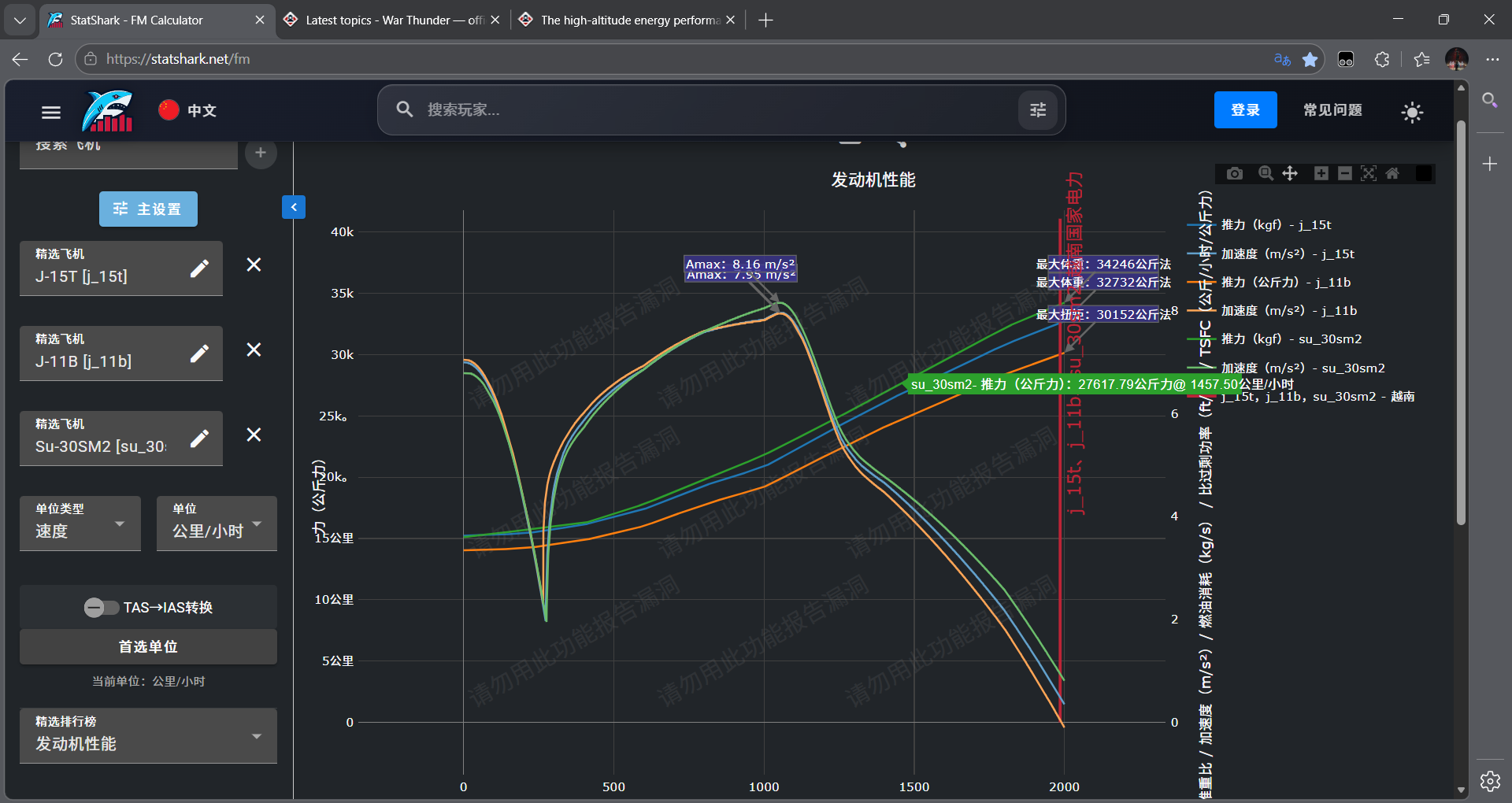
Facts have proven that the Su-30SM2 is superior to the J-15T even at medium and low altitudes.
The energy characteristics of the Su-30SM2 are better than those of the J-15T at any altitude, as long as the speed exceeds 600 km/h.
This is the top-tier aircraft Gaijin has prepared for China.
The J-15T has fewer missiles, weaker energy performance, worse ground-attack capability, poorer missile quality, an inferior engine, a less capable radar, and fewer countermeasure flares than the Su-30SM2.
Its only advantage is that it has a MAWS — but is that really worth a BR of 14.7?
The current J-15T is nothing more than a J-11B with an AESA radar, half the countermeasure count, and two extra missiles!
Honestly, I’m really getting a bit angry.
Gaijin wants money from Chinese players, yet this is what they give us?
Do you really think something like this will convince Chinese players to buy the MKK?
Or do you think no one on Chinese forums has noticed this problem yet?
how are pl12a’s right now?
Copy paste pl12
Currently its just a PL-12 with more battery life and no launch limits
no launch limit might be good considering the extreme maneuverability but should it get more range?
Should yes, and it technically does with the longer battery life.
It has a visibly larger engine compartment than the old PL-12 but in gaijins eyes more range = more battery life
Pl12 A/AE is the same they both uses the motor of the pl15 or a earlier variant of ttlat motor, in range pl 15 and pl12A should be close to eachother
how can they be the same if pl15 is dual pulse? is pl12a dual pulse too irl?
Thats what i wanted to edit, the only difference is the double pulse engine, i just got thrown out of the forum, but the rocket fuel mixture is pretty much the same as the pl15
Can we stop talking about this like its confirmed information…
Its “BELIVED” to be the same rocket engine as the PL-15E but without dual pulse its not confirmed or even mentioned anywhere…
In fact, the clear aim of Gaijin is to target the subsequent models of the Chinese Air Force, such as the J16 and J20, which are equipped with the WS-10B engine.If Gaijin still keeps the data of the Taihang unchanged, then the future strength of the Chinese Air Force is already doomed.
Agree
I agree with you. Bvvd plays a trick, what he had done toWS-10B actually hurts Chinese players. WS-10B engine should be improved IMMEDIATELY!!!
I have also noticed areas that require improvement regarding the thrust envelope of the WS‑10B engine:
Based on the latest data from Test Server .21 on March 3 and the flight envelope of the WS‑10B engine, the ram thrust coefficient of the engine is lower than that of the WS‑10A at all altitude ranges, resulting in a significant difference in the growth rate of the thrust curve compared with the WS‑10A.I sincerely hope the game developers will check the relevant coefficients and adjust the thrust curve appropriately.Currently, in top‑tier fighter matches, the J‑15T ranks last in acceleration performance at high altitude and high speed, and I hope this issue can be taken seriously.
This problem is specifically demonstrated at an altitude of 7,000 meters:
At 0 km/h:Dual WS‑10B thrust: 11,750 kgfDual WS‑10A thrust: 10,447 kgfDifference: 1,303 kgf
At 400 km/h:Dual WS‑10B thrust: 11,915 kgfDual WS‑10A thrust: 10,968 kgfDifference: 947 kgf
The dual WS‑10B gains 165 kgf of thrust from the ram effect at this speed range, while the dual WS‑10A gains 521 kgf from the ram effect.Despite having higher static thrust and being more technologically advanced, the WS‑10B even exhibits lower ram efficiency than its predecessor, the WS‑10A.
This may seem insignificant, but the gap will be further widened at higher speeds, even in the supersonic range, resulting in only a small improvement of the WS‑10B over the WS‑10A at high altitude and high speed.This issue is equally evident at other altitudes and speeds, resulting in low actual usable thrust from the WS‑10B.
According to the developers’ usual practice, thrust curves are usually created by scaling up the previous model proportionally based on the static thrust values shown in the in‑game interface.In other words, the thrust curve coefficients of the WS‑10B should be consistent with those of the existing WS‑10A in the game at all altitudes and speeds.However, in the latest test server, the coefficient of the WS‑10B is significantly lower than that of the WS‑10A, leading to insufficient thrust at high altitude and high speed.Currently, the climb and acceleration characteristics of the J‑15T in these altitude and speed ranges are far below the average level of top‑tier aircraft.
I sincerely hope the game developers will attach importance to this issue.
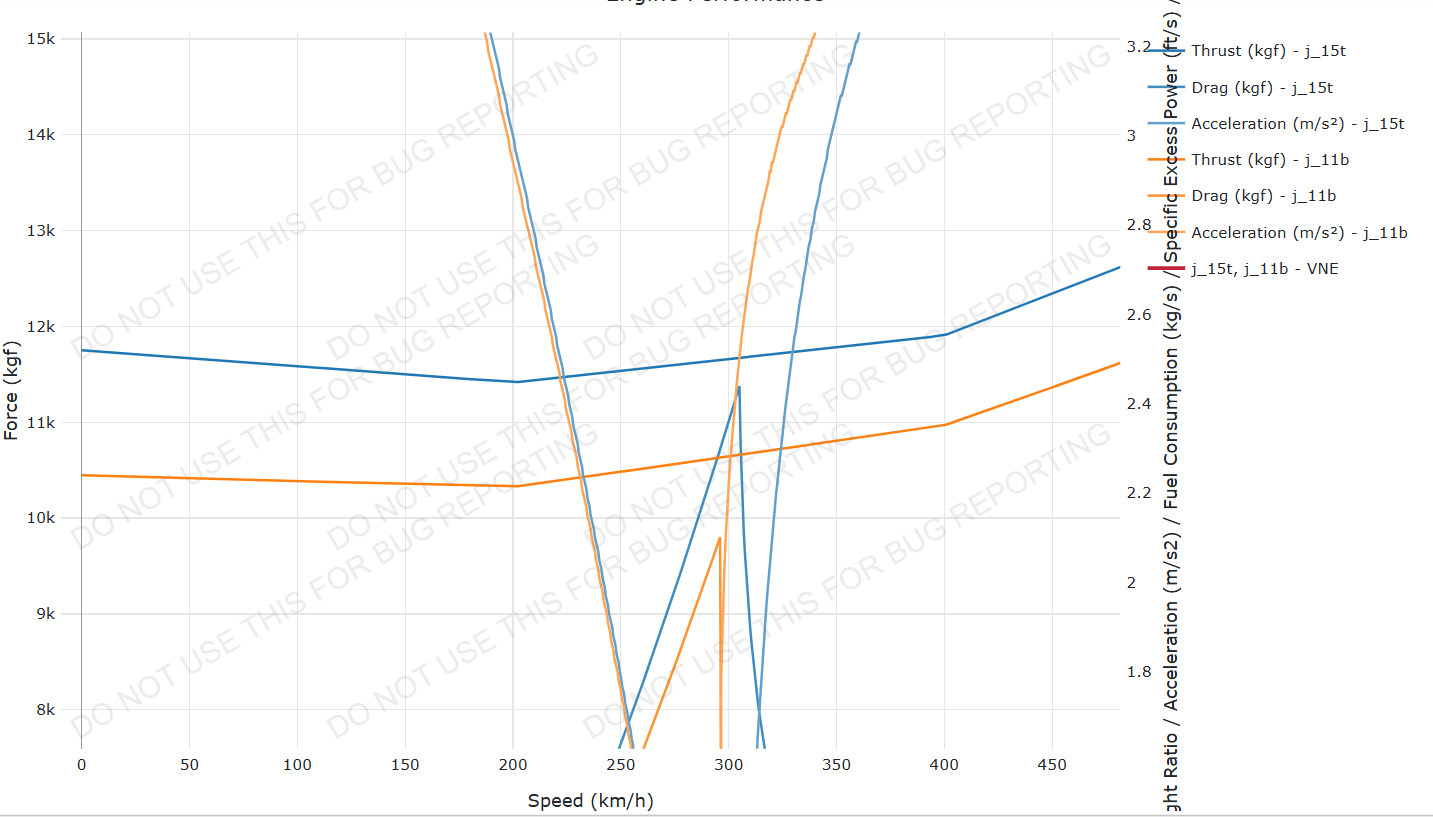
At 7,000 meters, it is clear from the curve that the gap between the two is narrowest at 400 km/h. This lower ram ratio will carry over to higher speeds, making the actual performance improvement of the WS‑10B disproportionate to its static thrust increase.This problem is equally obvious at other altitudes and speeds.