- Yes
- No
Hello all! This is my first ever aircraft suggestion, and in my opinion, I feel like this aircraft will be perfect for Warthunder.
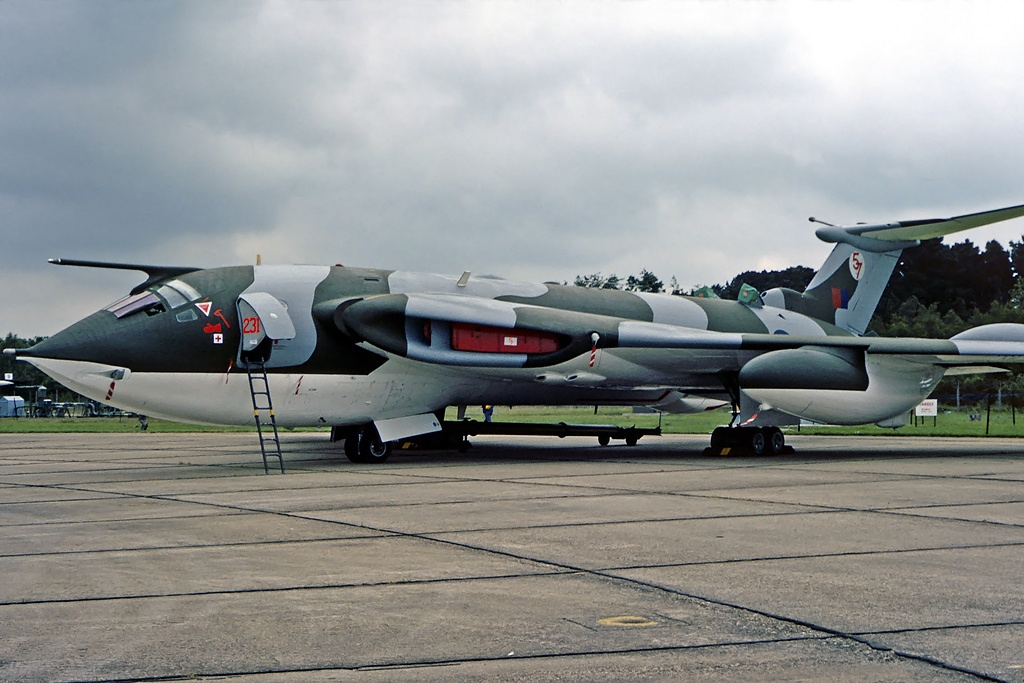
The Handley Page Victor B.2
The Handley Page Victor, or Victor for short, is a British jet-powered strategic bomber that was developed and produced by Handley Page within the Cold War. Its service was from 1958 up to 1969, as the British favoured the Vulcan as a large bomber force would no longer be needed.
The reason I suggest this absolute beauty of an aircraft is because I feel like it would fit perfectly within the new Nuclear Thunder mode, along with being a good bomber to compete with other various bombers within Warthunder, primarily the B-52H and the Tu-95. It would also be a great addition for the British Tech Tree, especially for its bombers. It could be great as an event vehicle, but in my opinion, I feel like having it part of the tech tree will be better.
History
The origin of the Victor and the other V bombers is linked to the early British atomic weapons programme and nuclear deterrent policies that were developed after the Second World War. The atom bomb programme formally began with Air Staff Operational Requirement OR.1001 issued in August 1946, which anticipated a government decision in January 1947 to authorise research and development work on atomic weapons; the US Atomic Energy Act of 1946 (McMahon Act) prohibited the export of atomic knowledge, even to countries that had collaborated on the Manhattan Project.
OR.1001 envisaged a weapon not to exceed 24 ft 2 in (7.37 m) in length, 5 ft (1.5 m) in diameter, 10,000 lb (4,500 kg) in weight, and suitable for release from 20,000 ft (6,100 m) to 50,000 ft (15,000 m).
At the same time, the Air Ministry drew up requirements for bombers to replace the piston-engine heavy bombers such as the Avro Lancaster and the new Avro Lincoln which equipped RAF Bomber Command.
In January 1947, the Ministry of Supply distributed Specification B.35/46 to aviation companies to satisfy Air Staff Operational Requirement OR.229 for “a medium range bomber landplane capable of carrying one 10,000 lb (4,500 kg) bomb to a target 1,500 nautical miles (2,800 km; 1,700 mi) from a base which may be anywhere in the world”. A cruising speed of 500 knots (930 km/h; 580 mph) at heights between 35,000 ft (11,000 m) and 50,000 ft (15,000 m) was specified. The maximum weight when fully loaded ought not to exceed 100,000 lb (45,000 kg). The weapons load was to include a 10,000 lb (4,500 kg) “Special gravity bomb” (i.e. a free-fall nuclear weapon), or over shorter ranges 20,000 lb (9,100 kg) of conventional bombs. No defensive weapons were to be carried, the aircraft relying on its speed and altitude to avoid opposing fighters.
The similar OR.230 required a “long range bomber” with a 2,000 nautical miles (2,300 mi; 3,700 km) radius of action at a height of 50,000 ft (15,000 m), a cruising speed of 575 miles per hour (925 km/h), and a maximum weight of 200,000 lb (91,000 kg) when fully loaded.
Responses to OR.230 were received from Short Brothers, Bristol, and Handley Page; the Air Ministry recognised that developing an aircraft to meet these stringent requirements would have been technically demanding and so expensive that the resulting bomber could be purchased only in small numbers.
Realising that the majority of likely targets would not require such a long range, a less demanding specification for a medium-range bomber, Air Ministry Specification B.35/46, was issued. This demanded the ability to carry the same 10,000 lb bomb-load to a target 1,500 nautical miles (2,800 km; 1,700 mi) away at a height of 45,000–50,000 ft (14,000–15,000 m) at a speed of 575 mph (925 km/h)
Specifications and Armament
--------------------------------------------------------------------------------------------------------------------------------------->Engines: 4 × Rolls-Royce Conway RCo.11 turbofan engines.
Thrust: 17,250 lbf (76.7 kN) per engine.
Wingspan: 120 ft (37 m).
First flight: 20 February 1959.
Entered RAF service: February 1962.
22,000lb (10,000kg) Grand Slam
2 x 12,000lb (5,400kg) Tallboy Earthquake Bombs
48 x 1,000lb (450kg) bombs
39 x 2,000lb (910kg) sea mines
ECM Suite (Could block enemy comms, and radar guided missiles)
Red Steer tail warning radar
Passive RWR (Radar Warning Receiver)
Metric Radar Jammer and Communications jamming equipment
Chaff/Flare housing on streamlined fairings on the trailing edges of the wings
Terrain-following radar (Not integrated into operational fleet, only trials)
Side Scan mode for bombing and navigation radar (Not integrated into operational fleet, only trials)
4 x Rolls-Royce Conway RCo.11 engines
17,250 lbf (76.7kN) - Thrust per engine
640 mph (1,030 km/h), approximately Mach 0.85 - Maximum Speed
580-595 mph (930-957 km/h) - Cruising Speed
52,500-55,000ft (16,000-16764m) - Service Ceiling
4,600 miles (7,400km) - Maximum Range
2,300 miles (3,700km) - Combat Range
In-game
In-game, I feel like it would be a perfect addition just before the Buccaneer S.2, at 9.3. It would suit this BR as the Victor B.2 has no offensive armament, similar to the Buccaneer and Canberra. It also suited the aircraft within Rank VI, such as the Lightning for re-fueling. In my opinion, the Victor B.2 would be an amazing addition to Warthunder. It would fit Nuclear Thunder perfectly, as it can carry its own nuke. It would also work well in Air RB as another Strategic Bomber, and along with the B-52H, and the Tu-95, it can expand on Strategic Bombers overall as a category for Warthunder’s future. It could lead to larger maps, more targets, and such for Air RB as a whole instead of just Nuclear Thunder.
Sources
https://ukdefenceforum.net/viewtopic.php?sid=e6168a5370e48e5ebbaa24eb8b66852d&t=1277