- Yes
- No
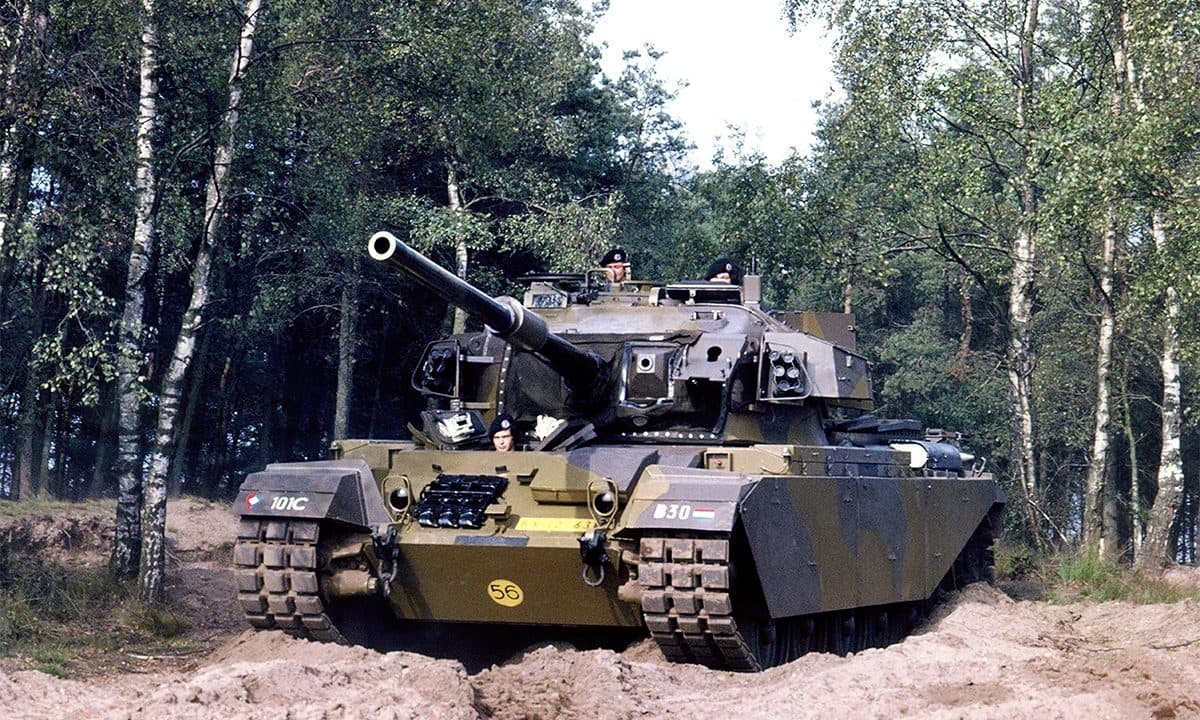
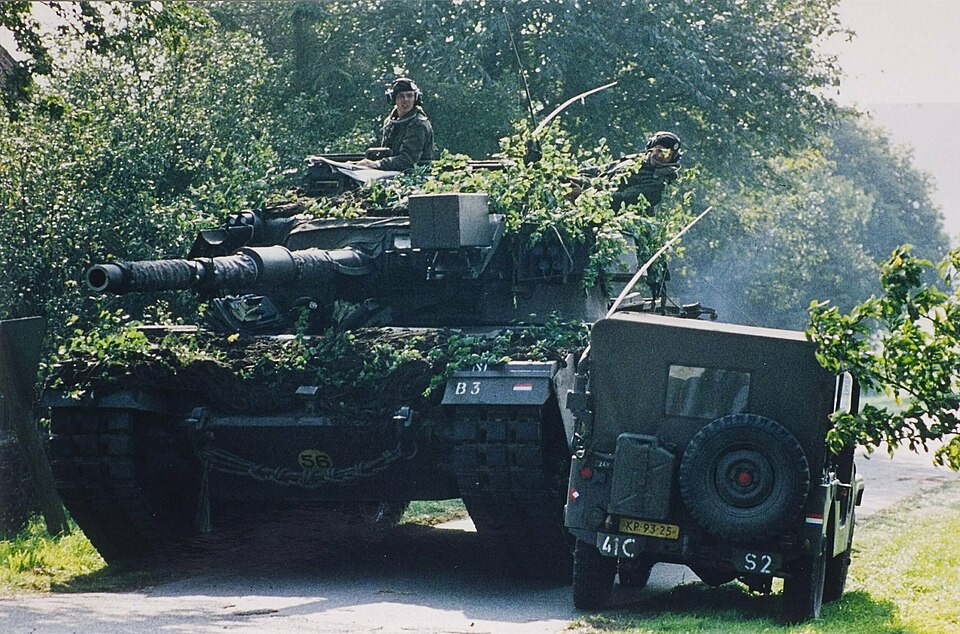
(Centurion Mk. 5/2 of 101Tankbataljon Regiment Huzaren Prins Alexander. without spotlight mounted)
1. History of the Vehicle
For more than three decades, the British-designed Centurion formed the backbone of the armoured forces of the Koninklijke Landmacht (KL). From its introduction in 1953 until its final withdrawal in the early 1980s, the Centurion equipped both ready and standby Dutch tank battalions and played a central role in the Netherlands’ Cold War defence posture within NATO.
The decision to adopt the Centurion was shaped by post-war realities. The Netherlands initially sought the American M47 Patton as a replacement for its heterogeneous and worn Sherman fleet. However, due to American requirements during the Korean War, the M47 was unavailable. Instead, under the Mutual Defence Assistance Program (MDAP), the United States financed the delivery of British Centurion tanks to the Netherlands. This decision proved fortuitous, as the Centurion was already recognised as one of the most capable post-war armoured designs.
Between 1953 and 1956, the Netherlands received several hundred Centurion Mk 3 tanks, which were soon upgraded to Mk 5 standard. Over time, further improvements were introduced to keep the vehicle relevant against evolving Warsaw Pact threats. The most significant of these upgrades was the replacement of the original 20-pounder gun with the British 105 mm L7, resulting in the designation Centurion Mk 5/2. This up-gunning program, carried out between the early 1960s and early 1970s, reflected a doctrinal shift toward increased long-range firepower rather than additional armour.
Despite its age, the Centurion remained in Dutch service well into the Leopard era. Budgetary constraints and organisational requirements meant that several tank battalions continued to operate the Mk 5/2 alongside Leopard 1 until the arrival of the Leopard 2 finally rendered the Centurion obsolete. By that time, the Centurion had served Dutch defence interests for over 34 years.
2. In-Game Role, Comparison, and Tech Tree Placement
The Centurion family is already represented in War Thunder through British, Swedish, and Israeli variants, which together define the vehicle’s gameplay role as a stabilised, high-accuracy gun platform with strong turret protection but limited mobility. The Dutch Centurion Mk 5/2 would fit naturally into this established gameplay niche while providing a historically distinct national variant.
Compared to the Centurion Mk 3 currently in game, the Dutch variant represent a major increase in lethality due to the adoption of the 105 mm L7 gun. This places them in the same firepower class as the Centurion Mk 10 and early Sho’t tanks, but without the later British hull upgrades. As a result, the Mk 5/2 functions as a balanced intermediate vehicle rather than a redundant copy of existing Centurions.
This vehicle is important for the BeNeLux sub-tree in the French tech tree. While France did not operate Centurions, the Netherlands was one of the largest users in NATO and fielded these tanks in Germany as part of the Central European front. Including Dutch Centurions allows the BeNeLux branch to represent its real armoured forces rather than existing only as a Leopard 2 add-on at top tier.
At present, the 7.7-8.3 BR range in the French tree is filled almost exclusively by unstabilised vehicles. While these tanks are powerful, they lack the gun handling and flexibility of a stabilised platform, which is a defining feature of NATO armoured doctrine at this tier. A Dutch Centurion would introduce a stabilised 105 mm gun tank into this bracket without breaking balance, giving players a new playstyle and filling a mechanical gap rather than simply adding more of the same.
Furthermore, BeNeLux ground vehicles currently have no meaningful representation below the top tier, with only the Leopard 2A4NL, 2A5NL, and 2A6NL appearing at BR 10.7+. Adding the Centurion Mk 5/2 would establish a mid-tier BeNeLux presence, allowing players to engage with Dutch armour before reaching modern MBTs.
In short, the Centurion 5/2 is not just historically justified; they solve two existing problems at once: the absence of stabilised NATO vehicle in the French mid-tier and the lack of BeNeLux representation outside the top tier.
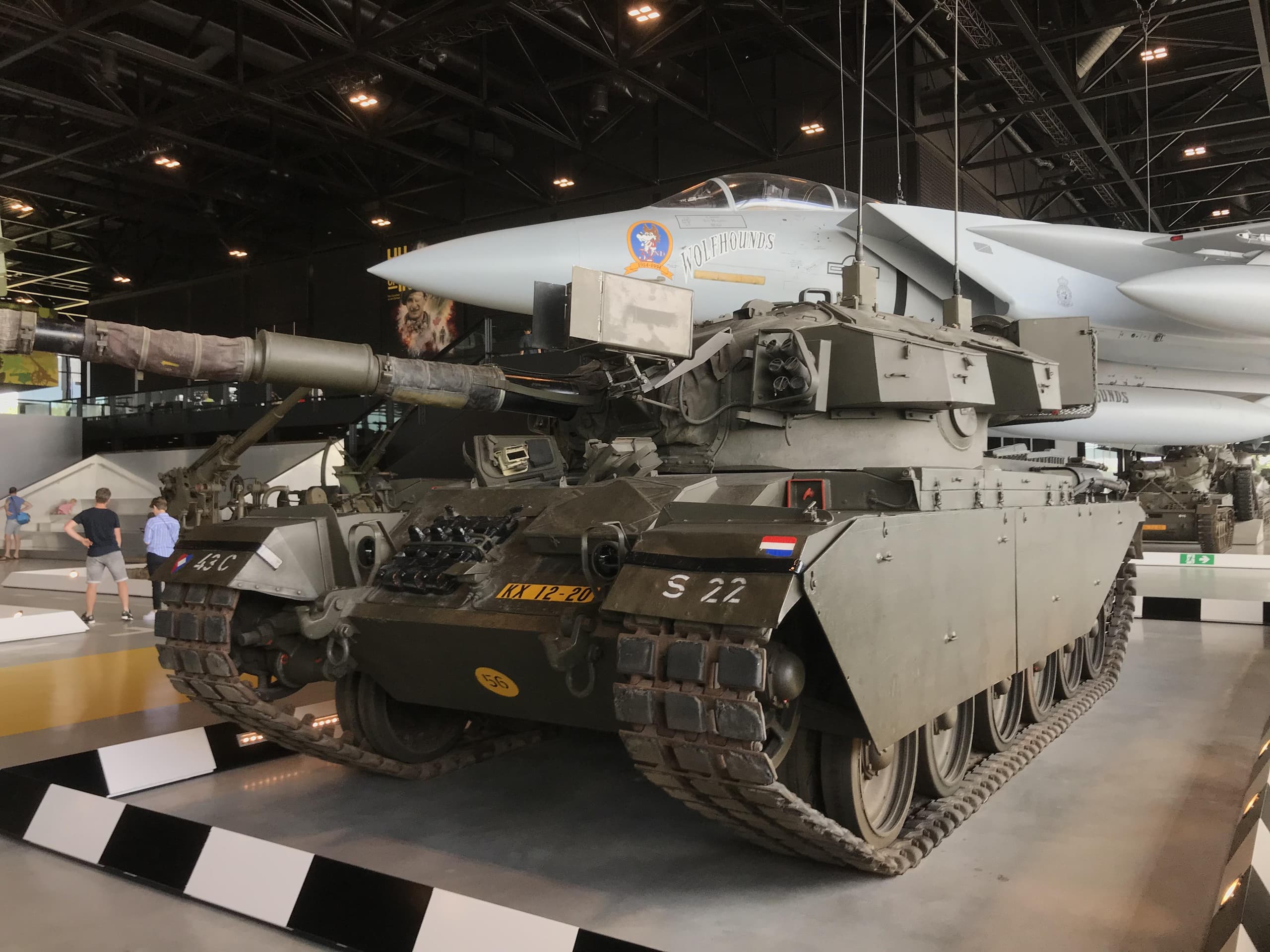
3. Technical Specifications and Subsystems
Centurion Mk 5/2 (Netherlands)
General
-
Manufacturer: Vickers-Armstrongs Ltd. (UK)
-
Base design: MK 5 Centurion
-
Crew: 4 (commander, gunner, loader, driver)
-
Role: Medium tank / early Main Battle Tank
Armament
- Main armament:
105 mm Royal Ordnance L7 rifled gun
Developed by the British Department of Tank Design and Royal Ordnance, the L7 replaced the earlier 20-pounder. Its adoption significantly increased anti-armour capability and effective engagement range, allowing the Centurion to counter contemporary Warsaw Pact tanks.
-
Ammunition types:
-
APDS-T (Armour-Piercing Discarding Sabot – Tracer): primary anti-armour round
-
HESH (High Explosive Squash Head): effective against armour and fortifications
-
SMOKE: screening and obscuration
-
Ranging Machine Gun (RMG):
Browning M2HB .50-inch, modified
Mounted coaxially with the main gun, the RMG fired specialised tracer-marking ammunition whose ballistic trajectory corresponded closely with that of the 105 mm projectile. Short bursts were used to estimate range prior to firing the main gun.
- Coaxial machine gun:
FN MAG 7.62 mm (Mitrailleur Algemeen Gebruik)
Introduced from 1969 onward, replacing the Browning M1919A4. The MAG offered improved reliability, standardisation with infantry units, and better sustained fire capability.
Installation of the MAG required minor modificatrion to the mounting system, Both the RMG and the MAG where mounted together, for in game refrence see how the coax is mounted on the Centurion Mk. 5/1.
Fire Control and Observation
- Gun stabilisation:
Gyrostabilised main armament
The Centurion’s stabilisation system allowed more accurate firing on the move and during short halts, a notable advantage over many contemporaries.
- Optical fire control:
Conventional optical sights supplemented by the RMG ranging method. No ballistic computer or laser rangefinder was fitted.
-
Night-fighting equipment:
-
Early: infrared observation system with IR searchlight made by Philips
-
Later: AEG xenon (IR) searchlight, offering greater range and improved illumination efficiency
(capable of both normal lighting and IR lighting)
- The driver also had access to IR vision devices to see where he would be driving (IR Headlight and projector screen)
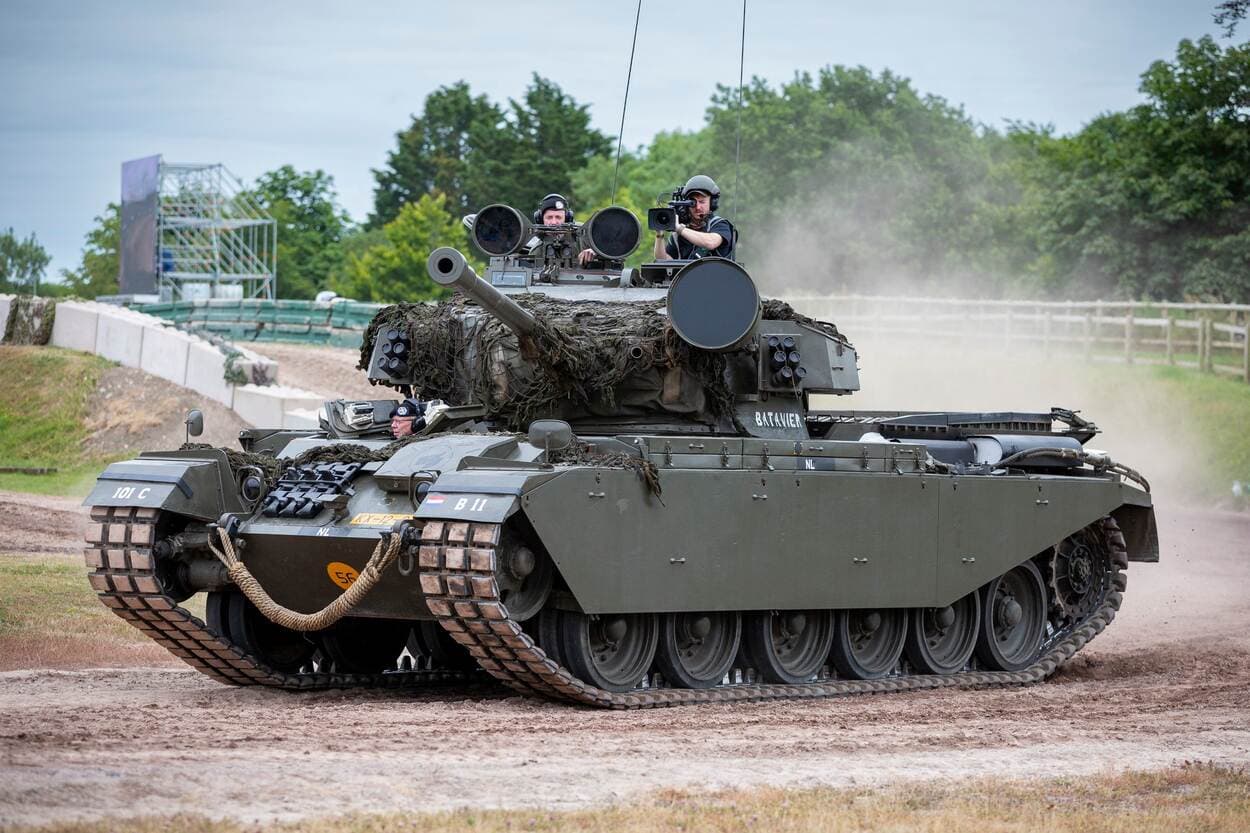
(Centurion Mk. 5 (A type barrel) with early Philips type IR spotlight)
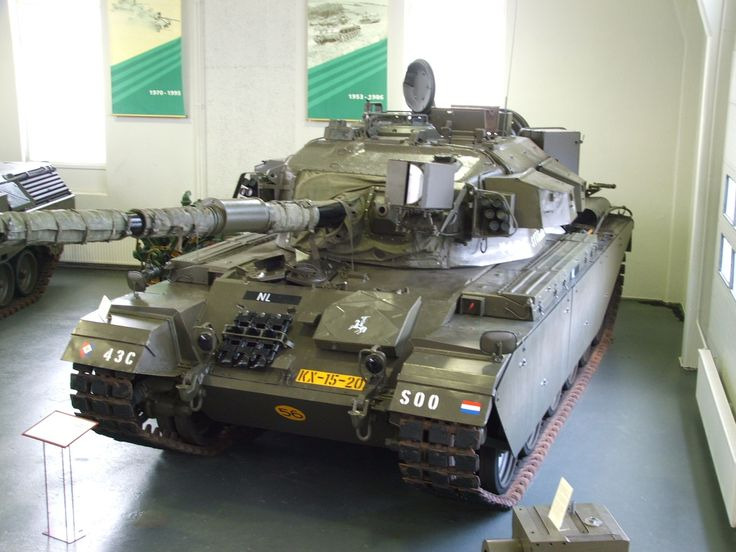
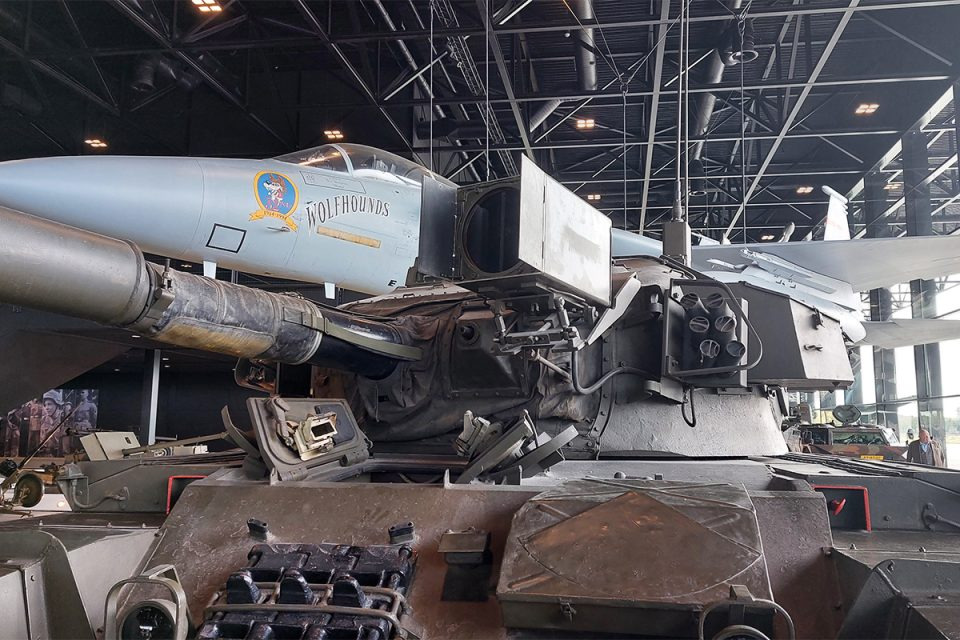
(Centurion Mk. 5/2 With late AEG xenon type (IR) spotlight
Mobility
- Engine:
Rolls-Royce Meteor V12 petrol engine
Derived from the Merlin aircraft engine, the Meteor provided high power output but suffered from high fuel consumption and limited operational range.
- Power output:
Approx. 635 hp (467 kW)
- Transmission:
Merritt-Brown Z51R
Combined gearbox, steering, and braking unit, allowing neutral steering and smooth gear transitions.
- Suspension:
Horstmann suspension system
Robust and well suited for cross-country mobility, contributing to the Centurion’s good terrain performance.
- Maximum speed:
Approx. 35 km/h on road
Armour Protection
- Armour concept:
Standard MK5 Centurion armour layout
- Up-gunning impact:
No armour reinforcement or thickness increase was introduced as part of the Mk 5/2 conversion; improvements focused on firepower and observation systems.
Note Engine swap trail:
In 1968, the Koninklijke Landmacht conducted trials to improve the Centurion’s operational reliability and range by replacing the original Rolls-Royce Meteor V12 petrol engine with a Continental AVDS-1790-2 diesel engine coupled to an Allison automatic transmission, identical to the powerpack used in the American M60 main battle tank. One Centurion Mk 5/2 and one Centurion Mk 7/2 were converted by 574 Tank Workshop in Leusden and tested by the Detachement Beproeving Voertuigen (DBV).
(possible event/premium vehicle)
The AVDS-1790-2 delivered approximately 750 hp, compared to the Meteor’s approximately 635 hp, representing a gain of around 115 hp. In addition to the higher output, the diesel engine significantly reduced fuel consumption and improved reliability.
The trials were technically successful, but the conversion was not adopted for fleet-wide use because of cost considerations: the price of modifying a single Centurion approached that of purchasing a new Leopard 1. Consequently, all operational Dutch Centurion Mk 5/2 and 7/2 vehicles retained their original Meteor petrol engines throughout their service life.
Sources
- Ruys, E.A.K.G.
De Centuriontank in Nederlandse dienst
Armamentaria – Jaarboek van het Legermuseum, Aflevering 37 (2002)
Koninklijk Nederlands Leger- en Wapenmuseum, Delft.
ISBN 90-6116-016-2, ISSN 0168-1672.
- De Boer, H.
Materieel van toen: Centurion
Materieelgezien, Koninklijke Landmacht / Defensie.
Archival material and interviews with personnel of the Koninklijke Landmacht and NIMH.
- AFL-11
Gevechtstank Centurion
Nederlandse militaire documentatie, gebaseerd op Britse ontwerp- en specificatiedocumenten van het A41 Centurion ontwikkelingsprogramma, Department of Tank Board (UK).
- Nationaal Militair Museum Soesterberg