To be fair, there’s a reason for that; The TF-102A was a modification of the original design and it’s side by side seating configuration heavily compromised the aerodynamics, so Convair learned their lesson and designed the F-106 from the ground up to have two seats in a tandem configuration, the single seat version mostly replaces the reat seat with extra fuel and space for electronics (and was launched first because they wanted all the performance they could get and they were having issues with the ejector seats).
1 Like
Difference in the pre-1962 naming standard and post-1962 standard
Turns out that the F-102A was originally supposed to carry the MB-1 rocket using the same configuration as the F106A, but ADC refused because they were expecting the F106A to be ready and operational much earlier.
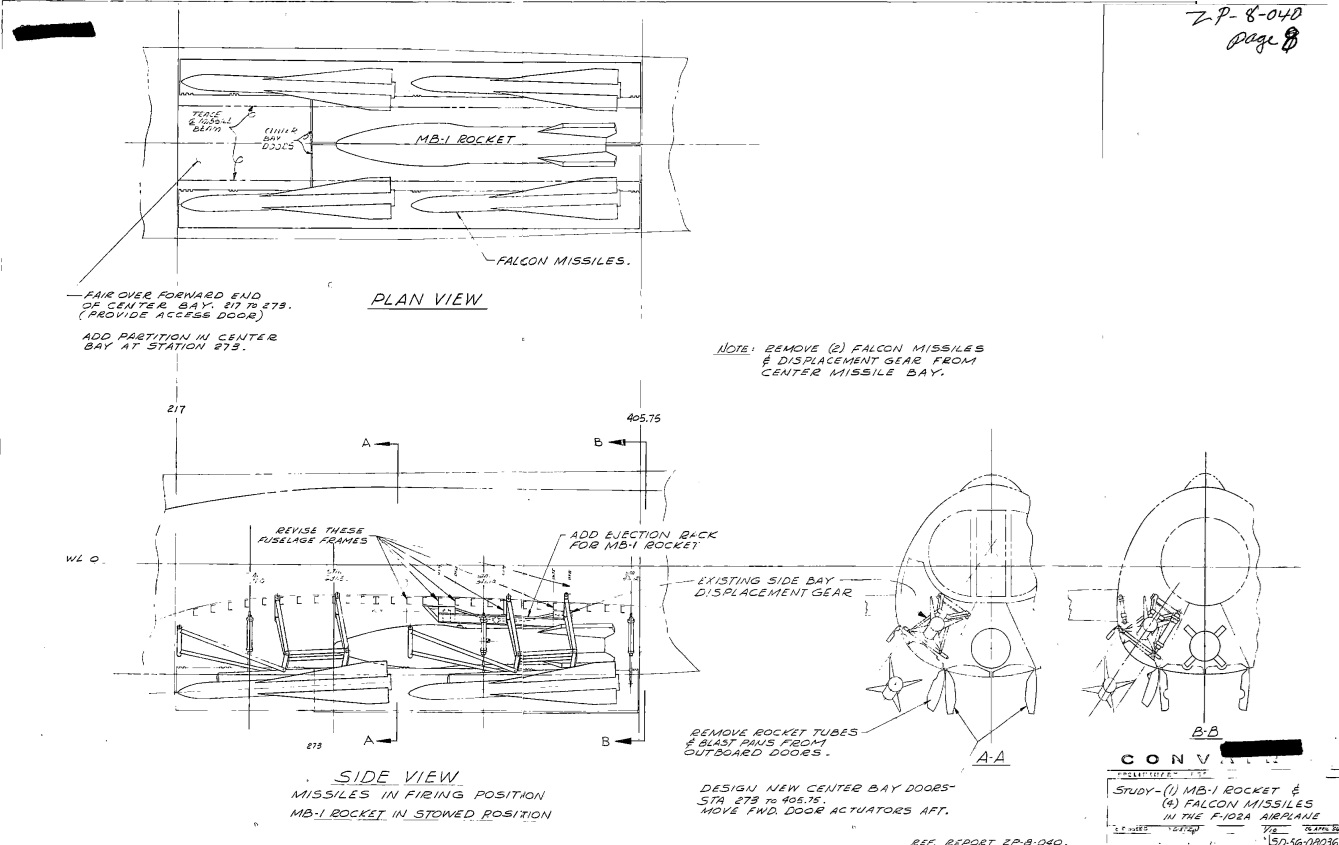
They ended up getting the GAR-11/AIM-26a just because General Le May said he wanted to see a Falcon air to air missile with an atomic warhead. No, really:
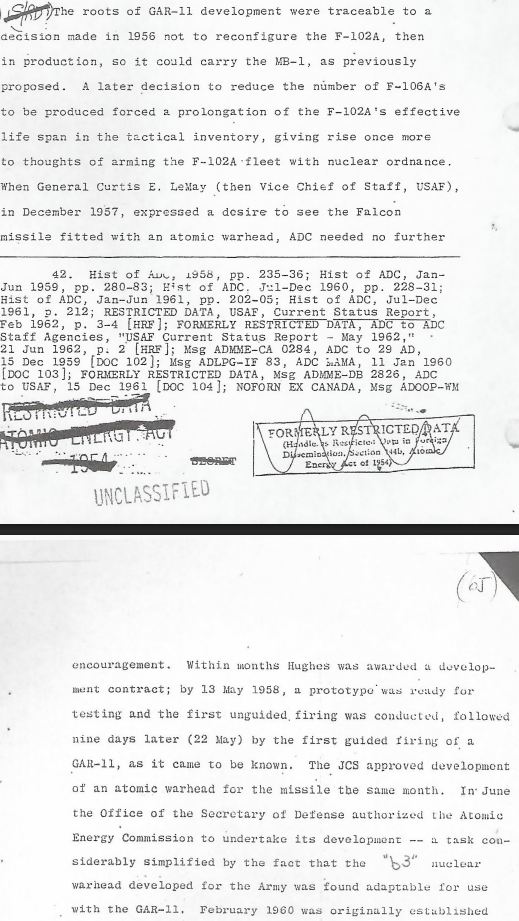
The whole thing ended up being a bit controversial later on, since one of the standard safety protocols for nuclear weapons is that you need at least two people working together to be able to arm them, in order to prevent any single person from being able to set off a nuke in a fit of madness or treachery. And it turns out that one of the few (if not the ONLY) exceptions to that rule was the single seat F102A and F106A, whose pilot necessarily had the full capability to launch the nuclear weapon by himself if he so wished… Good thing the 102A and 106A pilots were all very well adjusted.
4 Likes
I believe 300m is the 20 psi overpressure radius, which obliterates buildings. Keep in mind that the blast radius goes up with the CUBE root of the power, not the square root (we live in a 3D world after all), so by the game´s own standards, 300 times the power of the FAB-5000 (105m) means an armour destruction radius of 705m. (which sort of matches the 5 psi overpressure radius for an 1.5 kT airburst bomb according to this site NUKEMAP by Alex Wellerstein).
In real life the effects of the blast would change with altitude, but this blog shows the results of a fairly accurate calculation for a 12200m /40 000 feet altitude blast
For those that don’t understand italian, i’ll sum it up:
- Fireball radius 30m, Plexiglass/fiberglass burns within 200m, Aluminium bends within 400m, 3rd degree burns for the pilot up to 800m away.
- 3 Psi overpressure from a radius of 450 m, sufficient for total destruction of aircraft, while light damage is done up to a 900 m radius. If detonated at 1500 m altitude , 3 psi radius goes up to 580 m while light damage radius goes up to 1,5 km.
- Fatal radiation dosage in a 900m radius, significant up to 1,5 km. Neutron radiation also disables other nuclear weapons within a 860 m radius.
- EMP intense enough to disable unprotected electronics in a 800m radius, although potential damage can occur in a radius up to 3 KM
Also of note that there were essentially 3 versions of the genie, the original MB-1, the AIR-2A version which added a barometric sensor to prevent detonation below 1500m of altitude, and the AIR-2B which increased the power of the rocket motor.
5 Likes
Necessary addition
2 Likes

No questions asked.
4 Likes
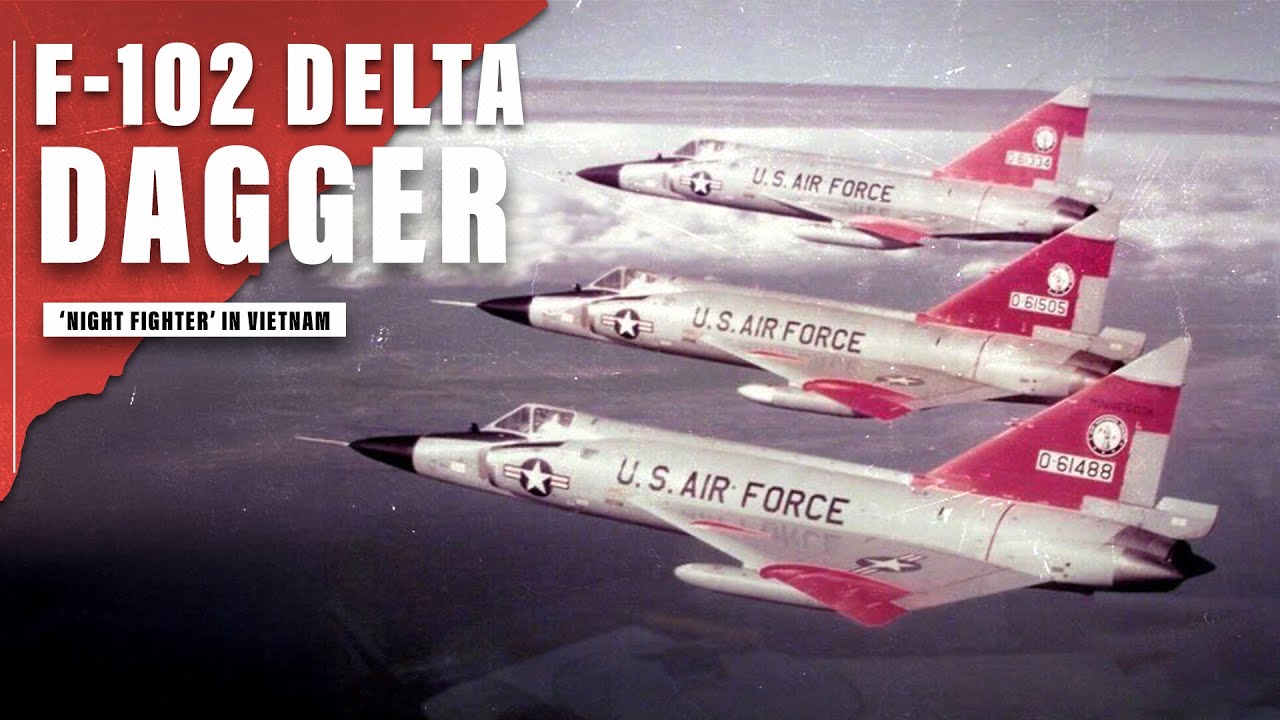
Linking an australian military aviation history video that is well researched and has some pretty interesting period footage of the 102, even if doesn’t really add anything new.
2 Likes
if this is added should probably be made 8.7 as it would be horrible against something like F100 seeing how the AIM-4s perform in game
2 Likes
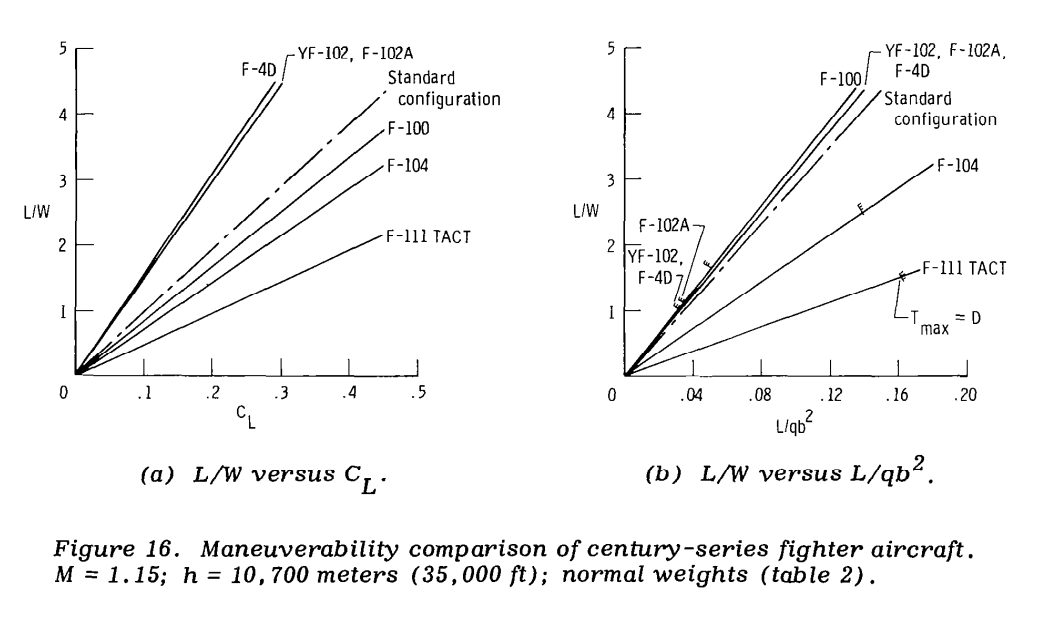
Some lift drag polar comparisons between century series aircraft (+F-4D Skyray and a NASA modified F-111) at mach 1.15. L is lift, W is weight, D is drag, q is dynamic pressure and b is wingspan.
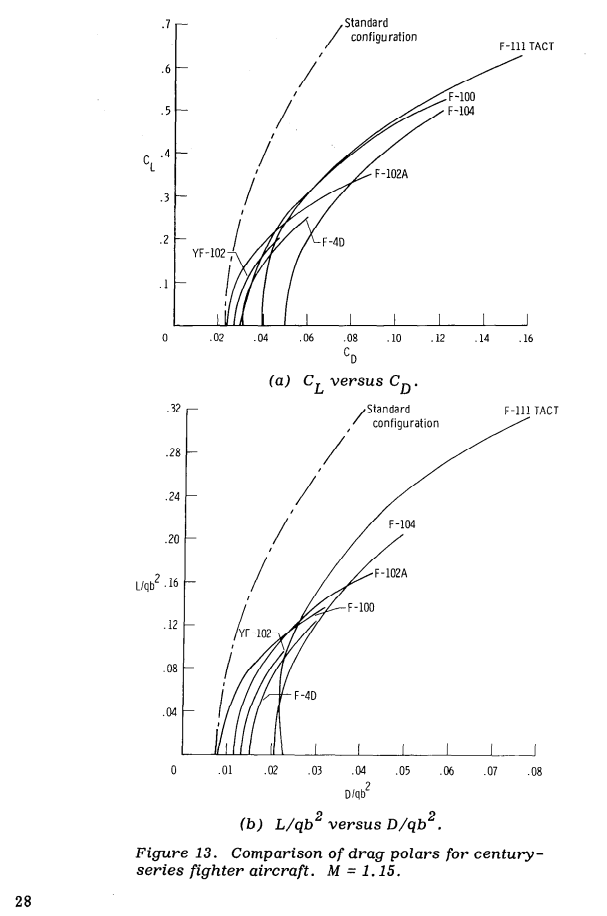
This second picture essentially compares available instantaneous load factor at that speed, and shows sustained load factor with a small flag (yf-102a and f-4d can’t sustain 1G at mach 1.15, for example.)
Some MB-1 testing, plus convair using vortex generator tabs to fix aerodynamic issues decades before it was fashionable.
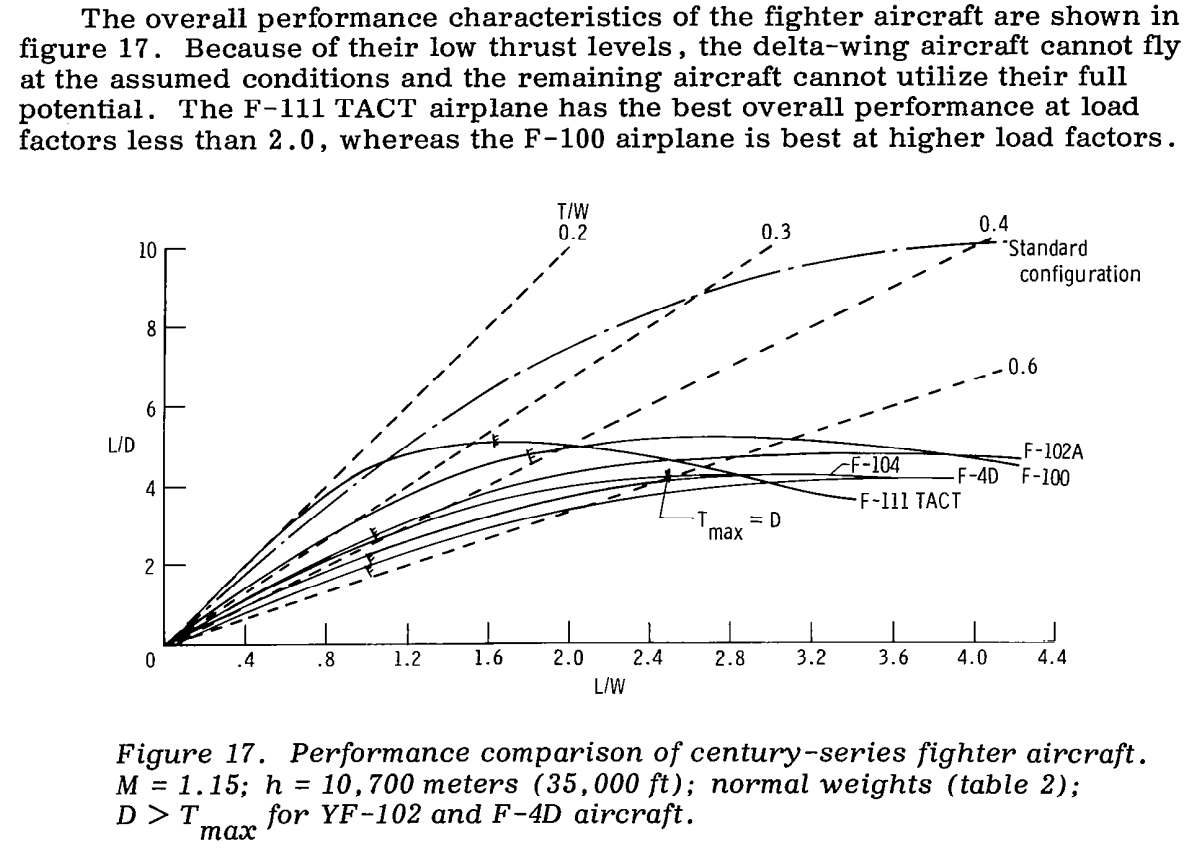
P.S: Maybe this chart is clearer. For reference, at mach 1,15 and 35 000 feet, the F-102A has a maximum L/D slightly less than 5, slightly less than 0,4 thrust to weight ratio, a sustained 1G load factor (basically can’t turn without losing speed or altitude), and a maximum instantaneous load factor greater than 4,4 G’s (slightly over 5Gs). Keep in mind that NASA’s F104 is stripped out of everything so it’s 2500 lbs lighter than the ingame F104G.
1 Like
+1. And the event vehicle part is a big ol’ noperino
1 Like
This article has a pretty detailed account of some of the F-102’s activities throughout the 8 years it was in service over Vietnam. To it, I would add some quotes from some old usenet forums.
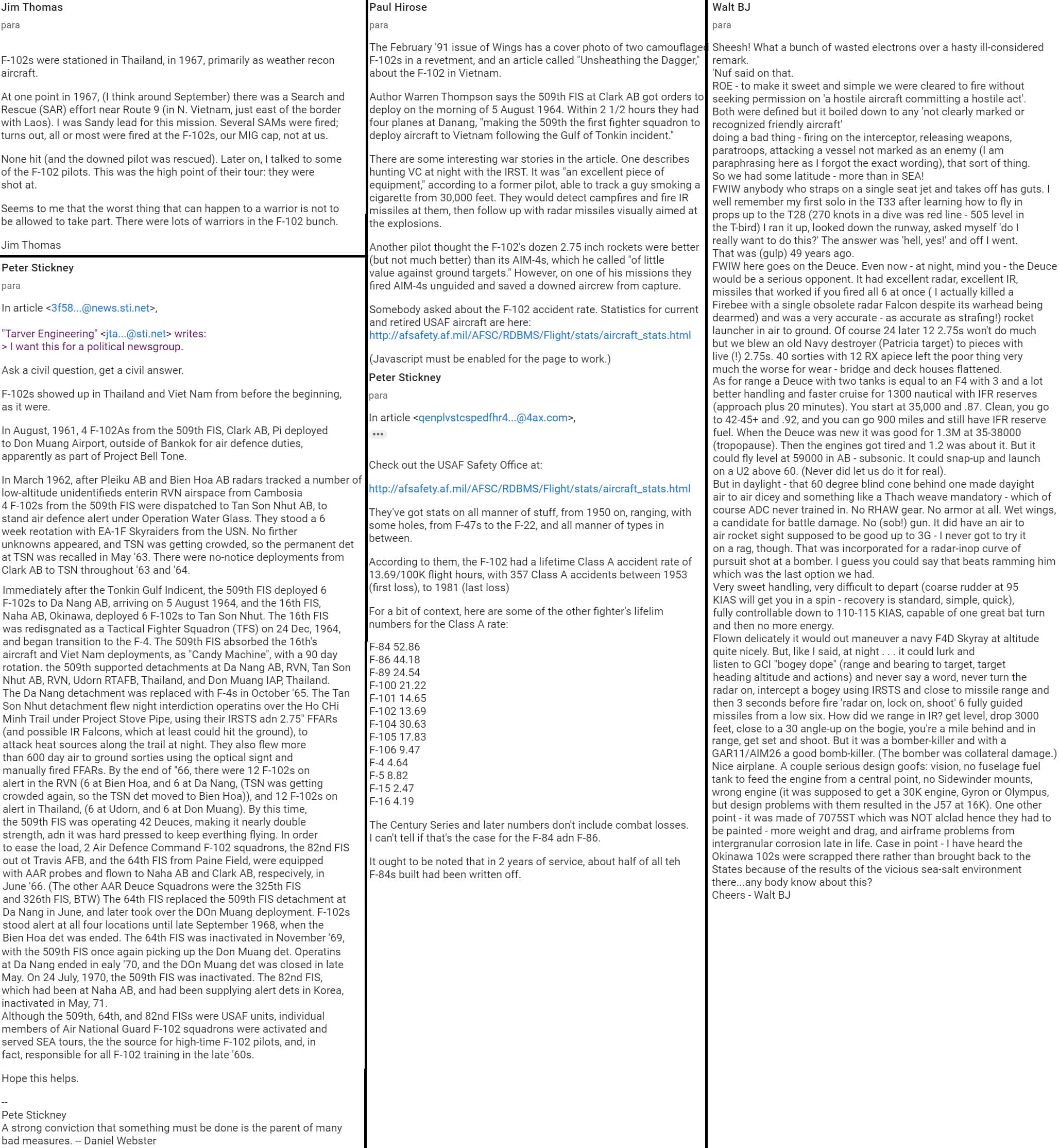
I particularly like the first quote
At one point in 1967, (I think around September) there was a Search and
Rescue (SAR) effort near Route 9 (in N. Vietnam, just east of the border
with Laos). I was Sandy lead for this mission. Several SAMs were fired;
turns out, all or most were fired at the F-102s, our MIG cap, not at us.
None hit (and the downed pilot was rescued). Later on, I talked to some
of the F-102 pilots. This was the high point of their tour: they were
shot at.
I can also add a link to youtube video from a vietnamese that reconstructed the incident where a f-102 was shot down by a mig 21 using both american and Vietnamese sources. The only correction I would make is that the 3 aim-4d missiles weren’t fired individually, they were fired in a near simultaneous salvo (not that they would hit regardless as they weren’t within range). While it’s not really useful to evaluate aircraft performance, it’s a good reminder of the importance of having ground or airborne radar control to maintain situational awareness.

As for the Greek or Turkish export versions, apparently they were early models that lacked IRST, datalink and were fitted with the earlier “case X” wing, thus lacking a bit in turn performance and service ceiling compared to the later, more cambered, “case XX” wing. The turkish airforce was apparently really found of the plane as they could finally fly at night or in bad weather to scare off russian bombers.

As for the F-102 vs F-5 incident over the aegean sea, this archived blog post goes into more detail than i ever could, but regardless I find hard to believe either side because a shootdown over the agean sea would have been unavoidably fatal, yet the only f-102 pilot kill on the turkish side in period happened in a takeoff accident, while the only f-5 pilot kill in period on the greek side happened in a landing accident, so i’ll leave it at that.
1 Like
It might save you here and there. The missiles are not enough.
Suggestion passed to the developers for consideration.
2 Likes