It is known that the empty weight of the J-15 is 17.5 tons. The J-15T extensively uses new composite materials, has a main landing gear reinforced with titanium alloy, features special weight-reducing grooves on the catapult bar, a reinforced nose landing gear, a redesigned and strengthened internal airframe structure, is equipped with an AESA radar, and has improved wing pylons. Therefore, its empty weight should be comparable to that of the J-15, even while using the WS-10B instead of the WS-10H. The internal fuel of the J-15 is known to be 9 tons, and that of the Su-27SK is 12,400 liters. Therefore, the J-15T’s internal fuel should be 9.5–10.1 tons (RP-5 kerosene, with a density of 0.795–0.816 g/cm³).
I will use computational methods to prove the relationship between drag and speed. Please use calculations to verify the data, because this data is all confidential. I believe that when you were doing the envelope for other aircraft, you also obtained it through computational methods.
已知J-15空重17.5t,J-15T大规模采用新型复合材料、主起落架采用钛合金强化、弹射杆上设计特殊减重槽、前起落架为加强、机体内结构重新设计加强、换装有AESA雷达、改进机翼挂架,其应于J-15空重持平,且是在用WS-10B而不是在WS-10H的情况下。内油以知J-15为9t,Su-27SK为12400L,则J-15T内油应为9.5-10.1t(RP-5煤油,密度取0.795-0.816g/cm³)。
我会用计算方法来证明阻力与速度。请采用计算的方式来确认数据,因为这些数据都是机密的,我相信在做其他飞机的包线时你们也是通过计算的方法得出。
Half-fuel, fully loaded (10 × PL-12A, 4 × PL-8)
半油,满载(10 × PL-12J-15T半油质量:m = 27000 kg
J-15T half-fuel weight: m = 27,000 kg
PL-12A: single unit weight m_PL12A = 180 kg, quantity n_PL12A = 10
PL-8: single unit weight m_PL8 = 115 kg, quantity n_PL8 = 4
Total mounted weight: m_stores = 10 × 180 + 4 × 115 = 1800 + 460 = 2260 kg
Total weight: m_total = 27,000 + 2260 = 29,260 kg
PL-12A:单枚质量 m_PL12A = 180 kg数量 n_PL12A = 10
PL-8:单枚质量 m_PL8 = 115 kg数量 n_PL8 = 4
挂载总质量:m_stores = 10 × 180 + 4 × 115 = 1800 + 460 = 2260 kg
总质量:m_total = 27000 + 2260 = 29260 kgA,4 × PL-8)
Wing area: 67.8 m²
PL-12A: Diameter = 0.203 m Area: S1 = π × (0.203)² / 4 ≈ 0.0324 m²
PL-8: Diameter = 0.16 m Area: S2 = π × (0.16)² / 4 ≈ 0.0201 m²
机翼面积:67.8 m²
PL-12A:直径 = 0.203 m面积:S1 = π × (0.203)² / 4 ≈ 0.0324 m²
PL-8:直径= 0.16 m面积:S2 = π × (0.16)² / 4 ≈ 0.0201 m²
Aerodynamic values:
C_D0 = 0.035
K = 0.18
C_L = 0.25
气动取:
C_D0 = 0.035
K = 0.18
C_L = 0.25
External interference factor: k_int = 4
Engine: Single thrust = 145000 N Total thrust: T_SL = 290000 N
外挂干扰系数:k_int = 4
发动机:单台推力 = 145000 N总推力:T_SL = 290000 N
6000 m:
ρ = 0.66 kg/m³
a = 316 m/s
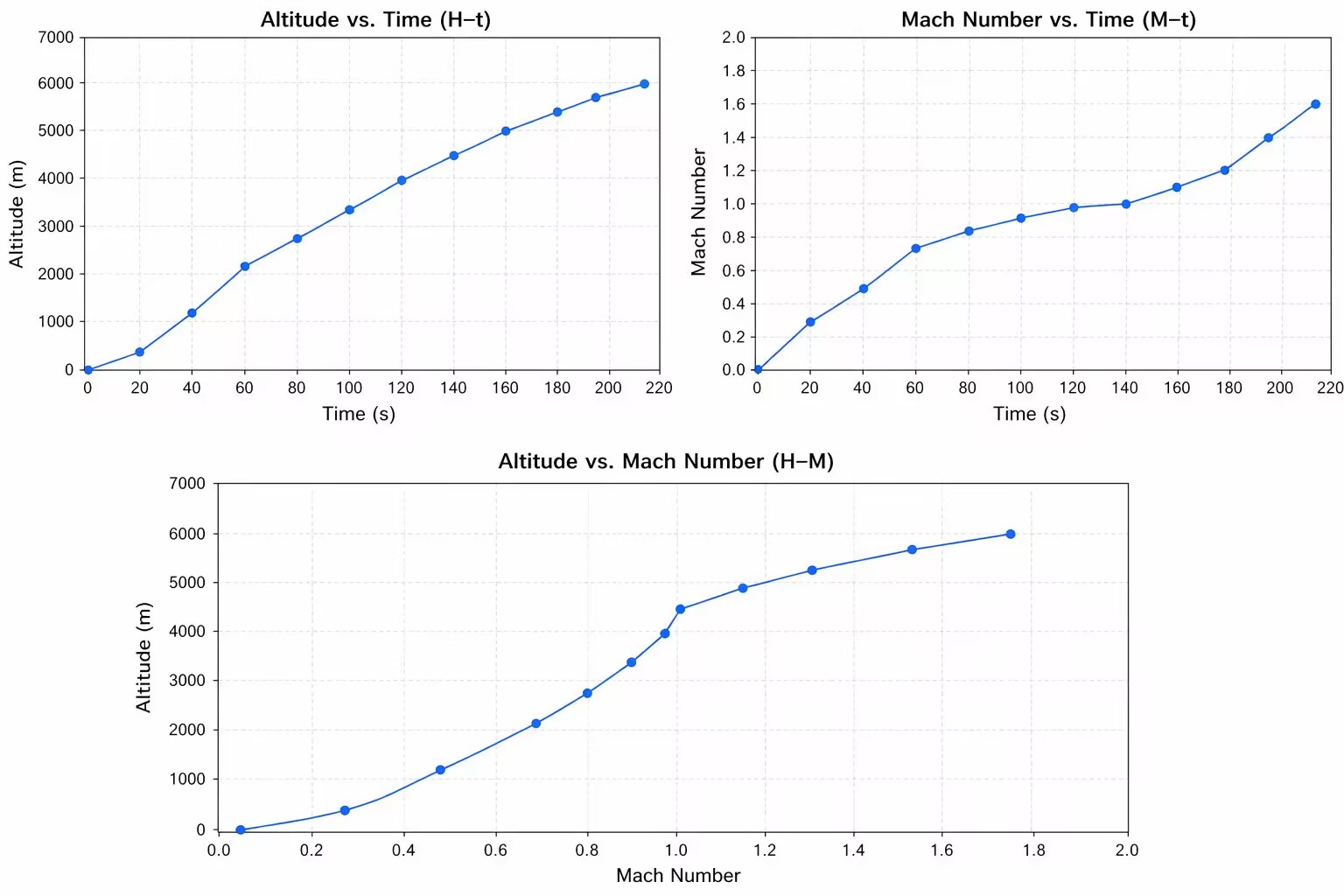
Time taken to accelerate by 1.6 Ma over 6 km
求取6km时加速1.6Ma用时
Body drag:
C_L² = 0.0625
K·C_L² = 0.18 × 0.0625 = 0.01125
Total drag coefficient:
C_D = 0.035 + 0.01125 = 0.04625
D_clean = 84360 × 67.8 × 0.04625
≈ 26400 N
External drag:
PL-12A: 10 × 0.55 × 0.0324 = 0.1782
PL-8: 4 × 0.5 × 0.0201 = 0.0402
Total: 0.2184
D_stores = 84360 × 4 × 0.2184= 84360 × 0.8736≈ 73700 N
Total resistance:
D_total = 26400 + 73700 = 100100 N
Thrust difference:T − D = 188500 − 100100 = 88400 N
Acceleration: a = 88400 / 29260 ≈ 3.02 m/s²
Transonic Acceleration:
Initial speed: V1 = 1.1 × 316 = 347.6 m/s
Final speed: V2 = 505.6 m/s
ΔV = 158 m/s
t3 = m × ΔV / (T − D)
t3 = 29260 × 158 / 88400≈ 52.2 s
Cross-tone correction:t3 ≈ 52.2 × 1.5 ≈ 78 s
Climb: 6000 m
Average climb rate: ROC ≈ 60–80 m/s
Take 70: t2 = 6000 / 70 ≈ 86 s
Considering transonic effects: t2 ≈ 110–130 s1
Takeoff:t1 ≈ 15–20 s
Total time:
t_total = t1 + t2 + t3 = 20 + 120 + 78 = 218 s
A stepwise climbing method is used
During the initial 0–20 s after takeoff, the aircraft performs liftoff and initial climb with a climb angle of approximately 10°–15°, during which the altitude increases from 0 m to about 300–500 m, and the Mach number rises from the takeoff condition to approximately 0.3. In the subsequent 20–80 s interval, the aircraft enters the primary climb phase, where the climb angle gradually increases to approximately 12°–18°, reaching a maximum of about 18° around 60–80 s. During this phase, the altitude rapidly increases from approximately 500 m to about 2500–3000 m, while the Mach number rises from about 0.3 to approximately 0.8. In the 80–140 s interval, the aircraft transitions into the transonic preparation phase, during which the climb angle is progressively reduced from approximately 18° to about 10°. The altitude further increases to approximately 4000–4500 m, and the flight speed approaches the transonic regime (Mach number approximately 0.9–1.0). In this phase, the energy distribution shifts from being predominantly potential energy accumulation to kinetic energy growth. During the transonic phase (140–180 s), due to the significant increase in wave drag, the climb angle must be further reduced to approximately 5°–8°. The altitude increases slowly to about 5000–5500 m, while the Mach number rises from approximately 0.95 to about 1.2. In this stage, the thrust margin is substantially reduced, and the acceleration process is constrained. Finally, during the supersonic acceleration phase (180–218 s), the climb angle is further reduced to approximately 2°–5°, and the flight process becomes predominantly acceleration-driven. The altitude increases from approximately 5500 m to the target altitude of 6000 m, while the Mach number increases from approximately 1.2 to 1.6. The aircraft ultimately reaches the target flight condition of 6000 m altitude and Mach 1.6 at approximately 218 s.
Make a bug report
They once replied to me, saying they do not accept those obtained through calculations, so I could only post them on the forum.
I thought only base J-15 is 17500 kg and that J-15t was reinforced to handle stobar operations which explains weight difference
i would ignore these posts the J-15T ingame is as “accurate” as you can get without schizoing too much and yes iirc that number is for the basic J-15
What you said is not correct. Compared to the 15, the 15T uses more weight reduction designs, such as using composite materials and removing or lightening materials where unnecessary. The weights should theoretically be balanced.
no,What you said is not correct. Compared to the 15, the 15T uses more weight reduction designs, such as using composite materials and removing or lightening materials where unnecessary. The weights should theoretically be balanced.