The game ERA exceeds the data on this website. Many claim the website lists a different version of the ERA, which is newer but almost 1.5 times weaker.
This sounds rather amusing, but technically, the ERA here has a different name.
The game ERA exceeds the data on this website. Many claim the website lists a different version of the ERA, which is newer but almost 1.5 times weaker.
This sounds rather amusing, but technically, the ERA here has a different name.
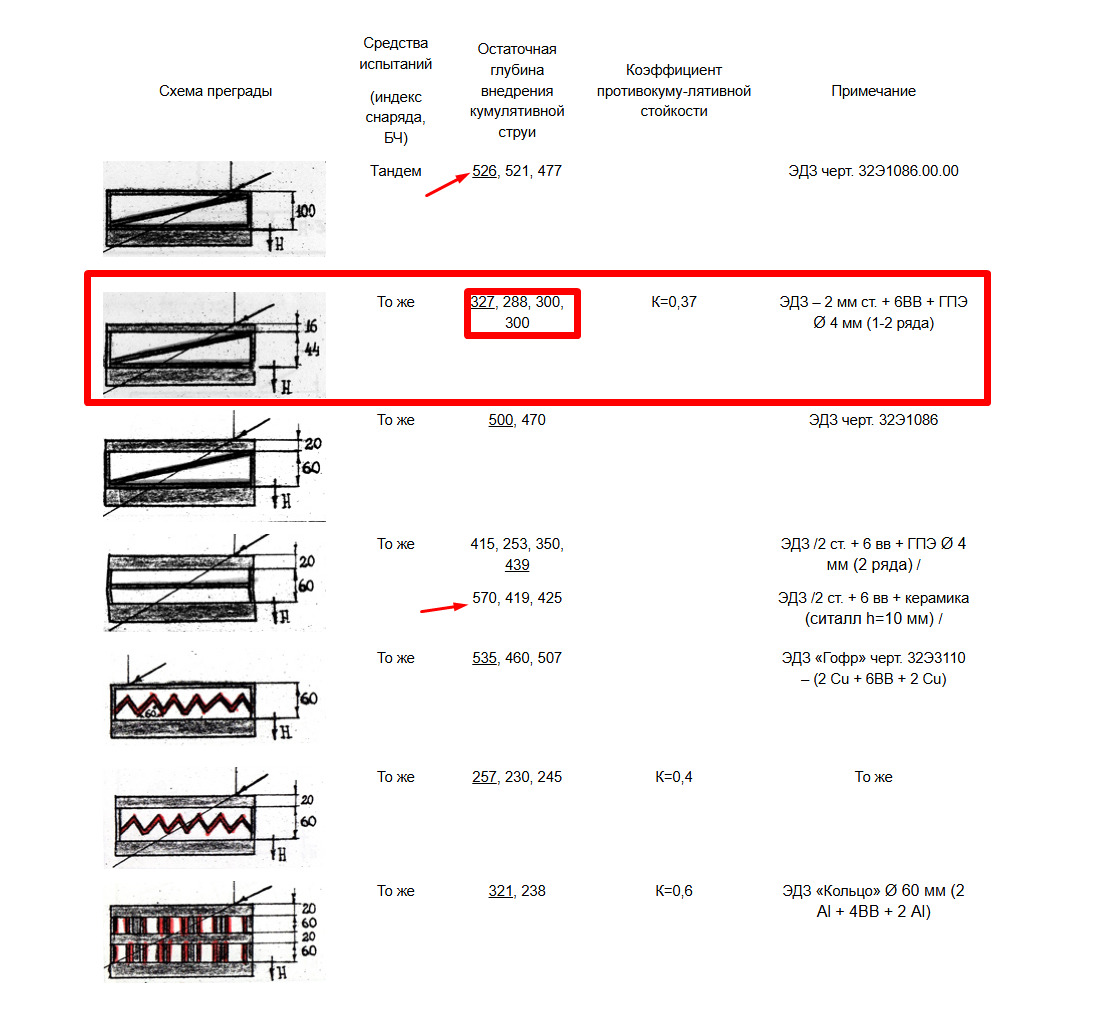
The 100m penetration is 262mm at 60 degrees, at 0 degrees the penetration is 454mm.
If you look at the plate being tested, it is at around 50 degrees not 0 degrees, therefore, we will use the 262mm figure, not the 454mm figure. Use the Pythagorean theorem to calculate what the actual penetration on LOS is for the dart hitting the angled plate. It is 524mm.
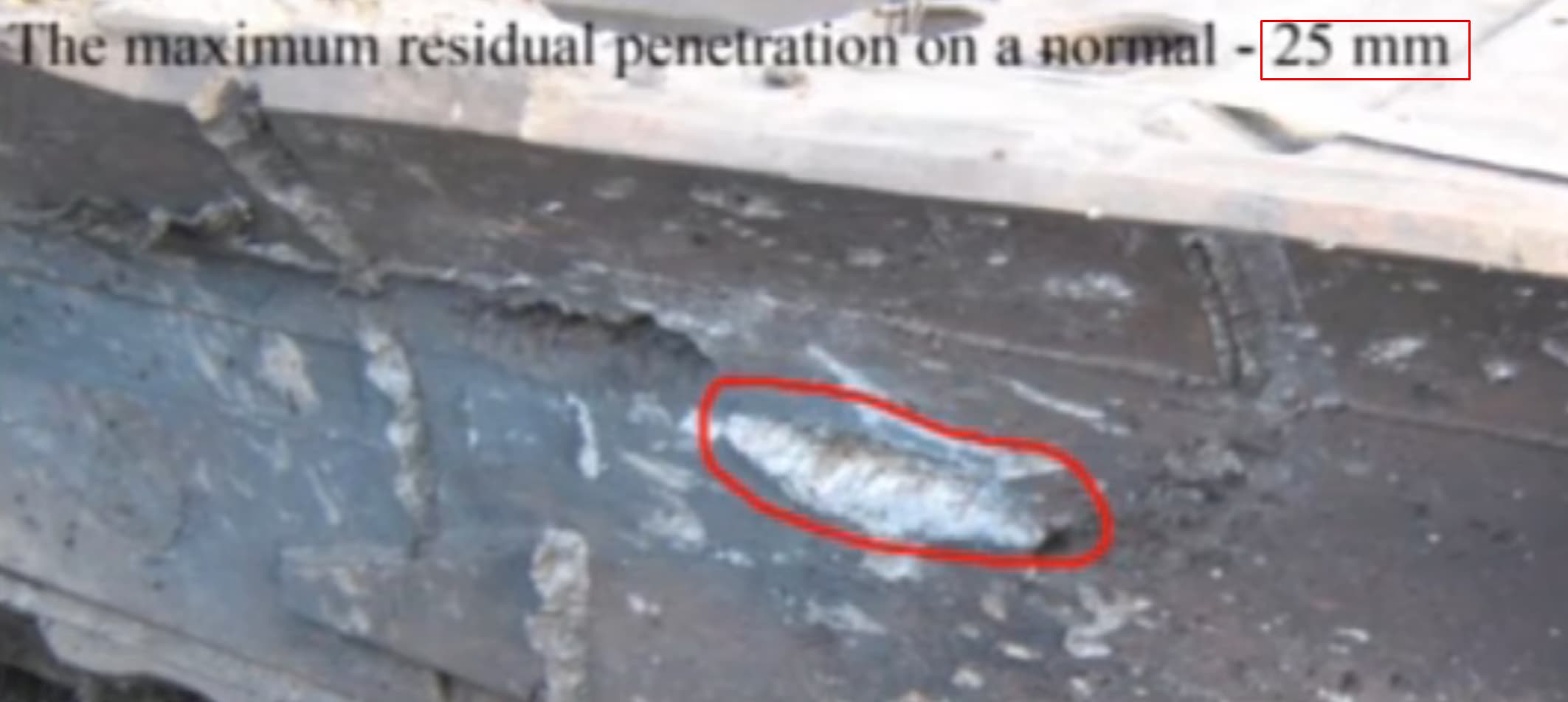
The residual penetration on the steel module is 60mm on the normal. Taking into account the 50 degree angle it was struck on, the projectile dug in 93mm from the LOS.
Therefore 524-93 = 431mm was stopped.
The only possible case in which we need to mess around with steel hardness is if the test module is made of unhardened steel, which is very much a possibility.
But assuming both the module and the tank are made of hardened RHA, we do not need to take into account anything, the result would be the same on both of them.
You claim that it is impossible to calculate the residual penetration of a shell and then proceed to spew out this:
524mm penetration, not 454mm. Please observe that the plate is at an angle not at 0 degrees.
The game makes no distinction between supported and unsupported plates and how much penetration they stop.
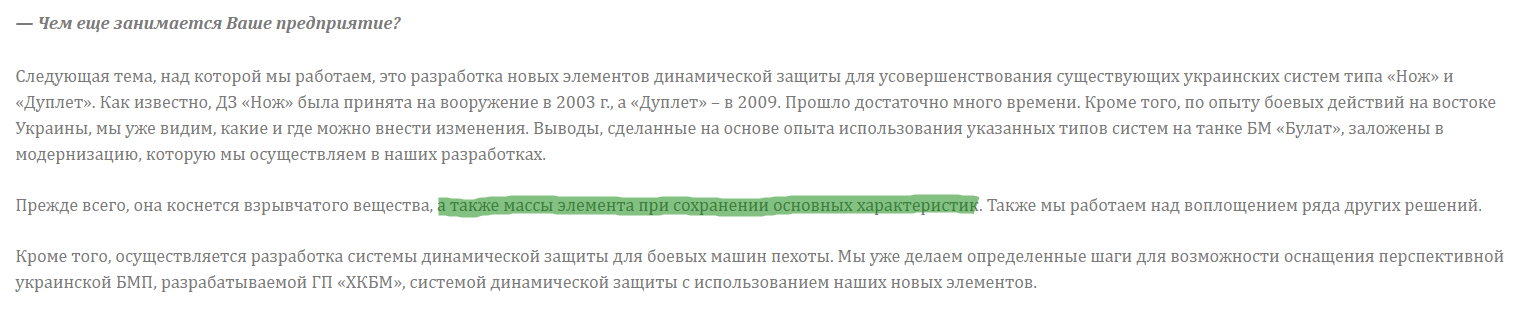
False, the manufacturer itself claims this, including saying that the new element is several times lighter than older models. Give the real story.
I don’t dispute that. But these figures aren’t applicable to the game because the resistance is specified differently.
What you see with an X in the protection analysis is the normalized resistance to penetration at 0 degrees. Is that clear to you?
We need this because the 3BM42 doesn’t penetrate 524mm of high-hardness steel. And it certainly doesn’t penetrate 524mm of high-hardness steel in a spaced barrier.
The 60mm-thickness of the front turret armor plate is at least 120mm compared to modern APFSDSs.
Therefore, you have no right to assume that if it’s penetrated 60mm, the shell lost 431mm of penetration, as it lost significantly less.
This is a very rough estimate, and I’m making it only because you’re making yours.
There’s no point in providing specific ERA protection figures, as they’re extremely difficult to calculate accurately.
The game doesn’t use LOS angled thickness. Stop wasting my time.
Firstly, I mentioned that the game models multipliers for multilayer barriers and steel hardness, so you can’t ignore them (but you don’t), and secondly, when assessing the ERA’s durability, the developer may well take into account the fact that the steel was conditionally infinite in tests.
reduced weight while maintaining the characteristics of the old one. Give the real story.
The BM Oplot uses better steel compared to the t-80u, but I don’t think gaijin wants to do hardness for all the tanks in warthunder.
its moreso that all T-80s overperform in their stab speeds except the t84
Yes I understand what your point is but that is not a usable number to determine how much penetration of 3BM42 would be stopped, for example, hypothetically, a 300mm plate at 60 degrees would have 600mm LOS thickness, in game’s X-ray it would show that effective protection against 3BM42 is around 500m. The shell is stopped in this test, however, it was stopped by 600mm of steel not by 500mm. You cannot use the “Effective protection against specified ammo” figure as the armour required to stop the shell. You have to calculate the actual amount of steel that was in the LOS to figure out the real penetration value.
Again, even if you use this number, you cannot use the 0 degree penetration figure for BM42, the plate is at an angle of 50-52 degrees, the amount of steel required to stop BM42 at that angle is close to the 60 degree figure of 524mm penetration. The amount of penetration stopped in this case would be close to 400mm instead of 430mm.
Sure, but, in game testing still does not match the test footage, even if 120mm residual penetration is observed, in game, we see 120mm+ residual penetration when firing much weaker rounds at longer ranges.
Yes it does, just in the protection analysis it lists a number of effective protection against the projectile you are using. This number does not correspond to the actual thickness of armour.
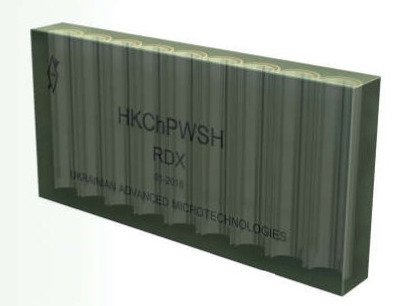
False again, It clearly states “maintaining the characteristics of the analogue”. For HKChPWSH, the analogue is ХСЧКВ-19A. Both have similar dimensions and number of charges. ХСЧКВ-34 is much thicker and has less charges.
Why am I not surprised…
Oplot has 4.4 like T-80U.
In this case, after calculating the armor at an angle, you should convert it to normal, taking into account the slope effect, so you can say, “I want the game to say X millimeters.”
Otherwise, it looks like you’re intentionally or unintentionally overestimating the durability.
I’m sure everyone who reads your message will be misled, because this is not the durability that should be indicated in the game.
120mm is the reduced resistance at 0 degrees, taking into account:
I literally did all the necessary calculations so I could subtract this from the 454mm penetration at 0 degrees.
Agreed. That’s all true. If we understand each other here, then why are you making calculations that will mislead people?
For the game, we’re interested in the “effective protection” of a given barrier. If we want to roughly estimate the ERA’s protection, we need to calculate how much effective protection a 60mm layer of steel would have if it was still partially penetrated by a shell.
This sounds like nonsense, frankly. The HSChKV-19A was never used to protect the Bulat BM (mentioned in the paragraph above), and was practically never used on the Oplot BM (only on the sides, and even then, not completely).
The HSChKV-19 has a completely different focal length, and its use in the Duplet module is useless; the second layer simply wouldn’t work at all, since there’s a thick plate above it.
The second argument for why this isn’t true is because, as far as I remember, a 60% weight reduction is claimed. This isn’t possible with the HSChKV-19A (the weight would be absurdly low), only with the HSChKV-34.
Actually, the number of craters doesn’t match the HSChKV-19A, as you say.
The HSChKV-19 has 11-12 craters, while this one has 9. At best, it’s somewhere in the middle.
But again, as I said above, the HSChKV-19A was almost never used (except for the BM Oplot in the sides) and offers virtually no protection against anti-tank missiles, so this is clearly a comparison with the HSChKV-34.
Am I correct in understanding that you’re saying they “learned the lessons from using the BM Bulat” and therefore replaced the HSChKV-34 with the HSChKV-19A equivalent?
This is an excellent solution: “let’s downgrade the tank’s protection, which reached an acceptable level precisely thanks to the ERA.”
Do you see the logic?
Once again, I am not suggesting using the numbers from the Duplet-2M, it is just obvious that they are equivalent (with a small margin of error) to the regular Duplet.
Yes but the penetration is 524mm not 454mm. You have taken into account the how much armour is increased on the plate but not how much penetration of BM42 is increased when encountering sloped armour. 120mm is the effective 0 degree protection of a 60mm HHRA plate at 52 degrees, the plate is still at 52 degrees, therefore we have to use the 524mm penetration figure, not 454.
I am not misleading anyone, the effective protection number does not correspond to the actual thickness, therefore we cannot use this figure to calculate how much penetration was stopped. We have to take the 524mm figure.
The logic does not matter because there is no evidence of this element ever being produced or tested. There are not even any photos of it in real life. The manufacturer is trying to sell the product and will of course not mention that it is worse than ХСЧКВ-34.
This is again not true, Duplet 2M lists penetration reduction of 3BM42 by 60%, and from the footage we can see that Duplet reduced the penetration of 3BM42 by about 82%. If we take your figure of 120mm residual penetration, then by 76%. Neither of these numbers are within “Margin of error” of 60%.
There is a sheet between the ERA layers
This is an incorrect tech mod response. Correct responses based on test data have already been provided here.
The game is already at version 4.4.
Are you starting the game or just browsing around?
Side ERA complies with IRL tests.
I’ve taken that into account. I use a special Slope Effect modifier, which allows me to calculate the equivalent armor resistance at a given angle as armor at a 0-degree angle. This coefficient immediately takes into account both the angle and the spalling effect of the back layer.
There’s no point in arguing with you; this is the formula used in the game itself to simplify the display, and all the numbers in the game are based on it.
If you’re trying to calculate defense in the game, please use it.
I’d say the only problem is how to attribute the additional resistance gained from the multi-layered barrier. In this case, the barrier becomes multi-layered because before hitting the turret, the shell collides with the ERA and four steel caps of approximately 15mm each, plus a damper between the layers.
In the game, the multiplier is applied to the resistance of the first turret layer, although these millimeters of protection could be included in the ERA, but reduce the resistance of the first turret layer.
This won’t change the overall protection, it will simply change its distribution.
I hope you understand what I mean. If not, I’ll give a simplified example.
In this case, you shouldn’t expect the equivalent protection in the game to be 532-93mm (or whatever you got), as that’s not what’s used in the game.
Additional calculations are needed later.
Am I correct in understanding that you just said “marketing lie”?
So, 10+ years after the original ERA was developed, they took it and made it worse, even though the BM Bulat’s protection, for example, was far from the best even with the original ERA?
True, protection against other threats hasn’t changed, and in some places has even increased (cumulative protection). How can this be?
You understand, of course, that there may be differences in the testing process, the number of tests, and the choice of final values (minimum, maximum, average)?
Furthermore, you’re using data on turret protection, but the UFP protection test data showed a much worse result (a large recess in the module’s rear 60mm plate).
My point is that this is far from an obvious question, and in my opinion, anyone who claims with absolute certainty that the new ERA is worse than the old one is simply wishful thinking. Just like anyone who claims the opposite with absolute certainty.
The Duplet data constantly contradicts itself. Therefore, you need to look at all sources as a whole, not just the one you like.
If you’re asking my opinion, I believe the test data is the most accurate.
So let me get this straight, you are trying to claim at a 60mm HHRA plate at 50 degrees (whose actual LOS thickness is 93mm), will provide 120mm of effective protection even after taking into account that 3BM42 penetrates 70mm more armour at that angle compared to the 0 degree penetration? So effectively, you are claiming that HHRA turns 93mm into 190mm equivalent?
Please provide your calculations and formulas used, because this is nonsense. The only modifier for HHRA provided by gaijin is x1.25, which will turn 93mm into 116.25mm. Lets say its actually 120mm to account for the plate being supported by steel behind it. However, this still does not account for the fact that 3BM42 penetrates 70mm more than 454mm at 60 degrees. So if you want to use the 454mm number, first 70mm must be subtracted from 120mm, or 70mm should be added to 454mm, which is what I was doing before. You can calculate this yourself.
I understand what you are trying to claim, but I’ll be honest, it seems like you are just plain lying. Please provide evidence that a 60mm plate will provide 120mm of protection even after taking into account 3BM42’s improved penetration performance at 60 degrees.
More like marketing half-truth, it is indeed better than 19A but all evidence points to it being worse than 34. BTW, you yourself have pulled out the “Marketing lie” argument several times when discussing nizh/duplet’s effectiveness compared to K-5.
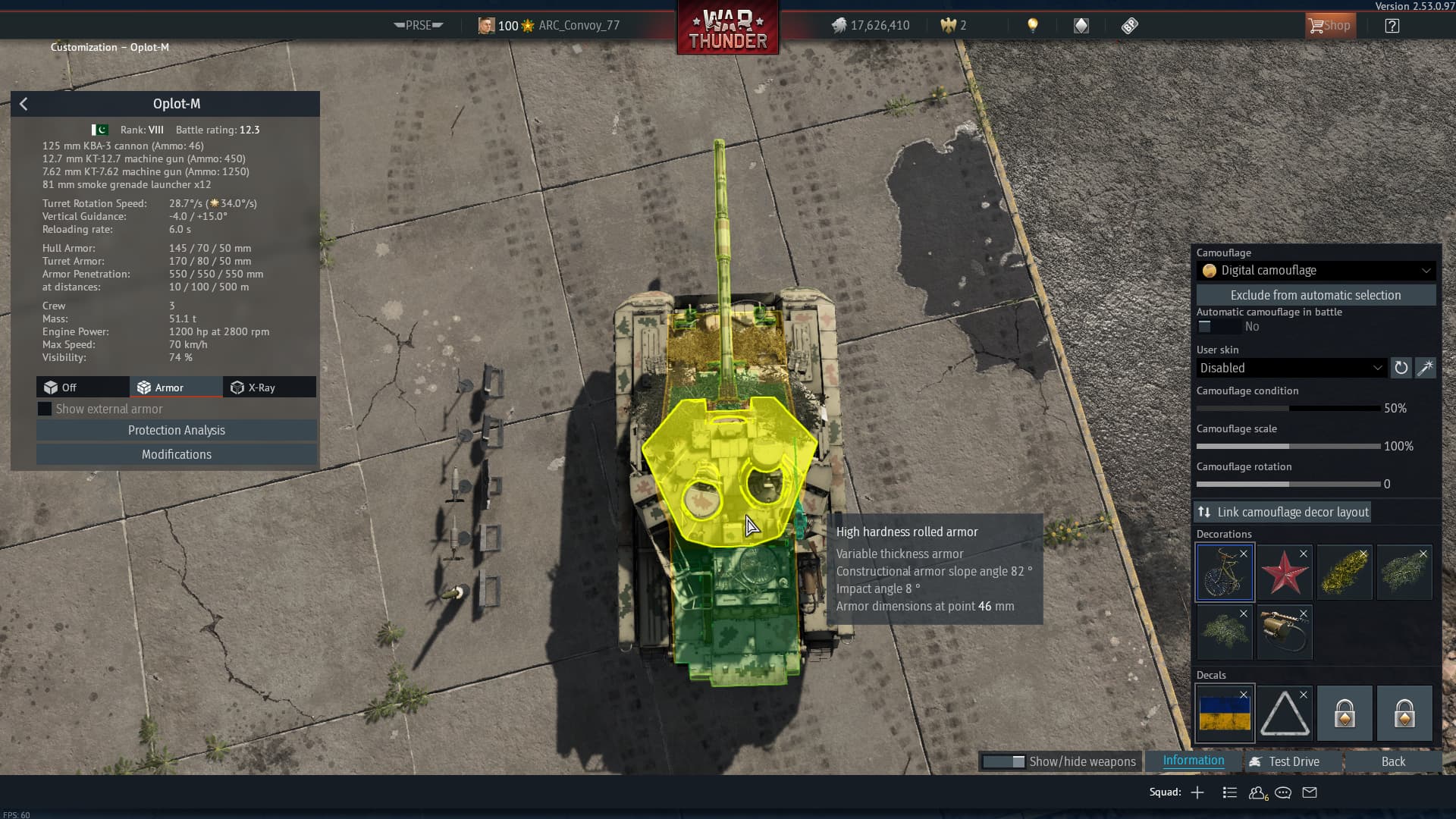
Have you tried measuring the Oplot turret’s in-game durability without the ERA? You understand that your calculations won’t match the in-game figures, but they will match mine.
By the way, the turret’s durability without the ERA is ~850mm from the APFSDS (I just looked it up). That’s a total of 200mm of HHA and 100mm of RHA (there’s also a honeycomb filler, but it contributes much less to the durability).
According to your calculations, a DM53 (350mm at 60 degrees) should at least have a yellow penetration indicator. However, it’s not even close.
There is also a multilayer barrier multiplier.
So, they drew a conclusion from the use of the BM Bulat and significantly reduced its defense?
You understand that this is kind of absurd, right?
I don’t use Russia’s estimates for the HSCHKV-34, and vice versa. I think this is sound logic.
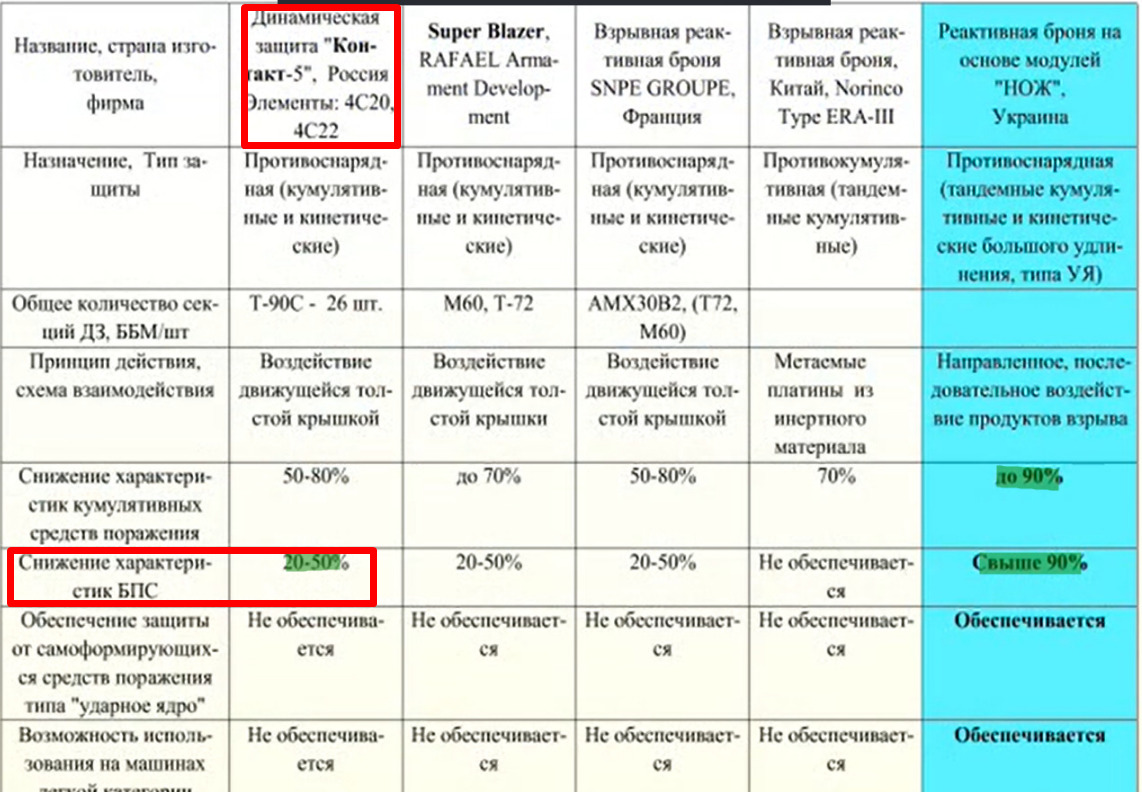
Furthermore, in many of Mikrotek’s materials, they gave Kontakt-5 either 20%+ protection or 20-50%, but then they started giving it exactly 20%.
This is obviously a manipulation of the numbers, so I don’t trust it (just like the Russian Federation’s HSCHKV-34 estimate).
Moreover, their materials also do not indicate the resistance of K-5 against tadnems, although we know for sure that this is not the case. It provides a certain resistance of ± level Nizh.
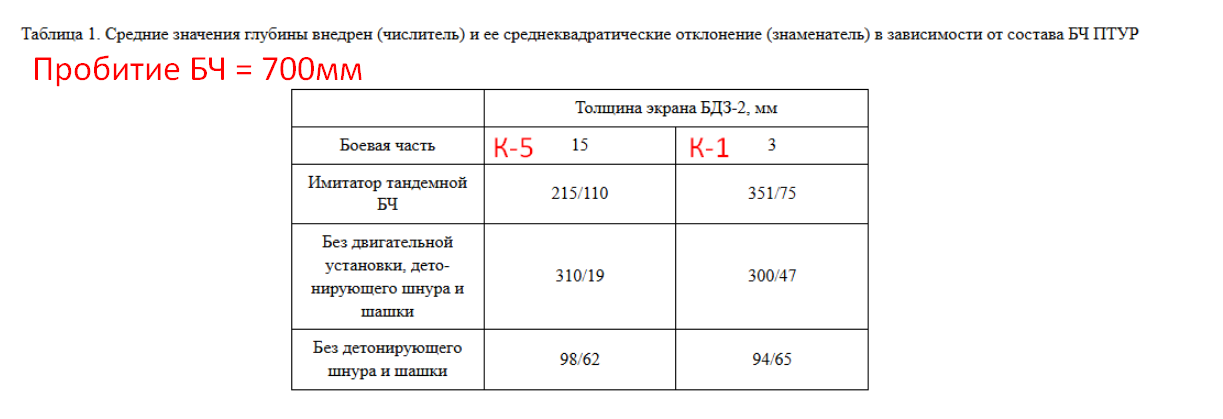
700-215=485mm
Here the initial penetration of the tandem is unknown, but it is not less than ~600 mm, and most likely 700 mm, since some other samples showed a result in the region of 530-570 mm.
So 600-700 - 330 = 270-370 mm
The top of the turret is also HHRA, lets see how much protection is provided against 3BM42 compared to orignal thickness of 45mm.
Lets say 45mm turned into 50mm, HHRA provided an additional 5mm, that means the mulitplier is about 1.10, this matches exactly with gaiijn’s stated multiplier for modern HHRA (1.10).

You still have not provided your calculations and multipliers you used to account for HHRA, for multiple layers of steel, ETC. I have already provided all the numbers I have used including sources from Gaijin, and in game testing that prove that according to in game numbers, the penetration stopped by duplet was 524-(93x1.10) = 421.7mm, approximately 80.47% of 3BM42, this of course matches the figure given in the brochure for Duplet provided by the real manufacturer exactly.
Where are the IRL tests?
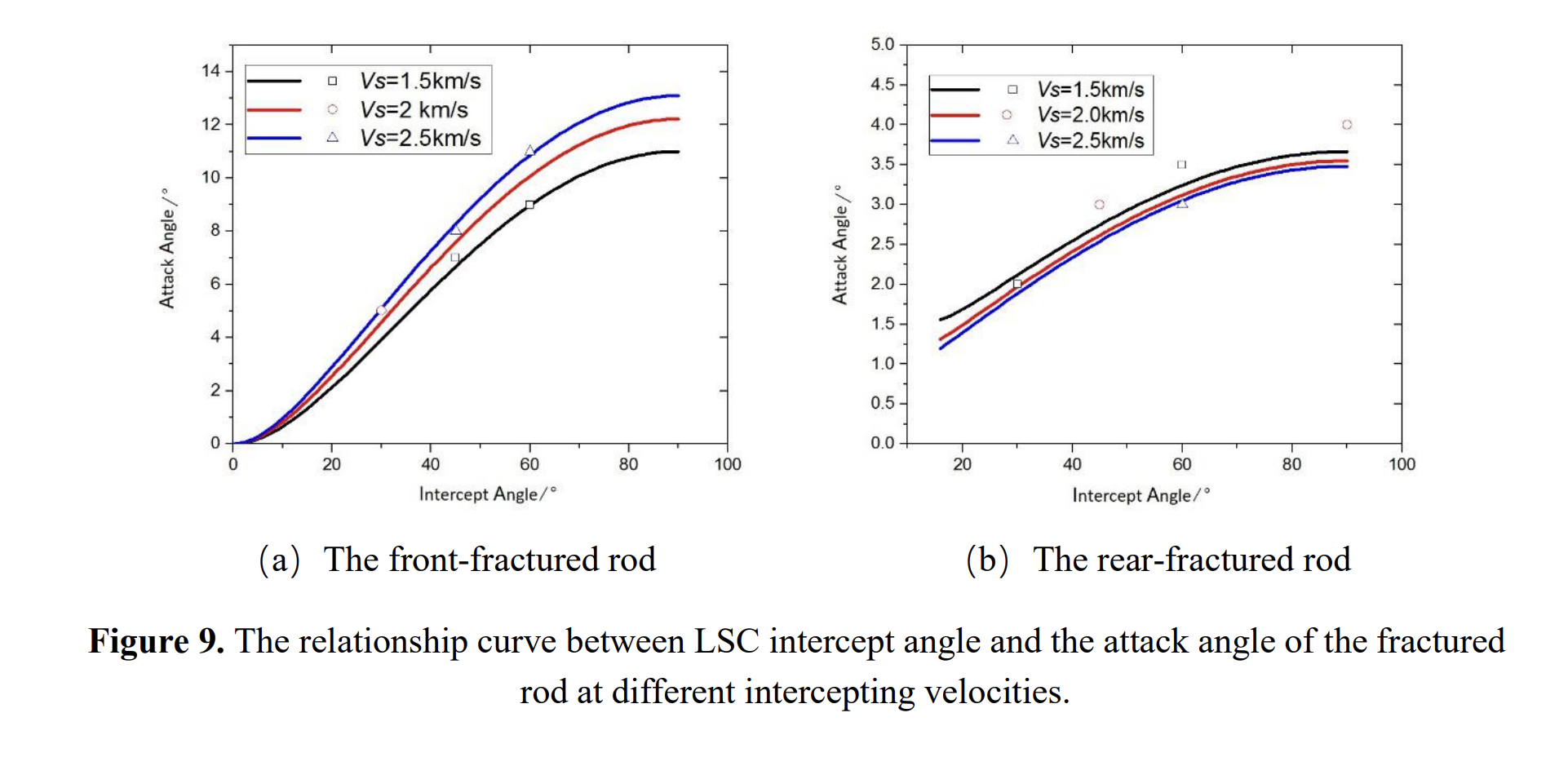
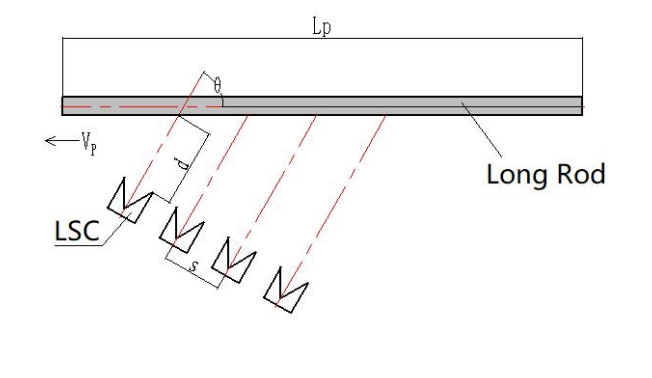
A paper did simulations of Linear Shaped Charges on APFSDS long rods and it does show that it yaws the rods.
Are you completely ignoring what I wrote because it’s inconvenient?
Try to explain, using your own logic, how a Oplot turret without ERA can have 850mm of normalized resistance.
What does this show? Video says its an anti-tandem explosive not a rod. and what’s the angle?
Look at the data I posted, the duplet should yaw the rod from the side.