So after looking up the datamined guided weapon data, some experiences using the aim-4s in warthunder and some testing with statshark missile calculator, i’ve concluded that both missiles need revised guidance parameters, the AIM-4F more so than the G.
First, because for some unkown reason the AIM-4F is hardcapped to 15 G´s of turning regardless of launch condition, when the 4G allows up to 27G’s which is pretty much the value stated by the smcs of both missiles.
Second, because it’s seeker has a narrower 25º gimbal limit, and while i haven’t found documents to prove otherwise it seems odd to me that it would have a lower limit than the 4G that it shares parts with (in game 30º, but there’s a blog that states the AIM-4D, which shared the seeker, had 48º) or the AIM-26b (ingame also has 48º) it was developed from. Not like the falcon is a thin missile without enough space for a gimballing head, either.
Third and most importantly, because it’s all too easy to make the missile bug out away from the target right when it’s about to hit, even against AI flying in a straight line. I think they just used PID values good for proximity fuses, but from what i could test the best values for contact fuses are a lot of proportional term, little to no integral term, and either next to none derivate term (practically undamped), or a LOT of it (between 1/3 and 1/2s of the proportional term). Once again, the 4F is worse off than the G just because it has less proportional term (they copy pasted the values from the aim-7c sparrow, clearly). Though there’s no way to be sure if these values helps with the terminal guidance bug without ingame testing it.
First item is easy enough to prove, but 2nd and 3rd is probably a bit too vague. But basically it’s unnecessarily hard to get a hit with the 4F on small planes like a mig 21, even if they are AI or AFK.
I’ve spent WAY too much time on research for this bug report Community Bug Reporting System , especially given all those other bug reports have not been acted on (and probably won’t as long as they only matter to a single event plane), but at least now it’s recorded that the gimbal seeker limits of the AIM-4 and AIM-26 falcons should be around 96-90º degrees, rather than the current 48º of the AIM-26, 30º of the AIM-4G or 25º (!) of the AIM-4F.
It certainly should help when it comes to using the HMS or giving extra lead to the missile…
Unfortunately the manuals disagree with your report sorry
J35F Del 3 gives both RB 27 and RB 28 and neither list it at 90 degrees
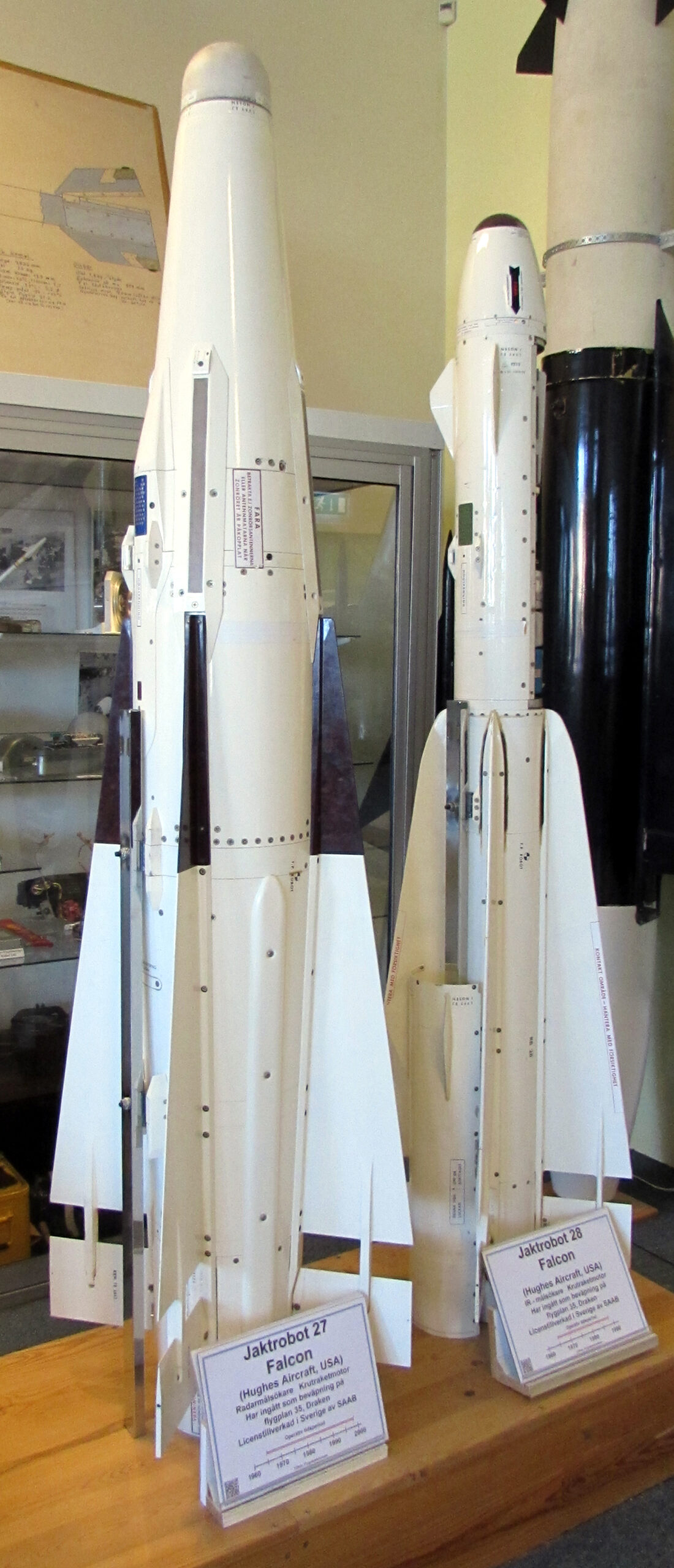
As for the Super Falcons ive no idea really so i cant comment on that but the Robot Museum is wrong
So what is the seeker angle specified in those manuals (not that i know swedish…)? I don’t mind correcting the bug report if there’s better information, either way those values would apply for AIM-4F, AIM-4G and AIM-26b in game.
…But that doesn’t actually contradict the bug report? Unless my understanding is wrong, when the manual states maximum deflection it’s comparing the maximum angle of the gimble vs the longitudinal direction of the missile - by definition, 0º of angle of deflection is straight ahead. So it would be able to go from -48º to +48º in azimuth and elevation, or 96º in total angular amplitude of motion - which is what warthunder specifies in the “gimbal limit” parameter.
You can see in the screenshots i posted that since the AIM-4G has 30º gimbal limit in the datamine, it’s able to search from -15º to +15ºrelative to straight ahead.
I’ve taken another look at the datamine, and it seems i’ve made an error in interpretation; Warthunder doesn’t specify angular amplitude of motion, it supplies 2 angles of deflection: Gimbal limit, and maximum lock angle before launch.What I screenshoted was the maximum angle before launch (15 degrees), but after launch it increases to 30 degrees.
Thus, the ingame seeker values for the AIM-26b ingame are correct (48 degrees gimble limit AND 48 degrees before launch), it’s just the seeker values for AIM-4F and G that need correction.
I’ve made reports regarding those issues too, I don’t think the problem in the super falcons is excess drag but lack of thrust in the boost phase; datamine coincides with the listed values in the smc, but i suspect that
the real missile doesn’t reduce thrust instantly between boost phase and sustainer phase (comparing the sum of impulses with overall specific impulse adds about 10 m/s to the base value)
listed values are for sea level at standstill, but the rocket motor gets a lot more efficient with speed and altitude; since warthunder doesn’t make corrections for these factors, the next best thing would be a fixed adjustment to make it correct for a launch around mach 1 and 5000m of altitude.
As for the Leading edge/trailing edge tracking, that’s actually part of the eccm/chaff filter mechanism also used by the AIM-4F, might as well edit the bug report to mention the AIM-26b.
On another note, is it true that the RB-28 was modified with a proxy fuse, or is that just some mistranslation/confusion between rb 27 and rb28?
I do agree that may be the case but without anything to show the snail best bet is drag to at least give it slightly more accurate performance
If sources rear their heads on actual impulse then it can be re adjusted
I havent seen that as its excluded from the SMC, only know from the J35 manuals
RB 28 underwent a fair amount of modifications, one of which is reducing the time to spool to missile from ~16 seconds to ~3 seconds off the top of my head
Until the swedish archives follow up a request for the falcon documents then its all second hand sources
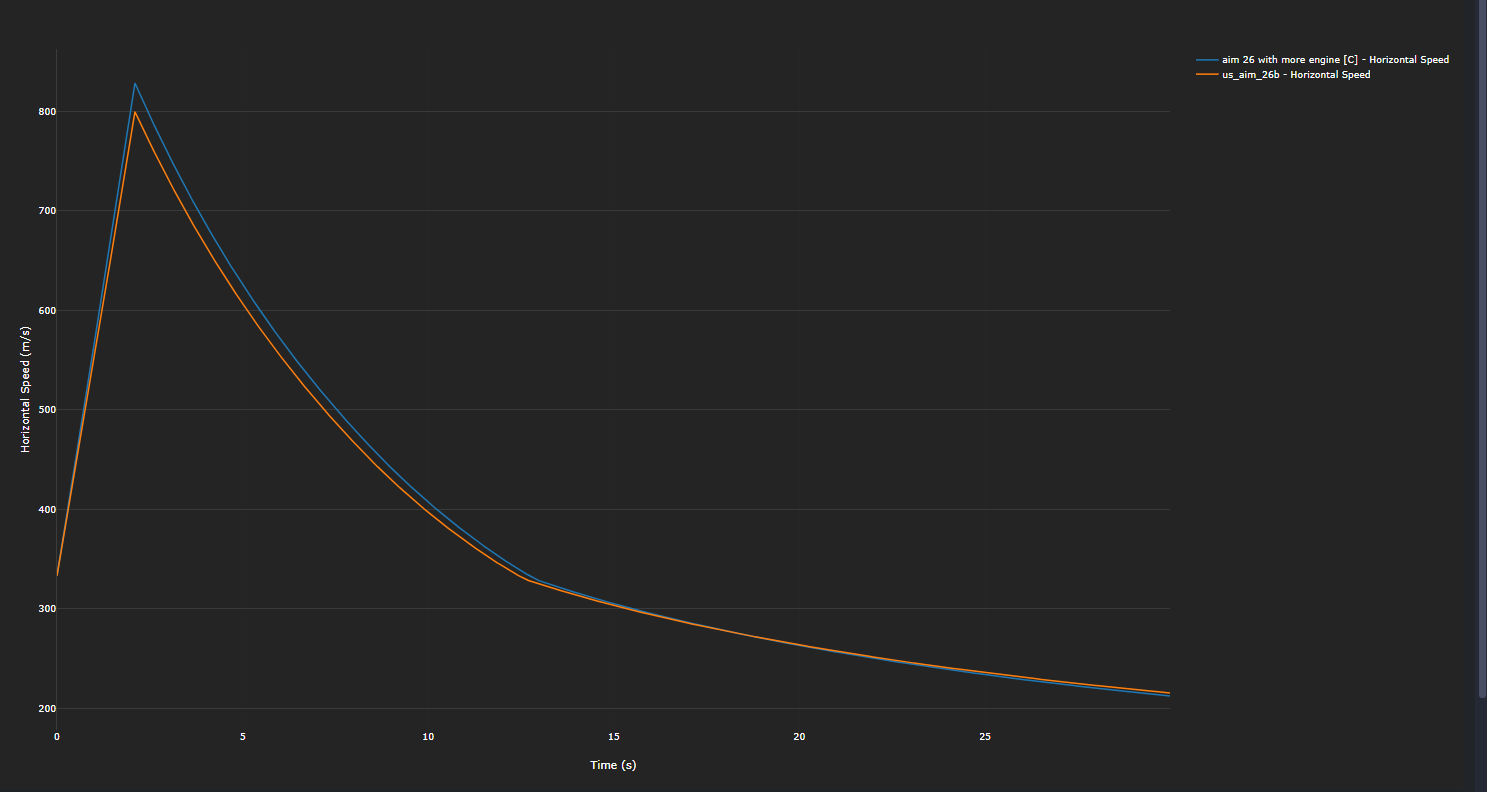
Rammed some bigger numbers into the AIM 26 and compared it to in game and the one with the better engine only keeps its lead for a short amount of time before basically falling in line with the one in game and then actually being slower than it by the end
Still also inaccurate to speed charts besides the maximum speed it reaches when booster ends
I was specifically talking about the super falcons, aim-4F and aim-4G, mainly because since they have booster and sustainer and thus are easier to get wrong, and in game the straight line performance doesn’t match the smc.
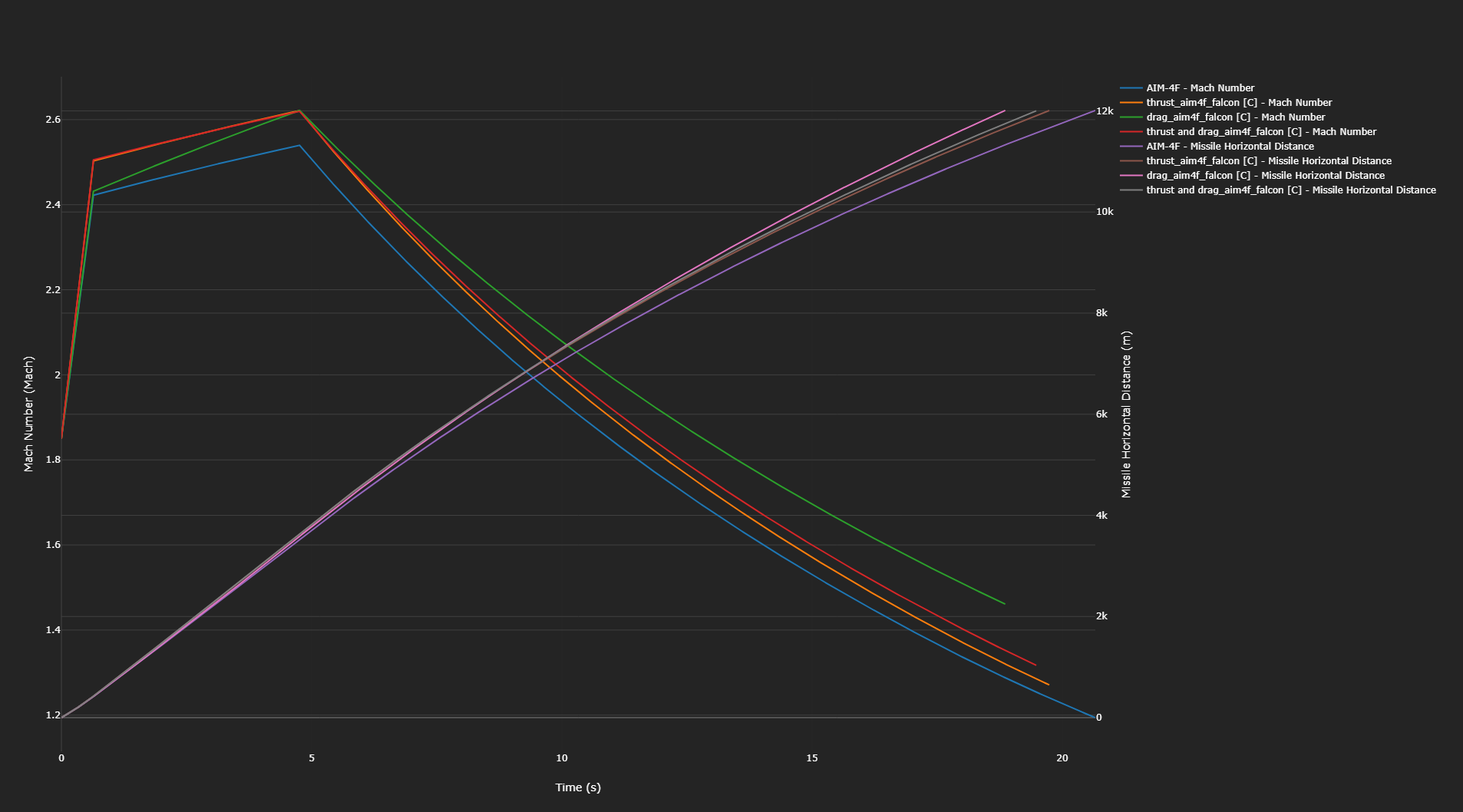
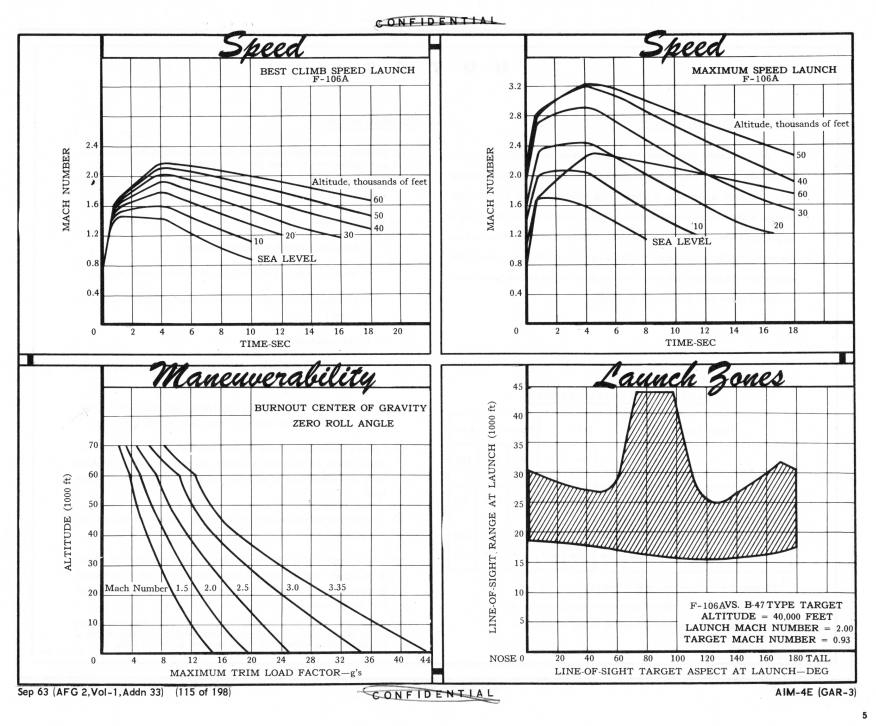
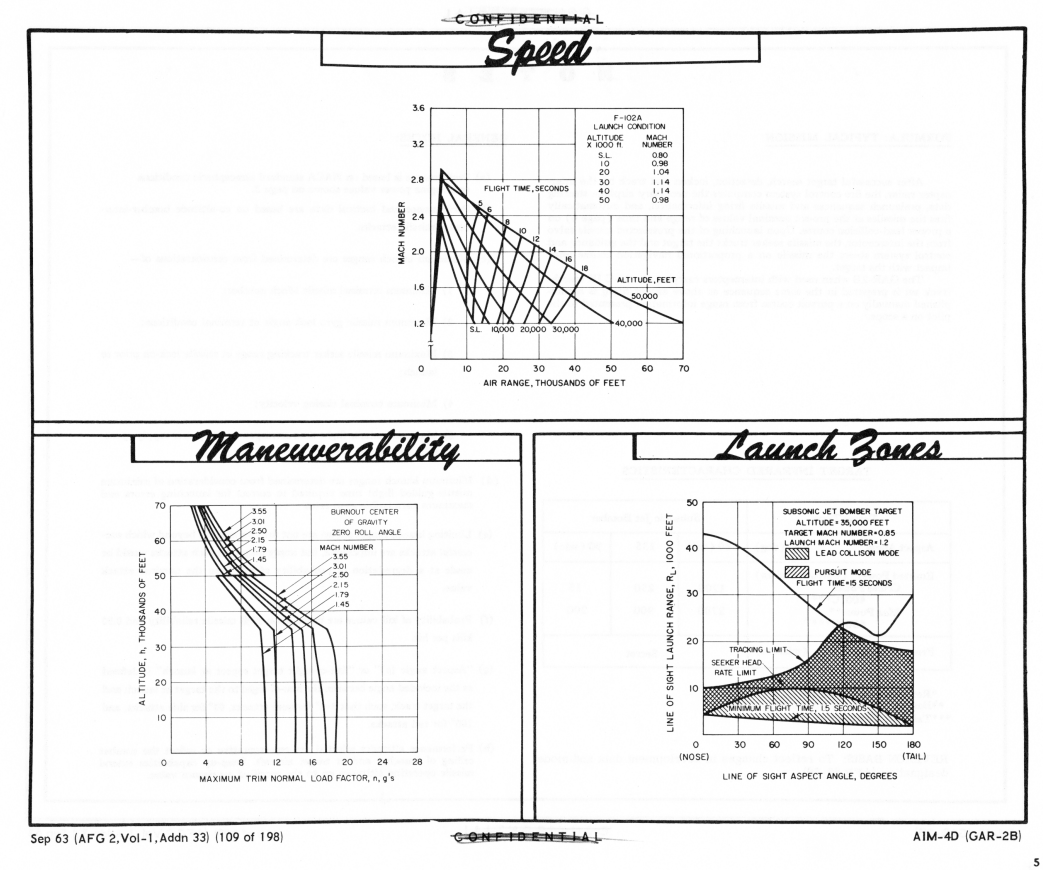
I’ll show it in stat shark by comparing it with the tabled value in the SMC, a mach 1,85 launch at 30 000 feet where the missile goes over mach 2,5 after booster cuts out, speed peaks at mach 2,61, and 15 seconds after launch the missile is still travelling over mach 1,6 (the smc still has it still traveling after 20 seconds but in warthunder the missile selfdestructs because it travelled too far).
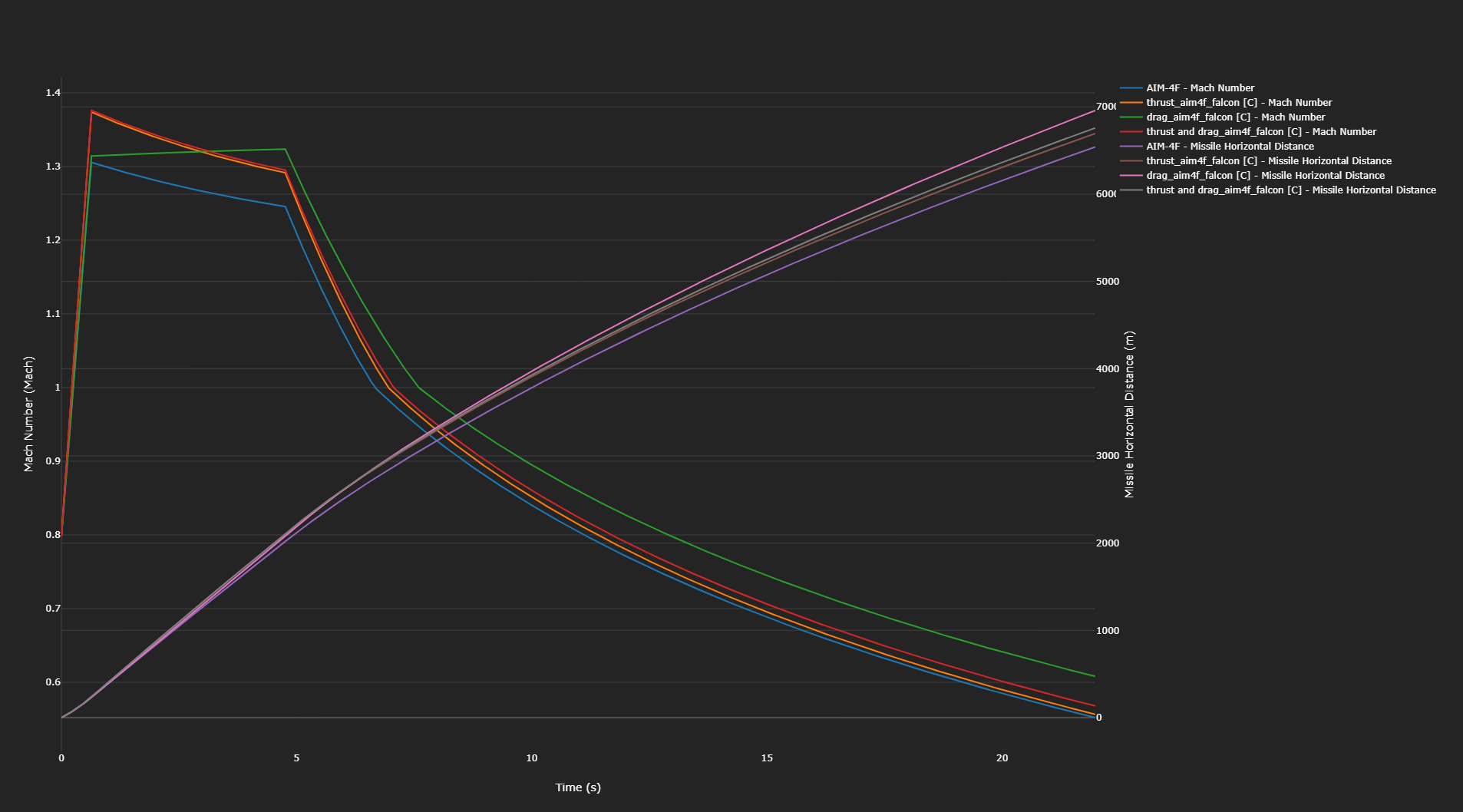
Compare the ingame aim-4F (blue) with custom versions of the missile where
only the thrust was increased (yellow, +13% booster, +4% sustainer )
only the drag was decreased (green, drag reduced from 2.025 to 1.7)
both were tweaked to match the smc exactly (red, +13% booster, drag 2.025 to 1.945).
Note how you can get pretty close just by changing the thrust.
If you change it to a mach 0,8 sea level launch, the ingame version is only correct up to 0,63 seconds mark when the booster cuts out, while the green graph may look the closest to the graph on the smc, but it’s actually going too fast by the 10 second mark. The thrust modified ones peak slightly more at first but are more acurate from the moment the sustainer cuts out.
But since statshark wasn’t allowed for bug reports, i just checked in game values in test flight and suggested that a 40% stronger thrust in the booster phase might be close enough, but if any moderator wants to pass on more exact adjustments do feel free.
Yeah this is by far the most egregious error i’ve spotted so far, it turns out that the ingame versions of the AIM-4F, AIM-4G and AIM-26B are limited to between a half and a forth of the turning ability they had historically. Community Bug Reporting System
I don’t expect this bug report to acted on any time soon, considering other examples, but to be fair I kind of understand what happened; they probably based themselves on the sea level performance of the AIM-26b without looking at the details.
And if anything, Hughes was just as sloppy when they made the AIM-4F and AIM-4G SMCs; the maneuverability graph looks like complete nonsense (g limit stays practically the same between 50000 feet and 30000 feet at the same mach speed, despite the massive difference in air density), unless you compare it with the AIM-4E SMC
and figure out they copy pasted the lower altitude values of the prototype missile, and drew a line connecting those values to the actual experimental results of the AIM-4F at 50 000 feet… if you calculate downwards from 50 000 feet, at sea level the AIM-4F can pull nearly 30gs at just mach 1.5, the graph should look like a bit like the aim-4D graph but with a lot more gs.
As of Swedish 1971 Information no but that leaves nearly 30 years of development and there was falcon upgrades in that time but the info is scarce and might only be for 27 and the Hawee upgrades for 27 dont matter in game due to how seekers are modelled
in the more than certain case the missiles were at some point refurbished there are many things that can happen, especially with more modern tech found towards the latter end of its life
Followed by the museum in arboga don’t actually know too much on the missiles themselves and those examples could be from the experimental side or pre Hawee or anything
And as per your own words, this could be finnish specific