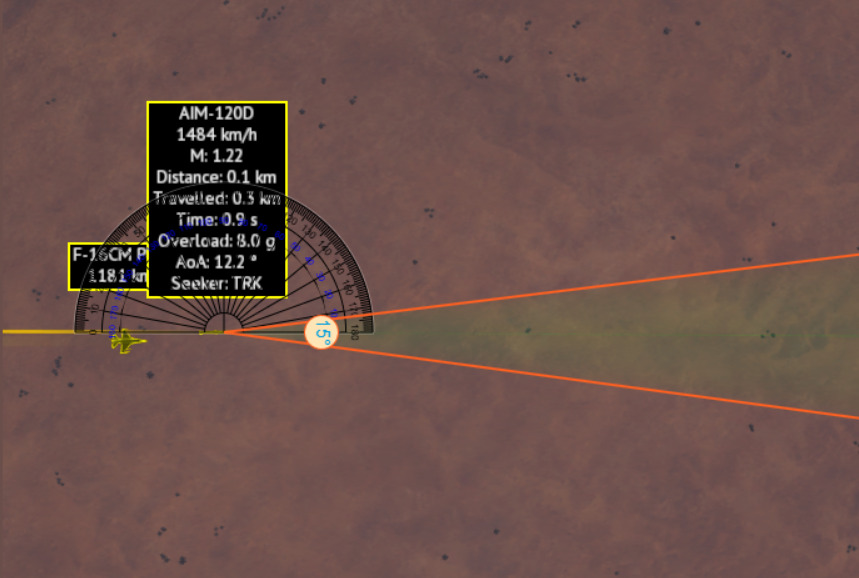
Dont know were you got 30°
Its 15° for the aim 120a and 7° for the mica
Id like to see the bug report am interested since j band is know to have a better range resolution which means its more precise at range but lets not confuse this with detection range
Though aim 120 does have a better detection range that is true because i band is more stable and travels further
25 km vs 20 km for the mica in similar conditions
In real condition the mica would probably 13 km to 14 km not 9 km
The only reason why it would drop that low is if the traget is very small or/ and bad weather
Also it is able to track LO targets like drones
For VLO its a different story since this is in the ranges of stealth aircraft like the f22
Very unlikely that it will track no matter the conditions
Any source for this claim, mathematics, whatever?
Gain formula is pretty straightforward, so do you know something others don’t?
FTR, in conditions where 120 gets 15km, MICA gets 9, at best, which is supported by math and physics, providing MICA has half the 120’s FoV and providing MICA has the same power on the seeker, which is very unlikely considering having ~1/3 less weight.
Not really. According to MBDA, they can actually increase the range of a seeker by increasing the frequency (and thus narrowing the band). That’s what they claim to have done between ASTER 30 B1 and B1 NT, from Ku to Ka band.
Edit : link : https://youtu.be/JG2B-Ot9SL4?is=j1NU_-kp2uevbXzi
30° would be wildly excessive. 15° is probably a bit high too, I’m guessing this value was based on the HPBW approximation for a parabolic reflector: HPBW (deg) = 70 * lambda/D, we find that the assumed antenna diameter is 14cm.
Searching around for what the antenna on the AMRAAM looks like, it’s very much not a parabolic reflector. Don’t have clear pictures, but one site says it’s a slotted waveguide planar array, in any case, an array. Array HPBW (deg) =~ 51 * lambda/D = ~11°. Datamines show -30 dB SLL attenuation, so this may mean for a more fair comparison, a taper should applied instead of considering sinc approximation, which means HPBW would become larger. I tried looking what a Taylor window for the requested -30 dB SLL would make the HPBW using simulated array factor and element pattern, gives me ~ 13-14° HPBW, assuming 9-10 elements. But idk what the devs use to simulate radiation patterns.
AIM-120 (10 GHz, I Band)
*High Altitude (>30,000 ft, clear) ~20–25 km
*Low Altitude (<10,000 ft, clear) ~15–20 km
*Weather (clouds, fog, rain, etc.) ~15 km
MICA-EM (20 GHz, J Band)
*High Altitude (>30,000 ft) ~25–30 km
*Low Altitude (<10,000 ft, clear) ~10–15 km
*Weather (clouds, fog, rain, etc.) ~5–8 km
Obviously, anywhere but above 30kft, the 120 has 5-10km advantage in seeker’s range.
Now, if we translate that into WT and the altitudes at which most shots occur, we can easily see that the MICA is way overperforming in detection range…providing it actually works at 20 GHz in the first place.
If it doesn’t (which is most likely), then it doesn’t have half the 120’s FoV.
So, which is it? You can’t have your cake and eat it.
Pulse doppler seeker is a lot worse when it comes to track VLO
You may get a lock on radar but that doesnt mean the missile seeker can see it
Compared to an aesa you atleast have a chance it tracks
Indeed, with a caveat.
RCS of 0.01m² in I band, isn’t RCS of 0,01m² in J band, or Ka band.
As the wavelength decreases, so does the RCS, too.
Eg. Su35 has J band radar in LEFs to look for V/LO objects.
October of 2008, an EM variant of the MICA missile intercepted a Banshee drone flying at low level over the surface and managed a direct hit at 15km away.
The banshee is a sea skimming drone mostly used for testing
Still not a peep about actual tracking range.
However, if proven to be true, it only means that MICA doesn’t work at 20 GHz, but much closer to Jband’s lower limit of 10 GHz, ie AIM120 and so the FoV should be proportionally larger.
As I said, you can’t have your cake and eat it.
Ofc, but we’re taking about MICA’s seeker range as a function of FoV, which in WT greatly reduces escape chance due the angle gating. The point is, MICA has been given superseeker which doesn’t exist. If it can do some things, it can’t do the others. However, GJ just gave some things, but “forgot” to take away the others. So, if GJ insists on such a narrow beamwidth that makes escape angle gating practically impossible, then the missile should have limitations in any altitude but the tropopause and above in terms of detection and tracking range. We should be able to lose it in a cloud, or rain, or fog, or just vapor at medium altitudes eg., if the DL isn’t available.
To get a bit further…again, physics says, if you want a MICA to have the same detection range of 15km in the same conditions as an AIM120, then the frequency should drop to 15GHz (about halfway in the Jband) and so the FoV should increase to 8.75°, as opposed to 6.6° at 20 GHz. Considering 120 should have ~11.8°, that’s ~25% difference in comparison to the current 50% difference.
just out of curiosity, what other advantages besides weather resistance and VLO does the AIM-120 seeker have, assuming the 15GHz MICA-EM to give them the same 15km range like you said