BTW it’s not just “SARs” or F/A-18 NATOPS performance data supplement:
4- ADA357045 Distributed Simulation Testing for Weapons System Performance of the FA-18 and AIM-120 AMRAAM 1998 LCDR Tom Watson Naval Weapons Test Squadron, Page 3:
It specifies 345 lb nominal weight for AIM-120A. Note that this is a report about simulation testing of the weapon’s performance dated 1998. I don’t think you can get a higher quality source than this …
5- Solid Propulsion Enabling Technologies and Milestones for Navy Air-launched Tactical Missiles Thomas Moore 2011 American Institute of Aeronautics and Astronautics, page 13:
6- Critical examination of a complex and critical major acquisition for the Department of Defense the advanced medium range air-to-air missile (AMRAAM) MIT 1994 Robbins, James F, page 16:
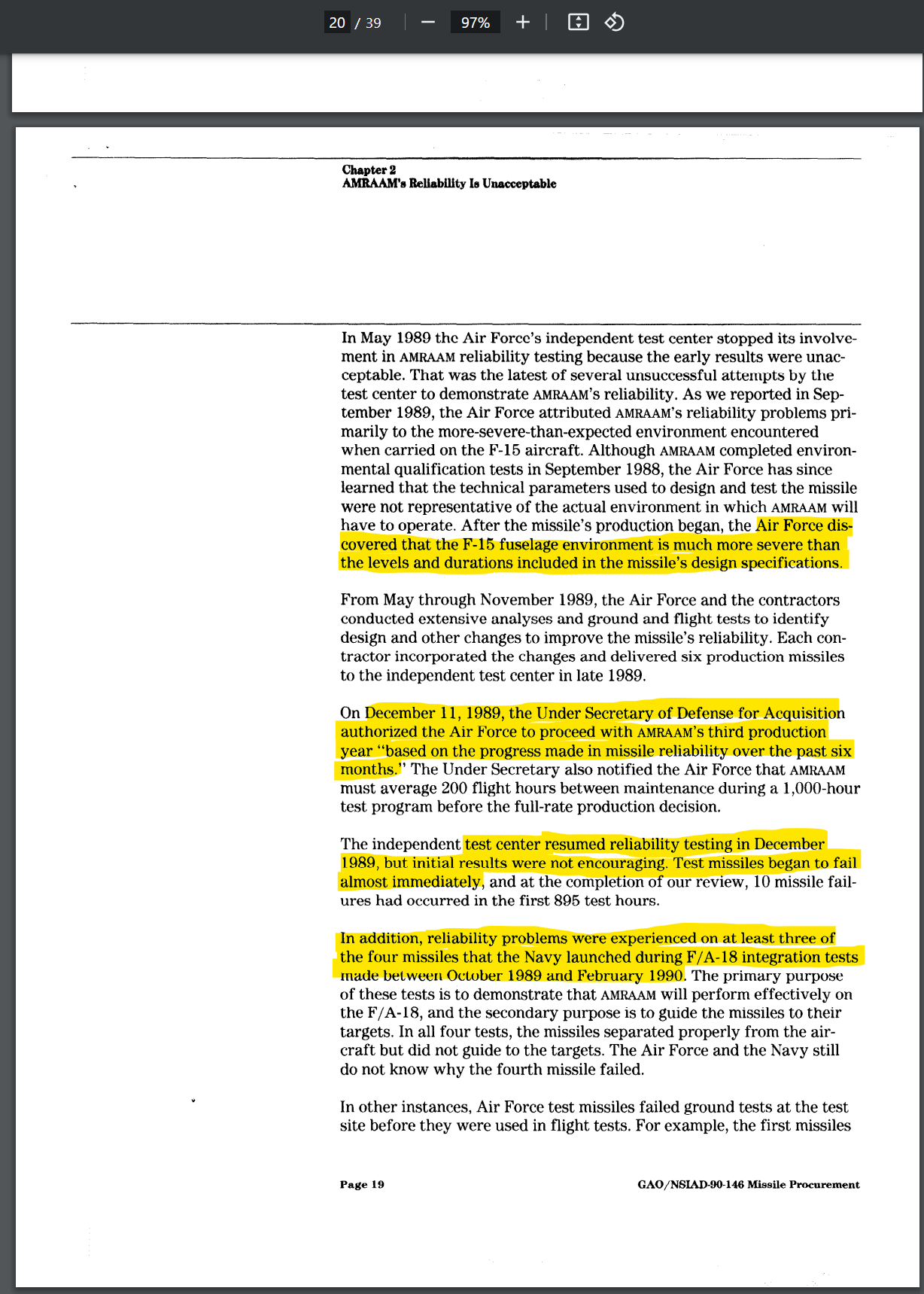
This (and not necessarily the cost) might be the reason behind the change in the materials (which resulted in the weight getting changed from 335 lb to 345 lb in the SARs FY 1990:
It doesn’t mention any specific variant but we can confirm it’s the A or B variant since the drawing has sharp front fins and not clipped ones like the C variant.
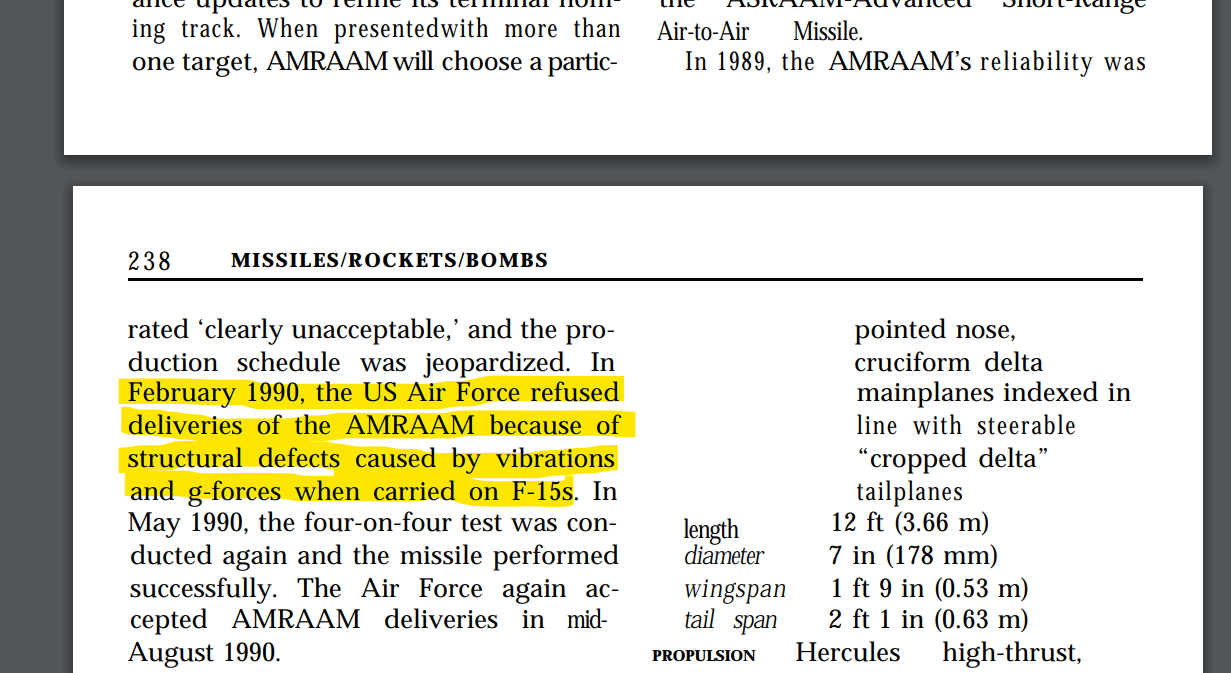
The missile has structural issues due to vibrations and g-loads on the F-15
The delivery gets refused and stopped by the USAF in Feb 1990
SAR FY 1990 records a weight change with explanation: “Missile weight increased due to a change in materials”
The May 1990 report I posted above also reports the weight of AMRAAM at 345 lb:
That is a valid explanation for a weight increase but I don’t think it has anything to do with the missile body and instead the well known change to the pylons.
Some basic values are given false or generic weights - in this case it is highly unlikely the weights are 356+ pounds seeing as there was a threshold of 350 for stores purposes and the 2015+ SAR reports make no mention of this threshold being increased. Demonstrated performance remains at 344 pounds, allegedly. Or (as I said before) They are reusing false numbers.
It’s quite possible that USN AMRAAMs are a bit different due to the requirements of the carrier operations.
Keep in mind that the USAF was the manager of the AMRAAM project while USN was a participant. So would make sense if their estimates didn’t reflect USN’s modifications specifically.
Yet they’re supplied from the same lot #'s as the AF. Lot 38 for example is going to several countries operating unique aircraft. Japan, Ukraine, multiple NATO member states operating either F-15, F-16, F-18, or even F-35.
Similarly, lot’s 1-4 are equipping both AF and NAVY planes. Any differences would be uniform between all missiles of each given lot # and they weren’t ordered for specific branch specifications.
Can someone tell me why the Su-27 or Typhoon or Rafale, when hit head-on with 120, don’t fall apart? And even the 9M now has a high destruction rate? Why do Rafale and Typhoon just stupidly ignore this missile? A month ago, a 120 missile fired head-on from five kilometers away was a guaranteed exit to the hangar, now it’s some kind of sluggish missile.
120А was nerfed significantly, excuse me, but if it flies past a subsonic Harrier that is coming at you at four kilometers, or three of these missiles plus a 9M fly two kilometers past the new IMBs (Rafal and Typhoon)… The missile has become worse than the 7M