I noticed you left out the part where they (once again) stated that these performance requirement changes were made prior to 1986. In fact, before 1984 the redesign took place as mentioned earlier.
This still does not explain the weight increase or what specifically was changed / modified post-1986 to increase the weight further as you claim.
He knows this, he’s intentionally discarding any and all sources that don’t agree with his report. It’s a pride thing I guess.
So you want to claim it’s a change from solid state to traveling tube and now you think it’s a change in materials? Why do manuals state varying weights between 326 and 348 pounds? You’ve explained nothing and reposted articles that are intentionally ambiguous.
The real answer, as I’ve said, is that the AMRAAM’s weight was classified and various manuals intentionally state erroneous data.
Can you show me instances where missiles from the same lot number exported to Britain got special materials and modifications somehow compared to the American missiles of the same lot?
You’ve already been informed that several manuals state the actual weight and you’ve ignored this & intentionally didn’t look for them (or more likely found and ignored them).
Attempted FOIA of the allegedly public weight resulted in a return stating the AIM-120A’s weight specifically is exempt from FOIA still until declassification currently scheduled in 2036.
Currently it is considered CUI as used in unclassified manuals stated above - and most documentation available although unclassified is restricted and exempt from FOIA.
The catch is … It doesn’t even specify any variants.
I.e. they didn’t put much effort into specifying accurate weight information because it wasn’t deemed necessary. Weight is just some side information there and is not even referring to any specific variant.
F/A-18C & E NATOPS FLIGHT MANUAL PERFORMANCE DATA are manuals which are more focused on the weight and drag of the stores and they say 348 and they specify each variant as well as their captive carry and telemetry variants separately.
So flight manuals have erroneous data but SAR’s can’t?
Hughes states a number and that isn’t believable, but when every single flight manual differs in numbers we have a winner that you’ve just selected arbitrarily? Your argument is even less worthwhile when you consider that some of the flight manuals (for aircraft we have in-game) list it as 331 pounds (5 pounds more than current…)… like is it really that big of a problem?
SARs reflect whether the contractor is meeting their obligations and program requirements or not.
And in the NATOPS flight performance data the weight and drag index values are supposed to be used for mission envelope calculations.
Whereas in the manual in question weight is for general familiarity. The ground crew are gonna just follow the loading procedures … They aren’t gonna use the missile’s weight parameter for anything …
Again … “Hughes said Hughes said”
Unnamed magazine correspondent =/= Hughes
It would only matter if the said manual was the source for the performance envelope
If they are basing the performance on the 327 lb weight document then obviously keeping all parameters (drag, thrust, loft etc) and changing the weight to 345 lb would make a difference.
If it’s not a big problem then why are you so defensive about it :)
BTW it’s not just “SARs” or F/A-18 NATOPS performance data supplement:
4- ADA357045 Distributed Simulation Testing for Weapons System Performance of the FA-18 and AIM-120 AMRAAM 1998 LCDR Tom Watson Naval Weapons Test Squadron, Page 3:
It specifies 345 lb nominal weight for AIM-120A. Note that this is a report about simulation testing of the weapon’s performance dated 1998. I don’t think you can get a higher quality source than this …
5- Solid Propulsion Enabling Technologies and Milestones for Navy Air-launched Tactical Missiles Thomas Moore 2011 American Institute of Aeronautics and Astronautics, page 13:
6- Critical examination of a complex and critical major acquisition for the Department of Defense the advanced medium range air-to-air missile (AMRAAM) MIT 1994 Robbins, James F, page 16:
This (and not necessarily the cost) might be the reason behind the change in the materials (which resulted in the weight getting changed from 335 lb to 345 lb in the SARs FY 1990:
It doesn’t mention any specific variant but we can confirm it’s the A or B variant since the drawing has sharp front fins and not clipped ones like the C variant.
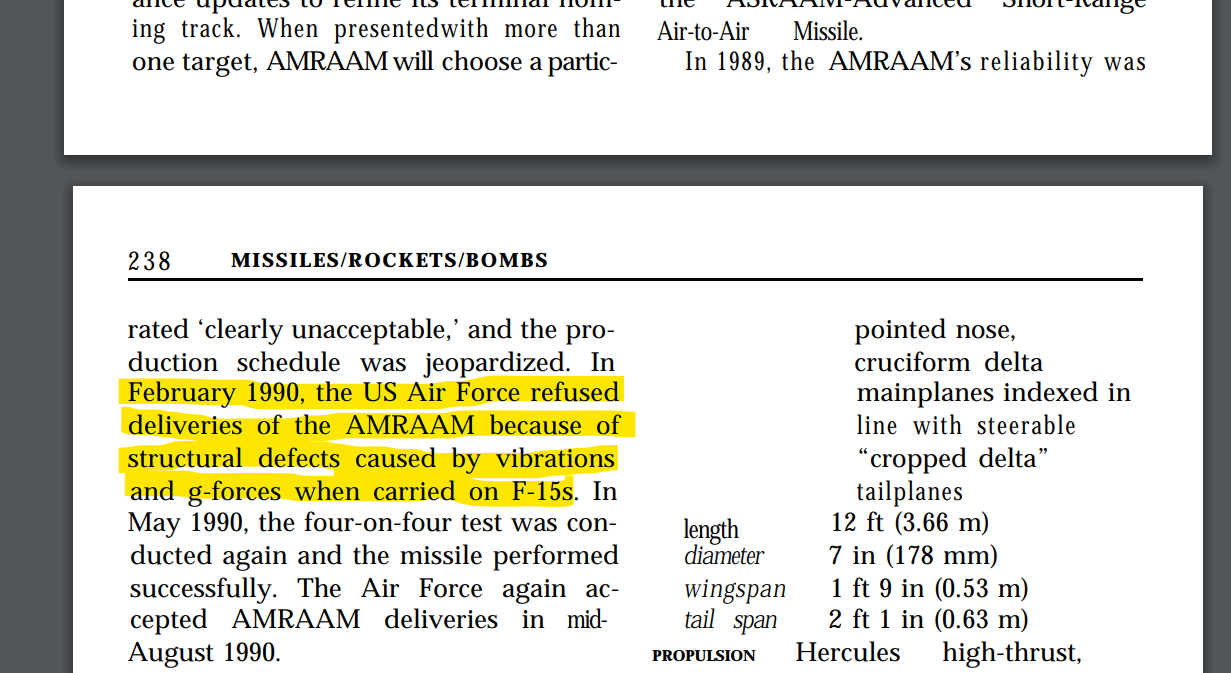
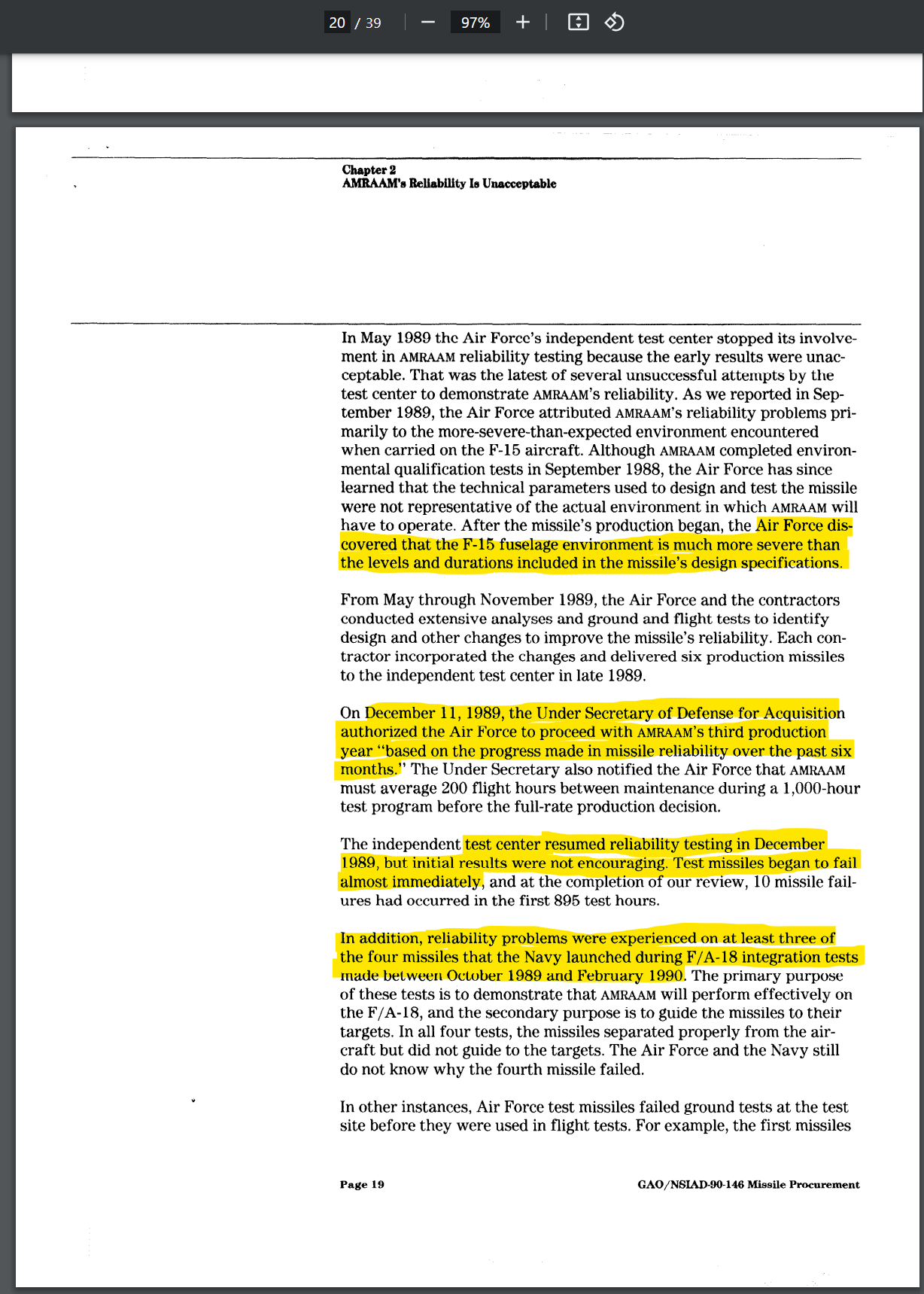
The missile has structural issues due to vibrations and g-loads on the F-15
The delivery gets refused and stopped by the USAF in Feb 1990
SAR FY 1990 records a weight change with explanation: “Missile weight increased due to a change in materials”
The May 1990 report I posted above also reports the weight of AMRAAM at 345 lb: