- Yes
- No
Hello everyone, and welcome to this new proposal.
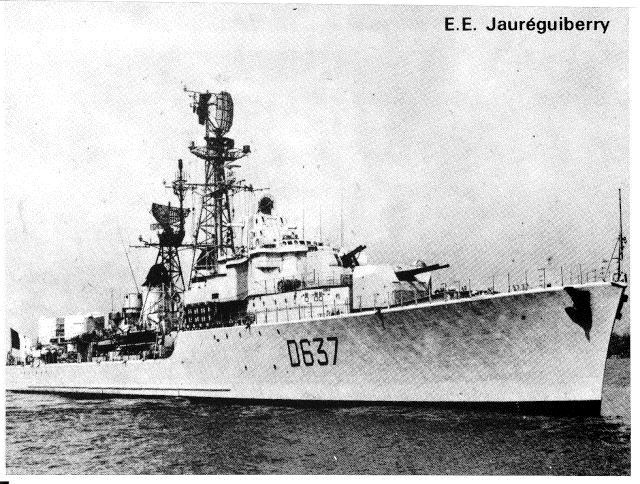
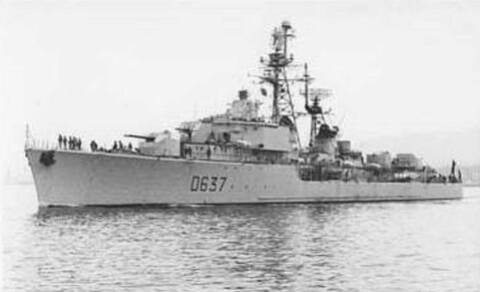
Today I present to you a new ship of the T53 class, the Jauréguiberry (D637).
Wishing to acquire anti-aircraft escorts with good combat capabilities to strengthen its fleet, decimated by the Second World War, France launched a major construction project for this type of ship in the late 1940s and early 1950s, thus giving rise to the three major classes of anti-aircraft escorts: the T47, T53, and T56 classes. The 14th of these ships and the last of the T53 class, the Jauréguiberry features all the characteristic features of these ships: high speed, decent anti-aircraft weapons, and modern equipment such as radars.
Laid down in 1954 in Bordeaux and launched in 1955, the Jauréguiberry was admitted to the French forces in 1958. This ship was, like many others at the time, attached to Force Alpha (French Unit dedicated to the realization and securing of nuclear tests on the Mururoa atoll in the Pacific Ocean, this unit is composed of military, logistics and scientific ships and is one of the main French forces of the time) with which it participated in numerous nuclear test campaigns. The ship was therefore deployed in the Pacific from 1966 to 1974. The Jauréguiberry also served as a setting for the film “The Drummer Crab”. Decommissioned in 1977, it served, like many other vessels, as a target for Exocet missile tests, sinking in 1986.
Named in honor of Jean Bernard Jauréguiberry, a 19th-century French naval officer born in Bayonne. He served on numerous ships around the world, deployed to South America, Asia, Africa, and the Caribbean. After numerous exploits (I won’t list them all because he accomplished a LOT, really a lot), he became Minister of the Navy. He is also known for representing France at the unveiling of the Statue of Liberty in New York.
Characteristics
-
Length : 128.60 m
-
Width : 12.71 m
-
Draft : 5 m
-
Mass : 3750 tons
The ship is powered by a set of four boilers and three steam turbines connected to two fixed four-blade propellers, producing a power output of 63,000 hp, capable of reaching 34 knots under normal conditions (the maximum speed reached during trials was 38 knots). The ship has a range of 5,000 nautical miles at an average speed of 18 knots. Two turbo-generators and two alternators generate the electrical power required by the ship.
The crew consists of approximately 350 sailors.
Equipment
-
Before 1970 :
-
Radar :
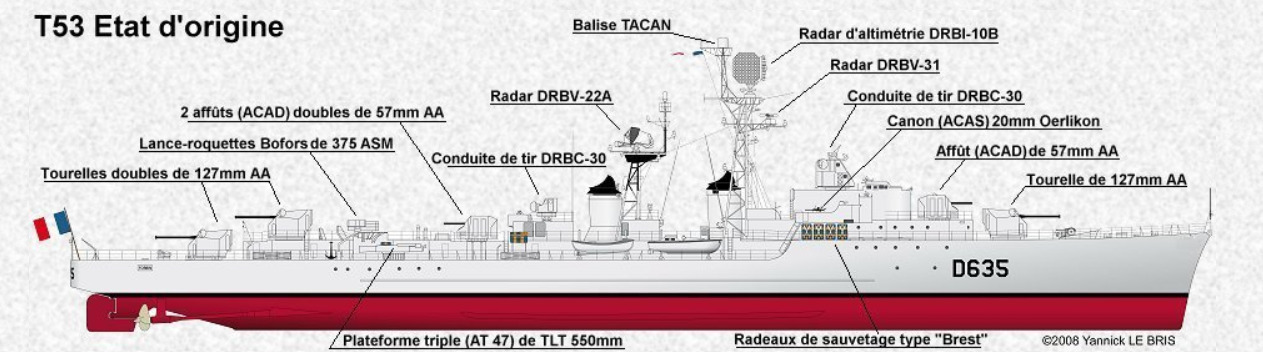
- DRBV-22A air surveillance radar
- DRBV-31 sea surveillance and navigation radar
- DRBI-10B altimetry radar
- 2 x DRBC-30 fire control radar (front one for the 127mm guns and back one for 57mm guns)
-
Sonar :
- DUBV-1B sonar
- DUBA-1B sonar
-
-
After 1970 :
-
Radar :
- DRBV-22A air surveillance radar
- DRBV-31 sea surveillance and navigation radar
- DRBI-10B altimetry radar
- 2 x DRBC-30 fire control radar (front one for the 127mm guns and back one for 57mm guns)
-
Sonar :
- DUBV-1B sonar
- DUBA-1B sonar
-
Tactical system :**
- Senit 2 tactical information system (was removed on 1977 to be installed on the Clemenceau)
-
Weapons
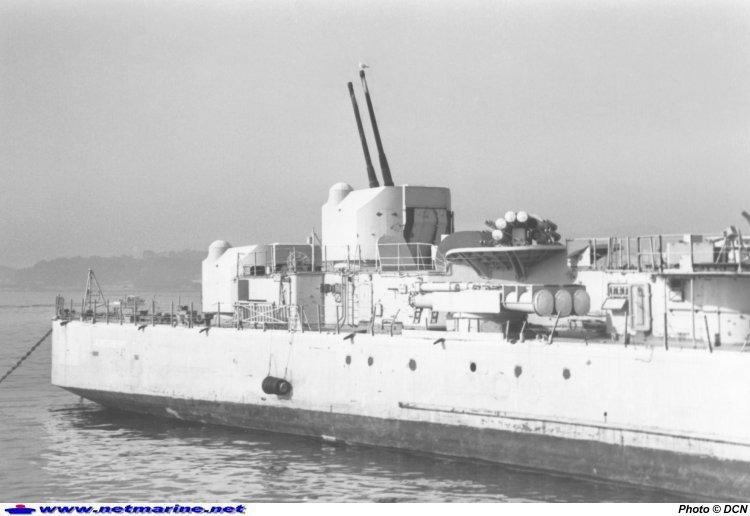
- 3 x 2 127mm mle 1948 canons
- 3 x 2 57mm mle 1951 canons
- 2 x 1 20mm canons
- 1 x 375mm Mod 1972 x 6 anti-submarine rocket launcher
- 2 x 3 550mm torpedo tube
Pictures
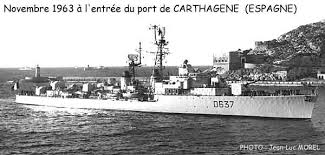
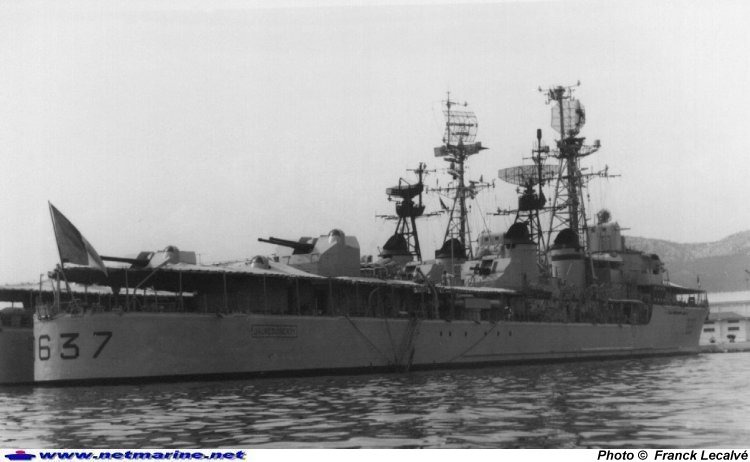
Sources
- https://imagesdefense.gouv.fr/fr/l-escorteur-d-escadre-jaureguiberry-servant-au-tournage-du-film-le-crabe-tambour-de-pierre-schoendoerffer.html
- Escorteur d’escadre Jauréguiberry
- Escorteur d’escadre Jauréguiberry
- https://www.meretmarine.com/fr/histoire-navale/plongee-dans-les-archives-les-anciens-escorteurs-d-escadre
- Le-Crabe-tambour.pdf
- Le-Crabe-tambour.pdf