- Yes
- No
Hello everyone and welcome to this new feature.
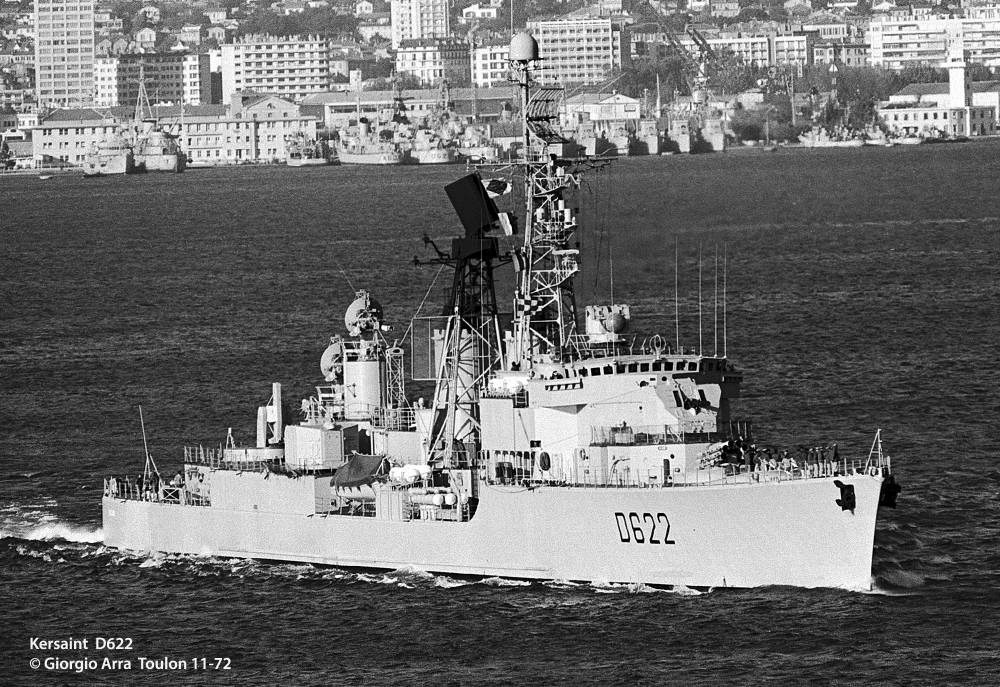
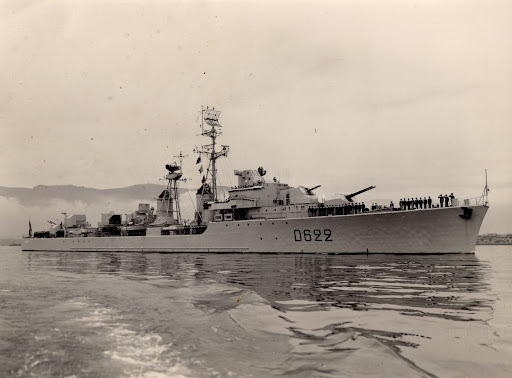
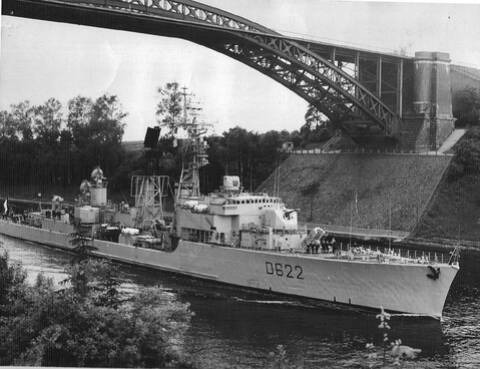
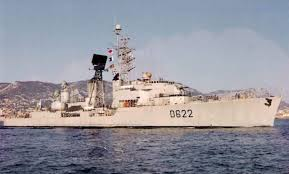
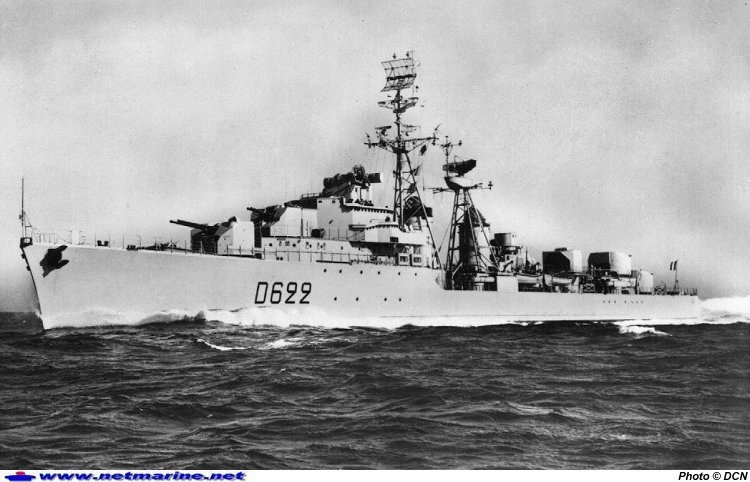
Today, I’m introducing a new French destroyer: the T47-class destroyer Kersaint (D622)
The T47 class was the first series of destroyer escorts designed for the French Navy after World War II. Construction began in the early 1950s, and the goal of this class was to strengthen the French fleet with modern and powerful vessels capable of accompanying larger naval units in the context of the emerging Cold War. The T47-class ships were equipped with substantial armament and technologies proven during World War II, such as surveillance radars and sonars that were highly effective for the time. Over the years, these destroyers underwent several upgrades and modernizations, allowing them to gradually specialize in different areas: some were adapted for anti-air warfare, others for anti-submarine warfare.
Built in Lorient starting in 1951 and commissioned in 1956, the Kersaint was one of the T47-class ships to benefit from the “Tartar” modernization program, named after the American anti-aircraft missile system, which significantly enhanced its air defense capabilities. Shortly after entering service, the Kersaint participated in the Franco-British intervention during the Suez Crisis in 1956. It was during this operation that it opened fire on an Egyptian destroyer, the Ibrahim El Awal, in a brief naval engagement.
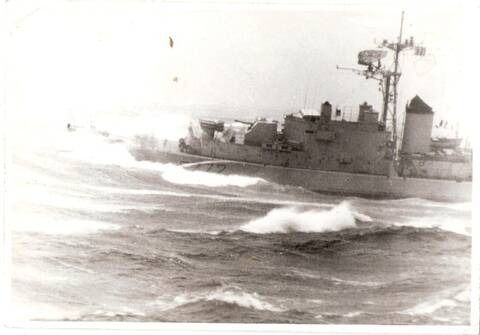
Throughout its career, the Kersaint carried out numerous overseas missions, crossing the Atlantic several times to reach the French West Indies, as well as the Indian Ocean, where it participated in various operations and deployments. Like most escort vessels of its generation, the Kersaint’s career ended in the 1980s. Decommissioned after several decades of service, it was ultimately sunk during live-fire exercises for the French Navy, thus serving one last time in crew training.
The ship was named after André Guy Simon Kersaint, Count of Coëtnempren, an 18th-century French naval officer. Joining the Navy as a young volunteer, he gradually rose through the ranks to become a vice-admiral. An emblematic figure of courage and loyalty, he was nevertheless executed during the French Revolution in 1793.
Characteristics
-
Length : 128 m
-
Width : 12
-
Draft : 5 m
-
Mass : 3850 tons
The ship is powered by a 63,000 hp Parsons turbine, driving two propeller shafts, which allows the ship to reach a speed of 32 knots. The estimated range is 5,000 nautical miles at a speed of 18 knots.
The crew varies depending on the era but is around 300 sailors.
Equipment
-
Radar :
- DRBV22 air surveillance radar
- DRBV31 sea surveillance and navigation radar
- DRBC31 fire control radar
-
Sonar :
- DUBV24 sonar
- DUBA1 sonar
Weapons
- Before 1963 :
- 2 x 3 127mm mle 1948 canons
- 2 x 3 57mm mle 1951 canons
- 4 x 20mm canons
- 4 x 3 torpedo tube (2x3 short for anti sub and 2x3 long for anti ship)
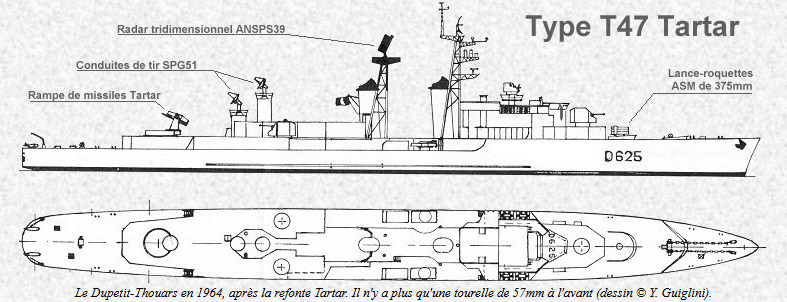
After the refit of 1936-1964, the Du Chayat became a ship mainly focused on anti-aircraft warfare, for this it received many new weapons and lost a large part of the weapons it previously possessed.
- After 1964 :
- 3 x 2 57mm canons
- 1 x Tartar Mk13 Launcher (40 missiles)
- 1 x 375mm Mod 1972 x 6 anti-submarine rocket launcher (turret on front platform)
- 2 x 3 torpedo tube (short tube)
The Tartar launcher can launch an American RIM-24 missile (one missile launch every 15 seconds), which can hit targets up to Mach 2 and up to 30 kilometers away. The Mk13 version installed on this ship can store 40 missiles in a fire-protected barrel.
Picture
Sources
- ir-667398.pdf
- Caractéristiques
- Surcouf T47 class Destroyer French Navy Marine Nationale
- https://www.meretmarine.com/fr/histoire-navale/plongee-dans-les-archives-les-anciens-escorteurs-d-escadre
- Kennisgeving voor omleiding
- Caractéristques de l'Escorteur d'Escadre le DU CHAYLA
- Redirecting...
- Redirecting...