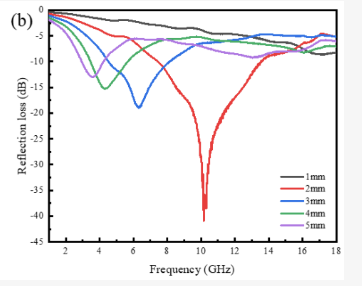
Is that “more absorbent RAM” unclassified as well? Otherwise, how exactly did they obtain its characteristics for the simulation?
This is a pretty crude model that doesn’t even include the aircraft’s skin. So how exactly are you deciding what’s realistic and what’s not? Another case of “I have a feeling” to you?
There are RAM materials significantly more effective than MnZn ferrite at X-band that are published. Such as CIP. It is quite misleading to use a RAM material to represent the radar blocker.
What? A fully conductive surface is impossible to have on a plane. Non of the external surfaces have any form of reduction. It’s not a “feeling”, it’s basic logic and understanding.
That is obviously classified but a very logical assumption is that it’s better than anything unclassified, same goes for the F-35 and J-20. If this wasn’t the case they would just go ahead and buy unclassified RAM with better absorption since its readily available.
There is also a lack of detail in the radar blocker, it’s simplified, giving it worse performance. I have explained 4 times why lack of detail on the outer details won’t effect RCS significantly. @ron_23 even quoted all of these messages so you easily access them although you still haven’t read them it seems.
Another thing to mention is the fact that the F-35 doesn’t have highly detailed panels either in the simulation. Both of these planes use serrations and treatment of panel edges to reduce scattering. Why would the F-35 suddenly have a significantly lower RCS than the Su-57 when it gets its panels properly modeled?
There is seriously no way that you don’t think that military classified RAM that has been researched extensively is worse than readily available RAM that even I could buy. There is a difference between a logic behind your reasoning and having ”a feeling”
How exactly? You can literally look at pictures to see what o mean. Some of the things I stated are just due to physics. I think we can trust the laws of physics.
Why are we not seeing a drastic change in RCS in the simulations? Geometry is exactly what has been modeled. Can you actually tell me what’s missing that could make the simulation significantly more accurate and why that would affect the RCS so much.
Let me remind you that we’re talking about a so called “5gen” aircraft that spent 20 years in development, whose pilot is still using a Brezhnev-era helmet with no HMD, whose missiles dont even fit properly inside the weapon bays, and which is being used as a missile truck deep behind the frontlines instead of serving as a gamechanger in an asymmetric conflict. So yes, logic is logic, but in this particular case I’d double-check everything. Just to be safe.
They do… R-77M which is designed for it, fits in the weapon bay.
No. You mentioned shaping and geometry but if this was the case, we would see a large difference in RCS between when they are modeled with the same RAM, why aren’t we seeing that in the simulation? The simulation obviously includes their geometry. So what is it, the lack of detail that is making the Su-57 look similar in terms of RCS to the F-35 in the model or is it something else?
One thing I can say is that the F-35’s RAM is overall much better than the RAM the Su-57 uses, mainly due to application and lifetime (a huge advantage in terms of cost, logistics and maintainability). Can’t say anything about absorption but I suspect it’s better due to integration in the panels and use of advanced composites. I still believe that the Su-57 uses better RAM reading available RAM, seems irrational to think otherwise.
Is there a point in arguing if you can’t make logical assumptions?
Please respond to the other point I talked about. Been waiting for a proper response surrounding that for a while now.
As long as there is good reasoning behind it, I don’t see the problem. If you don’t accept a logical assumption, we can’t say anything good or bad about the Su-57’s RAM, making the discussion about its stealth pointless.
Why is it not a problem when I suspect that the F-35 has a advantage? Seems contradictory.
I want to understand your standpoint as best as possible so I want to ask you this:
What is it that makes you think that these 2 results from the simulation can’t be compared? Is it the lack of detail on the panels? If so, why would the F-35 have such an advantage in RCS over the Su-57 because of this? Is it anything else? If so, why would it affect the RCS drastically?
If the F-35 has significantly better geometry for frontal stealth, why don’t we see it in the simulation when both get the same surface treatment?
All this is giving me chronic migraine, I could only imagine what the devs have to endure from expectations and requests. There’s simply no adequate game mode or map large enough for the strategic playstyle needed to utilise these vehicles effectively. Otherwise, it will just be like Ace Combat, which you can go play right now.
All of this adds up to longer development schedules and timelines. Development hours that can be used for quality-of-life improvements, features of the game that require polishing, new maps, and mode reworks. Cold War-era vehicles should be the limit for a while, at least 7-10 years until the game development matures and catches up. There are a lot of issues with WT as of now that require remedying, and I don’t think there’s a pressing desire to go “modern” right now.
Well, if you have another explanation for why the Su-57 isn’t being employed as a fully fledged 5gen combat system, other than its high RCS, I’d be interested to hear it.