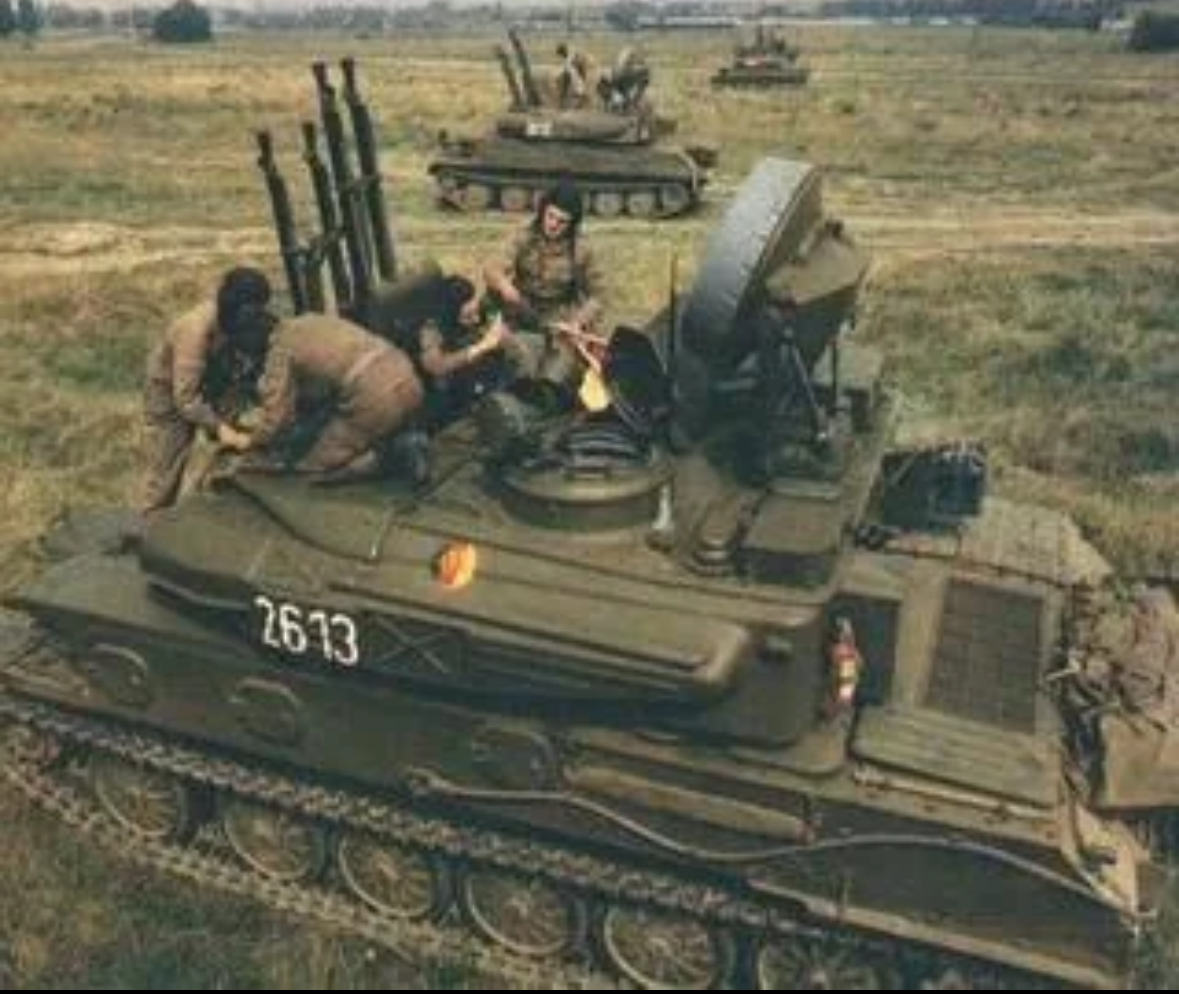
DISCLAIMER: This is just a work in progress draft/backup for a future suggestion and is not a suggestion as of yet

Basic history of this vehicle:
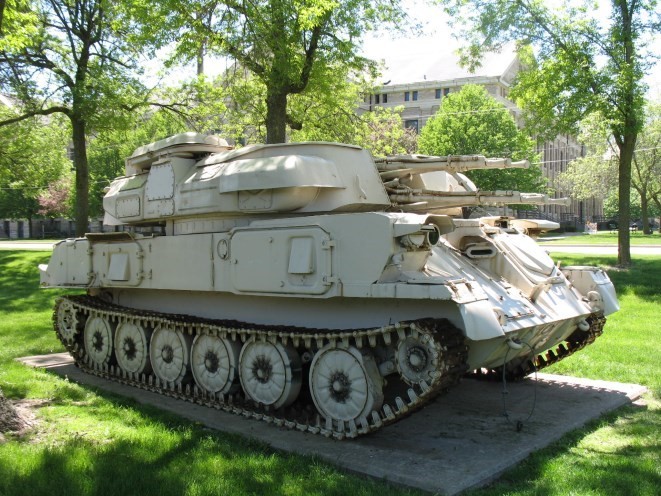
During the Liberation of Kuwait, coalition forces plowed through the Iraqi forces, with many Iraqi soldiers going AWOL (Away without leave) out of fear of being obliterated by the coalition forces, and in some cases even cheering on the coalition forces as they passed. However, these AWOL soldiers did not take their vehicles with them and left many of the fully functional vehicles abandoned. Some of those vehicles were taken by the Coalition forces and brought back to their home countries. A few examples were brought back with at least one example being currently or at least recently located at the Kansas National Guard museum.
However, before they were converted into static displays, they were operated by the US Army to assess the threat they posed to aircraft and for OPFOR purposes.
Vehicle development and history:
The ZSU-23-4 is a quad-barreled Anti-aircraft platform developed by the former Soviet Union in the early 1960s to solve a specific problem: protecting moving ground troops from fast, low-flying jets. Earlier anti-aircraft guns lacked the speed and accuracy to hit modern aircraft, so Soviet engineers mounted four 23mm autocannons onto a tracked chassis and equipped it with an integrated radar system. This “Gun Dish” radar allowed the crew to track and engage targets even in total darkness or heavy fog, providing a level of mobile air defense that NATO forces had never seen before.
The vehicle’s combat effectiveness was demonstrated during the 1973 Yom Kippur War, where it worked in conjunction with surface-to-air missiles to create “no-fly zones.” By filling the lower altitudes with a massive volume of fire, the Shilka forced pilots to fly higher, where they were easily picked off by larger missiles, this same principle was used during vietnam, however to a lesser effective outcome. Later, during the Soviet-Afghan War, the Shilka was adapted for a different role. Because its guns could tilt at high angles, it was used to provide direct fire against insurgents hidden in the mountains. This devastating ground-support capability earned it the nickname “the sewing machine” because of the rapid, rhythmic sound of its four barrels firing in sequence. Even as technology has improved, the Shilka remains in service with over 30 countries today. While its original electronics are considered outdated.
During the Iraqi invasion and subsequent occupation of Kuwait (1990–1991), the ZSU-23-4 “Shilka” served as the backbone of the Iraqi Army’s mobile, low-altitude air defense. Deployed primarily to protect elite armored and mechanized divisions, such as the Republican Guard, these vehicles were often positioned within desert “berms” or tucked into urban outskirts to provide a 360-degree “wall of lead” against low-flying threats. Iraqi commanders relied on the Shilka’s rapid-fire quad-cannons to compensate for the limitations of their larger surface-to-air missiles, which often struggled to track targets at low altitudes. During the occupation, the ZSU-23-4’s presence forced Coalition pilots to fly at higher altitudes (above 10,000 feet) to stay out of the reach of its deadly 23mm shells, effectively trading bombing accuracy for safety.
However, during the 1991 liberation of Kuwait (Operation Desert Storm), the ZSU-23-4’s effectiveness was severely neutralized by the Coalition’s superiority. While the Shilka’s RPK-2 “Gun Dish” radar was capable, it became a homing beacon for anti-radiation missiles and was frequently jammed by electronic warfare platforms. This forced many Iraqi crews to rely on manual sights that were far less effective against fast-moving jets. Many Shilkas were ultimately destroyed from a distance by AH-64 Apache helicopters using Hellfire missiles or A-10 Warthogs using Mavericks—weapons that could outrange the 2.5 km reach of the ZSU’s guns. By the end of the conflict, numerous abandoned or “knocked-out” Shilkas littered the “Highway of Death” leading out of Kuwait City, marking the total collapse of Iraq’s integrated air defense.
Additional info:
This Vehicle could potentially have a different camouflage or visual model compared to the other ZSU-23s; however, that would depend on what they base the final model on. It would be at Br 8.0 just as the USSR one is.
At least one ZSU-23 was used for OPFOR training at Camp Pendleton, Calif., on June 21st, 1997.
Images:

- Yes
- No
Closed because people dont know how to read something rather than just assume what it is, and dont realize this is a draft meant for feedback on how its layed out
Sources
RIA Self-Guided Tour: The Shiika | Article | The United States Army
https://kansasguardmuseum.com/ (virtual tour: Exterior 14)
A single ZSU-23-4 was last known to be located at the Rock Island Arsenal in May of 2019; however, the official site for the RIA no longer has any mentions of it or its current location.
https://catalog.archives.gov/id/6463613
Edit cause this got false reports as spam when it clearly isnt