- Yes
- No
 SU-102 - The Soviet Anvil

History
In late 1944, Soviet tank design was at a crossroads. The Red Army already had highly successful tank destroyers like the SU-100, but German armor was getting thicker, and Soviet leadership wanted to push the boundaries of firepower. They issued a challenge to their engineers: find a way to mount a heavy-tank artillery piece onto the chassis of a nimble, lightweight medium tank.
The engineers at the Uralmash factory took on the project, which they called the Uralmash-1. To build it, they used the chassis of the brand-new T-44 medium tank, but they immediately ran into a classic engineering problem. If they kept the standard layout with the crew cabin at the front and the engine at the back-the massive, long-barreled gun would stick out so far past the front of the vehicle that it would plow into the dirt whenever the driver went down a steep hill or crossed a ditch.
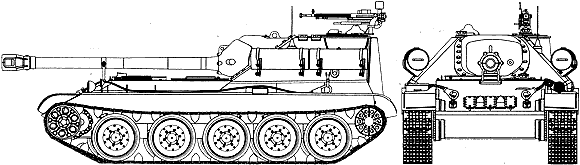
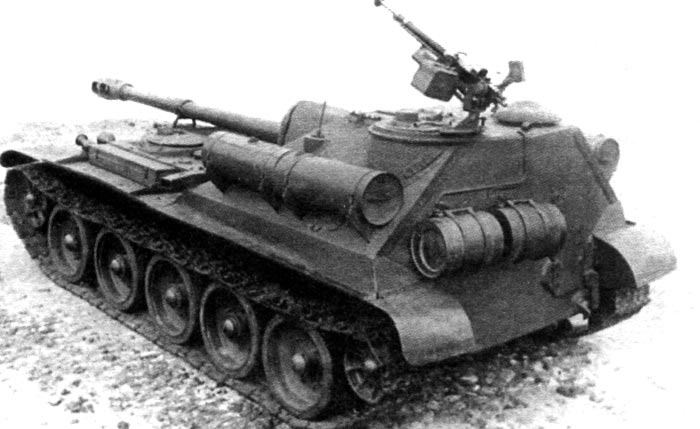
To solve this, the engineers did something radical. They completely inverted the internal layout of the tank. They moved the engine and the transmission to the front and middle of the vehicle, which allowed them to place the armored crew compartment, called the casemate, all the way at the rear. This completely eliminated the front overhang, making the vehicle incredibly stable, compact, and balanced while driving.
They built two prototypes to test different weapons on this new rear-cabin layout. The first was the SU-101, which carried a 100mm gun. The second, and much more powerful version, was the SU-102. The engineers managed to squeeze a massive 122mm D-25S field gun into its cabin. This was the exact same gun used on Russia’s giant IS-2 heavy tanks, but now it was mounted on a vehicle that sat incredibly low to the ground and weighed significantly less. On paper, the SU-102 was a masterpiece. It had 120mm of heavily sloped frontal armor, an incredibly tiny silhouette that made it almost invisible in an ambush, and enough firepower to obliterate any tank in existence.
However, when the prototype rolled out for testing in the summer of 1945, human reality caught up with the brilliant engineering. The very things that made the SU-102 so compact and well-protected made it an absolute nightmare for the crew trapped inside.
Because the powerful engine was jammed right next to the crew compartment without enough space for proper insulation, the cabin turned into a furnace. During summer trials, the temperature inside the tank reached an unbearable 50°C to 60°C. The crew was quite literally baking alive just from driving it.
Furthermore, firing a massive 122mm heavy artillery piece inside a tiny, enclosed steel box at the back of a light chassis created a devastating shockwave. The concussion inside the cabin was deafening, and the violent recoil shook the entire vehicle so hard that it threatened to break internal components. To make matters worse, the 122mm shells were heavy and came in two separate pieces the projectile and the powder charge. Trying to hoist these massive shells and load them into the breech inside a cramped, low-roofed, boiling-hot cabin was physically exhausting. The rate of fire was agonizingly slow.
By the time the engineers could even begin thinking about how to fix these severe ergonomics issues, World War II in Europe came to an end. The urgent need for a specialized, low-profile tank destroyer vanished overnight.
More importantly, Soviet tank technology made a massive leap forward with the creation of the T-54 main battle tank. The T-54 featured a fully rotating turret with a powerful 100mm gun, giving the army the firepower they needed without any of the tactical and physical limitations of a fixed-cabin vehicle. Realizing that the era of the casemate tank destroyer was over, the military quietly canceled the Uralmash-1 program.

Specifications
General Stats
- Crew: 4
- Weight: 34.8 tons
- Top Speed: 54 km/h (Forward) / -8 km/h (Reverse)
- Engine: 500 hp (14.3 hp/ton)
Armament
- (122mm D-25S)
-
- Reload Time: ~19 to 24 seconds (Crew dependent)
-
- Ammo Count: 28 rounds
-
- Gun Depression: -0.2°
-
- Gun Elevation: +18.5°
-
- Horizontal Traverse: 19° total (-9° left / +10° right)
-
-
- BR-471B (APHEBC)
-
-
-
- BR-471 (APHE)
-
-
-
- OF-471 (HE)
-
-
-
- D-471 (Smoke)
-
Armor Profile
- Upper Frontal Plate: 90mm at 63° (~190mm effective)
- Casemate Front: 120mm sloped (~200mm+ effective)
- Sides: 75mm
- Rear: 40mm
Check out the other variant of this vehicle the Su-101