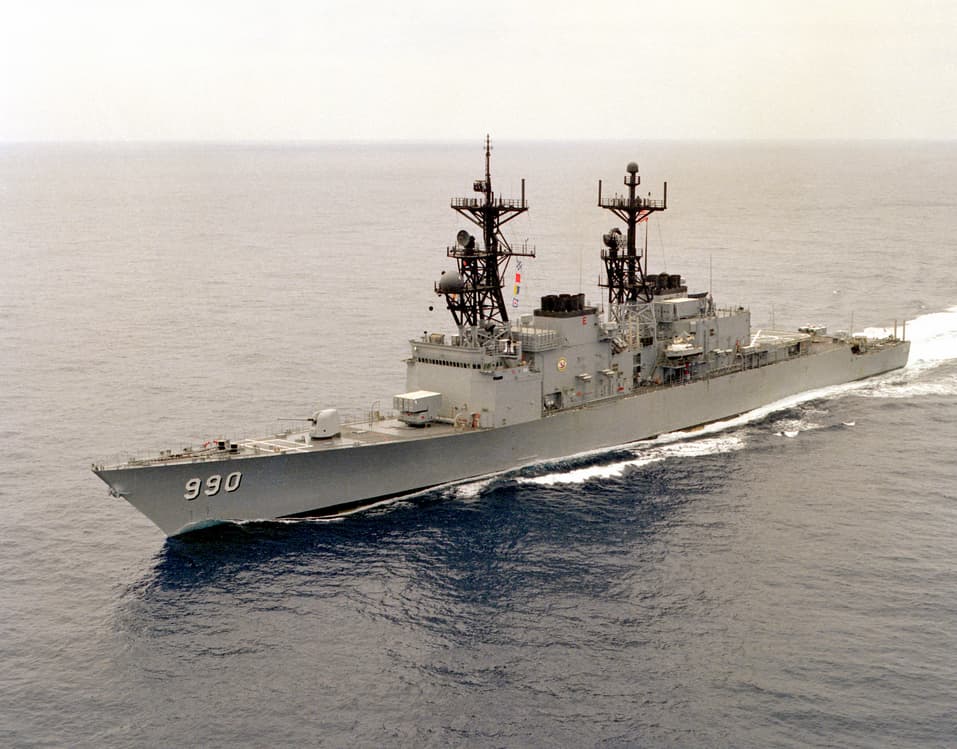
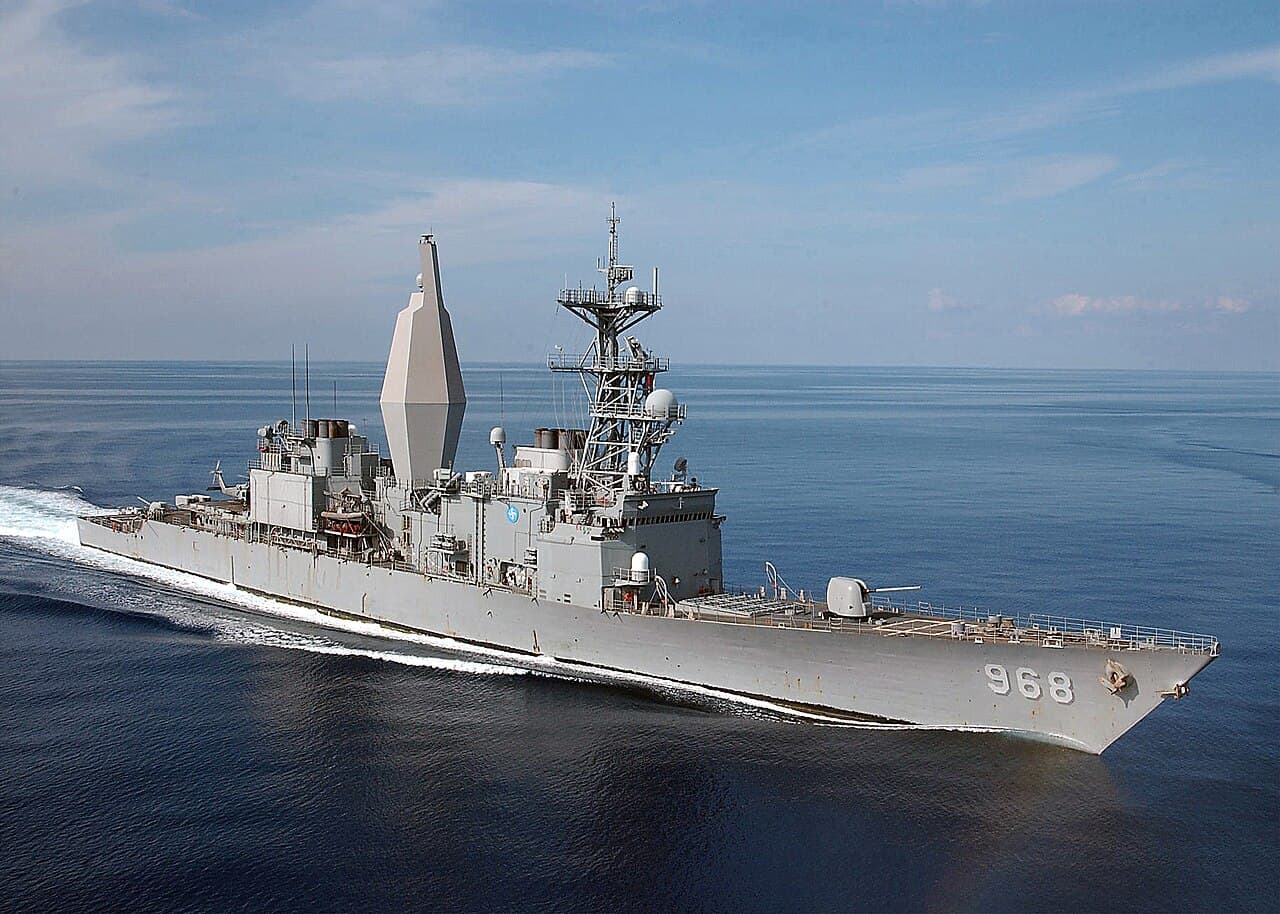
Description
Background
Artist’s impression of the DX destroyer bearing the name of USS Spruance (DD-963), July 1970.
The Spruance-class destroyer was introduced in 1975 to replace many aging WWII-built Allen M. Sumner- and Gearing-class destroyers. It was named after US Admiral Raymond A. Spruance, known for his successes in naval battles in the WWII Pacific. Before its introduction, the program originated in the 1960s, known as the DX program. This program defined the requirements of new-generation destroyers and aimed to build 30 planned ships in a single shipyard.
The destroyer, as defined, was designed to be equipped with gas-turbine propulsion, a flight deck, and an enclosed hangar for up to two medium-lift helicopters, all-digital weapons, and two automated 5-inch (127 mm) guns. With great emphasis placed on anti-submarine warfare and carrier group escorting duties, the destroyers were initially fitted with a single eight-cell RUR-5 anti-submarine missile system, or ASROC, on the forward bow and another eight-cell Sea Sparrow launcher on the aft hull. As completed, these ships were more than twice as large as a World War II destroyer and as large as a World War II cruiser.
USS Spruance (DD-963) during sea trials in early 1975.
The first ship, USS Spruance (DD-963), was launched on November 10, 1973, and commissioned on September 20, 1975. Twenty-nine destroyers were constructed and introduced to service by 1980. One additional ship, USS Hayler (DD-997), was ordered on September 29, 1979, originally planned as a DDH (Destroyer, Helicopter) design to carry more ASW helicopters than the standard Spruance-class design. However, this configuration was dropped, and the DD-963 class hull was constructed as a standard design but slightly modified, bringing the total to 31 Spruance-class destroyers. Despite having ASROC and Sea Sparrow launchers on board, these destroyers received the “DD” designation rather than “DDG” due to the inadequate availability of advanced defensive systems for a guided-missile platform.
A typical “as built” configuration of Spruance-class Destroyer.
Initially in service, Congress criticized the Spruance-class destroyers, viewing them as weaker and inferior compared to Soviet designs and earlier US designs that had more visible guns or launchers for general-purpose missiles. However, this criticism was later countered by praise for the success of the Spruance-class destroyers in their intended ASW role, thanks to their use of the hull-mounted SQS-53 sonar in combination with ASROC. In addition, these ships were retrofitted with the SQR-19 towed-array sonar and the LAMPS helicopters, which further improved their ASW capability, making them more capable ASW assets for the US Navy.
An early 1980s configuration of Spruance-class Destroyer with Armored Box Launchers between the ASROC launcher.
Aware of deficiencies in anti-aircraft warfare and anti-ship warfare capability, the Navy responded by introducing upgrades incorporating two quadruple Harpoon missile launchers and two 20 mm Phalanx CIWS guns on all Spruance-class ships. In addition to these upgrades, seven destroyers were modified to include Mk 143 Armored Box Launchers, one on each side of the ASROC launcher, providing ship and land strike capability by firing Tomahawk Land Attack Missiles (TLAM) and Anti-Ship Missiles (TASM).
USS Spruance (DD-963) in a late 1980s configuration, July 1987. Note the CIWS and VLS at the front and the other CIWS at the stern.
The ultimate major upgrade in early 1986 was the replacement of the ASROC launcher with a 61-cell VLS launcher, enabling the capability of firing a large number of TLAMs and TASMs. This upgrade was done on the other 24 ships. However, with the removal of the ASROC launcher, those VLS ships were left without critical ASW capability. The introduction of the Vertically Launched ASROC (VLA) upgrade in 1993 restored those ships’ ASW capability.
A 1990s configuration of Spruance-class Destroyer.
Excluding the VLA upgrade, major upgrades were carried out in the mid-1980s and completed by the late 1990s. Despite these improvements, the Spruance class remained insufficient in terms of defensive capabilities and was already outclassed by its peers, especially the Arleigh Burke-class destroyers, in the 1990s. Because of this and post–Cold War budget cuts, the Navy accelerated the retirement of the class, decommissioning the last ship, USS Cushing, in 2005. Most Spruance-class ships were scrapped or used as practice targets. However, these destroyers still saw significant action in various conflicts of the 1980s and 1990s, and their design served as an influential foundation for the Kidd-class destroyers and the state-of-the-art Ticonderoga-class cruisers.
Propulsion
The LM2500 engine is typically installed within a metal enclosure to isolate sound and thermal from personnel and adjacent machinery spaces.
As designed, the Spruance-class destroyer was powered by four gas-turbine General Electric LM2500 engines. This marked the Spruance class as the first class of ships in the US Navy to use gas turbine power. These engines provided the ship with a total of 86,000 shp and a full speed of 33 knots. The LM2500 propulsion system was so reliable and successful that it remained in use on most subsequent US warships through iterations of the LM2500 family.
Sensors
The Spruance-class destroyer was equipped with the AN/SPS-40B air search radar, a long-range, two-dimensional air surveillance radar for detecting airborne targets at long and medium ranges. In combination with the SPS-40B, the AN/SPS-55B was used as a surface surveillance radar to detect seaborne targets.
For ASW, an AN/SQS-53 sonar was mounted in the bow below the waterline, with both active and passive operating capabilities. It was a crucial sensor for ASW weapons guidance. With the introduction of the LAMPS upgrade, the ship could use the AN/SQR-19, a tactical towed-array sonar capable of passively detecting hostile submarines at very long range.
AN/SLQ-32 antenna on the Sprunace-class destroyer USS Nicholas (DD 982).
The AN/WLR-1 and -11 served as the ship’s original radar warning receivers, functioning as passive electronic countermeasure systems to identify incoming anti-ship missile threats. During later modernization efforts, these systems were replaced by the more advanced AN/SLQ-32 electronic warfare suite, which offered improved capability in detecting and providing early warning of hostile emitters and targeting systems.
Armament & Upgrades
USS Spruance (DDG 963) firing its 5” 54 gun during a three-day exercise in the Central Arabian Gulf, September 15, 2004.
The destroyers were armed with two 5-inch (127 mm)/54 caliber Mk 45 guns, one on the bow and one aft. The Mod 1 incorporated a major improvement in its ability to select and fire six different kinds of ammunition. The most common type was high-explosive, in either anti-aircraft or high-capacity projectiles. The gun’s rate of fire was 20 rounds per minute in automatic mode.
The Mk 45 guns were controlled by the Mk 86 Gun Fire Control System, a digital system providing naval gunfire control against surface, air, and shore targets, capable of tracking four surface targets, two shore targets, and one air target simultaneously. The Mod 3 of the Mk 83 installed aboard the DD-963 could direct the fire of two 5-inch guns against two tracked targets at once. The system included two track-while-scan radars: the AN/SPG-60 for air targets and the AN/SPQ-90 for surface and low-flying airborne targets.
Phalanx Block 1 test-firing aboard USS Carl Vinson CVN-70, February 20, 2003.
Two 20 mm Phalanx CIWS Mk 15 guns were installed as part of post-launch upgrades to improve close-range anti-aircraft and anti-missile defense. One was installed on top of the bridge and the other on top of the hangar. These were later upgraded to Block I, which improved radar, ammunition capacity, rate of fire, engagement envelope, and computing.
Left: Mk-16 Launching System aboard the Spruance-class USS O’Bannon (DD 987). Right: Honeywell RUR-5 ASROC firing off from Charles F. Adams-class USS Goldsborough (DDG-20).
Crew loading Mk 46 torpedo into the Mk 32 torpedo tube launcher aboard Spruance-class USS Leftwich (DD-984), July 1, 1986.
The Mk 16 Launching System was an eight-cell ASROC launcher, nicknamed “Matchbox,” and was the primary missile system for the ship’s intended role. Once fired, the missile released a parachuting, acoustic-homing Mk 46 torpedo to hunt down hostile submarines. The launcher carried a total of 24 ASROCs and was supported by two triple Mk 32 torpedo tube launchers located amidships on either side, which also fired Mk 46 torpedoes.
RIM-7M Sea Sparrow firing from the Mk 29 GMLS onboard Spruance-class USS Fife (DD 991) during the Pacific Phase of Exercise, May 7, 2002.
On the aft section, an eight-cell Mk 29 NATO Sea Sparrow launcher provided medium-range air defense, with a total of 24 RIM-7 missiles. The Sea Sparrow used semi-active guidance to intercept airborne targets.
Harpoon missile firing from Spruance-class destroyer USS Fletcher (DD-992), 1980.
The incorporation of the Harpoon system was the first new missile system addition on the ship in 1978. Due to the cheap and easy installation, eight Harpoon anti-ship missiles in canister launchers were quickly installed amidships for anti-ship offensive capability.
USS Hewitt (DD-966) was the first Spruance-class destroyer to receive this upgrade in 1978, and by 1985, all ships had included this missile system. This system fired RGM-84 missiles toward hostile surface ships using the missiles’ active radar homing in a low-level, sea-skimming cruise trajectory.
Spruance-class destroyer USS Merrill (DD-976) test firing a Tomahawk missile from its port-side Mk 143 Armored Box Launcher, 1980.
To further increase strike capability against sea surface or land targets, seven ships that were not selected to incorporate VLS received Mk 143 Armored Box Launchers for Tomahawks on each side of the ASROC matchbox. USS Merrill (DD-967) was the first ship of the class to incorporate this missile system. These ABLs provided eight BGM-109 Tomahawks in total on board. Each ship fired four TLAMs using a navigation system for land strike and four TASMs using active homing radar for ship strike. Comte de Grasse, Merrill, Conolly, John Rodgers, Leftwich, Deyo, and Ingersoll were seven vessels that received the ABLs and would not receive VLS retrofit, with the exception of USS Deyo.
A BGM-109 Tomahawk firing the 61-cell Mk 41 VLS aboard a Ticonderoga-class cruiser USS Shiloh (CG 67), September 4, 1996.
Not long after, ABLs revealed the challenge of a limited number of Tomahawks aboard. To circumvent this, the remaining 24 ships were retrofitted with a 61-cell Mk 41 VLS forward, replacing the ASROC launcher, for a greater weapons load at the cost of losing long-range ASW capability; however, they were still capable of using ship-launched torpedoes from the torpedo tubes at extremely short range. A VLS was first installed aboard USS Spruance in 1986. All other 23 ships would follow suit, and USS Deyo, originally fitted with ABLs, became a very unique ship as the only Spruance-class destroyer armed with Armored Box Launchers that were later upgraded to the Mk 41 VLS. The provision for this configuration was 24x Sea Sparrow, 37x TLAM, 24x TASM, and 8x Harpoon.
An RUM-139 VL-ASROC firing from the Mk-41 VLS aboard Spruance-class destroyer USS David R. Ray (DD-971).
Development of the Vertically Launched ASROC (VLA) to fit ASROC munitions inside the Mk 41 VLS had been underway since 1983 but suffered delays. From 1993, a few VLS ships finally incorporated VLA upgrades to restore their long-range ASW capability by loading RUM-139 VL-ASROCs into the VLS. This changed the provision to 24x Sea Sparrow, 57x TLAM, 8x Harpoon, and 4x VL-ASROC, with the TASM missiles withdrawn from service in 1994 and converted to Block IV TLAM-Es.
An RIM-116 rolling airframe missile from USS Gerald R. Ford (CVN 78) during combat systems ship qualification trials, April 16, 2021.
A 21-round Mk 49 Rolling Airframe Missile launcher was the final upgrade made to the Spruance class in the late 1990s. Ten vessels were identified as having received this upgrade: Elliot, John Young, Briscoe, Cushing, O’Bannon, Thorn, and Fife. The launcher, mounted on the starboard fantail, fired RIM-116 RAMs. Although it had less range than the Sea Sparrow, the launcher was capable of engaging multiple targets simultaneously and intercepting sea-skimming anti-ship missiles to improve anti-missile defense, unlike the Sea Sparrow, which was limited by its single illumination channel. The RIM-116 was guided by passive homing and semi-active radar. This upgrade started in 1997 on USS Oldendorf (DD-972), with the last installations completed by 2003. The provision for this configuration became 24x Sea Sparrow, 21x RAM, 57x TLAM, 8x Harpoon, and 4x VLA. This upgrade concluded the comprehensive modernization of the Spruance-class destroyers before the Navy began to swiftly decommission the vessels between 1998 and 2005, with several not even reaching 20 years of service.
Left: Kaman SH-2F Seasprite. Right: Sikorsky SH-60B Seahawk
Initially in service, the Spruance-class destroyers were not equipped with Light Airborne Multi-Purpose System (LAMPS) equipment but were quickly retrofitted with LAMPS I, which included two SH-2F Seasprite ASW helicopters in an enclosed hangar to enhance ASW capability beyond the intended range. These helicopters were capable of deploying Mk 46 ASW torpedoes and passive/active sonobuoys to detect and datalink information on submerged targets to the vessel. Later in service, the Spruance-class vessels replaced the SH-2Fs with SH-60B Seahawks with LAMPS III equipment.
Trails left by the Mk 245 infra-red decoy round from Mk 36 chaff launchers aboard HMS Bulwark, 2007.
As for countermeasures systems, the vessels included Mk 36 chaff decoy launchers used to defend against anti-ship missiles by creating false signals with an array of chaff cartridges, confusing hostile missile guidance and fire control systems. The number and arrangement of Mk 36 launchers installed depended on the size of the ship, ranging from two launchers on a small combatant to as many as eight on an aircraft carrier, so it is believed that two to four Mk 36 launchers were mounted on ships of this class as standard. Each launcher had six 130 mm fixed tubes arranged in two parallel rows at angles of 45 and 60 degrees to provide a spread of launched decoy cartridges at a speed of 75 m/s.
AN/SQL-25 Torpedo Protection Concept
The Torpedo Countermeasures Transmitting Set AN/SLQ-25, known as Nixie, was a common noisemaker tool used to confuse and defend against hostile acoustic- and wake-homing torpedoes. When a Nixie was towed by the vessel, it sent out a simulated ship noise signal to draw a torpedo away from its intended target. It was retrofitted quickly as the class of ships entered service.