I wouldn’t be surprised if it’s some kind of hidden mechanical glitch they gave this type of bullet. It would be like the stupid mechanic they gave the initial APCR and APDS rounds, which should fragment upon impact with spacer armor of a certain thickness and spacing, but in the game, an IS3 stop the Conqueror’s APDS round because it has a track in the hull front.
1 Like
If you want an actual explanation, it’s because Gaijin use the slope performance formular for the different AP types from the book WWII Ballistics Armor and Gunnery, here are values for AP, APCBC and most importantly APBC
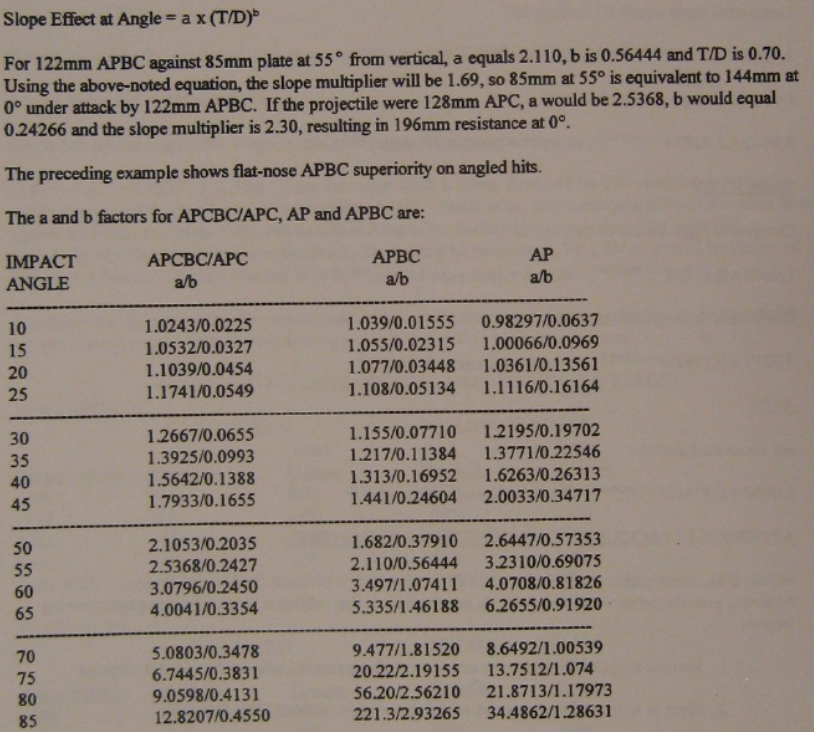
And if you do the calculations using these formulars for the whole armour plates like the VK you showed you get numbers very close to what War Thunder spits out.
As for the Abrams it’s actually because the specific area you shot is at the edge of a plate that’s modeled ingame as only roughly 19mm from what I remember and the APBC slope modifiers do wonders against very thin highly angled plates (not to mention ricochets don’t happen if the shell is over 4 times larger than the armour plate), I also think this plate at the edge goes slightly passed both the Composite armour and the back plate which is why the effectiveness is so low at that specific point.
Lastly the effectiveness of layered armour is reduced because the shell penetrates each plate separately and thus the formular needs to be done once for each layer of armour, leading to the two separate armour plates returning far lower values than a single plate of the same thickness, this effect is much more noticeable with APBC rounds though as their slope modifiers perform amazingly against armour plates thinner than their shells diameter.
When I did all the calculations myself using the WWII Ballistics Armor and Gunnery formular, all the numbers I got were only a few millimeters off at most from the numbers shown in the War Thunder protection analysis.
2 Likes
Well, I don’t buy it.
See, the difference for APCBC layered vs non layered is very small. For APBC there is 33% drop.
Also the assumption that with bolt on plates “each is penetrated separately” is completely wrong, as there is no space between them and they can’t be treated as wholly separate.
Finally, I was kinda wrong, it was 365K that had its fronr paet depart in simulated penetration test on youtube, actually helping penetration T33 style. 365B can’t do that and I don’t really buy the “turning 120 LOS into 98mm effective”, as again, it’s straight from the realm or long rod penetrators.
The problem with having two inclined layers is that after piercing the first one, the bullet loses speed, changes trajectory, and also deforms, making it harder for it to pierce the next layer.
In the case of that bullet, it’s curious, since it weighs the same as the APBC, but doesn’t have as much explosive filler, which would give it greater structural integrity. If you add that to the same factor as the T33, it would make this AP bullet practically the same as the APBC, differing only at long distances and high angles.
You don’t have to buy it, that’s simply how this penetration formular works (weather or not it’s right is up for debate), also whilst I can’t give you sources right now, I do remember a while ago there was a small push to have layered armour plates nerfed as someone found a source that stated that layered armour was slightly less effective than a single piece of the same thickness, which does somewhat backup the results of the formular.
The conversation is in the forums somewhere, so I’ll do some searching for it later.
I mean, I don’t really buy the “greatly superior angled penetration” of APBC, Soviets went with BR412D APCBC for 100mm gun despite the fact APBC with War-thunder like angled performance is simply better vs post war tanks that have angles everywhere.
I mean, it is, and if you look at my screenshots, Pzgr 39 does slightly better vs T-34E than vs VK +5 degrees.
I would be perfectly happy with 10 or even 15% difference.
But here effective armor goes like 33% down.
So, the layered armour nerf that was suggested is actually different from what currently happens ingame, from what I can remember off the top of my head the posts source stated that a layered armour plate with a combined thickness of 80mm made from a 50mm and 30mm plate would have an effective thickness of closer to 70mm than 80mm, and they were essentially asking for all layered armour plates to receive a quality multiplier nerf similar to CHAs to replicate this effect (which until I find their post I can’t even tell you if this effect was about flat or angled plates).
The massive difference ingame comes from the slope modifiers used for both APCBC and APBC from WWII Ballistics Armor and Gunnery, because the game calculates both plates separately these multipliers have a far larger impact on the effectiveness of the layered armour plates (the game also uses a more simplified version of the formular, so things are off by a few millimeters) for example when running the numbers myself with the formular I got an effective thickness for the T-34E against 88mm PzGr. 39 of 147.5mm and an effective thickness of 168.2mm for 88mm PzGr. 39 against the VK at +5 degrees, whereas for 85mm BR-365 I got 146mm against the the VK at +5 degrees and 94.5mm against the T-34E (it could actually be as low as 87.6mm because the formular using the APBC values gives the 15mm plate a slope modifier that would result in it being worth less than 9mm, losing effective thickness rather than gaining it, so I just kept it at 15mm) like I said the formular for APBC makes it amazingly effective against armour plate thinner than the shells diameter.
If this doesn’t feel right, then you’d have to find a source that proves that both armour plates should be calculated as one plate or find a source that overrides the slope modifiers for APBC shells from WWII Ballistics Armor and Gunnery.
LOL, so we have a calculation that is certainly wrong, as 2 plates welded to one another is not the same as 2 separate plates, but we have to find a source to prove that made-up calculation is wrong.
There is no such source, as there is no “fact” to disprove, as never in the history has anyone ever claimed 2 plates sandwiched together are the same as 2 separate plates.
Gaijin made it the hell up and it can’t be disproven. Just like you can’t disprove the existence of unicorns. You can also say it’s completely unproven. Just like Gaijin’s ridiculous soviet WW2 long rod performance.
Pzgr 39 simulated vs Jumbo
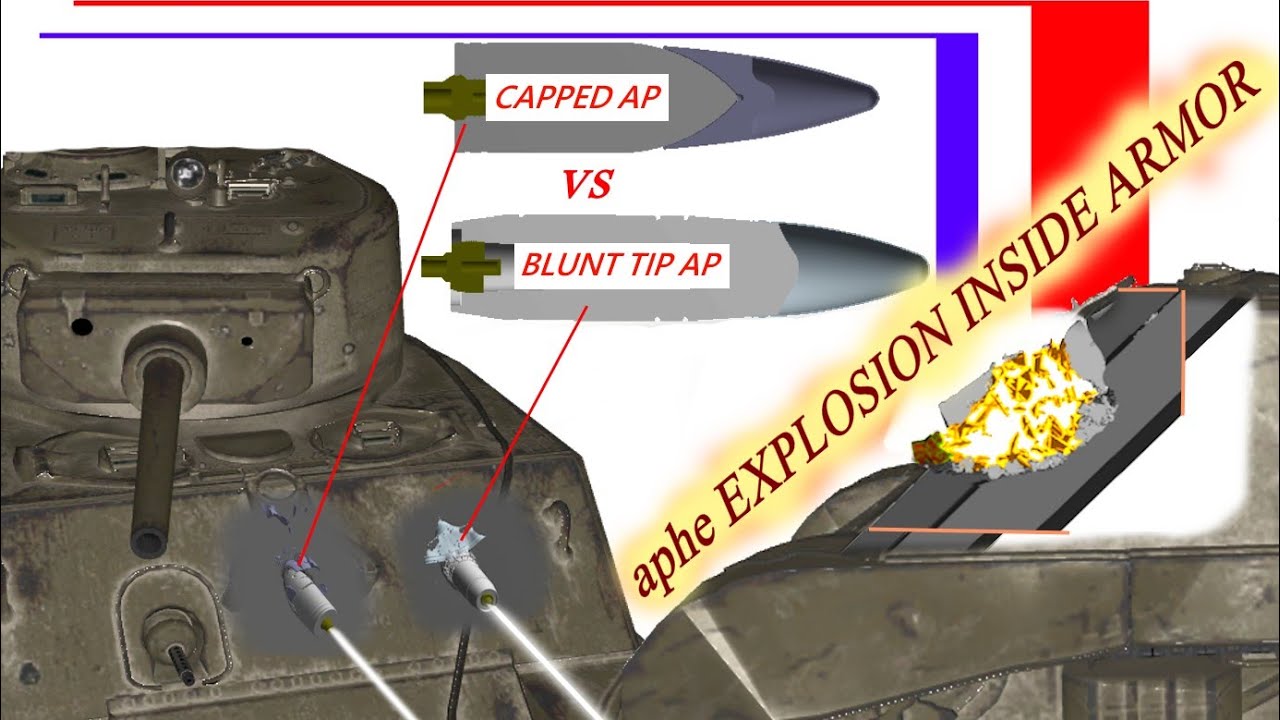
85mm BR365 simulated vs Jumbo:
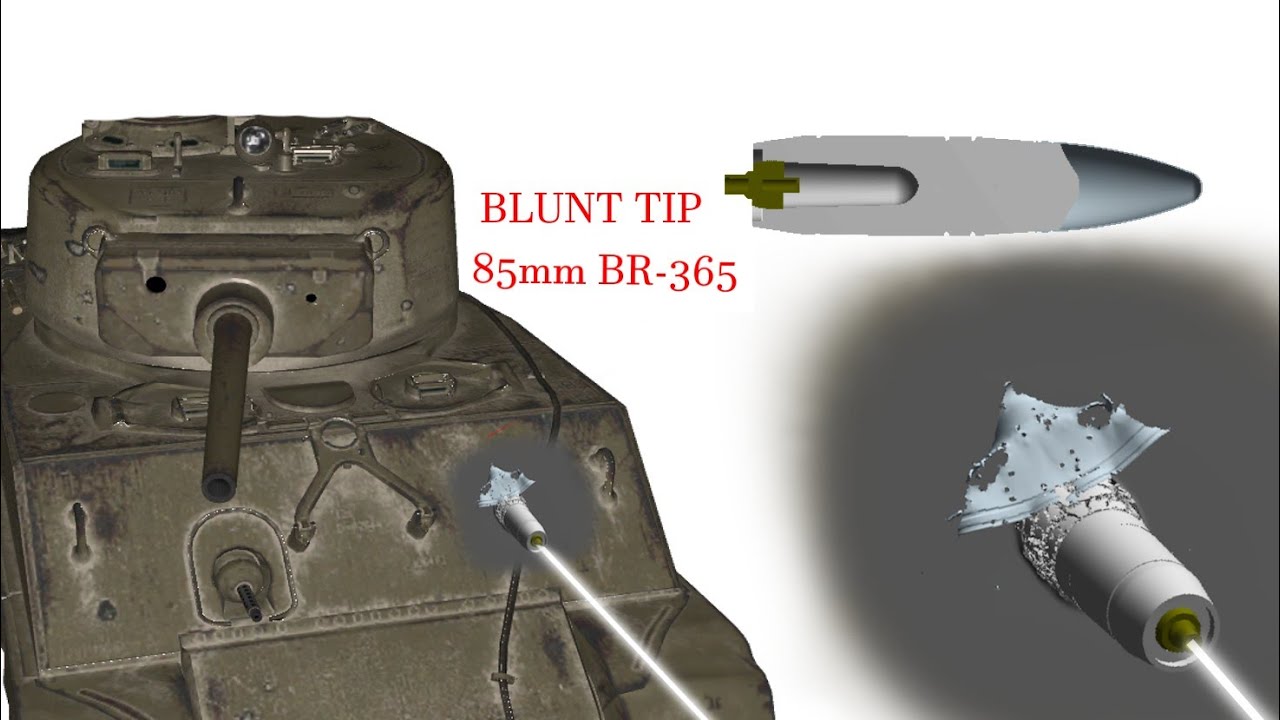
Did it perform better?
Kinda.
Did it perform anywhere close to how Gaijin’s magic calculator claims?
Nope.
1 Like
They way it works in WT is simply incorrect.
When layered armor is hit, the game doesn’t look at the total thickness but individually calculates the protection of plate A and plate B.
Because blunt APBC have insane overmatching performance treating layered armor like spaced armor, which the game does because it doesn’t understand the difference, means that 45+15mm are both much more overmatched than just a 60mm plate.
While other AP rounds don’t benefit that much from overmatching so the result isn’t as wrong as when APBC is used.
It’s the same when APDS and APCR used to shatter on Ferndinands front armor.
Because the game made the shell shatter after passing through the first 100mm plate, as if it was spaced armor.
This is a general issue that the game doesn’t understand the concept of layered armor, and considers the armor and angle of underlying armor.
4 Likes
The thing is Gaijin rarely make changes based on logic; I’ve seen dozens of bug reports that use basic logic and the games code for their claims, only for them to get shot down because of lack of ‘real’ evidence or because they don’t accept using the games code as evidence, so literally the easiest way to make a change would be to find documentation to prove that the current system calculates layered armour wrong.
4 Likes
That might be the case, i do not know. If you have the sources to prove it then i recommend reporting it :)
I guess for the same reason BI has 5 times engine efficiency at lower settings - because Gaijin made data the hell up, so GL proving them wrong.
Here is similar situation. Gaijin thrusts Stalin’s long rod in our faces with purely fictional properties, and we have to prove wrong a made-up event with scientific data.
We basically need a scientific study on 1 specific Soviet shell vs layered armor, GL HF.
If Gaijin decided BR365 can go through mountains - GL with that, as there is also no scientific data proving it can’t, as nobody has ever made a study to disprove such ridiculously stupid idea.
1 Like
The issue is mainly the incorrect calculation of layered armor as spaced armor or individual plates to be precise.
Also APBC has other properties that aren’t modeled, like the increased efficiency to penetrate flat overmatching armor.
But that’s something that isn’t considered in general.
Same with armor hardness and how that changes efficiency based on impact angle.
Instead everything is just based on RHA equivalent.
1 Like
To be fair Gaijin didn’t make this data up, they got it from WWII Ballistics Armor and Gunnery (at player request mind you, before that they modeled shells based on each shells induvial performance data) they just implemented it badly, additionally the Soviet tanks aren’t the only ones who reap the benefits of the WWII Ballistics Armor and Gunnery slope effects, as all APBC shells ingame act this way, you can test this with American and French APBC shells and see they have the same magic slope effect (they are far fewer in number tho and tend not to have HE filler).
Regardless it’d be nice if someone found something on the behavior of Layered Armour so that Gaijin would actually look into this.
yea it doesnt make very much sense it seems they took normalization and cranked it 600% of what it should be as these rounds can have actual nonsense angle performance