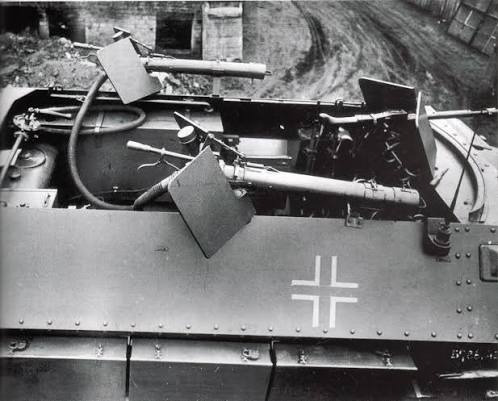
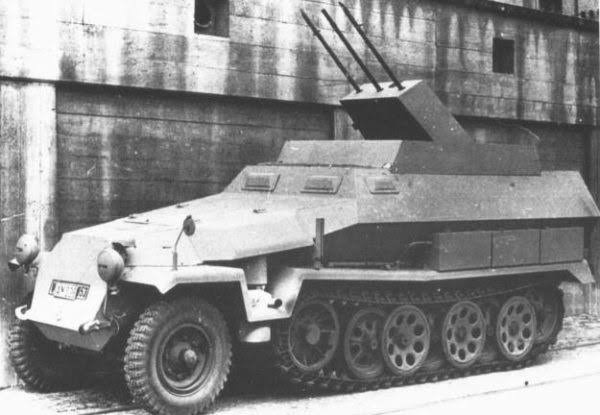
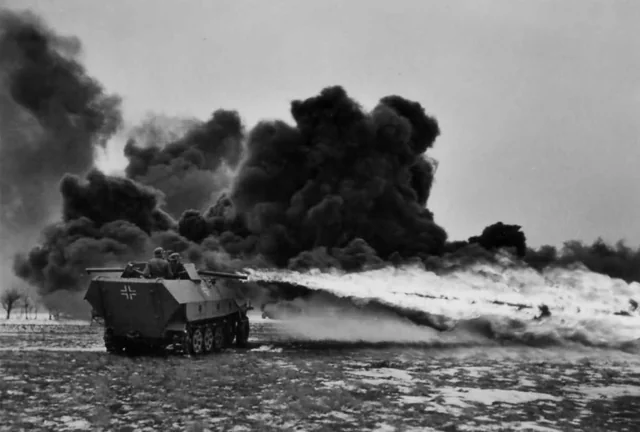
The Sd.Kfz. 251/16 (Sonderkraftfahrzeug 251/16 Flammpanzer) was a highly specialized combat variant of the medium armored half-track, designed explicitly for close-quarters assault and bunker-clearing operations. By replacing traditional infantry transport space with high-pressure flame throwers, it provided German mechanized units with a devastating weapon to break entrenched enemy defensive lines.

History
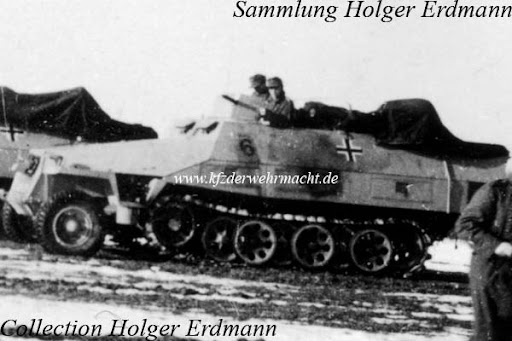
The development of the Sd.Kfz. 251/16 began in January 1943, driven by the brutal lessons of close-quarters urban combat learned during the Battle of Stalingrad. The German Army desperately needed an armored, mobile platform capable of flushing out heavily fortified enemy machine gun nests, pillboxes, and urban strongpoints without exposing fragile infantry to direct defensive fire. Engineers utilized both the Ausf. C and the later, simplified Ausf. D chassis of the standard medium half-track to mount a heavy, vehicle-borne flame thrower system developed by the firm Koebe. Production began in the spring of 1943, and the vehicle was officially integrated into the Panzerpionierbataillone (Armored Engineer Battalions) attached to Panzer and Panzergrenadier divisions. It was Used by the 5th SS Panzer Division Wiking

Deployed on both the Eastern and Western Fronts from mid-1943 onward, the Sd.Kfz. 251/16 became a feared weapon on the battlefield. Its primary tactical deployment involved advancing closely behind frontline tanks, using its armor to shield itself until it was close enough to unleash devastating bursts of fire onto enemy trenches, fortified buildings, or forest positions. The psychological impact of the weapon was immense, often forcing defenders to surrender immediately upon its approach. However, because it operated at the absolute tip of the spear and carried highly volatile fuel tanks, it was a high-priority target for enemy anti-tank gunners. Approximately 300 units were produced or converted before production ceased in late 1944, with very few surviving the intense, attritional combat of the war’s final months.
Crew Capacity
The Sd.Kfz. 251/16 operated with a standard crew complement of five men, making it a highly coordinated unit where individual roles were strictly divided between vehicle operation and specialized weapons deployment. The spatial layout of the vehicle was completely reworked from the standard personnel carrier to accommodate the large internal fuel reservoirs and high-pressure pumps.
The driver sat in the traditional front-left position of the forward armored cabin, while the vehicle commander sat to his right, managing radio communications and directing the overall assault. The remaining three crew members were stationed in the open-topped rear compartment to manage the flame throwing equipment. Two dedicated flame thrower operators stood on specialized platform steps on the left and right sides of the vehicle hull, each controlling a pivoting projector. The fifth crew member was a mechanic/assistant stationed at the rear of the cabin, whose sole responsibility was to manage the heavy, temperamental Koebe centrifugal pump system and regulate the pressure valves supplying the incendiary fuel fluid to the weapons.
Armament
The offensive armament configuration of the Sd.Kfz. 251/16 replaced all standard infantry transport functions with an unparalleled capacity for incendiary warfare. The primary weaponry consisted of two 1.4 cm Flammwerfer projectors mounted on pivoting, shielded pivots along the left and right upper superstructure walls of the rear compartment. These twin projectors were connected via high-pressure hoses to two massive fuel reservoirs located internally along the floorboards, holding a combined total of 700 liters of specialized oil-and-tar flame fluid mixed with gasoline. Powered by a separate gasoline-fueled pump engine, these projectors could shoot continuous or burst streams of fire up to a distance of 35 meters, effectively incinerating everything within their path.
In addition to the main heavy flame throwers, early production models were uniquely equipped with a detachable 7 mm portable light flame thrower connected to a 10-meter-long flexible hose. This weapon was stored at the rear of the half-track and could be uncoupled, allowing the crew or accompanying combat engineers to dismount and assault the interior of bunkers or tunnels by hand. For conventional defense, the vehicle retained a standard 7.92 mm MG 34 or MG 42 machine gun mounted on a shielded pivot at the front of the passenger compartment, giving the crew a vital tool to suppress enemy infantry outside the effective range of the flame projectors or to protect the vehicle during a tactical retreat.
Armor Configuration
In terms of protection, the Sd.Kfz. 251/16 utilized the standard welded steel plating of the baseline Ausf. C or Ausf. D chassis, which was angled to optimize its defensive capabilities against small arms fire and artillery shrapnel. The front engine nose and driver cabin featured the thickest armor, measuring 14.5 mm, providing adequate protection against standard infantry rifle rounds and distant heavy machine gun fire. The sides and rear of the hull were constructed from 8 mm thick sloped steel plates, which successfully guarded the crew from standard battlefield small arms but were highly vulnerable to anti-tank rifles, heavy machine gun bursts at close range, or any dedicated anti-armor autocannons.
The primary defensive modification unique to the 16 variant was the addition of small, angled armor shields fitted directly onto the pivots of the left and right flame projectors to protect the upper bodies of the operators while they stood up to aim. However, the vehicle possessed two major tactical vulnerabilities. First, it remained entirely open-topped, leaving the five-man crew completely exposed to hand grenades, mortar airbursts, sniper fire from elevated buildings, and artillery shrapnel. Second, carrying 700 liters of highly volatile, pressurized incendiary fluid inside the thin-skinned hull meant that any armor-piercing or incendiary rounds penetrating the side plates would instantly trigger a catastrophic, un-survivable explosion, making the vehicle structurally fragile under concentrated anti-tank fire.
Technical Data
| Parameter | Specification |
|---|---|
| Engine | 1 × Maybach HL 42 TUKRM (6-cylinder liquid-cooled gasoline engine, 100 hp) |
| Length | 5.80 m |
| Width | 2.10 m |
| Height | 1.75 m (excluding defensive machine gun shield) |
| Ground Clearance | 0.32 m |
| Combat Weight | 8.62 metric tons |
| Maximum Speed | 52 km/h on paved roads / 21 km/h cross-country |
| Flame Fuel Capacity | 700 liters (stored in two internal tanks) |
| Flame Operational Time | Approximately 80 two-second bursts or roughly 160 seconds of continuous fire |
| Maximum Flame Range | 35 meters under optimal pressure conditions |
| Defensive Ammo Capacity | 2,010 rounds of 7.92 mm ammunition for the machine gun |
| Operational Range | 300 km on roads / 150 km off-road |
Gallery
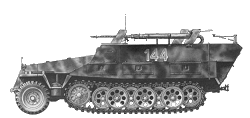
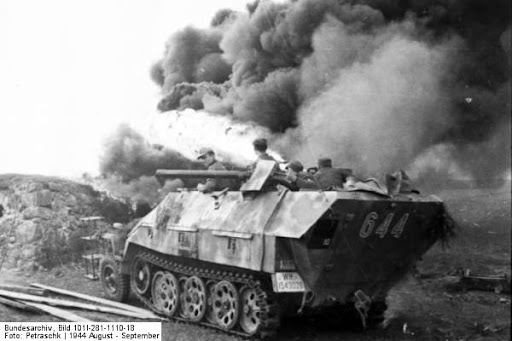
Sources
(Sd. Kfz. 251/16)
(SdKfz 251/16 Mittlerer Flammpanzerwagen of the 5th SS Panzer Division Wiking | World War Photos)
(Schützenpanzerwagen Sd.Kfz. 251 – Wikipedia)
(Schützenpanzerwagen Sd.Kfz. 251 – Wikipedia)
(Sd Kfz Number Table)
(Sonderkraftfahrzeuge)
https://www.youtube.com/watch?v=msObGd8nSos
https://www.youtube.com/watch?v=ZsnfXfuGRrg