- Yes
- No
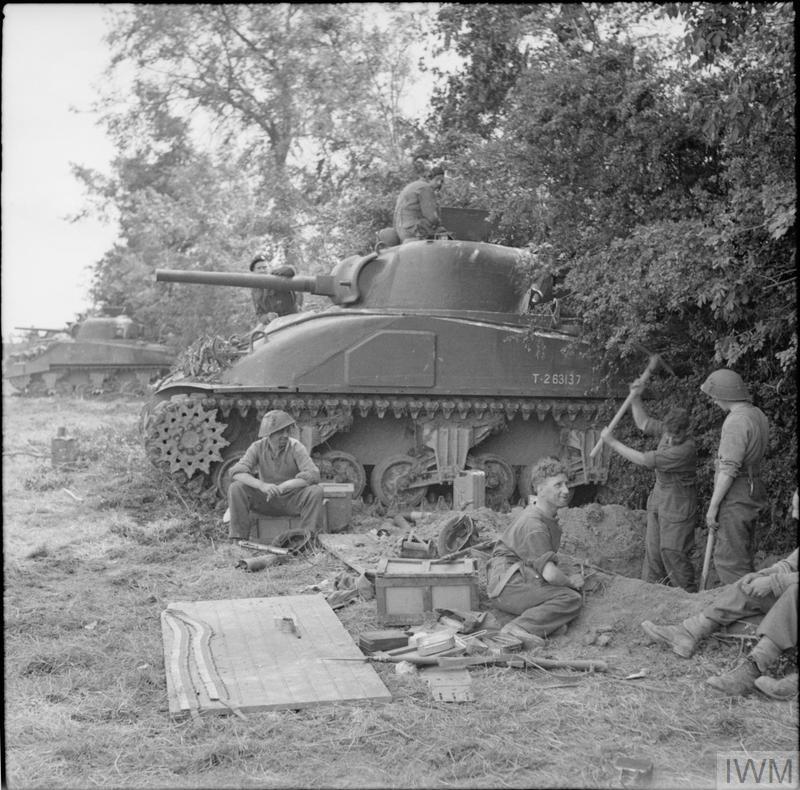
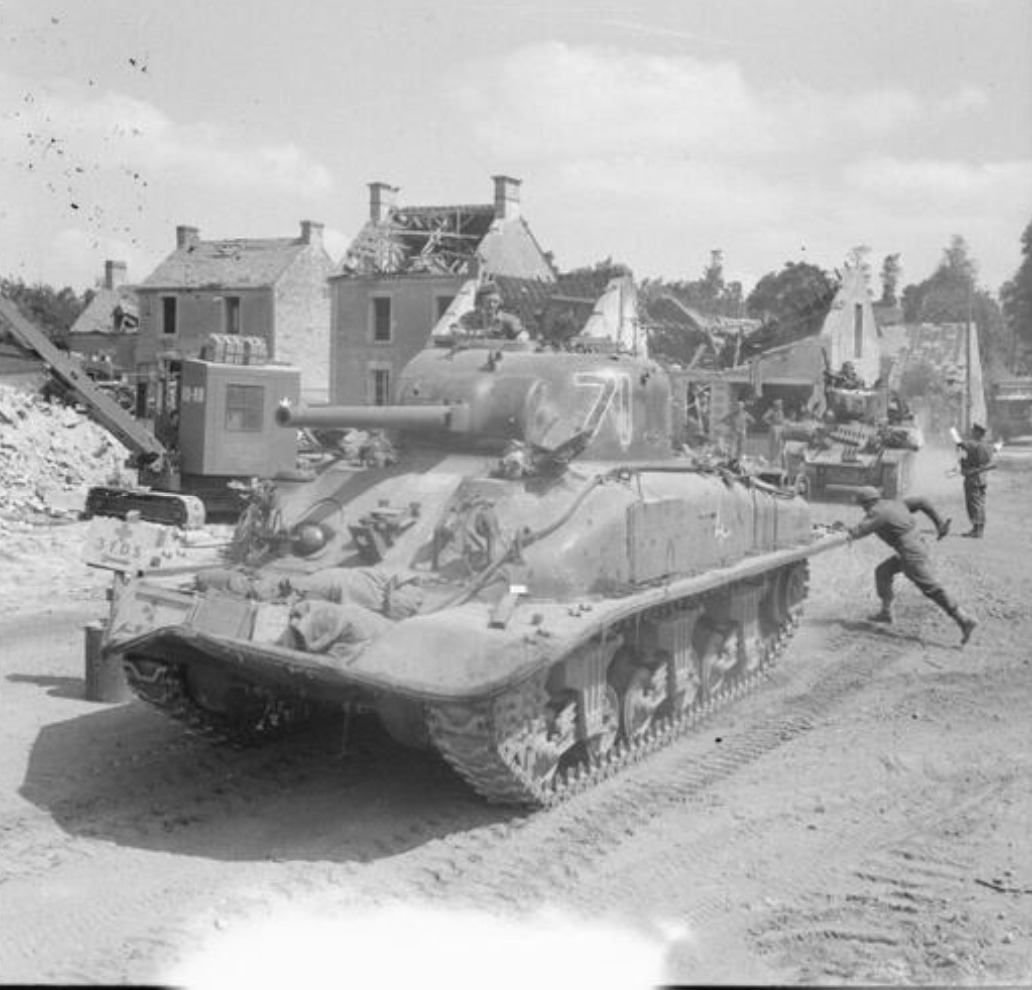
Infantry of 49th Division digging in beside Sherman tanks near Rauray, 30 June 1944. - IWM (B 6225)
History
The early welded hull Shermans had two big problems during production. The first was that they required a well-trained workforce of welders and the second was that they were time-consuming to build. The worst offender was the hull front as it was made up of multiple smaller pieces with the exact amount and design varying depending on the manufacturer but all following the same basic principle.
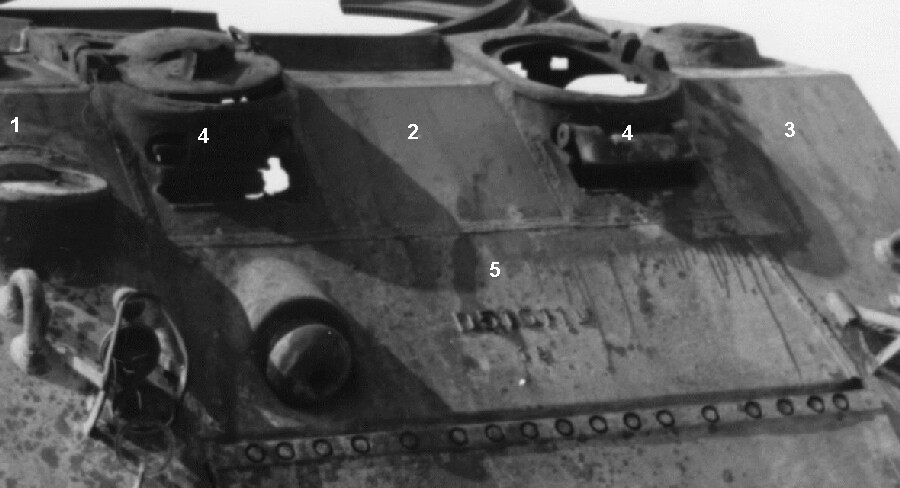
As can be seen here on this Pressed Steel Car Co. hull, sections 1, 2, and 3 were armour plates and the drivers’ hoods (4) and the D51011 piece (5) were castings all of which had to be welded together.
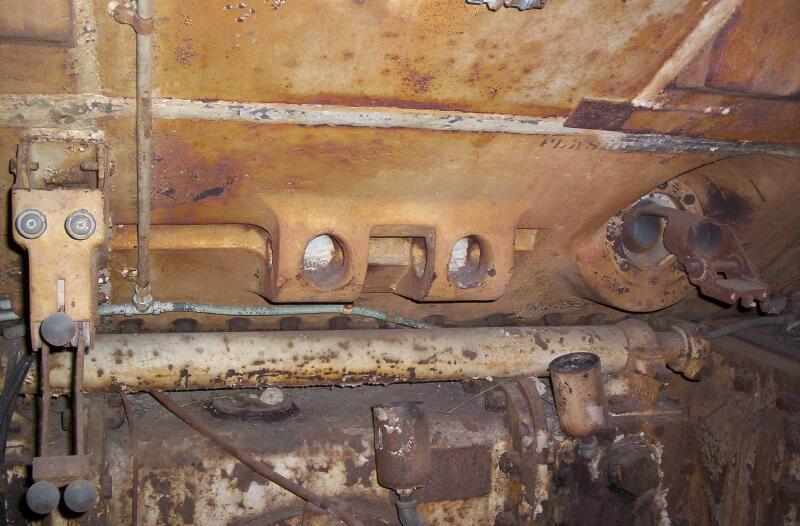
The inside of an American Locomotive Co. (ALCO) hull.
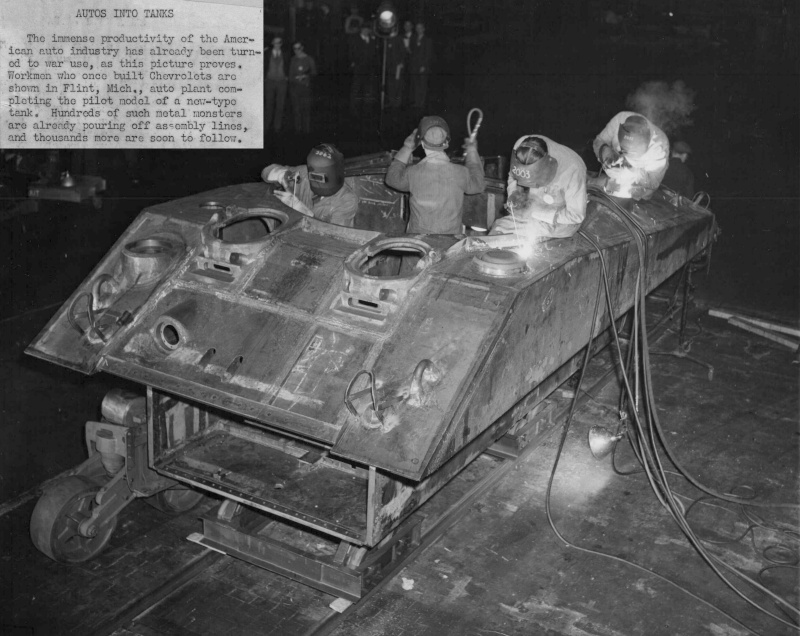
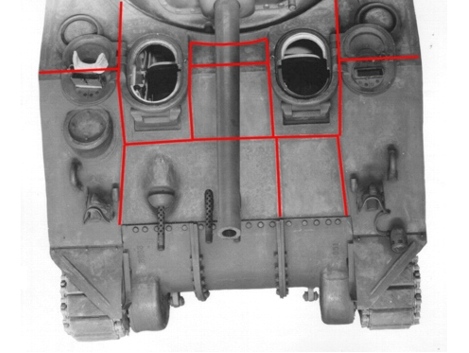
A Fisher Body hull being built and a marked up image showing the multiple pieces it consists of.
A Pullman Standard hull.
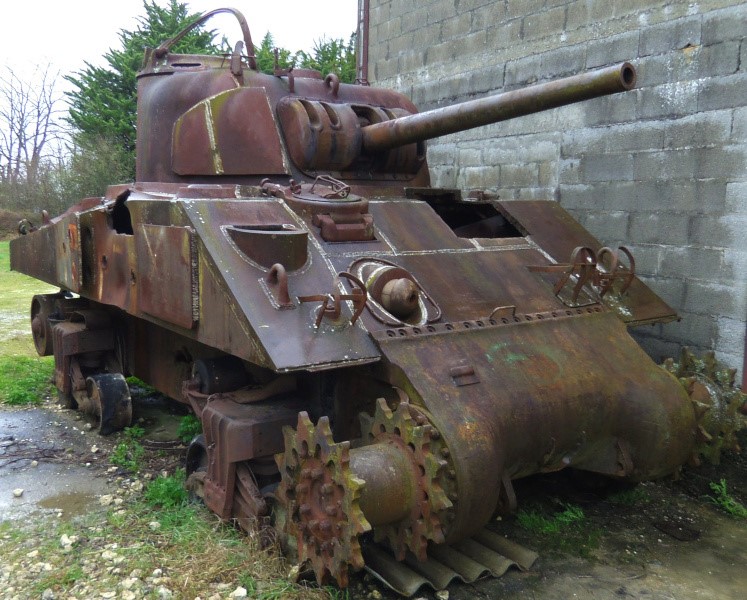
Casting the hulls was both quicker and cheaper and there was even a consideration of switching production completely over to cast hulls but this was soon regarded as being unfeasible as a number of the foundries didn’t have the ability to create castings as large as that of the entire hull.
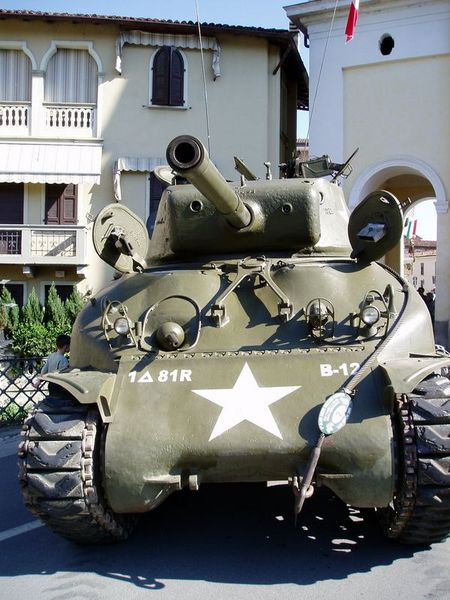
In October 1942, the Ordnance Department began work with Chrysler to create a cast front which simultaneously solved the problem of the welded front ends and was small enough that the smaller capacity foundries would also be able to produce it. This cast front would then simply be welded to an otherwise welded hull. These tanks were not given any special designation and instead were still just referred to as M4s but they’ve since been given the term ‘M4 Composite’.
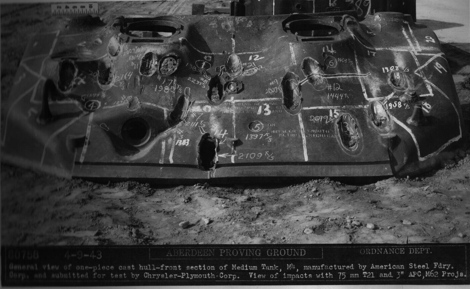
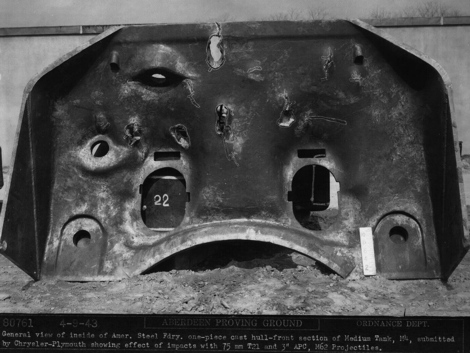
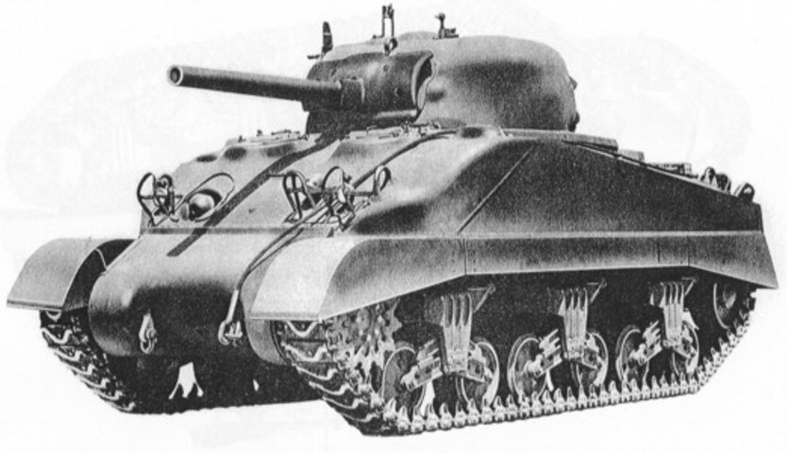
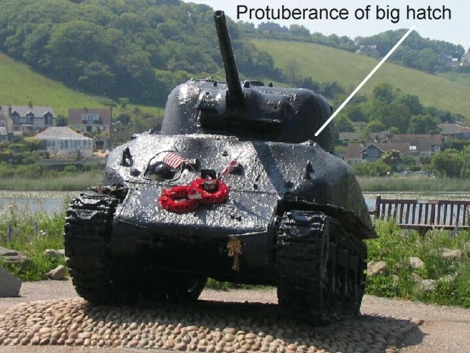
Chrysler produced 1676 M4 Composites from August 1943 through to January 1944 with approximately only 50 of these being the 56° ‘small-hatch’ glacis design before switching over to the 47° ‘large-hatch’ glacis design.
Evidence suggests that ALCO also produced approximately 300 large-hatch Composites from October to December 1943 as part of their last Sherman production order.
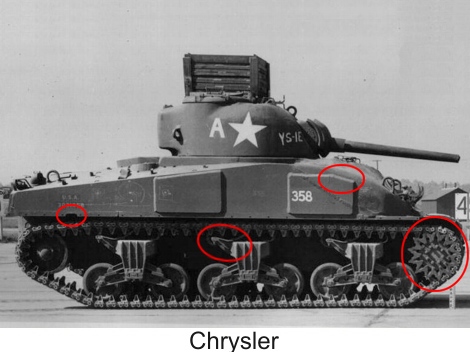
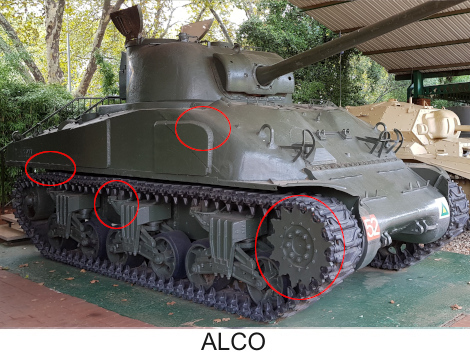
A comparison of Chrysler and ALCO-built Composites.
- The top corner of the right-front applique plate is rounded on ALCOs but cut at a straight angle on Chryslers.
- The ALCOs use the “plain” drive sprockets whereas Chrysler used their own design of sprockets throughout their Sherman production.
- Most Chrysler Composites have the later style of ‘upturned’ return roller arms. ALCO seem to have finished their Sherman production using the earlier ‘straight’ return roller arms.
- The ‘notch’ in the strip for fitting the sandshields appears to have been exclusive to Chrysler’s late production and remanufactured M4A4s and their Composites. It’s believed that the notched sandshields were adjustable by 11 inches to allow fitting on both M4A4s and Composites.
- ALCO tanks were likely built with D50878 low-bustle turrets while around 700 Chrysler tanks would’ve had the D78461 high-bustle turrets.
British/Commonwealth Service
Britain received a little over 2000 M4s as part of Lend-Lease, with these being allocated from September 1943 through to May 1944. There doesn’t seem to be any information as to the exact split of all-welded and Composite hulls but the standard M4s received the designation of Sherman Mk. I while the Composite became the Sherman Mk. I Hybrid.
The Hybrid is probably most famous as one of the three hull types used for Firefly conversions (the others being the welded Mk. I/M4 and the Mk. V/M4A4) but not every tank was suitable for conversion and so a fair amount saw service in their base 75mm guise.
Hybrids saw use in North-West Europe and Italy with none seeming to have been sent to the Far East whereas the majority of American Composites were deployed in the Pacific Theatre.
For the fighting in NWE an effort was made prior to D-Day for the tank units to be equipped with singular types of Shermans wherever possible for parity of fuel types and parts. As such the primary user of Mk. Is/Hybrids was 33rd Armoured Brigade which had 157 of them on strength in June '44 with another 52 with Tank Replacement Groups (exact split of welded and Hybrid is unknown).
As the fighting progressed, this became a bit more difficult to manage as the numbers of stocks dwindled and were replaced. For example, 4th Armoured Brigade, which were a predominantly Sherman Mk. II/M4A1-equipped unit also received a number of Hybrids.
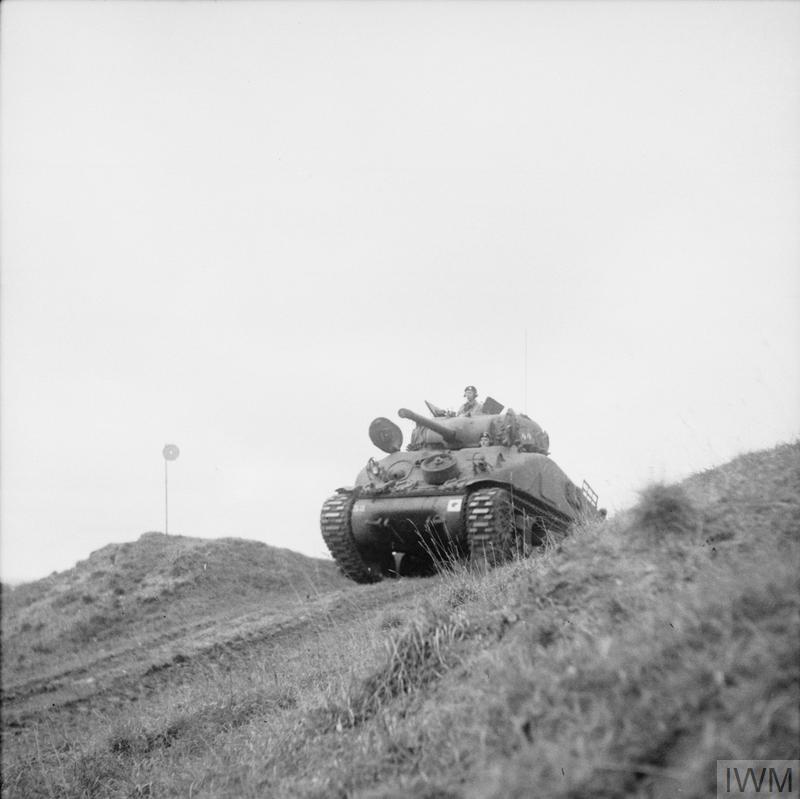
Sherman tank of the 4th Armoured Brigade on exercise at the Putlos Range near Oldenburg. - IWM (BU 11223)
In-game
While Britain does already have a 75mm Sherman, in the form of the Sherman II, it’s at 3.7 while everyone elses M4A1s are at 3.3. If the Sherman II were to have its completely ahistorical T45 APCR removed and be pushed down to 3.3, it would open the doors for another 3.7 Sherman to take its place.
While the Sherman Mk. III and Mk. V were more prevalent among British forces, and I would love to see both added to the British tree, I have chosen this as a fairly unique Sherman variant with only one other nation currently having it in the form of the Italian Premium Sherman I Composito.
Aside from the Italian one being in a different colour and having markings applied, if a British one were to be added it could be further visually distinguished with things like the later design of blanket box and be either partially or fully fitted with sandshields.
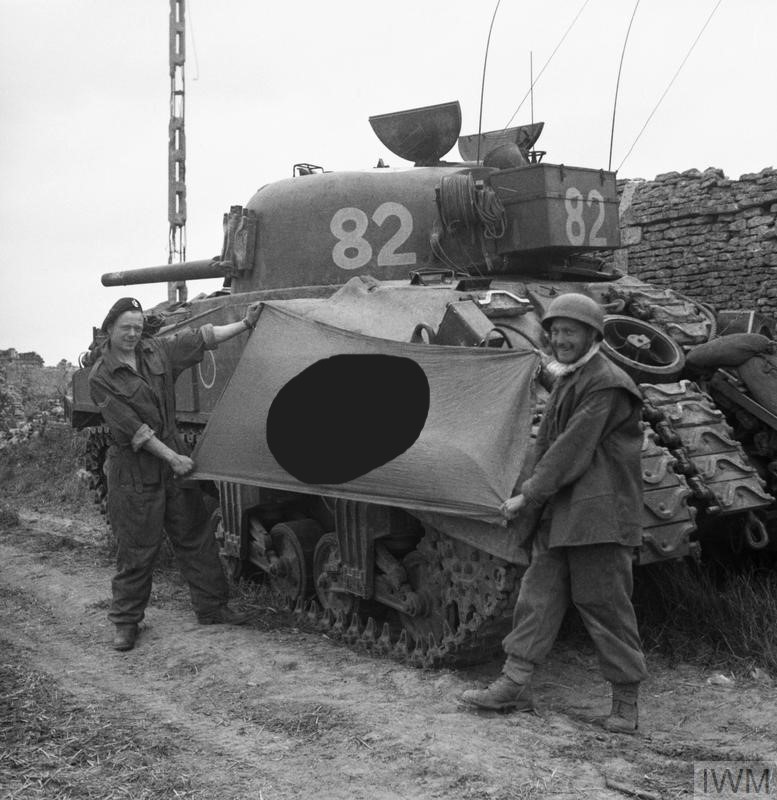
Sherman tank crewmen L/Cpl S. James and Sgt H. Coe of 27th Armoured Brigade hold up a German swastika flag they captured during the attack on Caen, 10 July 1944. - IWM (B 6904)
Specifications
The specifications of this tank would be exactly the same as the Italian premium Sherman I Composito.
Crew - 5
Weight - 31.5t
Engine - Continental R-975 C1 (400hp)
Max speed - 24mph
Armament
75mm M3
2x .30cal MG
1x .50cal MG
Max elevation/depression - +25/-10
Ammunition
97 shells
3,000 .30cal rounds
400 .50cal rounds
Figures taken from War Thunder Wiki
Armor penetration (mm) at a distance:
10m / 100m / 500m / 1000m / 1500m / 2000m
M72 Shot - AP: 91 / 88 / 78 / 67 / 57 / 49
M61 Shot - APCBC: 104 / 102 / 93 / 84 / 75 / 68
M48 Shell - HE
Armour
Nose - 63.5mm
Glacis - 63.5mm
Lower Hull Sides - 38.1mm
Upper Hull Sides - 38.1mm + three 25.4mm applique plates
Hull Rear - 38.1mm
Hull Roof - 19.05mm
Turret Ring Collar Front/Sides/Rear - 63.5mm/19.05mm/19.05mm
Engine Deck - 19.05mm
Turret Front - 76.2mm/one 50.8mm section at the gunner’s controls
Mantlet - 88.9mm inner + 50.8mm gun shield
Turret Sides - 50.8mm
Turret Rear - 50.8mm
Turret Roof - 25.4mm
Images
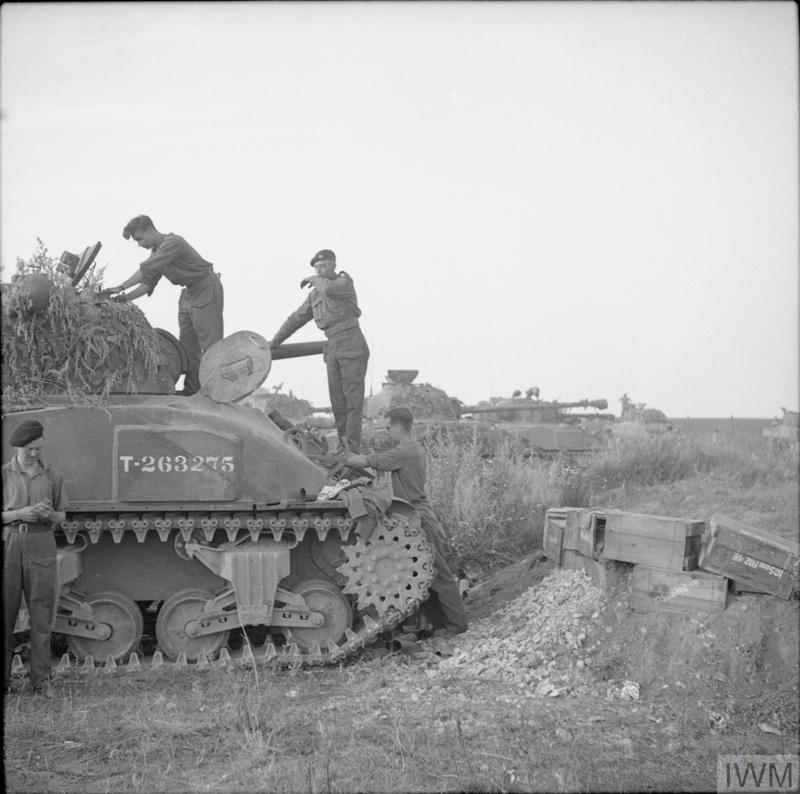
Sherman tank crews preparing for Operation ‘Totalise’, 7 August 1944. - IWM (B 8805)
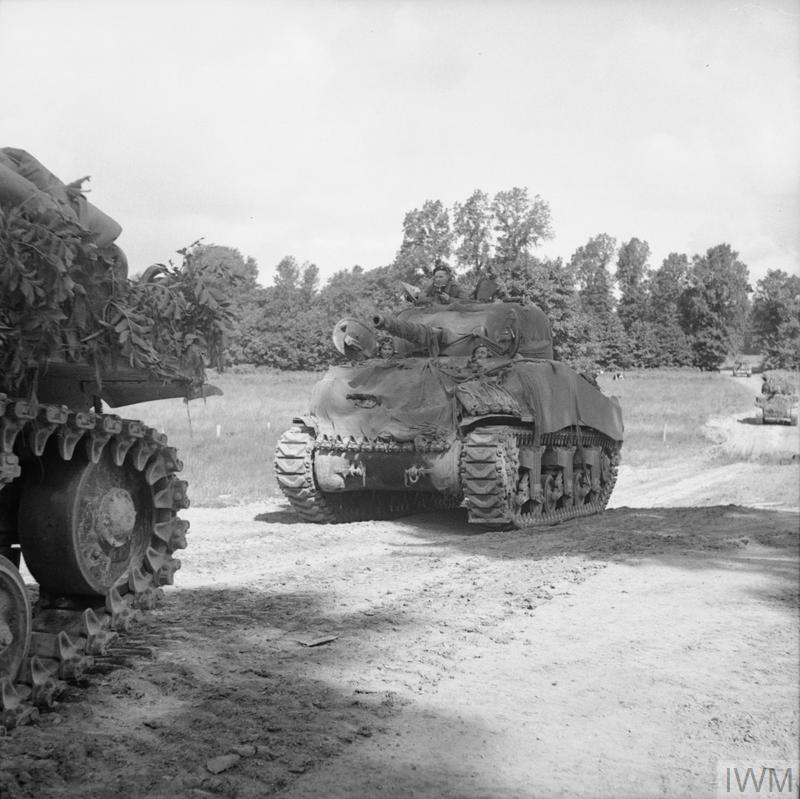
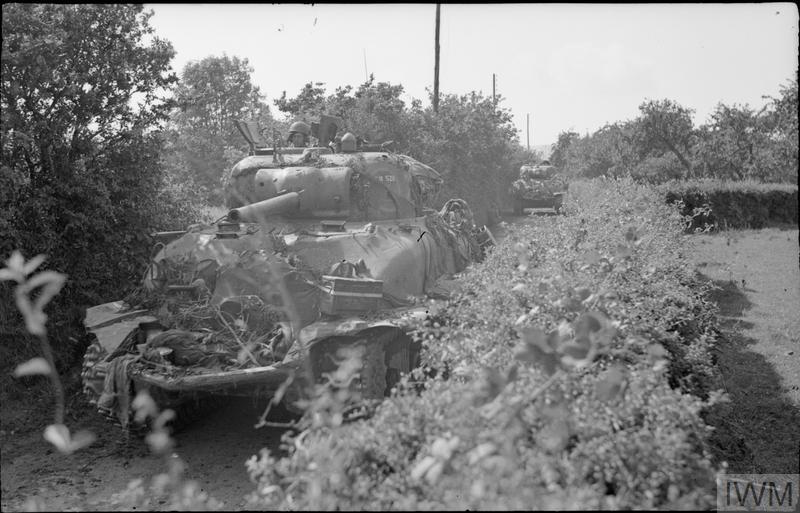
Camouflaged Sherman tanks moving up near Livry during Operation ‘Bluecoat’, the offensive south-east of Caumont, 30 July 1944. - IWM (B 8240)
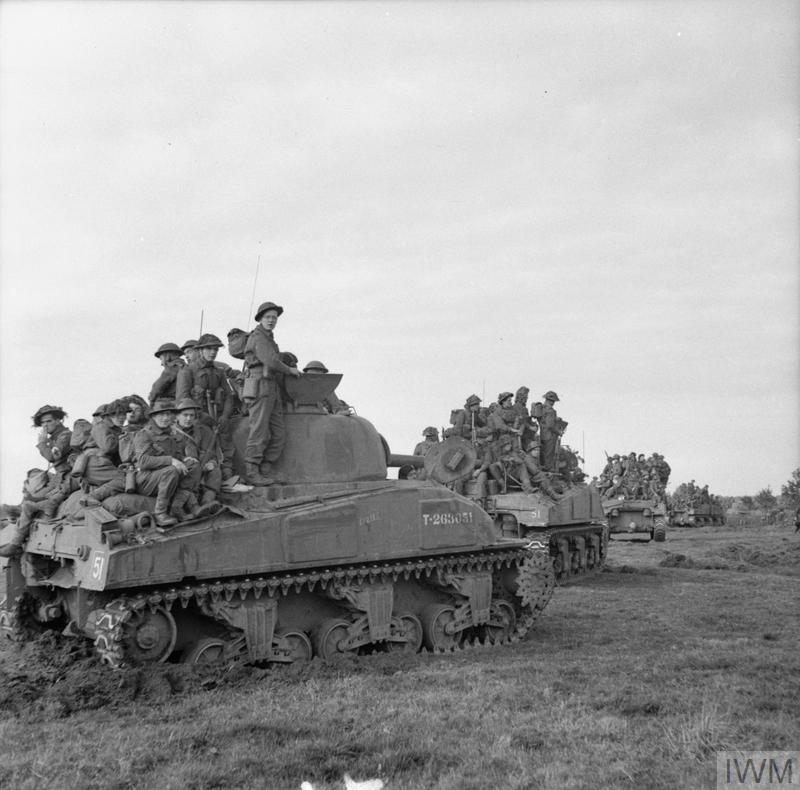
Infantry of 51st Highland Division are carried into battle aboard Sherman tanks near Udenhout, 29 October 1944. - IWM (B 11464)
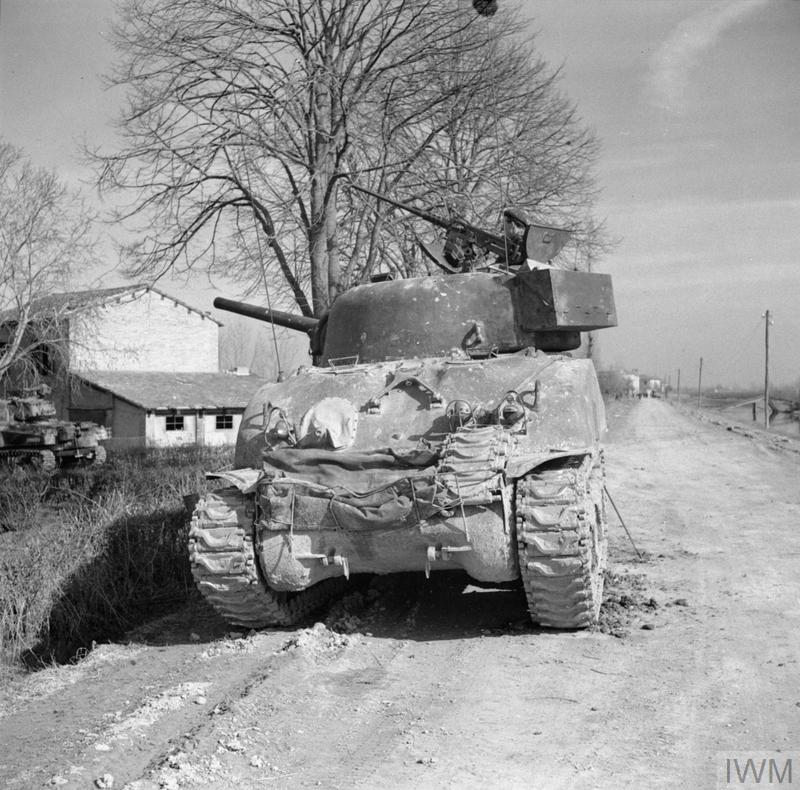
A Sherman tank of the North Irish Horse fires at enemy-occupied buildings across the River Senio, San Alberto area, 21 February 1945. - IWM (NA 22499)
Sources
British Battle Tanks: American-Made World War II Tanks - David Fletcher & Steven J. Zaloga
Sherman Minutia (Sherman minutia homepage) - Pierre-Olivier Buan, Joe DeMarco and Leife Hulbert
Sherman Tanks British Army and Royal Marines - Dennis Oliver
British Tanks In Normandy - Ludovic Fortin