- Yes - In the Tech Tree.
- Yes - Event/BP.
- Yes - Premium.
- No - I would not like to see HMAS Stuart I in game.
HMAS Stuart at Malta, (1940)
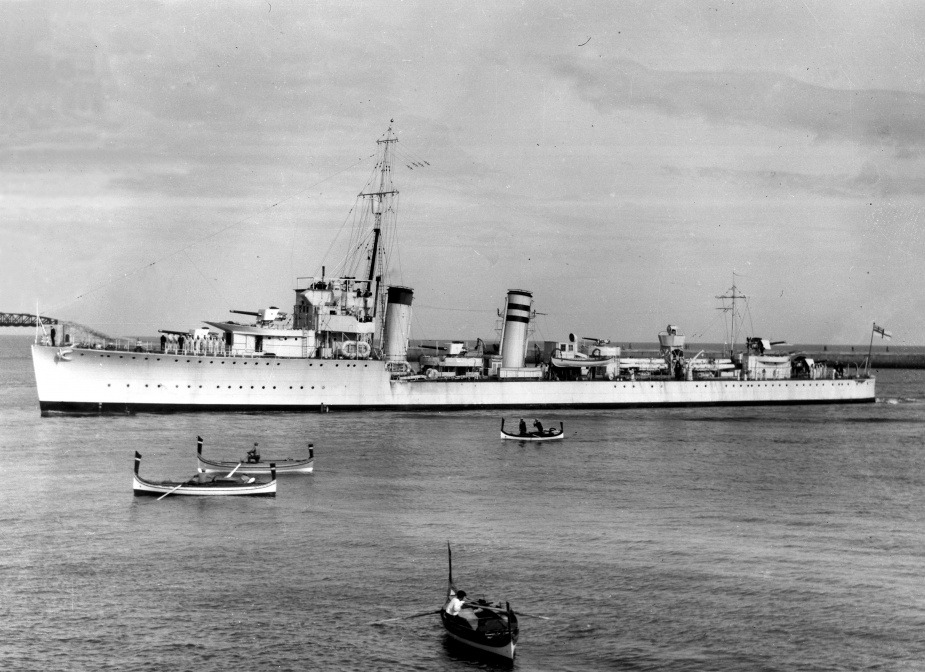
Description:
Purchased to replace the older Parker-class Destroyer Leader, HMAS ANZAC (I) as part of modernisation within the Royal Australian Navy’s (RAN) destroyer flotilla. Instead of leading the S-class vessels that were in service with HMAS ANZAC, she would serve with the equally old, but more capable V & W-class Destroyers.
During her service in the RAN, her role would shift from fleet operations to convoy escort as Australia’s position in the war changed along with her own capability compared to modern types of destroyers. This suggestion is for her 1941 fit.
HMAS Stuart during a dry dock period, probably during one of her refits. (n.d)
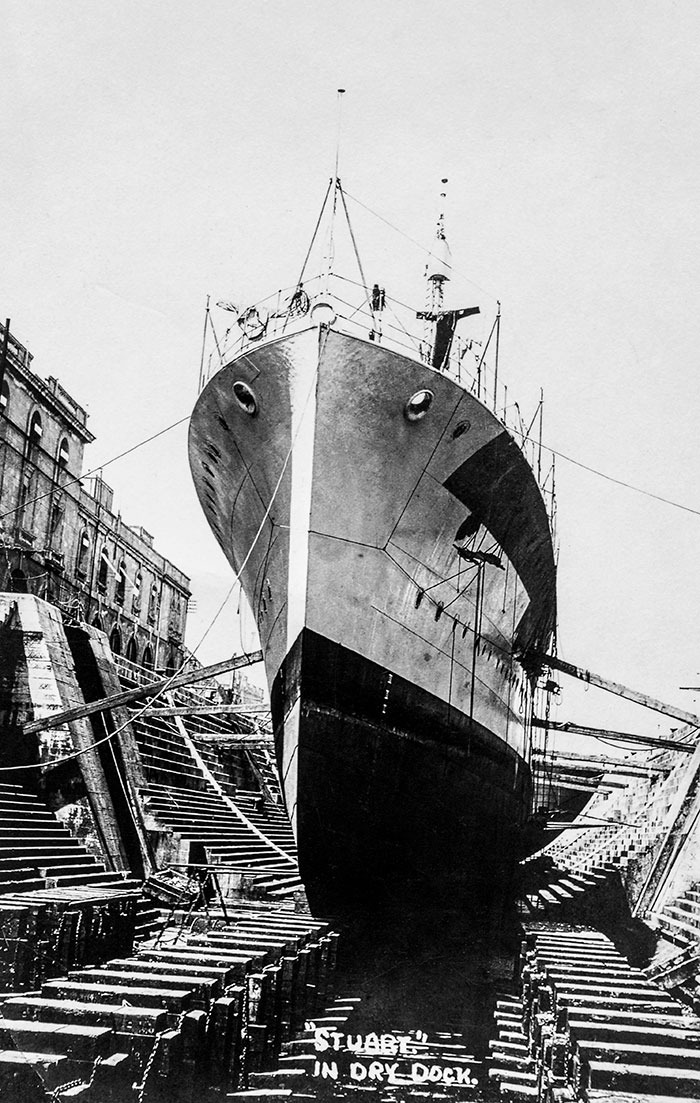
History:
Royal Navy Service:
Laid down as HMS Stuart by Hawthorn Leslie and Co, at Hebburn-on-Tyne, on the 18th of October 1917, she would launch on the 22nd of August 1918, and commission into the Royal Navy on the 21st of December 1918. Although commissioned too late to see action in the First World War, HMS Stuart would see service in the immediate post war, mostly with the 2nd Destroyer Flotilla. In this group she would operate in the Mediterranean and Black Sea, where she would see the disintegration of the Ottoman Empire, and take part in the British intervention into the Russian Civil War.
During operations in the Aegean Squadron she would assist Greek troops in operations against the Turks, escorting troopships as part of the Greek landings at Smyrna in May 1919, and the landings at Panderma in July 1920. During operations in Russia she would be based out of Yalta, however this would not last long, as she would also partake in the evacuation of troops from the British Military Mission in March 1920 as the Bolshevik forces advanced on Novorossiysk. Back in the Aegean by 1921 she would be based out of Constantinople as part of the Allied Occupation force.
By 1923 operations would calm down significantly, with vessels mostly partaking in exercises and generic fleet duties. This would continue until 1933 when she was decommissioned and listed for transfer to the RAN along with three V-class and one W-class Destroyers.
HMAS Stuart in speed trials after refit, (1941)
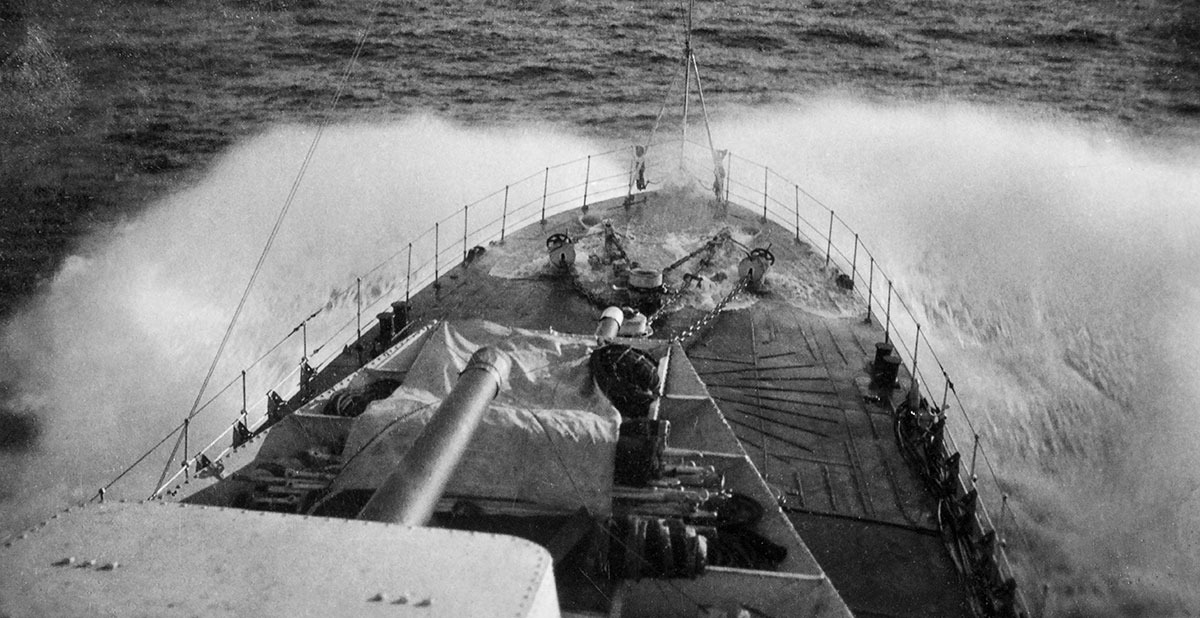
Royal Australian Navy Service:
HMS Stuart would become HMAS Stuart on the 11th of October 1933, when she left Portsmouth bound for Australia. She would arrive at Sydney on the 21st of December 1933, sailing through the Suez Canal, and Singapore. She would serve on fleet duties on the Australia station, such as fleet exercises, convoy escort, and trials. She would be placed into reserve on the 1st of June 1938 due to manning shortages.
She would recommission from the 29th of September 1938 to the 30th of November 1938 due to the Munich Crisis, however with the end of that potential conflict she would decommission. On Australia’s declaration of War on the 1st of September 1939, she would recommission for service in the conflict.
Her first duties were to work up and practise ASW Patrols in the Sydney Harbour, a duty which would alternate between herself, HMAS Vendetta and Waterhen. However on the 14th of October that year, she, and the HMAS Vendetta and Waterhen would sail to Singapore. They would be joined by the HMAS Vampire and Voyager at Singapore, as those vessels were based out of Fremantle.
The ships would sail for Malta on the 13th of November 1939, but each vessel would sail individually, and thus arrived at Malta at varying times. Stuart herself would arrive on the 1st of January 1940. Now at Malta, the ships would form the 19th Destroyer Division, with the leader HMAS Stuart, as well as the Voyager, Vendetta, Vampire, and Waterhen. This group would be labelled the ‘Scrap Iron Flotilla’ by Joseph Goebbels due to the age of the vessels, all being built for the First World War. This Nickname would be taken favourably by the Australians.
On the 27th of May 1940, the 19th Division would be merged with the 20th Division, forming the 10th Destroyer Flotilla. Stuart would lead the 10th in the Battle of Calabria, but would also provide gunfire support to the army in the Western Desert Campaign. During operations around Tobruk, Stuart would attack the Italian submarine Gondar with Depth Charges, eventually leading to the surrender and the scuttling of the submarine. All but two of the Gondar’s crew was rescued.
During her time in this area she would survive over 50 air attacks, which was in part helped by a refit in early 1941, removing the ‘Q’ amidships turret, and the ‘X’ aft turret for two QF-2pdr Pom-Pom guns, five single 20mm Oerlikons spread around the upper decks, a captured Breda 20mm gun mounted near the torpedo tubes on the starboard side. This would supplement her already existing AA armament of a QF 3-inch 20cwt, and five .303 MGs.
She would also support the 6th Australian Division when it captured Tobruk on the 22nd of January 1941, this was done in company with the HMAS Vampire, Voyager, and the HMS Gnat and Terror. She would partake in the battle of Matapan in March 1941, when she would torpedo the Italian Cruiser Zara. In March through to April 1941 she would partake in the escort of troopships to Greece, then by April the same year she would partake in the evacuation of troops from Greece.
After her service in Greece, the Scrap Iron Flotilla would take part in the Tobruk Ferry Service, running supplies to the besieged forces at Tobruk. Stuart herself would herself take part in 24 runs. By this point she was heavily worn out, and on her final run experienced an almost fatal engine failure, leading to her withdraw from the area to Alexandria on only the starboard shaft.
As she was not outright disabled by this, she would sail for Australia via Singapore for proper repairs. She would arrive at Melbourne on the 27th of September 1941, immediately going into dry dock for repairs and refit. This refit would be extensive, and work would not only focus on repairs, she would also be re-armed into an escort vessel, to protect the Coastal convoys to Australia with Vital war goods from the United Kingdom, United States, and New Zealand.
Works included removing ‘A’ Turret, increasing depth charge stores, the removal of three 20mm Oerlikons, as they inhibited the gun arcs, the removal of all the .303 MGs, as they were useless as AA weapons by this point, the removal of the 20mm Breda gun, as she did not have access to the great number of captured Italian stores all the way in Australia. However she did gain the Hedgehog ASW Mortar in place of ‘A’ turret, and further depth charge throwers. Her torpedoes were also removed.
She would recommission from this refit In April 1942, where she would operate in coastal escort around Australia, but would see an expansion of her area of operations to New Guinea in October. She would return to only escorting around Australia in March 1943.
She would be converted to a troopship and stores ship in early 1944, where she would lose the forward boiler and associated funnel for greater storage area, removing the gun in the ‘Y’ position, and adding further AA. This resulted in a final armament of one BL 4-inch Mk.I, seven 20mm Oerlikons, twelve QF 2pdrs in three quad mounts, the Hedgehog Mortar, two DC rails, and four DC throwers.
She would serve on this duty until January 1946, transporting supplies around Australia and New Guinea. She would pay off at Sydney on the 27th of April 1946, being sold to T Carr and Co to be broken up on the 3rd of February 1947. During her war service she lost no men.
| General Characteristics | |||||
|---|---|---|---|---|---|
| Name: HMAS Stuart | |||||
| Country: Australia | |||||
| Type: Destroyer Leader | |||||
| Class name: Scott-class | |||||
| Year of commission: 1933 | |||||
| Refit: 1941 | |||||
| ----------------------------------------------------------------------------------------------------------------------------------------- | |||||
| Dimensions: | |||||
| Length: 332 ft 7.5 in (101.384m) | |||||
| Beam: 31 ft 9.375 in (9.68m) | |||||
| Draught: 11 ft 4 in (3.45m) | |||||
| Displacement: 2,053t | |||||
| ----------------------------------------------------------------------------------------------------------------------------------------- | |||||
| Propulsion: | |||||
| Powerplant: Steam turbines, 4x Boilers, 2x Turbines, 43,000 shp (32,000 kW) across 2 shafts | |||||
| Speed: 36.5kt | |||||
| Endurance: 5,000nmi (5,600 km; 3,500 mi) at 15kt | |||||
| ----------------------------------------------------------------------------------------------------------------------------------------- | |||||
| Armament & sensors: | |||||
| Compliment: 167 | |||||
| Primary armament: 3x1 BL 4.7-inch Mk.I | |||||
| Secondary armament: 5x1 20mm Oerlikon, 1x1 20mm Breda, 1x1 QF 3-inch 20cwt, 2x1 QF-2pdr | |||||
| Tertiary armament: 2x3 21" Torpedo tubes, 4x1 .303 Lewis, 1x1 .303 Vickers, 2x DCT, 2x DCR | |||||
| Sensors: - nil |
HMAS Stuart after another of her refits, (1944)
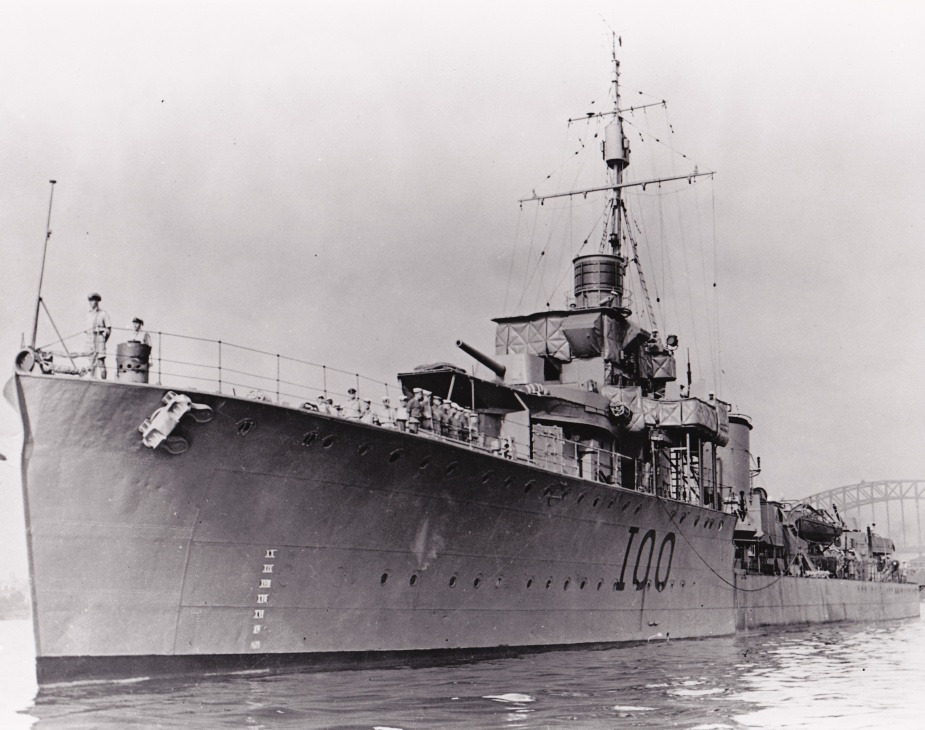
Sources:
Friedman, N.(2009) British Destroyers: From Earliest Days to the Second World War (pp.166-167)
The Navy List, January 1933, p274
Gillett, R. (1983). Australian and New Zealand Warships 1914-1945 (p.94)
M.J. Whitley. (1988) Destroyers of World War Two. (p.17)
HMAS Stuart (D00) - Wikipedia
HMS Stuart
HMAS Stuart (D 00) of the Royal Australian Navy - Australian Destroyer of the Admiralty Leader class - Allied Warships of WWII - uboat.net