- Yes
- No
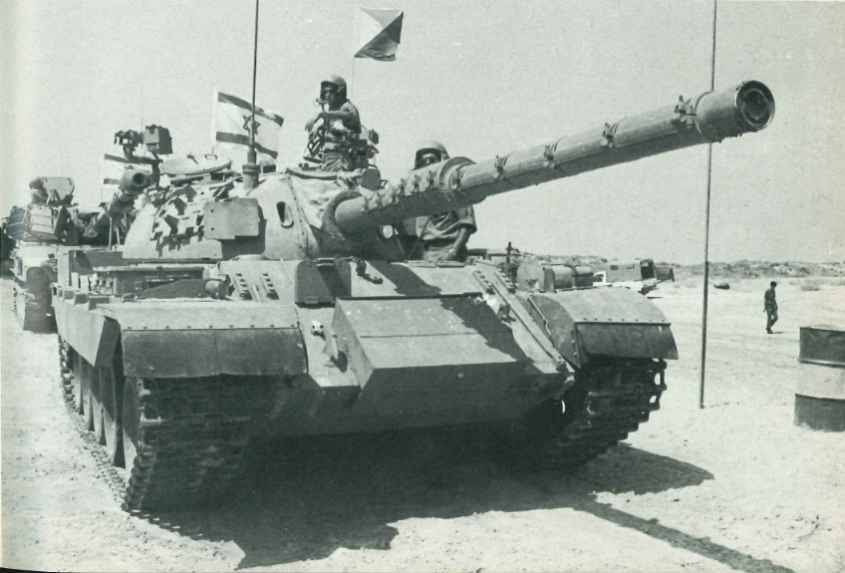
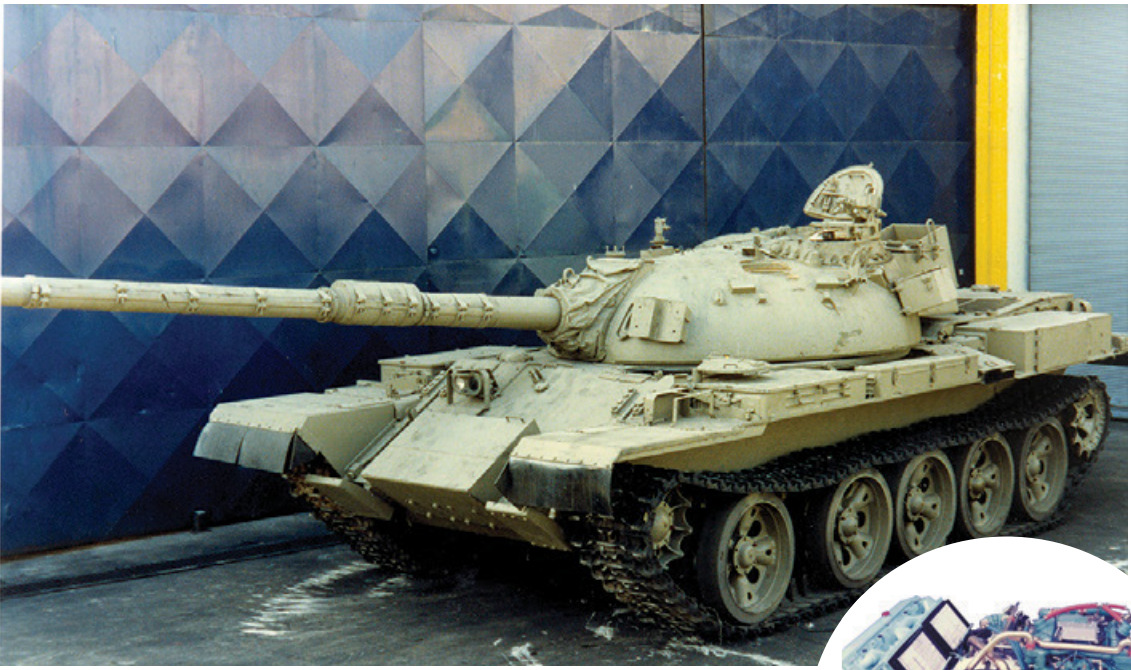
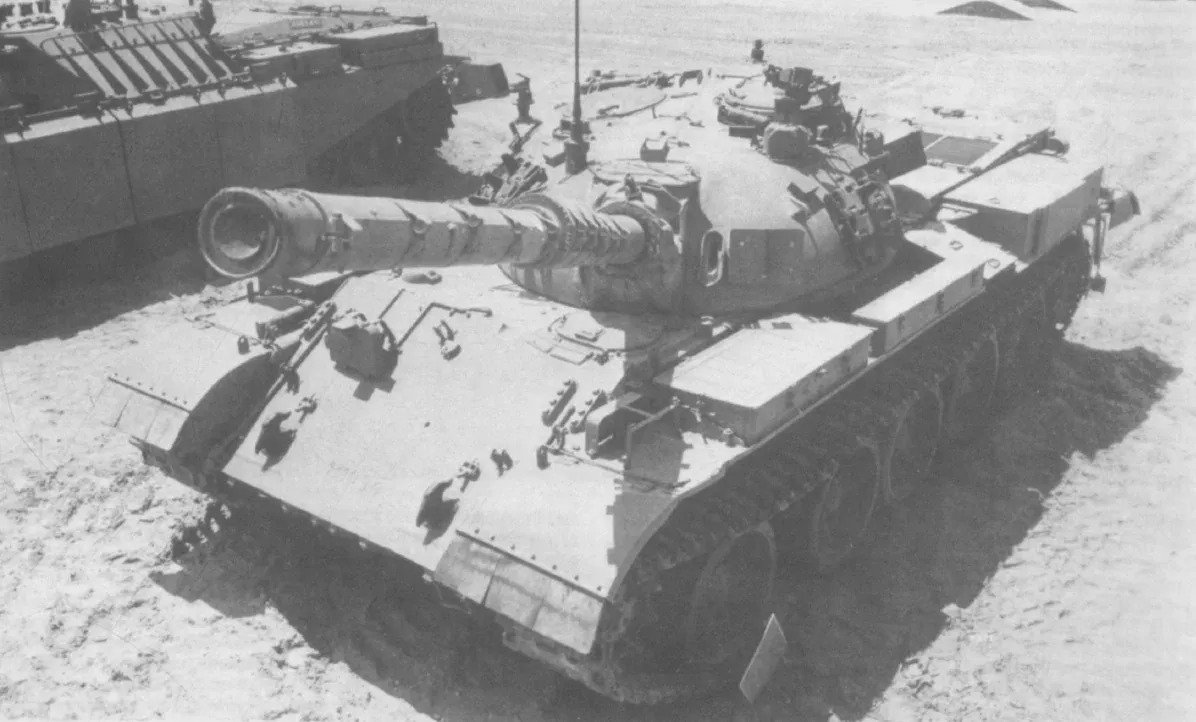
- BASIC DESCRIPTION -ㅤSamovar HP - The “Hull Prototype”, otherwise known as the “Hull Technology Demonstrator” or “HTD” for short, is one of several “Samovar” prototypes developed by the IDF in the 1980s during a general modernization effort to “Westernize Tirans.” As the name suggests, this specific prototype focused primarily on improvements to the hull, though the turret also received upgrades that were largely identical to other 1980s Tiran modernizations. There was another derivative prototype called the “TP” (Turret Prototype) which, conversely, used an unmodified Tiran 5 hull but incorporated a highly modernized turret.
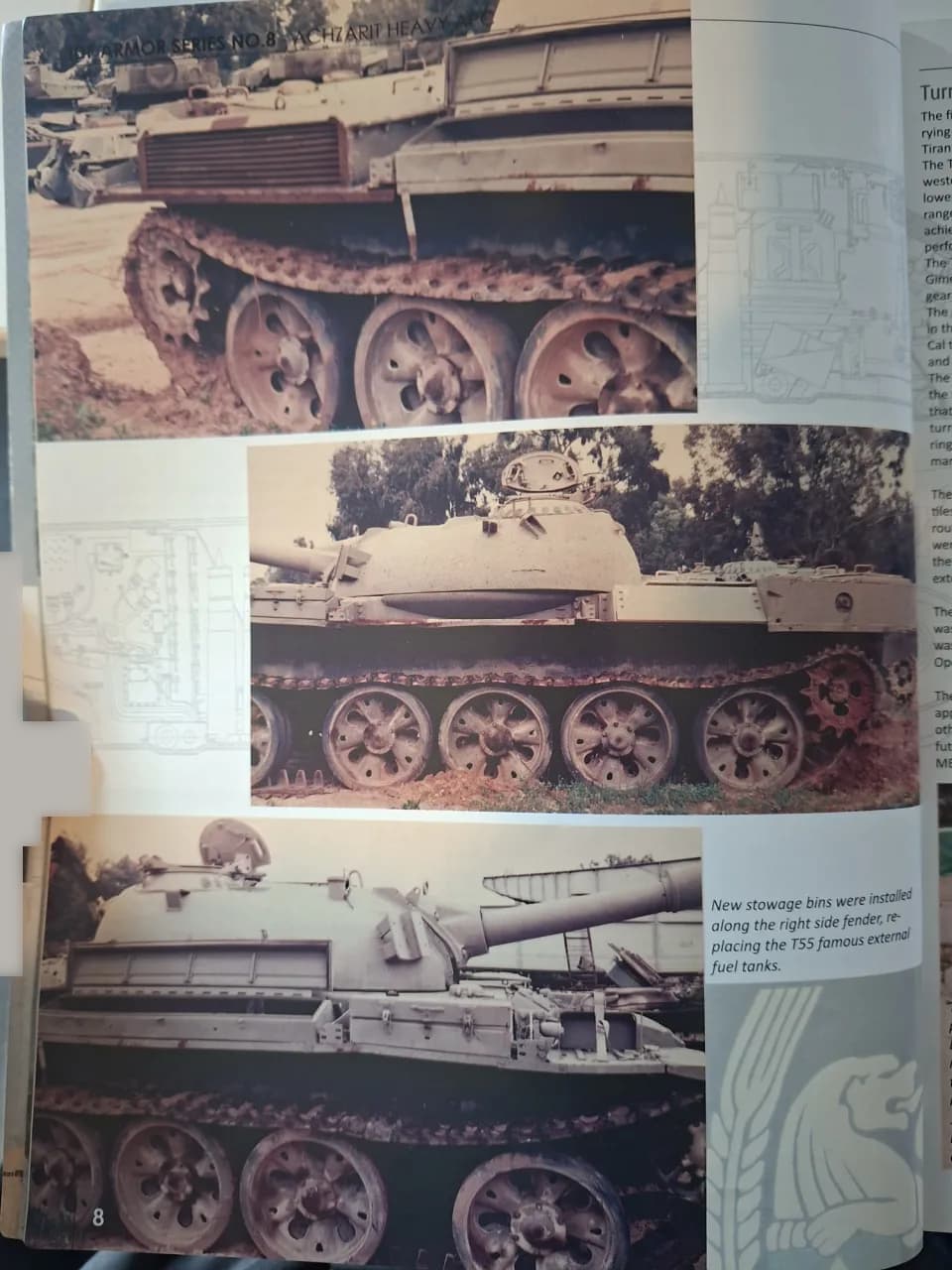
ㅤThe hull prototype was based on the Tiran 5 (T-55). It introduced a new powerpack featuring a Detroit Diesel 8V71T engine rated at 609 hp with a water-cooling system, paired with an Allison XTG-411-4 automatic transmission. To accommodate the new engine, the hull was completely redesigned, giving it a distinctive “NATO hump.” The Soviet two-piece final drive system was replaced by a custom-made, single, easily removable unit, and the original air filters were replaced by a far more powerful assembly used on Israeli Magachs and Merkavas, which was better suited for harsh Middle Eastern environments. The fuel system was also fully reconfigured, replacing the external fuel tanks with four internal tanks (including two designed to combine ammunition storage with diesel fuel cells), while the freed-up space on the fenders was repurposed for additional storage.
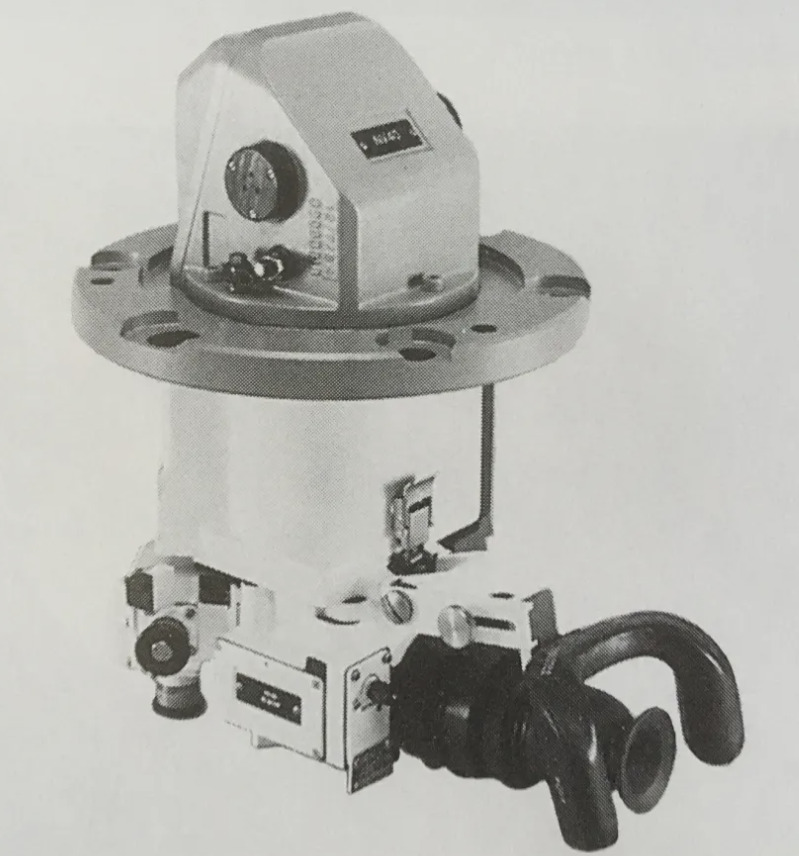
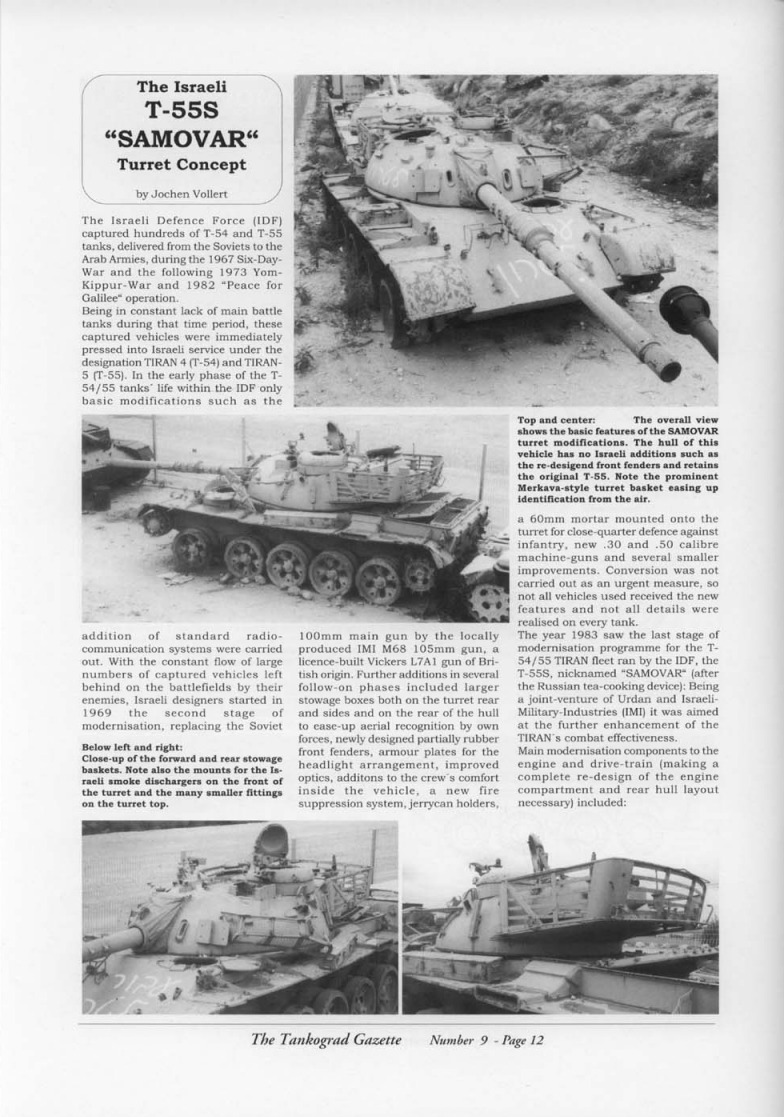
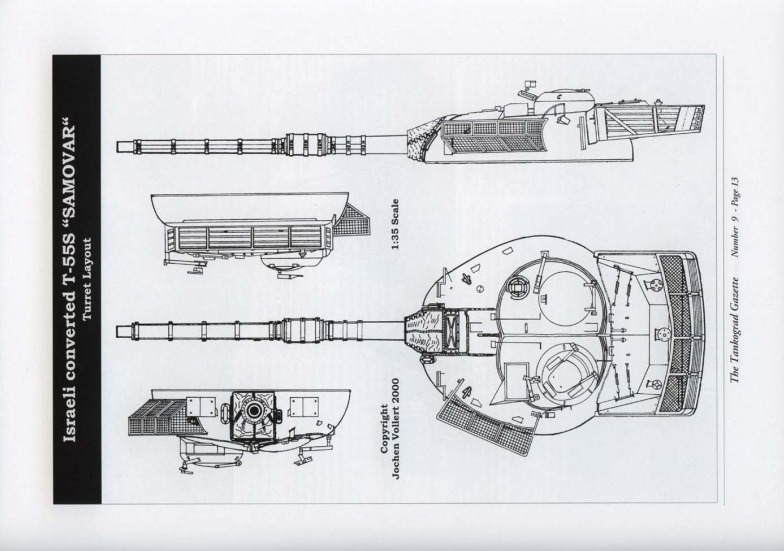
ㅤThe turret, while not the main focus of this exact prototype, was also quite modern, receiving a set of upgrades similar to those found on the Tiran 5Sh and Tiran 6 in their late stages of service during the 1980s. It featured a fire control system (FCS) designated as the FCS-30 or FCS-3000 (though other sources claim it was Lancelot). The FCS was paired with an TL10-T integrated laser rangefinder mounted on the Tiran gunner’s telescope, as well as a new passive periscope system featuring the NV40 for the gunner and NV39 for the driver. This provided second-generation image-intensifier night vision sights, eliminating the need for the IR searchlight found on the original Soviet T-55. Additional accessories included new radios, an extra storage basket on the rear of the turret, pintle-mounted 7.62 mm machine guns for the commander and loader, a 60 mm mortar, and a quad-mount for IS-6 smoke dischargers. The main armament, just like the Tiran 5Sh, was the 105 mm Sharir cannon, but on the Samovar, it received a thermal sleeve similar to those fitted on the Merkava Siman 1 or 2. The turret traverse mechanisms and stabilization systems found on the original T-55A were left unchanged.
Spoiler
- Part 1: Origins of the Tirans in the IDF -ㅤFollowing the Six-Day War in June 1967, the Israel Defense Forces captured up to 820 Egyptian tanks and self-propelled guns in the Sinai Peninsula, which included several hundred T-54 and T-55 tanks, alongside another 15 T-54s and 5 T-55s captured on the Golan Heights. Out of this total, approximately 200 vehicles were fully operational, while many others sustained only minor damage. Recognizing their low silhouette, reliable suspension, and good armor protection, the IDF made the decision to adopt the tanks into service as early as July 1967.
ㅤThe initial batch consisted of 130 tanks, comprising 81 T-54s and 49 T-55s. Upon entering service within the IDF, they received an initial set of modifications focused on basic standardization. These included general repairs, replacing machine guns, updating radio equipment, and utilizing a mix of domestically manufactured spare parts and components purchased from Finland. Official data records that 146 tanks were standardized between 1968 and 1969. These vehicles saw early combat during the War of Attrition (1969–1970), most notably participating in Operation Raviv on September 9, 1969, a daring armored raid along the African coast of the Gulf of Suez utilizing six T-55 tanks and three BTR-50 APCs carrying paratroopers.
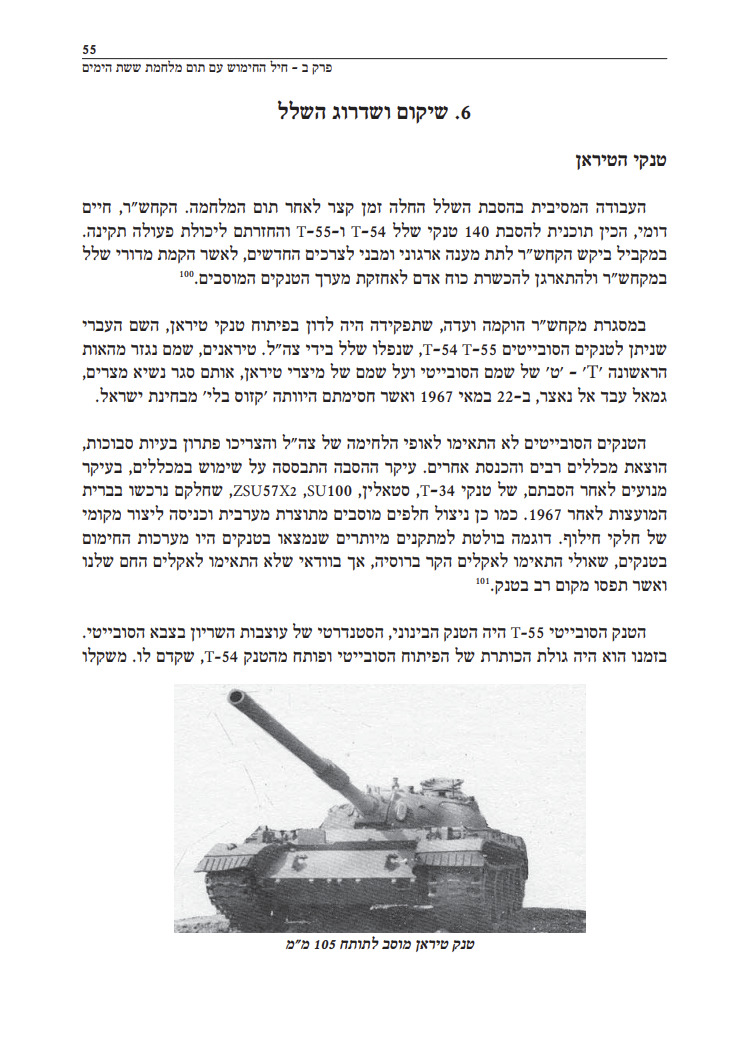
Tiran 4 (T-54) in Israeli serviceㅤName Origin: The designation “Tiran” (meaning “cruel ruler” or “Tyrant”) had a dual origin: it was derived from the first two Hebrew letters (…-טי / Ti-…) used to pronounce their Soviet T-designation, and it was named after the Straits of Tiran, whose blockade by Egyptian President Gamal Abdel Nasser on May 22, 1967, served as the trigger for the outbreak of the war.
- Part 2: Further Modifications of Tirans and Their Late Service -ㅤPrior to the Yom Kippur War, in the early 1970s, the IDF initiated a major firepower upgrade to replace the original Soviet 100 mm D-10T guns with the Western 105 mm M68 (L7A1 variant) gun, largely due to a shortage of 100 mm ammunition and its high cost. Around 250 T-54/55 tanks were rearmed with the 105 mm gun. The modified tanks were redesignated with the suffix “Sh”, which stands for “Sharir”, the Hebrew designation for the British-derived 105 mm gun (i.e., Tiran 4Sh and 5Sh).
ㅤAt the outbreak of the 1973 Yom Kippur War, modified T-55s already made up 7.6 percent of the Israeli tank fleet. In the course of battles, Israel captured an additional 1,500 Arab tanks, including 200 T-62s, with 550 found in working order. Of these, 400 were integrated into service, including 72 T-62s. By the mid-1970s, Tirans accounted for up to 20 percent of the IDF’s active tank fleet. The captured T-62 tanks underwent the same standardization as the T-54/55s, but retained their 115 mm smoothbore gun, earning the new designation Tiran 6.
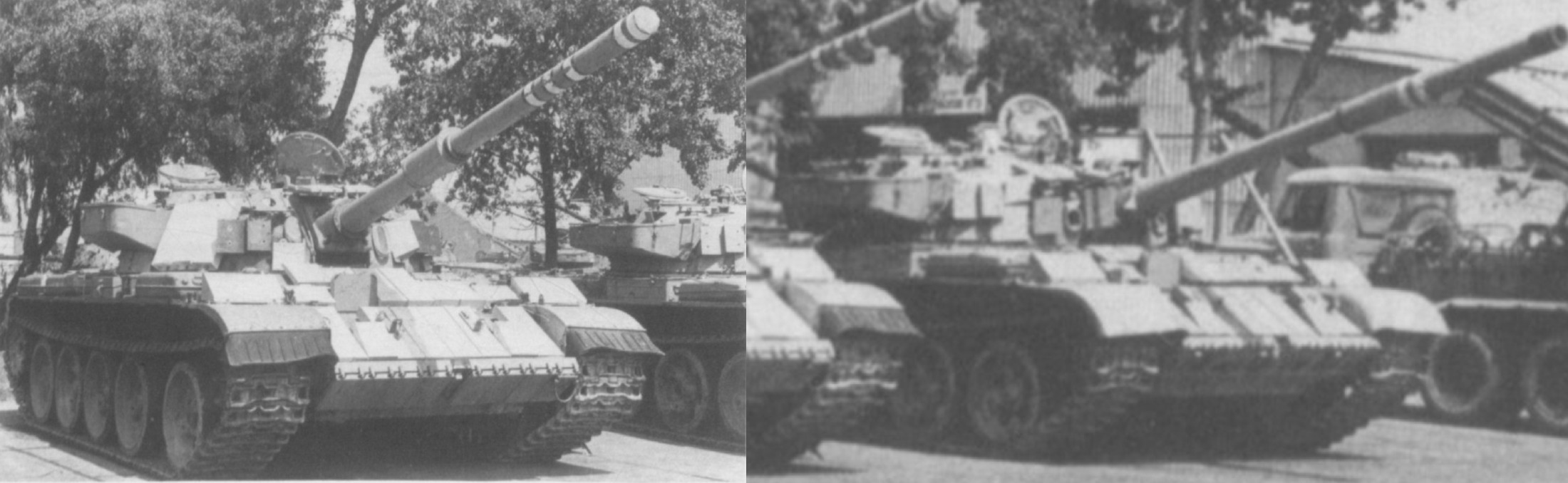
Tiran 4Sh and 5ShㅤLater in their service, the Tirans received even further upgrades to maintain their relevance and combat effectiveness. In 1983, improvements introduced to the Tiran tanks included a passive gunner’s periscope (NV40), a passive driver’s periscope (NV39), an integrated laser rangefinder mounted on the Tiran gunner’s telescope, and the “FCS-3000” fire control system. This was followed in 1984 by the introduction of the Baltan (a.k.a. Blazer) explosive reactive armor package for the Tiran 5Sh and 6. That same year, these modified tanks were unveiled to the public by the then-Chief Ordnance Officer, Brigadier General Tuvia Margalit.
ㅤIn the following years, the remaining Tiran units were gradually disbanded, beginning with the 440th Reserve Division in 1986. This was followed by the 320th Reserve Brigade, which began downsizing that same year until being fully disbanded in 1992, marking the formal end of Tiran service in the IDF.
Modified Tirans revealed to the public, 1984. Left: Tiran 5Sh; Right: Tiran 6- Part 3: The Westernized Tiran Project – ‘Samovar’ -ㅤFollowing the Yom Kippur War, in 1974, IDF Headquarters decided to improve and modernize its large fleet of Tirans captured during the 1967 and 1973 wars, particularly given the increased number of vehicles entering service, including 111 Tiran 6s. This initiative was pursued to maintain the Tirans in an updated operational condition on par with the newly arrived M60 Patton tanks. Although an engine conversion project had been explored as early as 1969, the new program aimed for a comprehensive “Westernization” of the entire vehicle rather than just its powerpack. Consequently, in early 1975, an expedited development program was launched, with a goal of defining the characteristics of the upgraded tank. The primary catalyst for the project was a severe supply chain shortage and the high cost of Soviet-made spare parts, compounded by slow maintenance turnaround times, replacing a Soviet engine took 14 to 18 hours compared to just 2 to 3 hours for Western tanks.
ㅤThere was also a political motive for equipping the Tiran tanks with Western systems: Israel’s leadership clearly understood that future military aid from the United States could be made contingent upon Israel’s acceptance of American terms for ending a war or regional conflict. The program to upgrade captured Soviet tanks ensured that, even if such restrictions were imposed, the IDF would still be able to bring its Tiran fleet up to the standard of the American-made tanks already in its inventory.
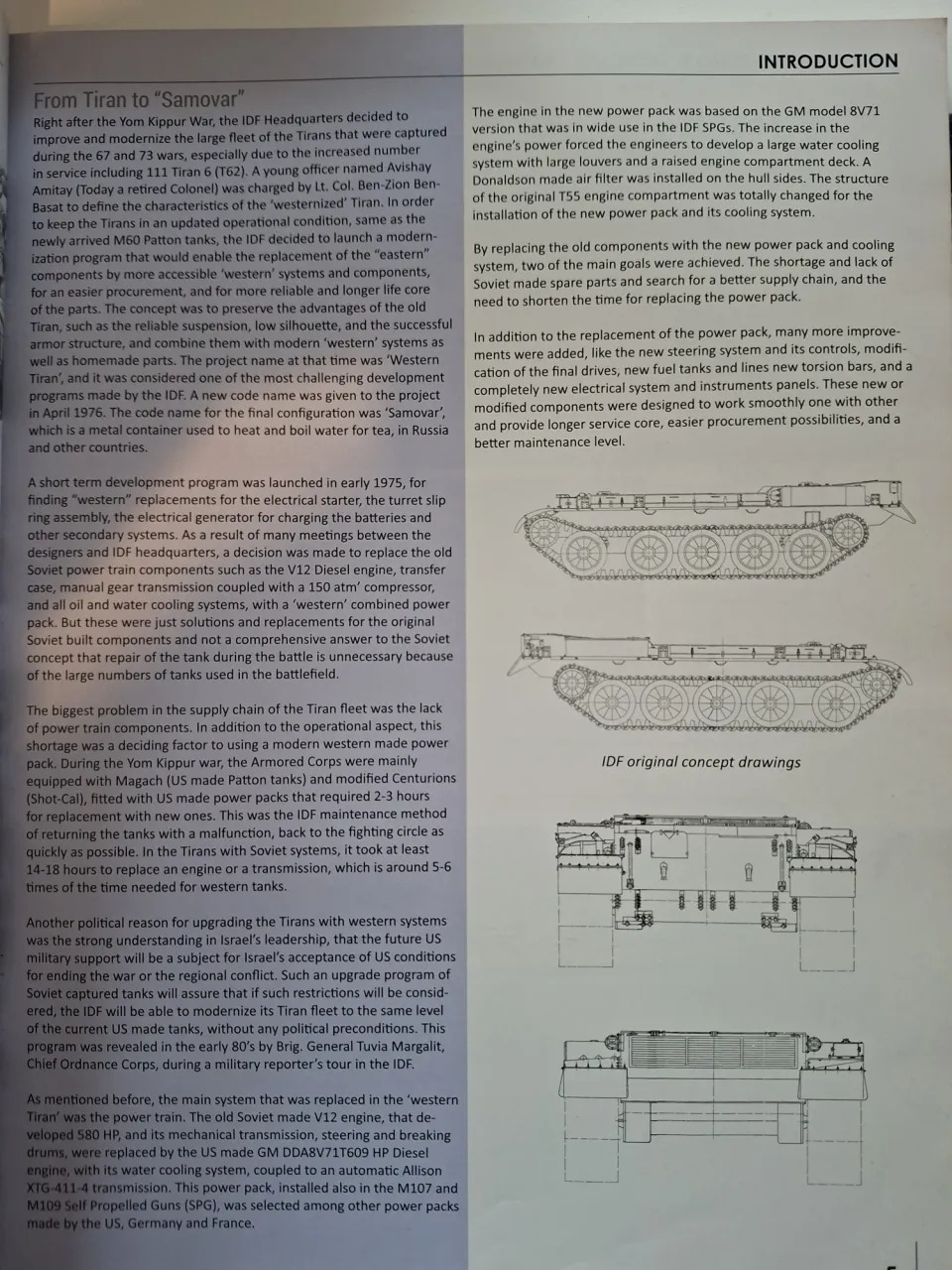
ㅤOfficially designated as “Samovar” in April 1976 (named after the Russian tea boiler container), the project sought to combine the Tiran’s proven legacy features, such as its reliable suspension, low silhouette, and excellent passive armor structure, with top-tier Western and domestically developed systems. The core upgrade was a new powerpack featuring a US-made diesel engine and an automatic transmission.
ㅤHowever, re-engining the T-55 was far from an easy task. The confined engine compartment severely limited initial options for a replacement engine, and while several candidates were evaluated, none fit the tight space. To overcome this, IDF engineers decided to enlarge the engine compartment by cutting into the rear section and relocating the cooling system behind the engine, rather than keeping it in its original position directly above the engine. The final choice fell on the eight-cylinder Detroit Diesel 8V71T engine, already standardized in IDF service across the M107, M109, and M110 self-propelled artillery platforms. In its standard form, however, the engine produced only 500 horsepower, which would have left the tank severely underpowered. To achieve adequate mobility, engineers squeezed every possible horsepower from the engine, successfully uprating it to 609 horsepower through minor modifications. This increased power output required engineers to develop a high-capacity water-cooling system featuring large louvers. The original Soviet manual transmission was replaced by an automatic Allison XTG-411-4 transmission equipped with a torque converter, ensuring optimal power delivery across all gears and seamless gear shifts. This new powertrain was not only easier to operate, but also allowed the tank to reach speeds significantly higher than those of the original design.
ㅤAnother major modification in the powerpack involved the final drives. The original Soviet design utilized a two-part planetary arrangement, with one section permanently installed inside the hull and the other hinged to the engine. In contrast, the new final drive was a custom-made single unit that could be removed together with the engine, making it far easier to service and replace. As a result, an engine change was reduced to just a 30-minute job, a massive improvement compared to the 14 to 18 hours required on the Soviet design. Furthermore, the air intake system was upgraded to a much more powerful Donaldson air filtration assembly (similar to those used on Israeli Magach and Merkava tanks), which was far better suited for harsh Middle Eastern environments. The fuel system was likewise completely reconfigured, eliminating external fender fuel tanks in favor of four internal tanks (including two designed to integrate ammunition stowage). The space freed up on the external fenders was subsequently repurposed for extra gear storage.
ㅤBy replacing the old components with the new powerpack and cooling system, two primary goals were achieved: mitigating the shortage of Soviet-made spare parts through an improved supply chain, and drastically reducing the time required to replace the powerpack.
ㅤIn addition to the engine conversion, numerous other improvements were implemented, including a new steering system with updated controls, new torsion bars, and a completely redesigned electrical system with new instrument panels. These new and modified components were engineered to work smoothly with one another, providing longer service life, simplified procurement, and superior overall maintainability.
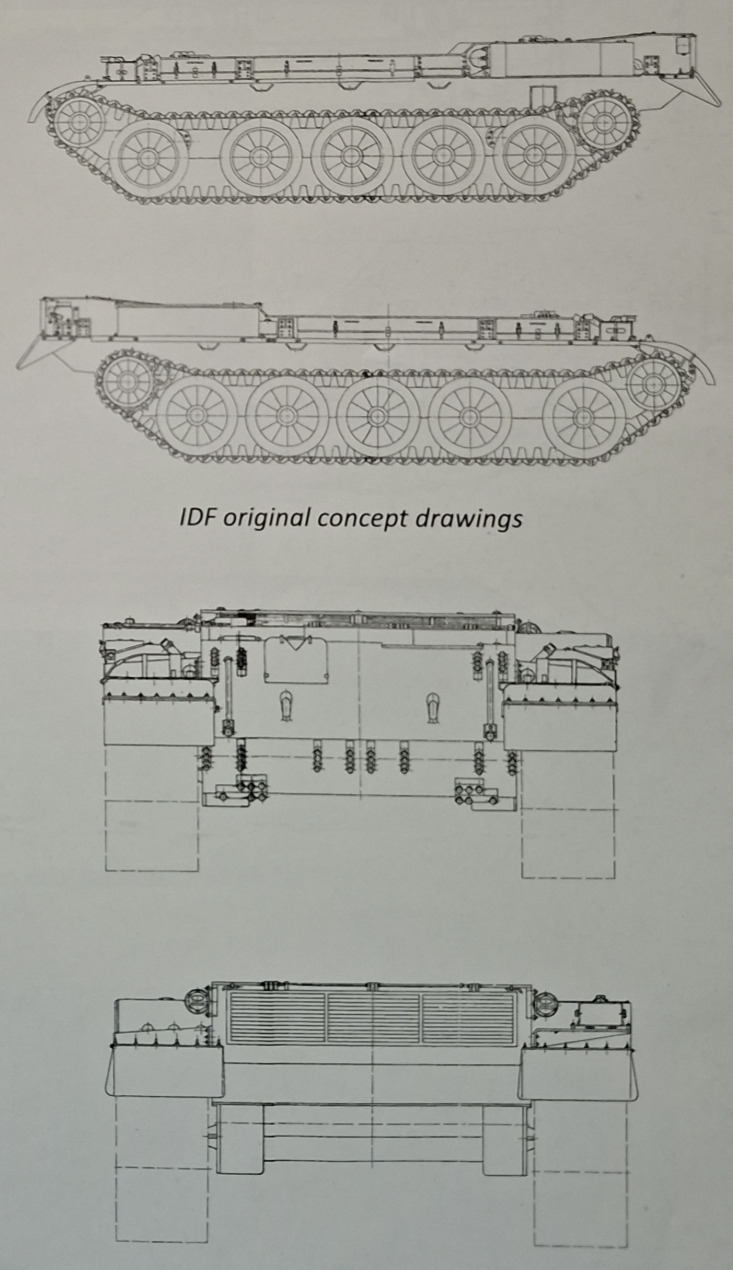
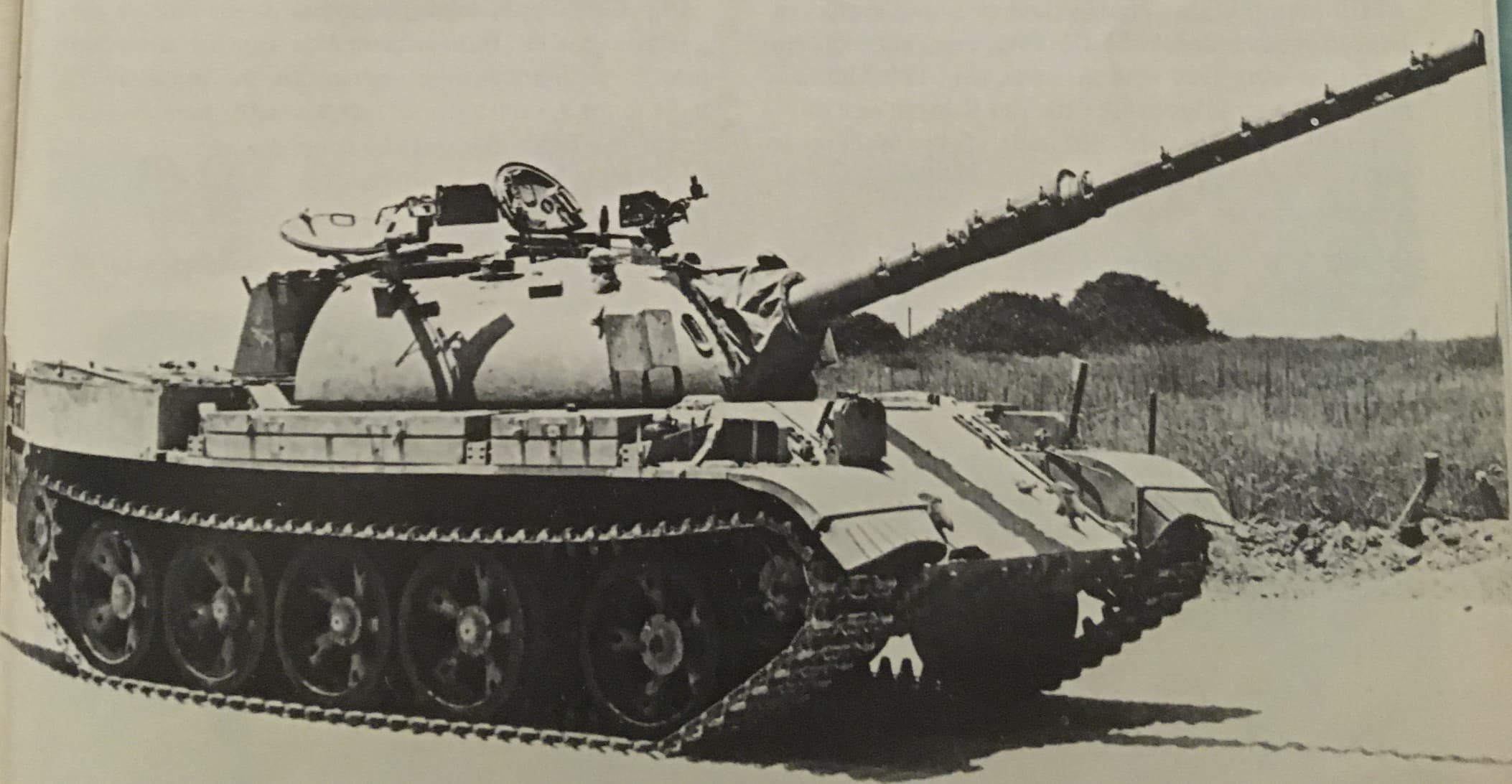
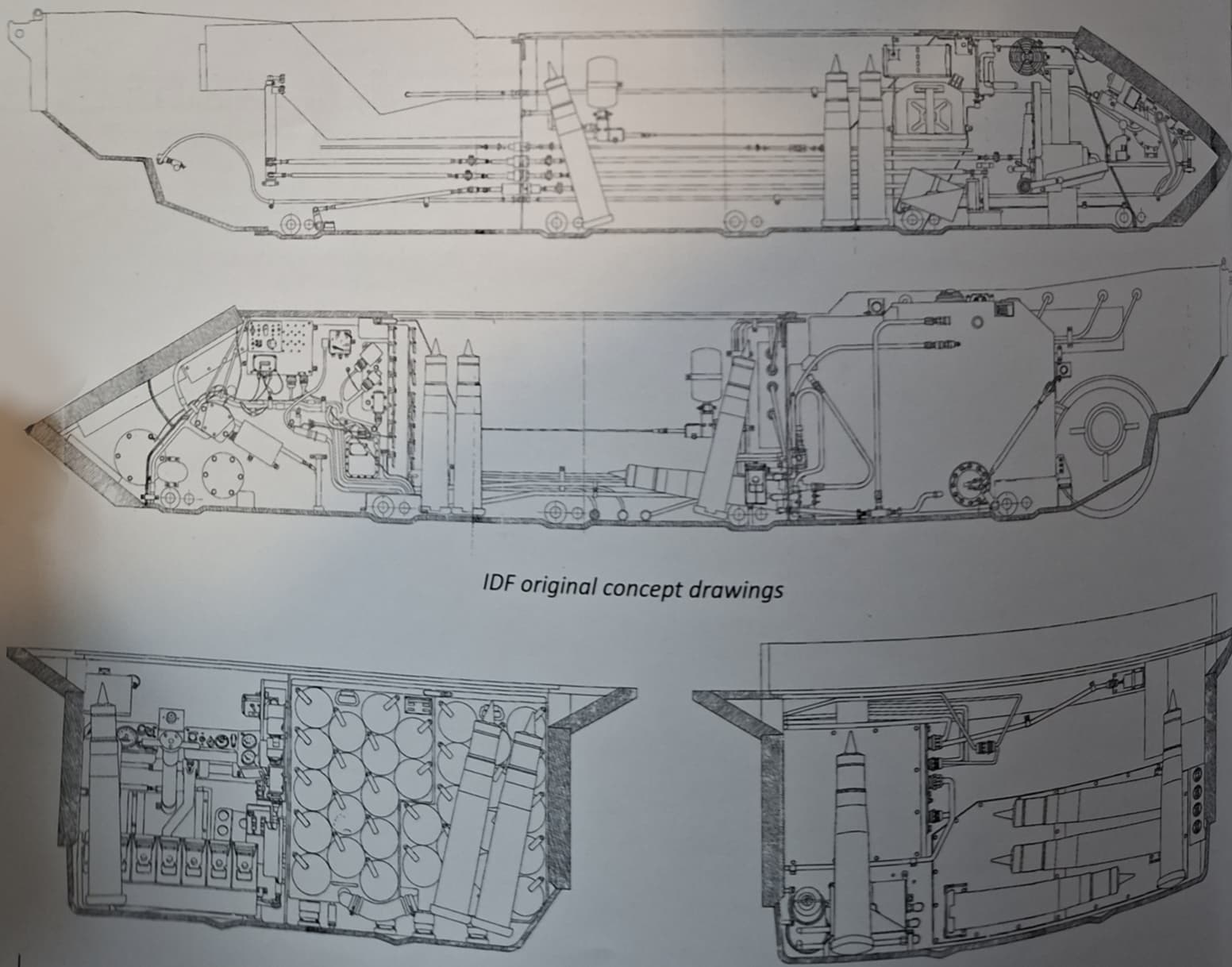
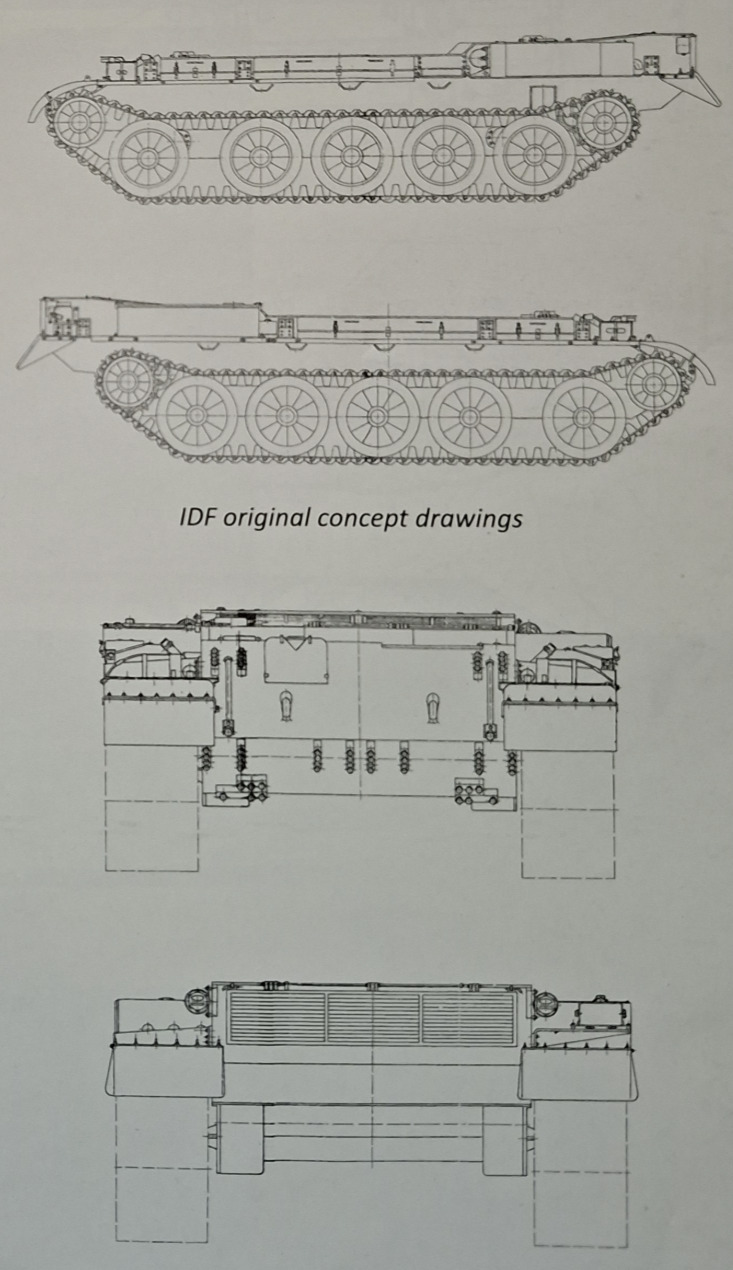
IDF concept drawing of Samovar hull- Part 4: The Prototypes Built During the ‘Samovar’ Project -ㅤThe first Samovar prototype completed its initial test drive in April 1980, followed by proving ground trials in September 1980. This first vehicle was essentially an extensively modified Tiran 5 hull; its turret was added solely for weight testing and lacked internal systems. Notice, for example, the missing gunner’s periscope.
The first Samovar Prototype, year unknown (1980?)ㅤA second prototype followed in April 1982. Once again, the primary focus was the hull, leading the prototype to be dubbed the “Hull Prototype” or “Hull Technology Demonstrator.” It incorporated a more finalized hull design and featured a functional Tiran 5Sh turret. While not the main focus of testing, this turret received a set of upgrades similar to those found on post-1983 in-service Tiran 5Sh/6 modernizations. The turret featured an Israeli-made fire control system, British-made periscopes with image-intensified night vision (NV40 for the Gunner, NV39 for the driver), an integrated laser rangefinder (TL10-T) mounted on the gunner’s telescope, new radios, an additional storage basket at the rear of the turret, pintle-mounted 7.62 mm machine guns for the commander and loader, a 60 mm mortar, a quad-mount for IS-6 smoke dischargers, and 105 mm Sharir cannon with a thermal sleeve. It also retained some of the original T-55 systems such as the turret traverse, and stabilization systems.
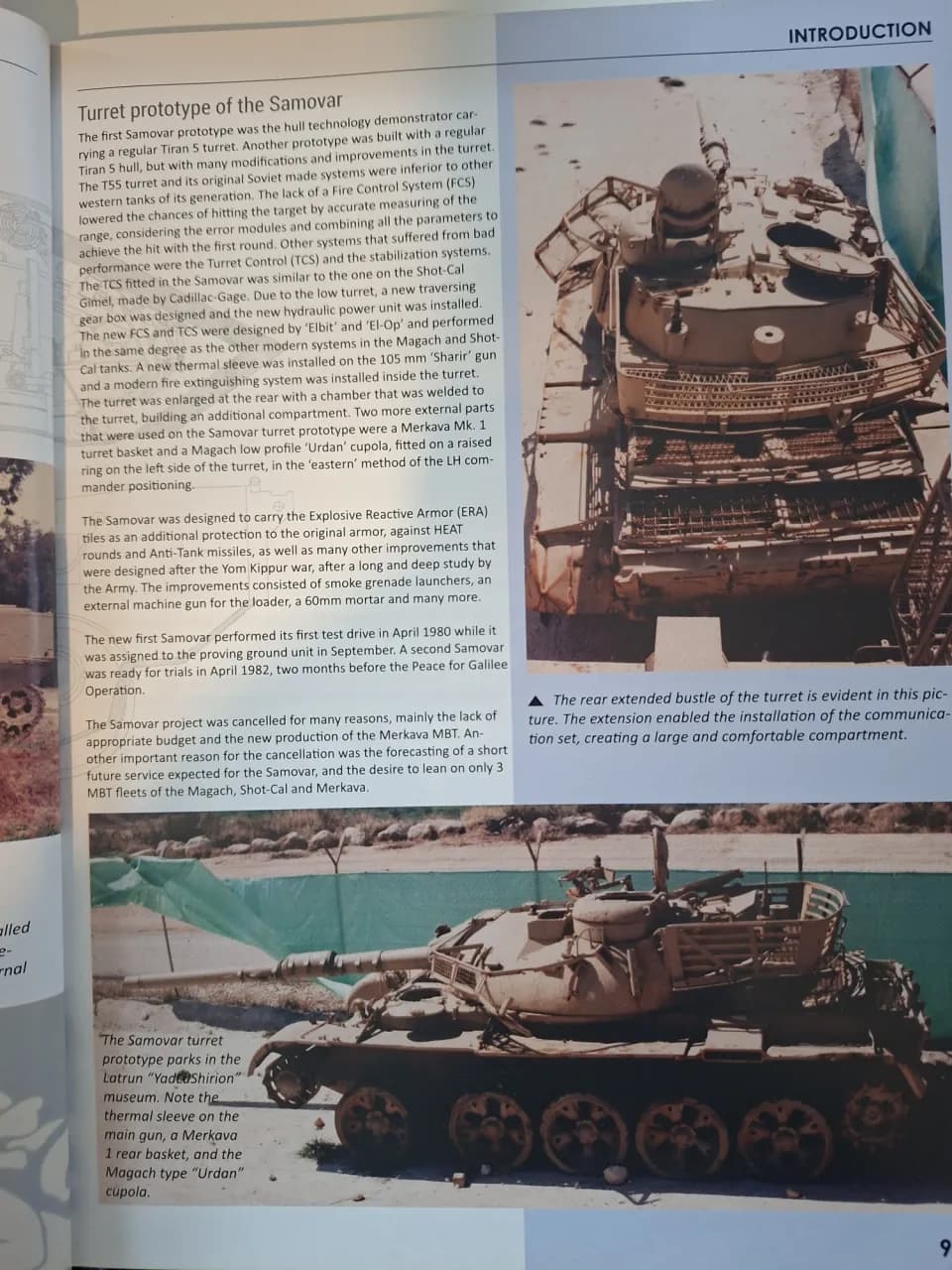
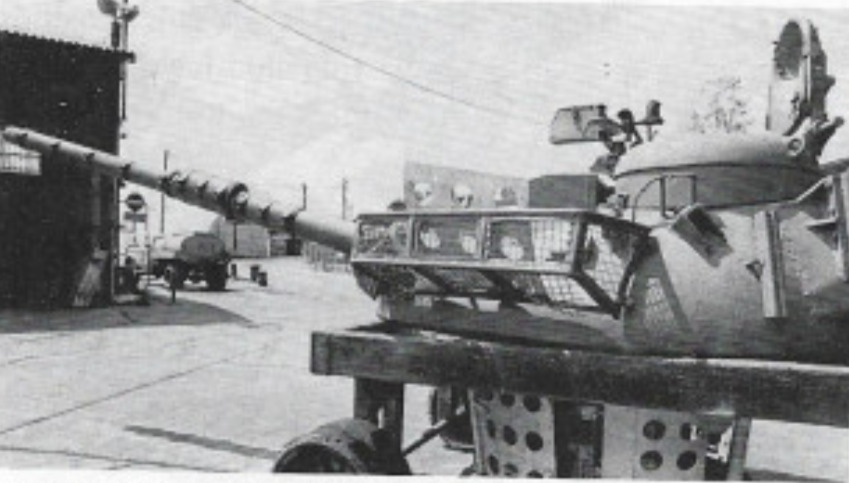
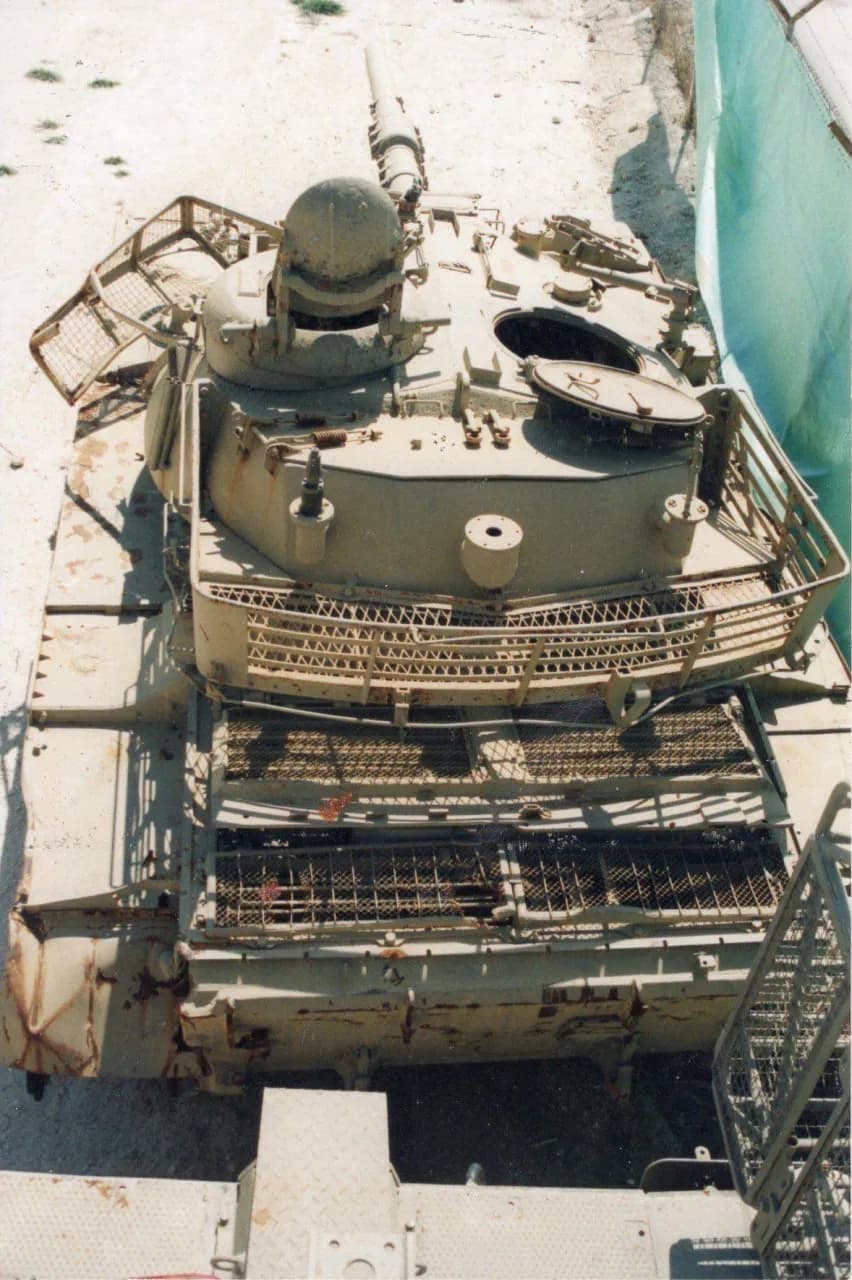
The second Samovar Prototype, dubbed as “Hull Prototype”, year presumably 1983ㅤThese hull prototypes were followed by a turret prototype, or “TP” for short, which conversely used an unmodified Tiran 5 hull but incorporated a highly modernized turret. The new turret featured a US-made Turret Control System (TCS) and stabilization systems by Cadillac-Gage, similar to those on the Shot-Cal Gimel. Due to the low turret profile, a new traversing gearbox was designed and a new hydraulic power unit was installed. The turret also featured a domestically produced BAT-30 FCS with new sights, significantly enhancing first-round hit probability. The new gunner’s sight replaced the original periscope station, providing a far better field of view and magnification, though it relied solely on image-intensified night vision with no thermal imaging. The turret was enlarged at the rear with a welded chamber to house an additional compartment. Two other external additions used on the Samovar turret prototype were a Merkava Mk. 1 turret basket and a low-profile Magach “Urdan” cupola fitted on a raised ring on the left side of the turret, retaining the Eastern style of left-hand commander positioning. Likewise, the turret featured modifications also found on the Hull Prototype, such as pintle-mounted 7.62 mm machine guns for the commander and loader, a 60 mm mortar, a quad-mount for IS-6 smoke dischargers, and a thermal sleeve for the main gun.
The highly modified turret before it was installed on a hull, year presumably 1985- Part 5: Project Cancelation and Fate of The Prototypes -ㅤDespite achieving high professional standards and overcoming major engineering challenges at a low development cost, the Samovar project was ultimately cancelled in the late 1980s. The cancellation was driven by budget constraints, the successful introduction and mass production of the domestic Merkava main battle tank, and a strategic decision to streamline the IDF armor fleet around only three MBT platforms (Magach, Shot-Cal, and Merkava).
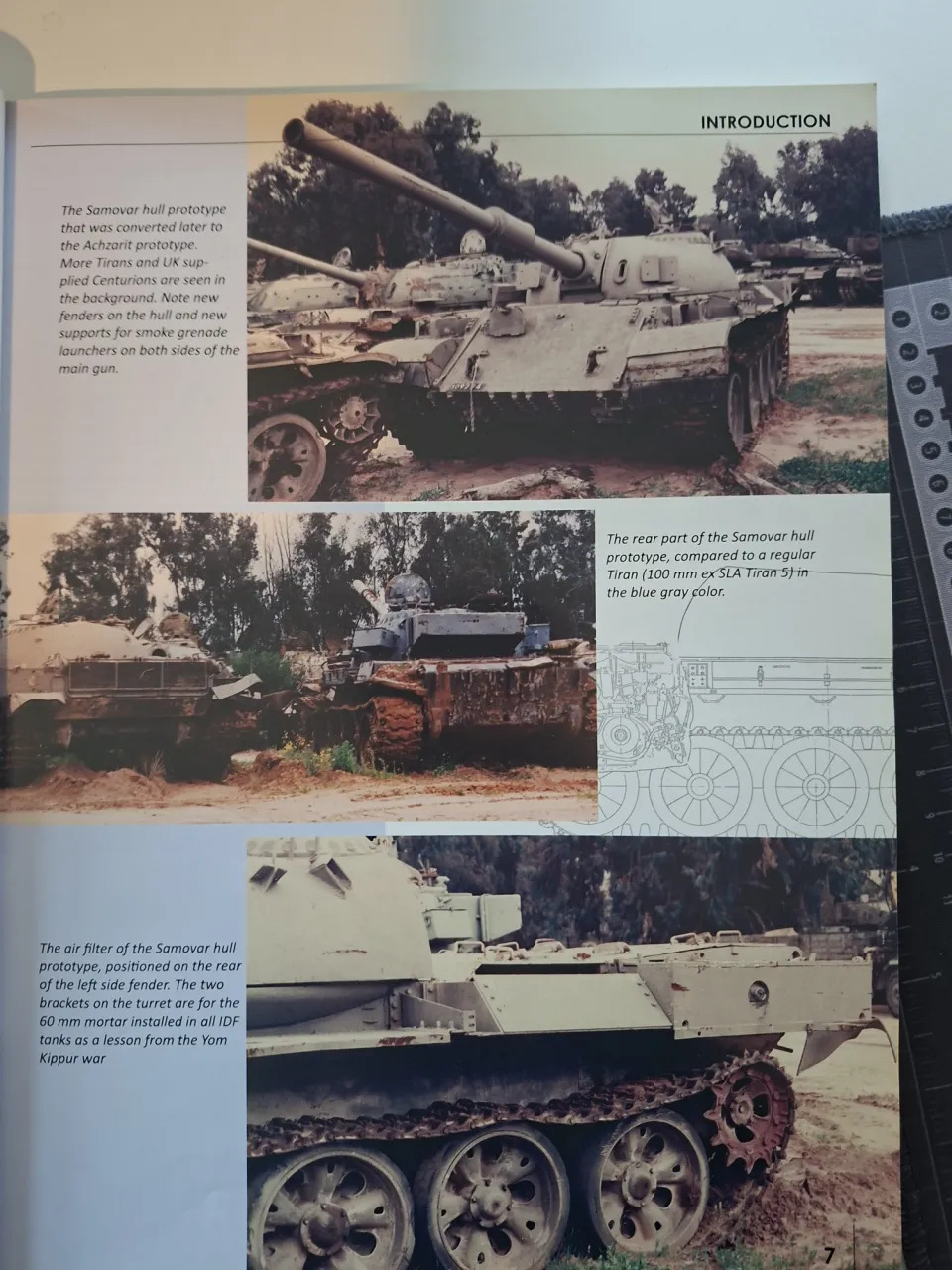
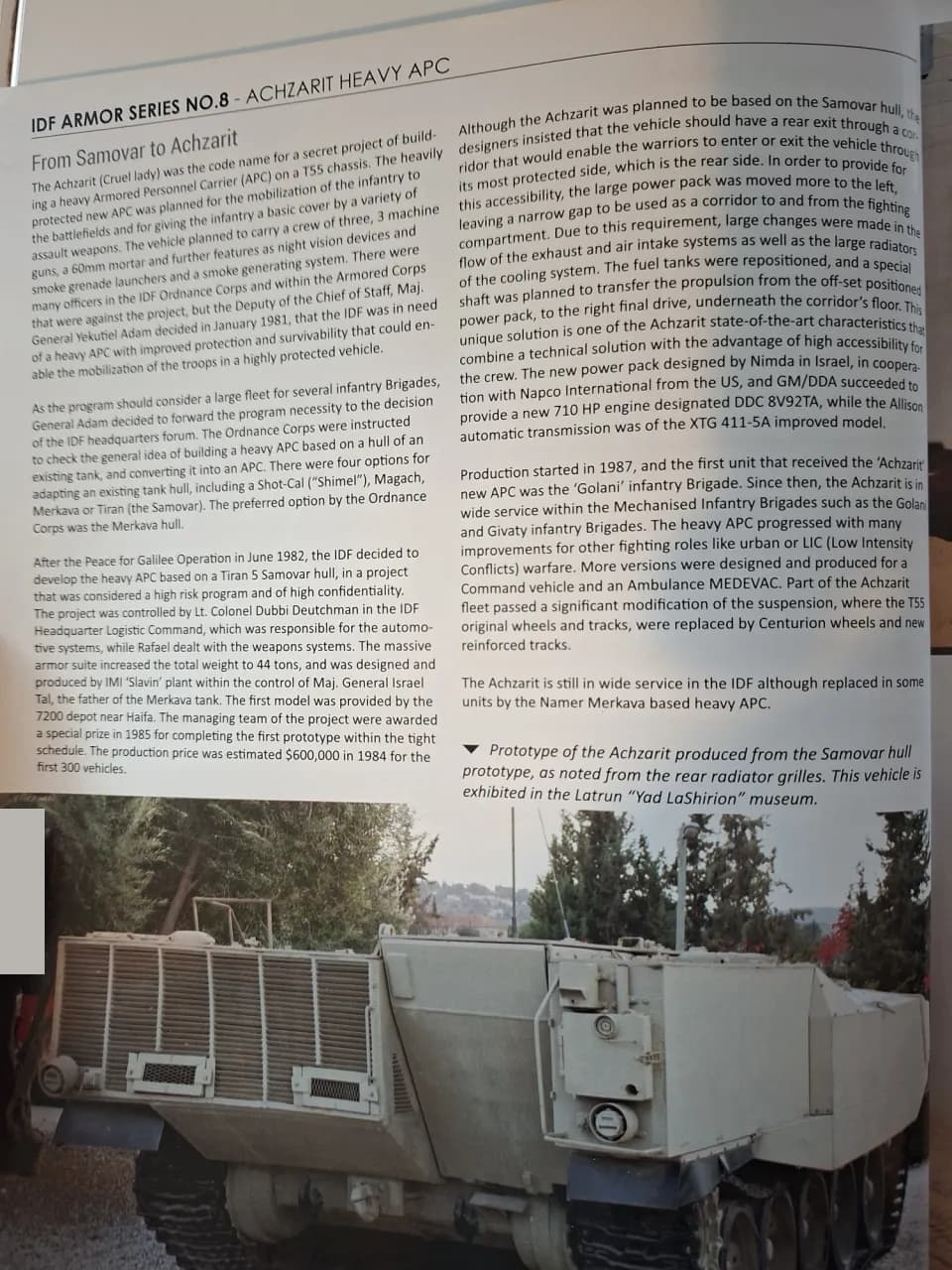
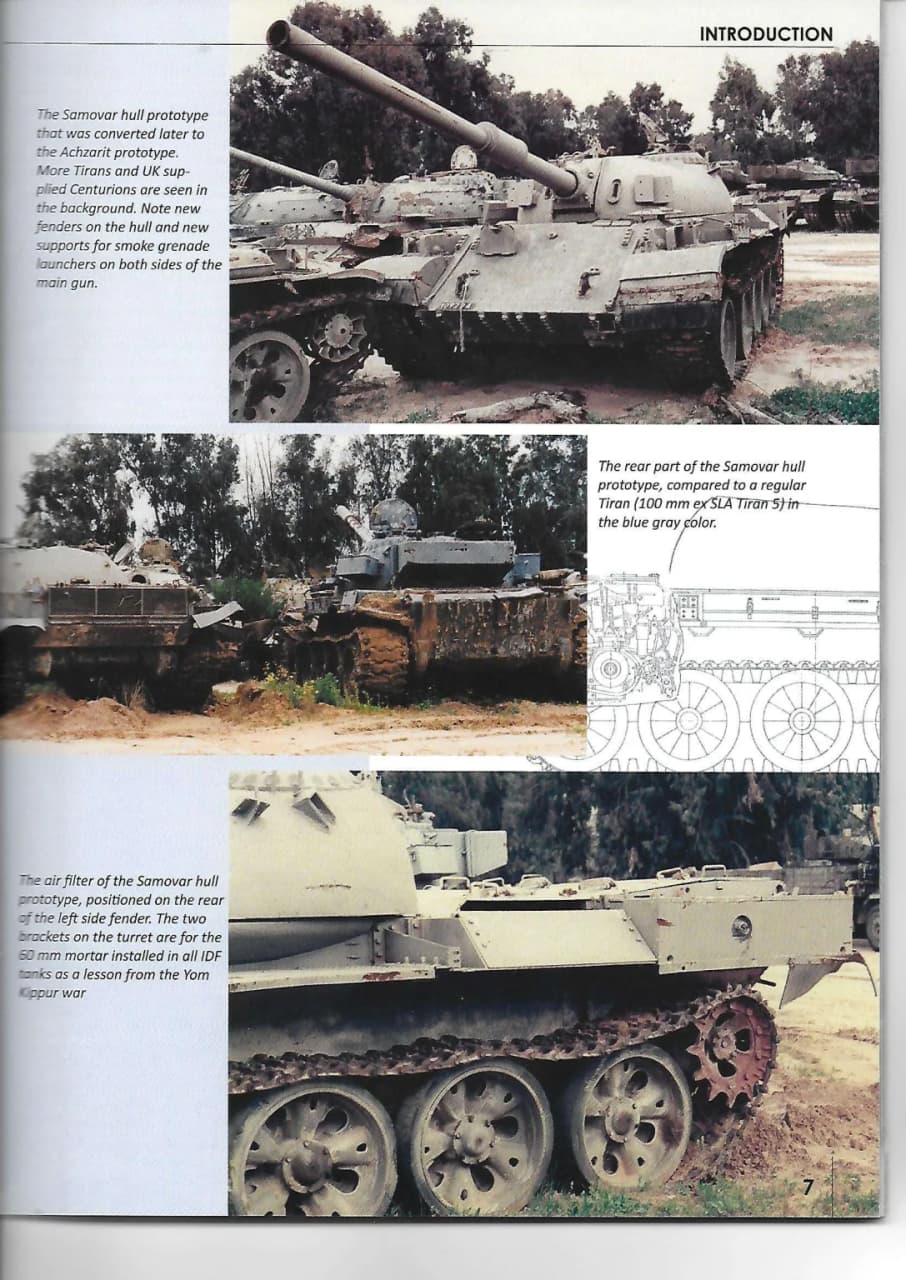
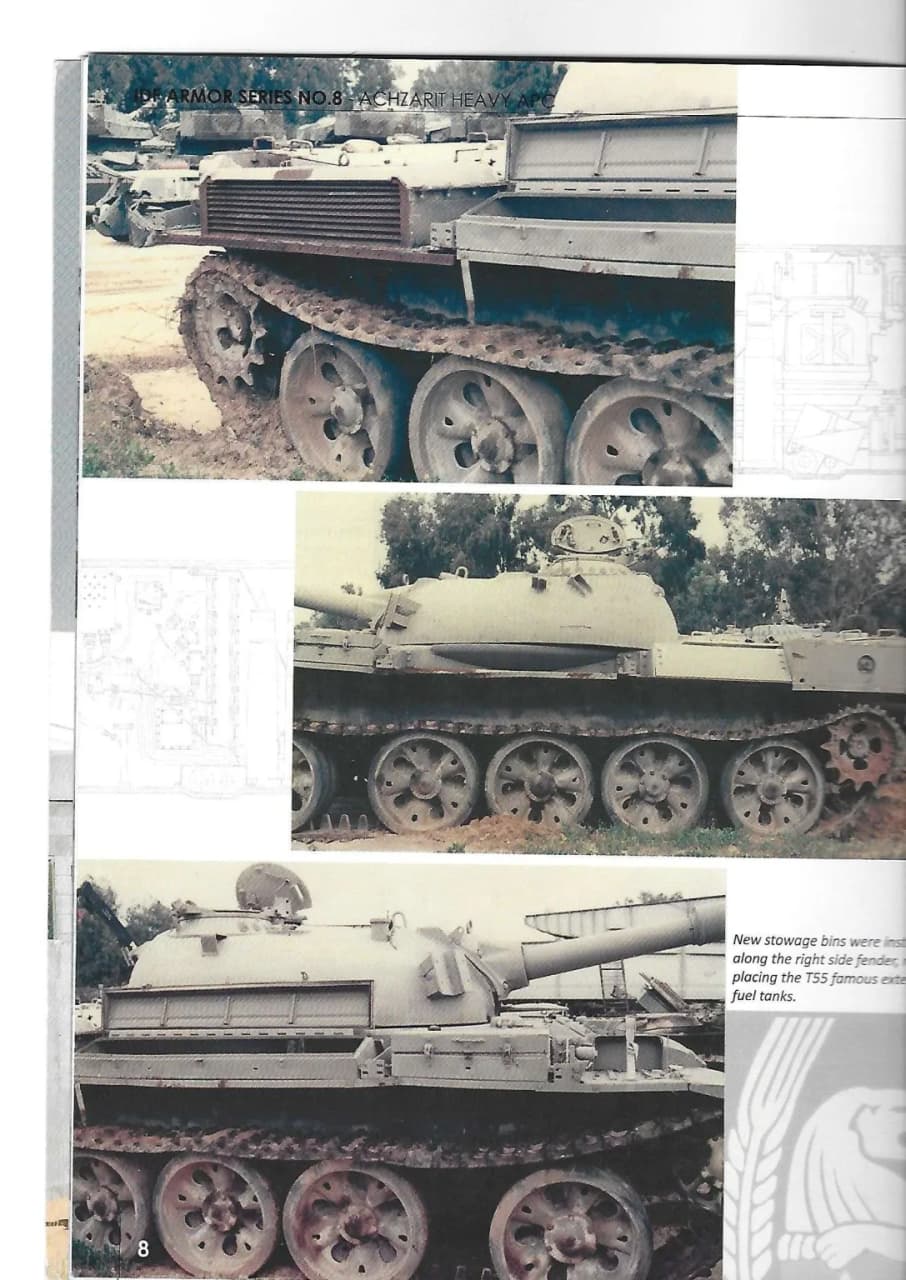
ㅤThe first prototype was sent to the Plugot scrapyard until it was reused to build a prototype for the Achzarit Heavy APC; today, it can be found at the Yad La-Shiryon Museum converted into a completely different vehicle.
The first hull prototype before and after its conversion to Achzarit HAPCㅤThe second prototype was transferred to Nimda, a company that played a major role in the motorization and design efforts in cooperation with the Ordnance Corps. It was notably used by Nimda for promotional material during the 1990s and early 2000s, offering foreign customers everything Samovar had to offer. Although it achieved no commercial success, it interestingly still appears in their product catalog even today.
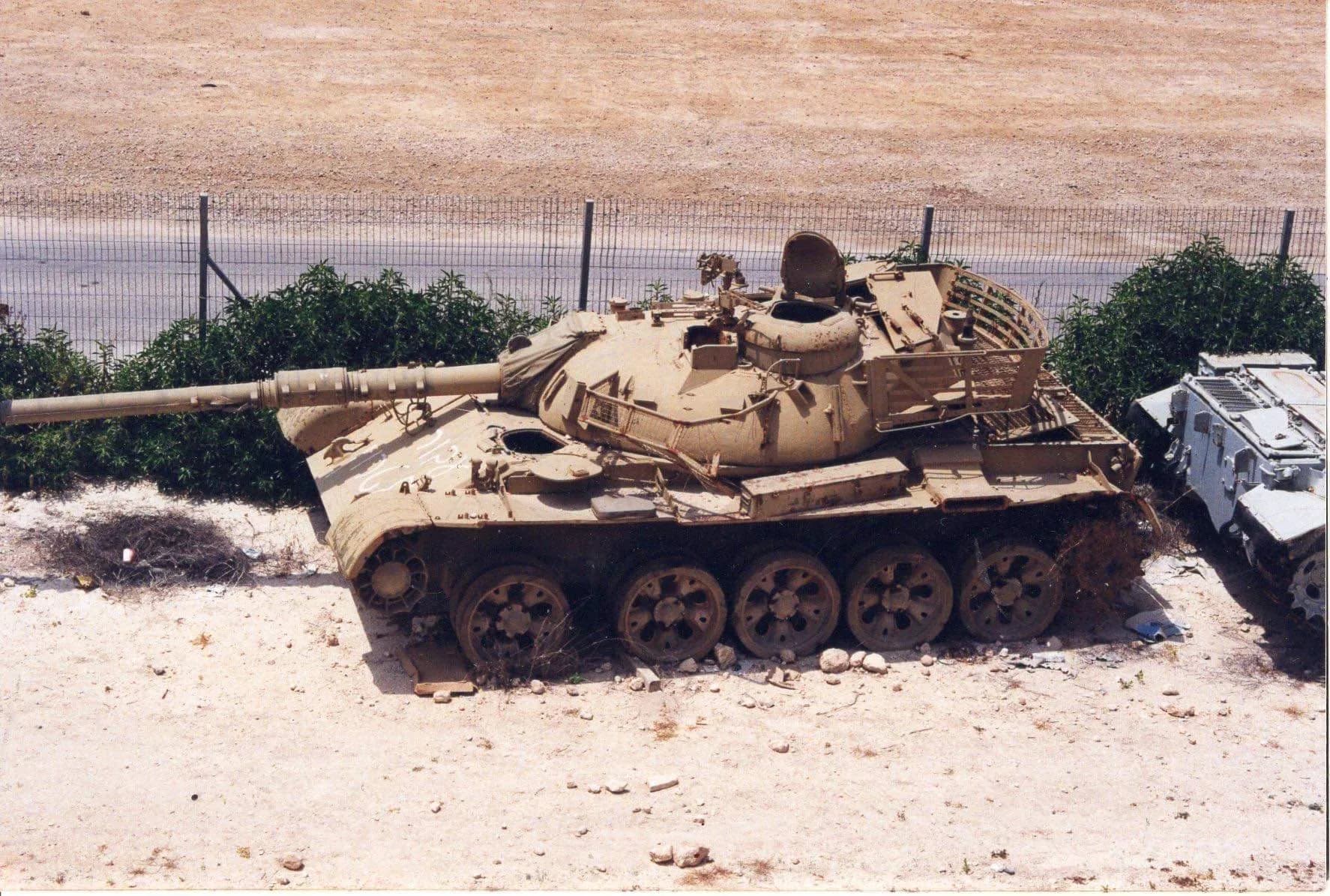
The most recent image of the second hull prototype, presumably at the Nimda facilityㅤThe turret prototype can be found in the Yad La-Shiryon Museum’s storage yard. It is in poor condition, missing major components, and generally broken down. Its poor condition is likely why it is still not on public display, primarily due to a lack of restoration funds.
Samovar turret prototype at Yad La-Shiryon Museum’s storage yardㅤInterestingly, there is another notable prototype vehicle that appeared in footage from as early as 1986–1987. It is unknown whether it was built as part of the Samovar program or as a separate prototype utilizing knowledge gained from Samovar. Overall, it resembles a Tiran 5Sh, but features Baltan (Blazer) reactive armor, a gun thermal sleeve, a new sight that appears similar to the one found on the Samovar TP (though slightly different), and what appears to be LWS (Laser Warning System) sensors installed. It appears to be in the possession of IMI, as it was spotted in several pictures taken at their facility.
Unknown prototype, at IMI facility
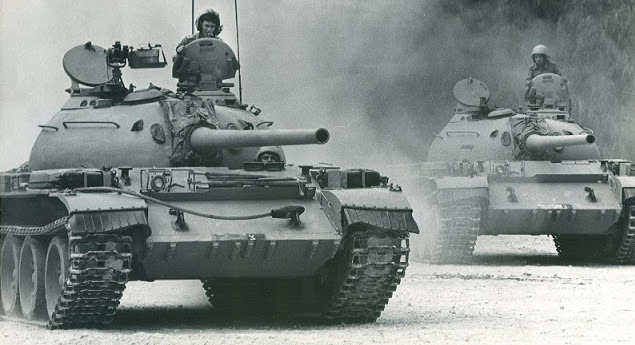



TL;DR: Key features of Samovar Hull Prototype
- Hull
- Detroit Diesel 8V71T engine rated at 609 hp
- Allison XTG-411-4 automatic transmission (4 forward gears and 2 reverse gears)
- Redesigned engine compartment incorporating large louvers and a raised deck, giving it a distinctive “NATO hump”
- NV39 periscope for the driver with image-intensified night vision
- Other: a new water-cooling system, Donaldson air filters, new steering controls, modified final drives, reworked fuel tanks, and updated torsion bars.
- Retained features from T-55: reliable suspension, low silhouette, and excellent passive armor structure
- Turret
- Fire Control System (according to different sources that might be either: FCS-3000 or Lancelot)
- Integrated laser rangefinder mounted on the gunner’s telescope
- NV40 periscope for the gunner with image-intensified night vision
- Main Armament: 105 mm ‘Sharir’ cannon
- Secondary Armament: 7.62 mm coaxial, 2x pintle-mounted 7.62 mm (for commander, reloader)
- Smoke Charges: a 60 mm mortar, and a quad-mount for IS-6 smoke dischargers (each carries 6 smoke grenades, meaning a total of: 24 charges)
- Other: new radios, and an extra storage basket on the rear of the turret
- Retained features from T-55: Turret traverse, gun elevation and stabilization systems.
Spoiler
Armament:ㅤThe main armament of the Samovar HP is the standard 105 mm Sharir cannon used by Israel at the time, which is a license-built M68 (L7A1 derivative). Secondary armament consists of a coaxial 7.62 mm machine gun and additional pintle-mounted 7.62 mm machine guns for the commander and loader. The machine gun types used are either .30 cal (M1919) or FN MAG 60-40.
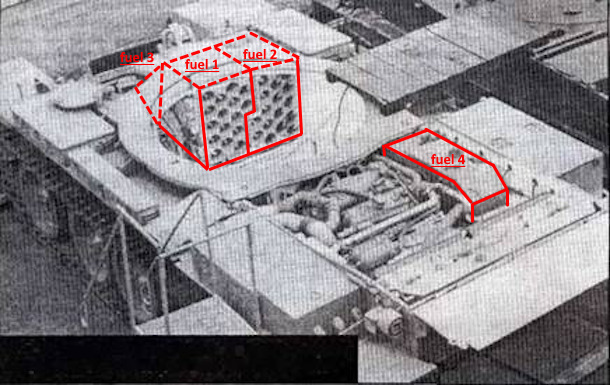
Ammo Stowage:ㅤThe ammunition stowage underwent a complete reconfiguration compared to the original T-55, primarily due to the new 105 mm caliber and the introduction of a new fuel system. This system replaced the combination of external and internal fuel tanks with four enlarged internal tanks (including two designed to combine ammunition storage with diesel fuel cells).
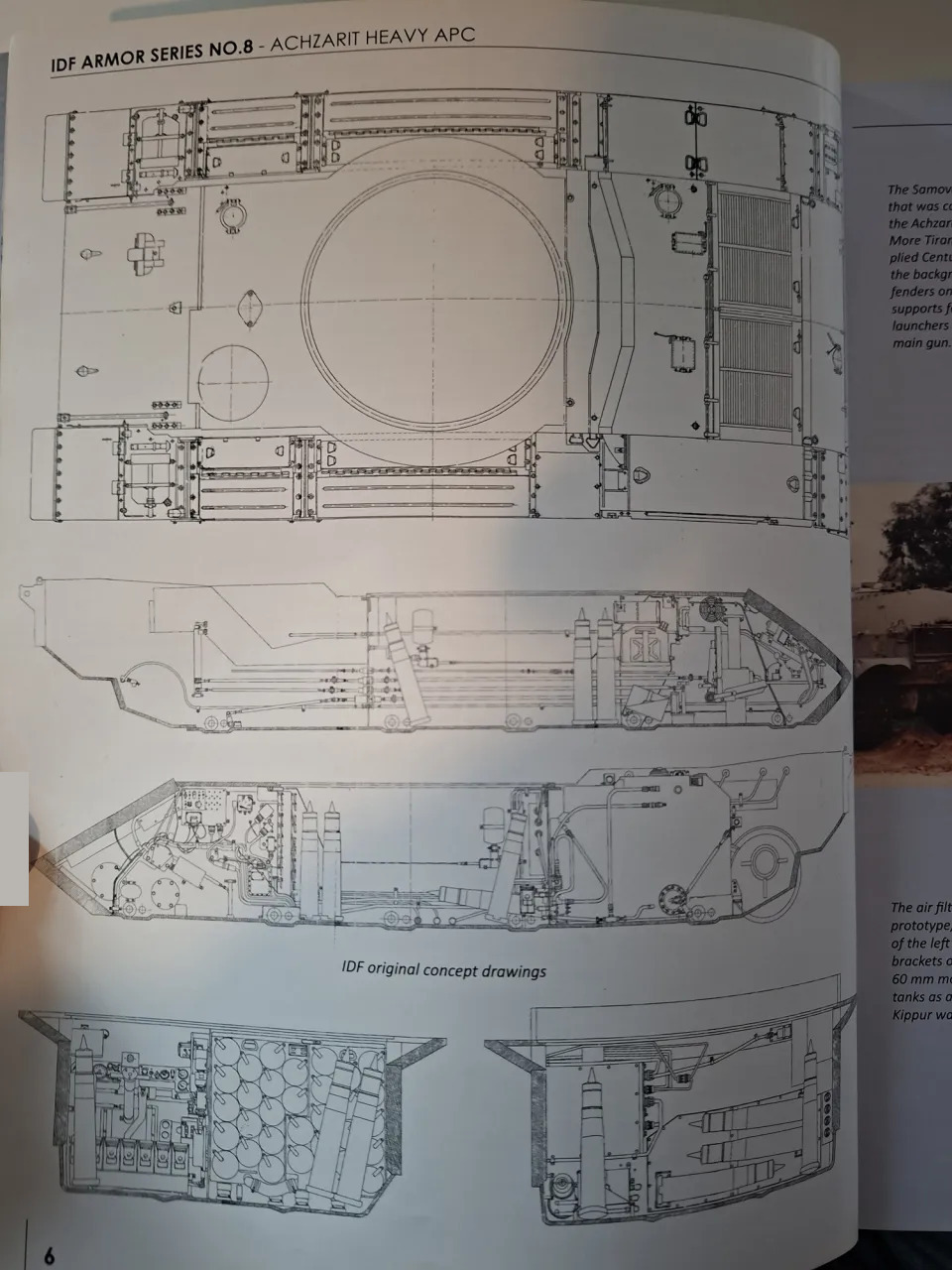
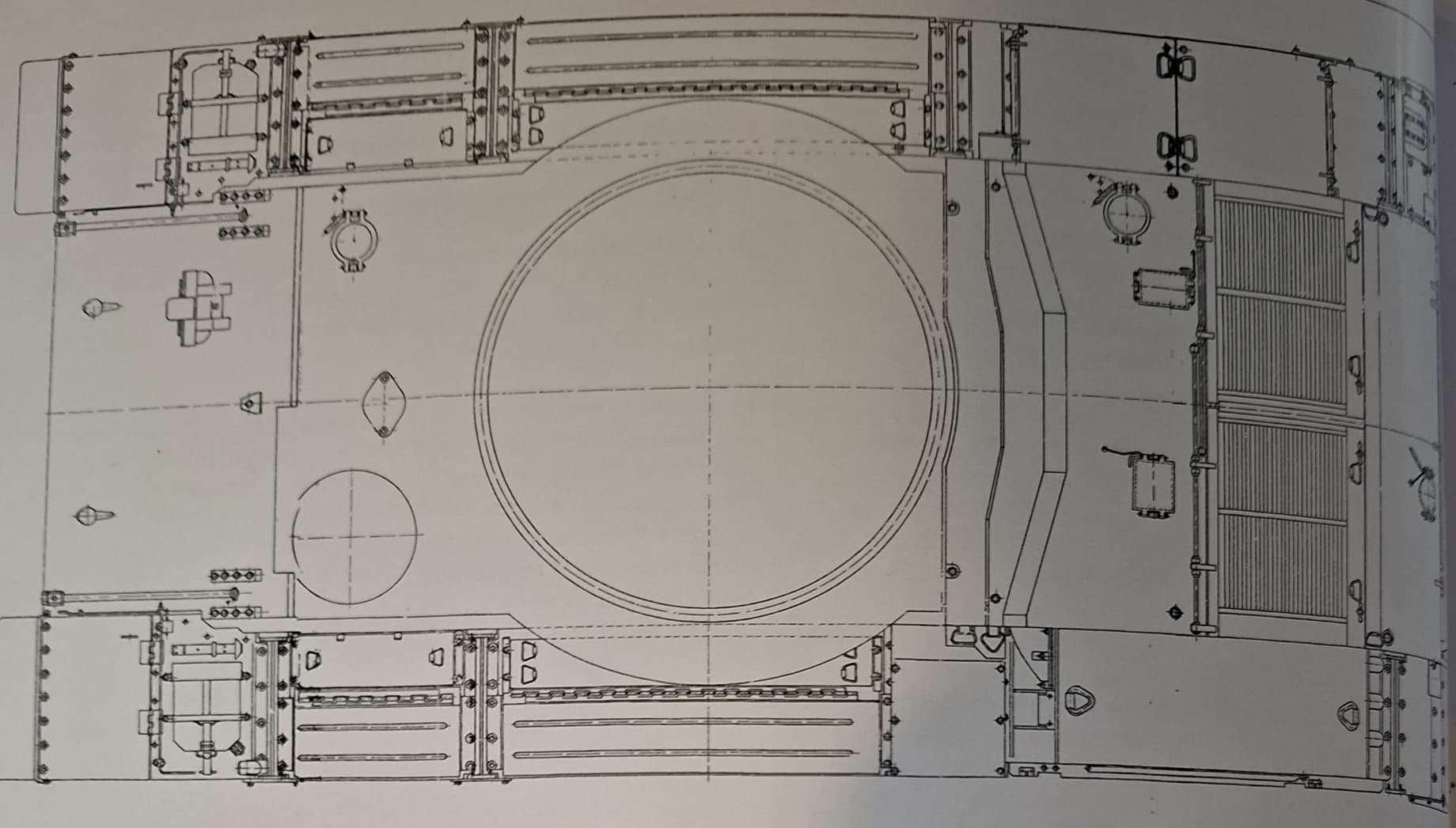
ㅤThanks to IDF concept drawings, as well as photos of the tank without its turret, we can accurately determine the stowage layout. The two ammo racks within the fuel tanks are placed at the front, right next to the driver. Each of these fuel tanks can house 16 rounds, accounting for 32 rounds of ammunition. Additionally, there are 10 ready-rack rounds arranged vertically and horizontally around the turret ring in the hull. As for the turret itself, it is unknown whether it retained the original T-55 turret ready rack; if it did, that would add an additional 6 rounds.ㅤWith that in mind, the total 105 mm ammunition stowage on the Samovar HP would be:
- Without turret ammunition:
- Total ammo: 42 rounds
- Ready rack: 10 rounds
- If turret ammunition is retained:
- Total ammo: 48 rounds
- Ready rack: 16 rounds
ㅤAs for the 7.62 mm ammunition stowage: Jane’s specifications for the Samovar state that it carries a total of 3,500 rounds, though this figure should be taken with a grain of salt. Based on concept drawings, we know that the hull housed 7 ammunition canisters for 7.62 mm rounds. Since each canister typically holds 200 rounds, this accounts for 1,400 rounds, plus an additional 600 rounds pre-loaded into the three machine guns (200 rounds each). There is likely more 7.62 mm ammunition stored in the turret, but further information is required to confirm the exact amount.
IDF concept drawing of Samovar hull
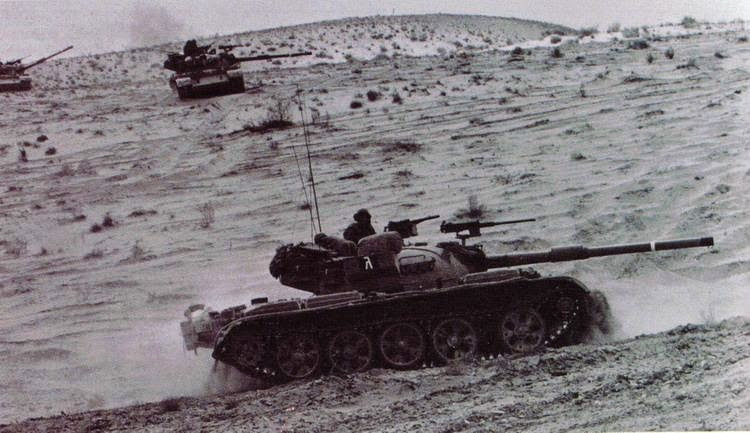
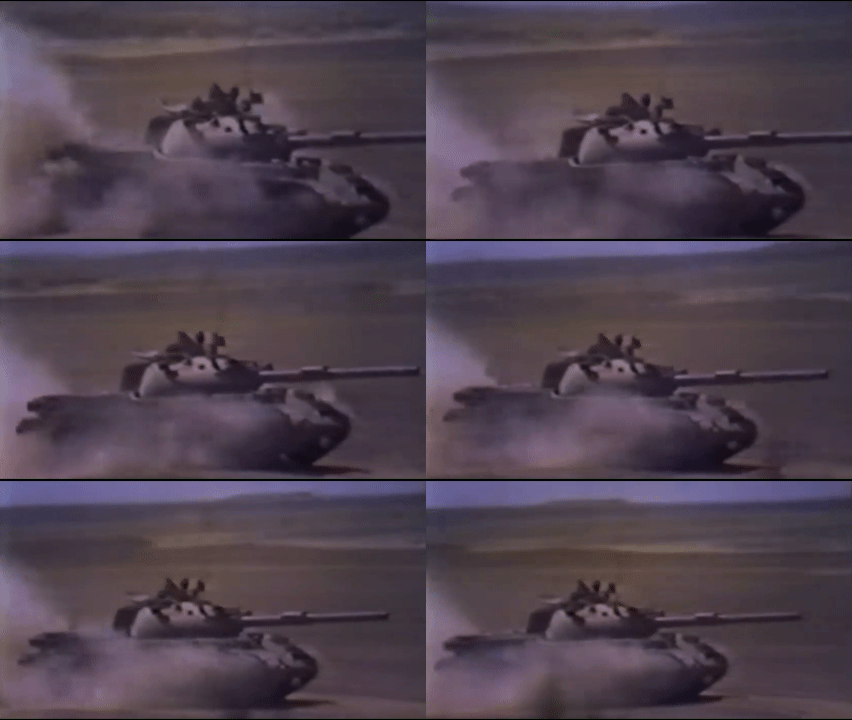
Samovar HP without turret, fuel tank ammo layout can be seenStabilization and Traverse Mechanisms:ㅤNotably, the Samovar Hull Prototype retains the original turret traverse and stabilization systems found on the base T-55. The turret can traverse 360° at a speed of ~15°/s, with elevation limits of -5°/+18° (though when facing backward, gun depression is even more restricted due to the raised engine deck) and a vertical speed of ~5.5°/s. The stabilization system is the STP-2 “Tsyklon” two-plane stabilizer, which remains reliable at cross-country speeds up to 25 km/h, though accuracy degrades significantly over severe bumps or rough terrain.
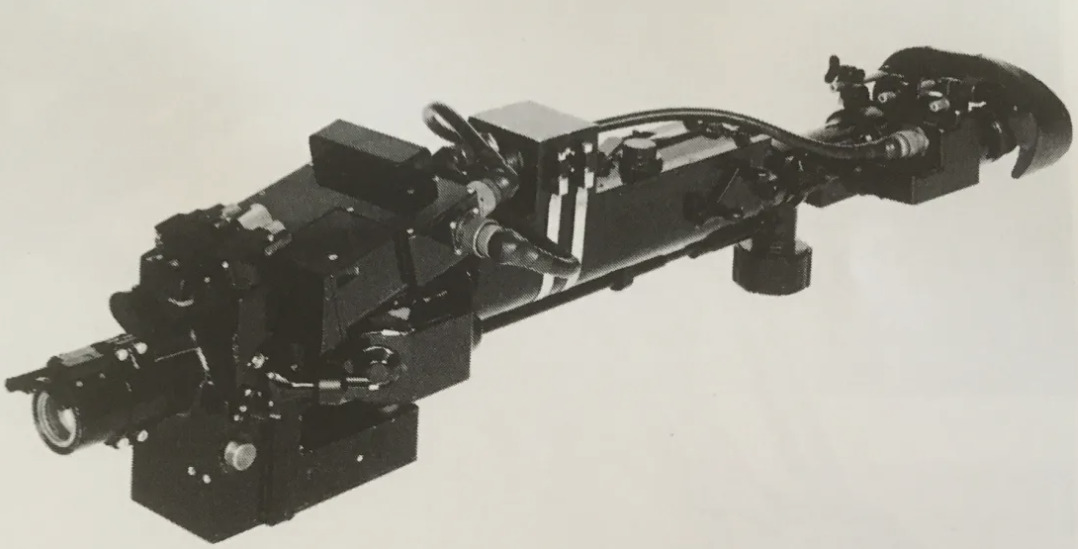
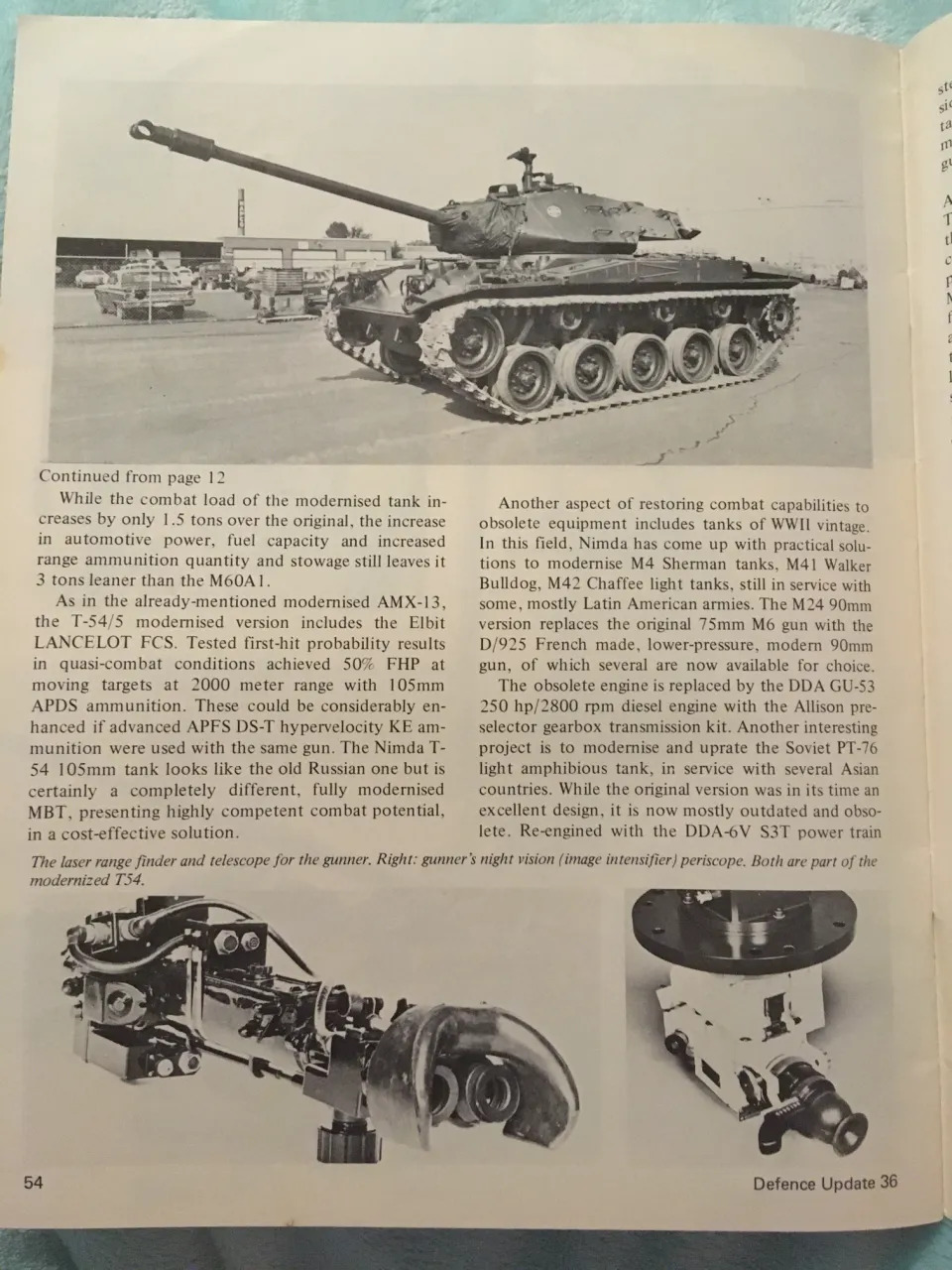
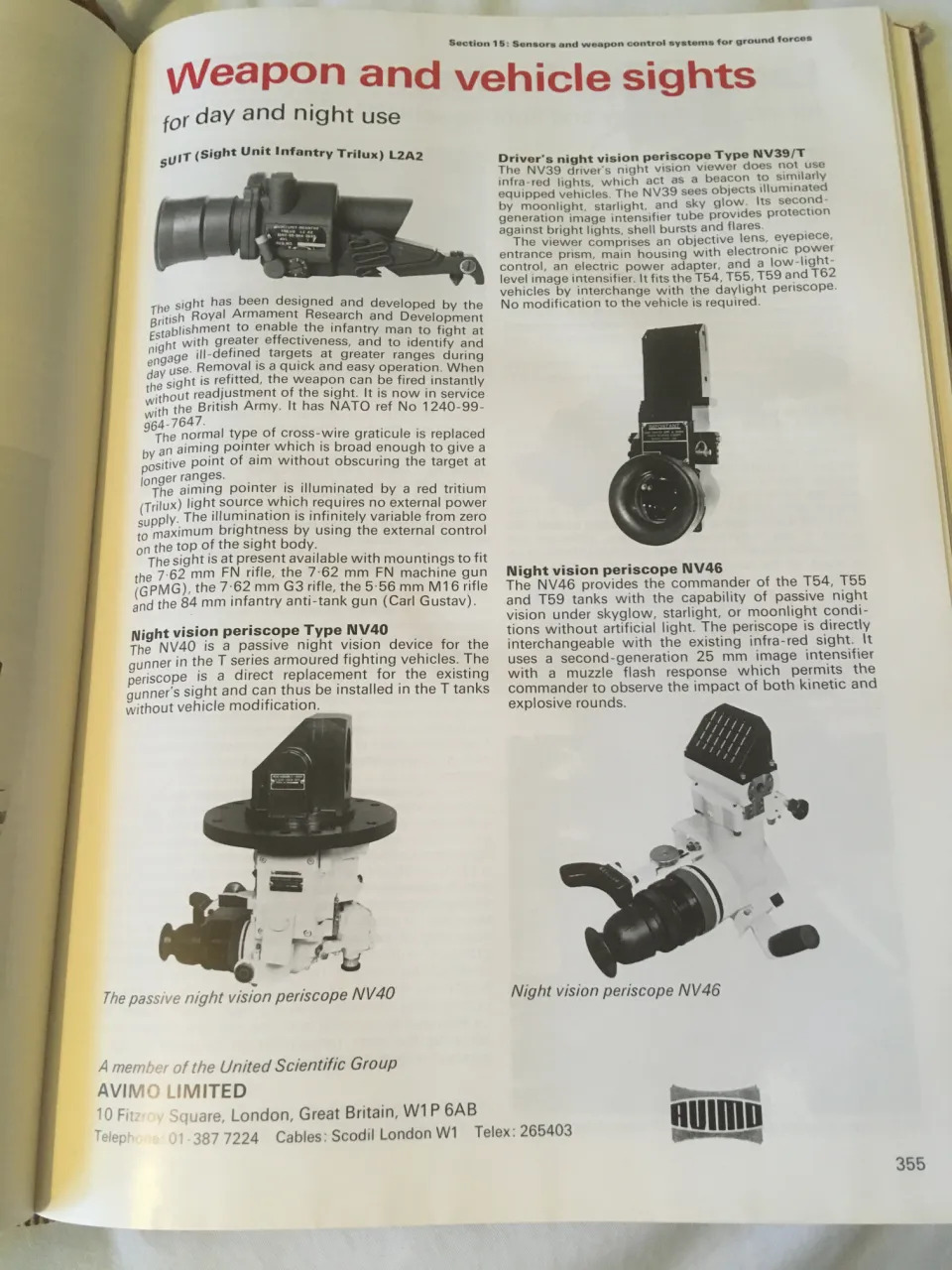
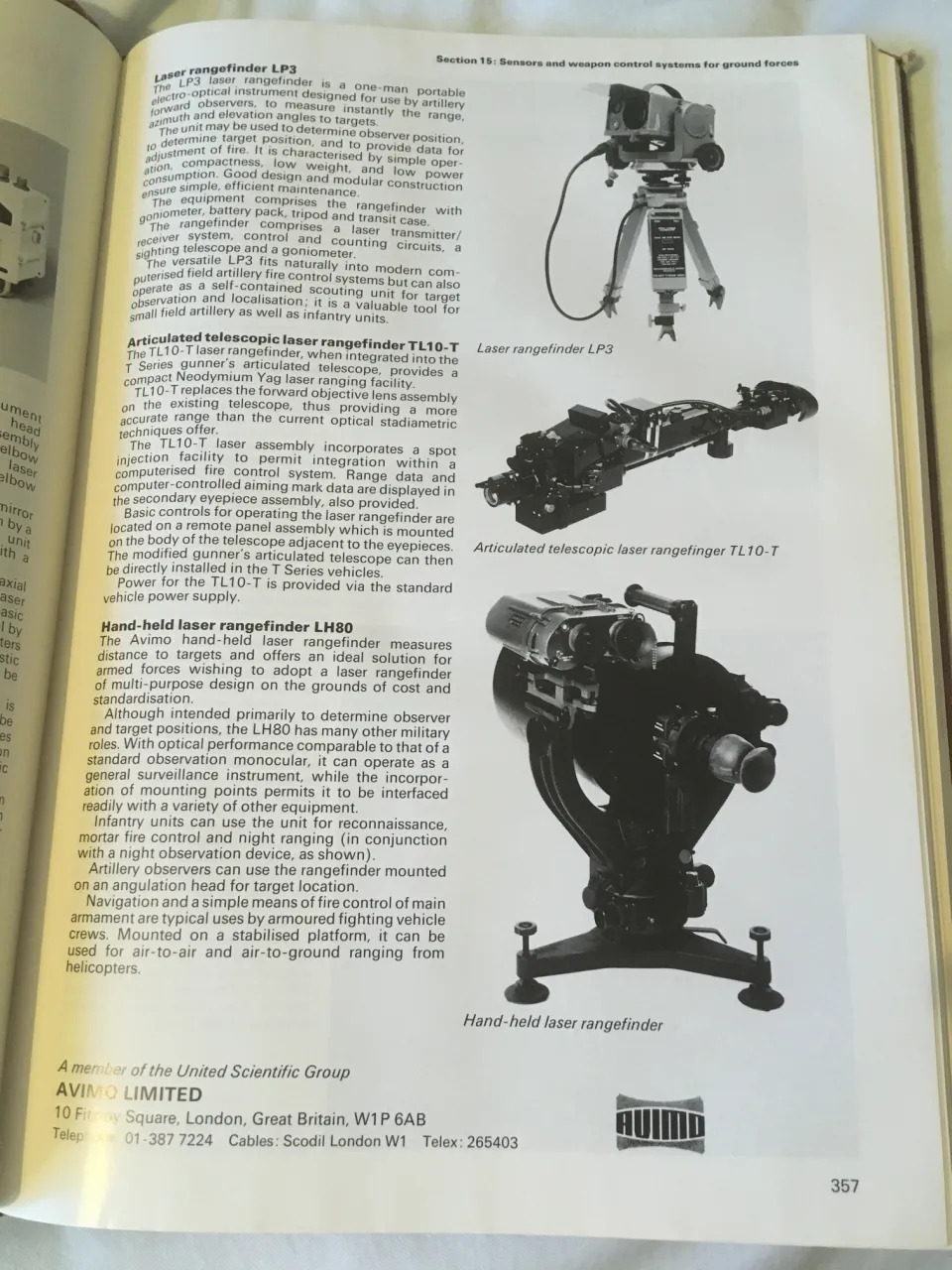
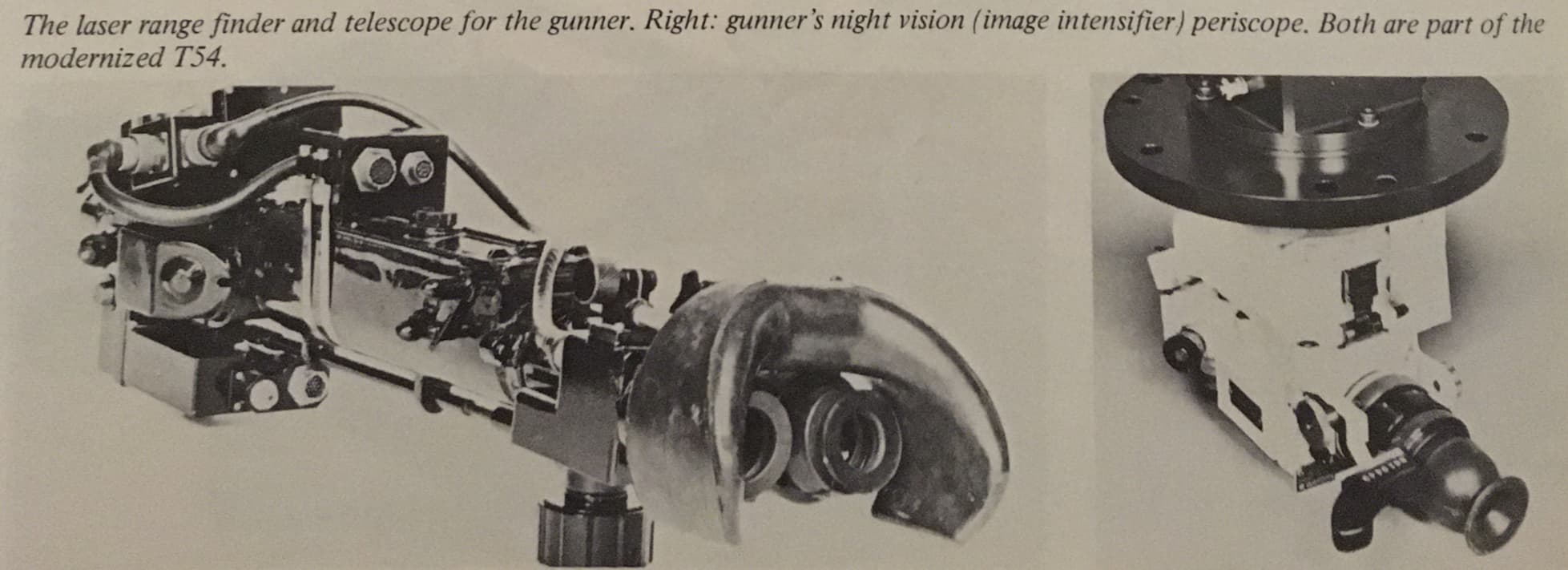
Samovar HP in motion; stabilization system demonstratedFire Control System and Sights:ㅤThe Samovar features a fire control system, though the exact designation varies depending on the source, being listed either as the FCS-3000/FCS-30 from Astronautics or the Lancelot/Lan-Sadot from El-Op. The Samovar’s FCS is paired with upgraded periscopes and a telescope produced by the British company Avimo. The optics suite consists of a TL10-T integrated laser rangefinder built into the original T-55 telescope, an NV40 passive periscope for the gunner, and an NV39 passive periscope for the driver. Both periscopes feature second-generation image-intensified night vision, eliminating the need for the infrared searchlight found on the original Soviet T-55. None of these optical modules required structural modifications to the turret; for instance, the NV40 fits directly into the mounting space of the original TPN-1-41-11 periscope.
- NV40 gunner periscope, specifications:
- Field of view: 7.3°
- Magnification: x7.1
- Maximum detection rage of tank-sized target:
- In Moonlight conditions: 2700 m
- In Starlight conditions: 1300 m
NV40 periscope
- TSh2B-32P articulated telescopic sight, specifications:
- Low power: 3.5× magnification (offering a wider 18° field of view).
- High power: 7× magnification (offering a narrower 9° field of view)
- Laser Rangefinder: TL10-T (Nd-YAG laser)
TSh2B-32P with TL10-T laser rangefinder
105 mm Ammunition Types:ㅤAll of the Israeli 105 mm ammunition types used by the Samovar are already present in War Thunder, so they are listed below without specifications:
- M111 “Hetz” APFSDS
- M152 HEATFS
- M156 HESH
- M416 Smoke Shell
Spoiler
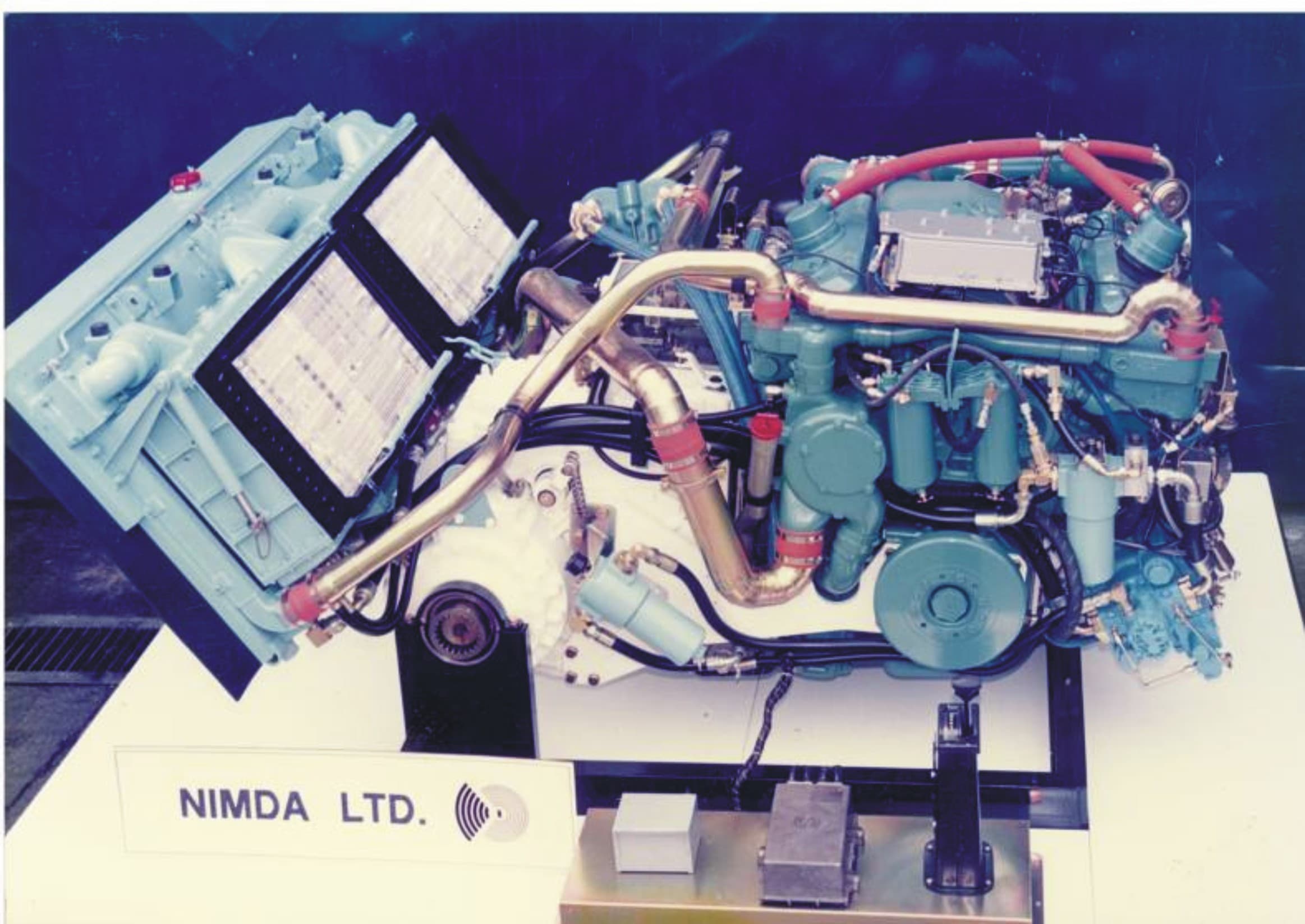
ㅤThe automotive part was the main focus of the Samovar HP. The engine compartment had to be drastically redesigned because no Western engine could fit inside the tight space of the original T-55 hull. IDF engineers enlarged the engine bay by cutting into the rear section, raising the engine deck, and moving the cooling system behind the engine instead of keeping it directly above it.
The powerpack used on Samovar HPEngine & Transmission:ㅤThe new powerpack features an 8-cylinder Detroit Diesel 8V71T engine, which was already widely used in the IDF on M107, M109, and M110 self-propelled guns. In its stock form, the engine produced only 500 hp, making the heavy tank severely underpowered. To fix this, engineers squeezed every bit of power out of it, uprating it to 609 hp @ 2500 RPM with minor modifications. The engine was paired with an automatic Allison XTG-411-4 transmission with a torque converter, giving it smooth gear shifts across 4 forward and 2 reverse gears.
Engine compartment exposedCooling System, Air Filters & Final Drives:ㅤBecause of the extra horsepower, engineers had to build a larger water-cooling system with prominent louvers at the rear of the tank. The air intake was upgraded to a much more powerful Donaldson air filter system housed inside an armored box. It delivers a high air volume (800 m³/h), handles desert dust much better, and only needs compressed air cleaning every 50 hours (compared to every 25 hours on the original Soviet setup). Lastly, the old two-piece final drive was replaced with a custom single-unit design that unbolts right along with the engine. This brought engine replacement times down from 14–18 hours to just 30 minutes.
Distinctive large louvers (used for cooling and exhaust)Dimensions and Weight:ㅤThe dimensions of the Samovar are mostly identical to the baseline T-55 with a few small changes. The length with the gun forward is slightly different because the 105 mm Sharir barrel is 5.34 m long (compared to 5.35 m for the Soviet D-10T2S). The torsion bars and road wheels were also raised by a few centimeters to make the ride a bit more comfortable for the crew. Due to the new Western powerpack, total combat weight increased by 1.5 tonnes.
- Length (gun forward): 8.99 m
- Hull length: 6.46 m
- Width: 3.27 m
- Height (to turret roof): 2.40 m (slightly higher)
- Ground clearance: 0.43 m (slightly higher)
- Combat weight: 37,500 kg
Performance:ㅤAlthough there are no official specifications for the re-engined Samovar’s performance figures, we can calculate its theoretical performance using its known engineering parameters:
(Big thanks to Henry! for helping me with that)
- Known Parameters:
- Engine Output: 609 hp @ 2500 RPM
- Torque Output: 1,200 lb-ft @ 1600 RPM
- Track Width: 580 mm
- Vehicle Width: 3.27 m
- Gross Vehicle Weight: 37,500 kg
- Calculated Parameters:
- Power-to-Weight Ratio: 16.24 hp/t
- Track Contact Area: 44,544 cm²
- Nominal Ground Pressure: 0.84 kg/cm²
- Peak Theoretical Acceleration: ~2.3 m/s² (0.23 g)
- 0 - 32 km/h (0 - 20 mph) Time: 9.5 to 11.0 seconds (Estimated)
- Top Speed (Mechanical): 55 - 60 km/h
- Max Climbing Gradient: ~60% (31°)
ㅤ (Theoretically, the engine could push the tank up to 71 km/h, but the stock T-55 tracks and suspension would physically fall apart at those speeds, and the engine would redline)
ㅤUsing these numbers with the known gear ratios of the XTG-411-4 transmission, we get the following top speeds per gear:
- Gear / Ratio & Top Speed:
- 1st Gear (4.69 : 1): 9.3 – 10.2 km/h
- 2nd Gear (3.18 : 1): 13.7 – 15.0 km/h
- 3rd Gear (1.59 : 1): 27.5 – 30.0 km/h
- 4th Gear (Top) (0.794 : 1): 55.0 – 60.0 km/h
- Reverse 1 (5.60 : 1): 7.8 – 8.5 km/h
- Reverse 2 (3.79 : 1): 11.5 – 12.6 km/h
ㅤThe Samovar HP is a comprehensive upgrade over the baseline T-55. While maintaining roughly equal performance in gradient climbing and acceleration, it offers significantly higher top speeds both forward and in reverse (for reference, the stock T-55 reaches a top speed of 50 km/h forward and only 7–8 km/h in reverse).
Spoiler
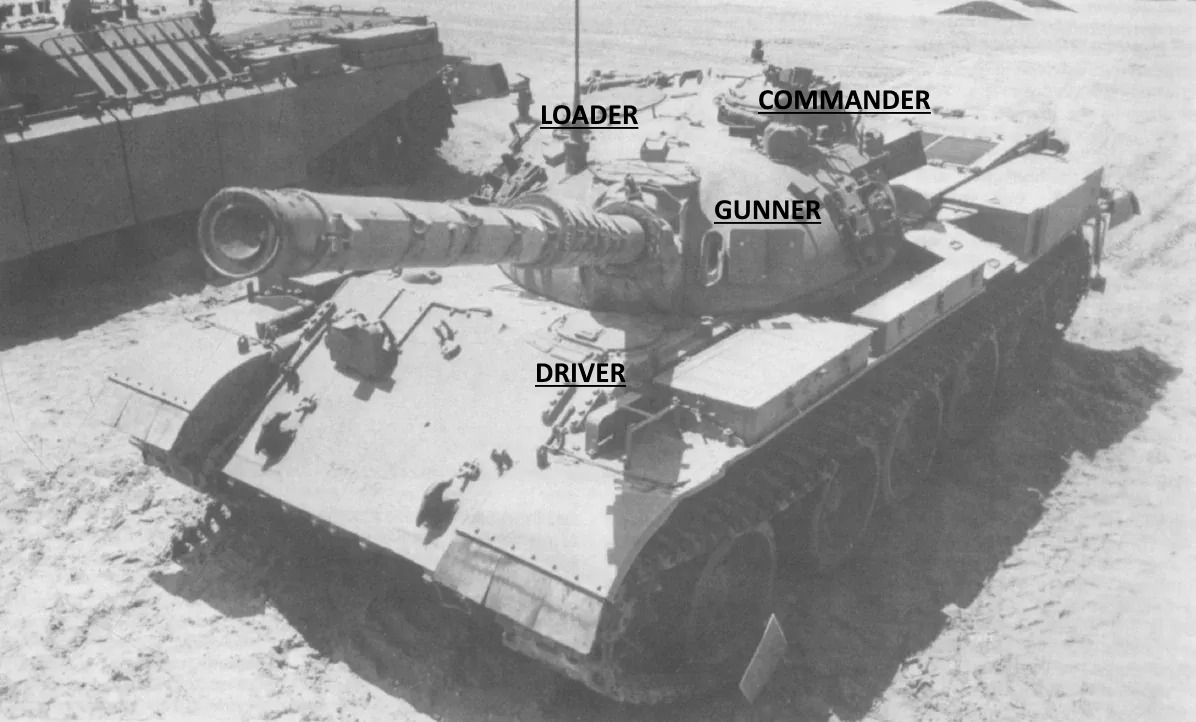
Crew Arrangement:ㅤThe Samovar retains a 4-man crew (commander, driver, gunner, and loader), as well as the standard Eastern-style crew layout: the driver is positioned on the front-left of the hull, the gunner and commander sit on the left side of the turret, and the loader is on the right side.
Crew arrangement diagramArmor:ㅤThe Samovar utilizes baseline T-55 armor, which consists of a cast steel turret and rolled homogeneous steel (RHA) hull armor. However, one notable change can be seen in the IDF concept drawing of the Samovar hull: the rear armor appears to be roughly the same thickness as the bottom. On the original T-55, the rear is armored with 30–45 mm of steel, whereas the bottom is only 20 mm, which would represent a notable downgrade in rear protection. The general armor thickness values are:
Turret Armor
- Front: 200 mm / 0°
- Front (at angle): 70 mm / 52°
- Sides: 160 mm / 0°
- Sides (at angle): 115 mm / 45°
- Rear: 65 mm / 0°
- Rear (at angle): 50 mm / 45°
- Roof: 30 mm
Hull Armor
- Front:
- Upper glacis: 100 mm / 60°
- Lower glacis: 100 mm / 55°
- Sides:
- Upper sides: 60mm / 60°
- Lower sides: 80mm / 0°
- Rear:
- Upper rear: 20 mm / 0°
- Middle rear: 20 mm / ~45°
- Lower rear: 20 mm / ~70°
- Bottom: 20 mm
- Roof: 15–30 mm
IDF concept drawing of Samovar hullInterior:ㅤThe interior layout of the tank is largely identical to the baseline T-55. However, the fuel system was completely reworked with enlarged tanks, three located on the right side of the front hull and one in the rear. Most of the ammunition is stored in a “wet stowage” configuration inside two of the front fuel tanks. Diesel fuel serves as additional protection because it has a high flash point and does not ignite easily; liquid diesel can absorb heat and shrapnel, before they reach the shells and reduce the overall post-penetration damage. Furthermore, the amount of loose, exposed ammunition stored around the hull sides and rear turret basket is significantly reduced compared to the stock T-55.
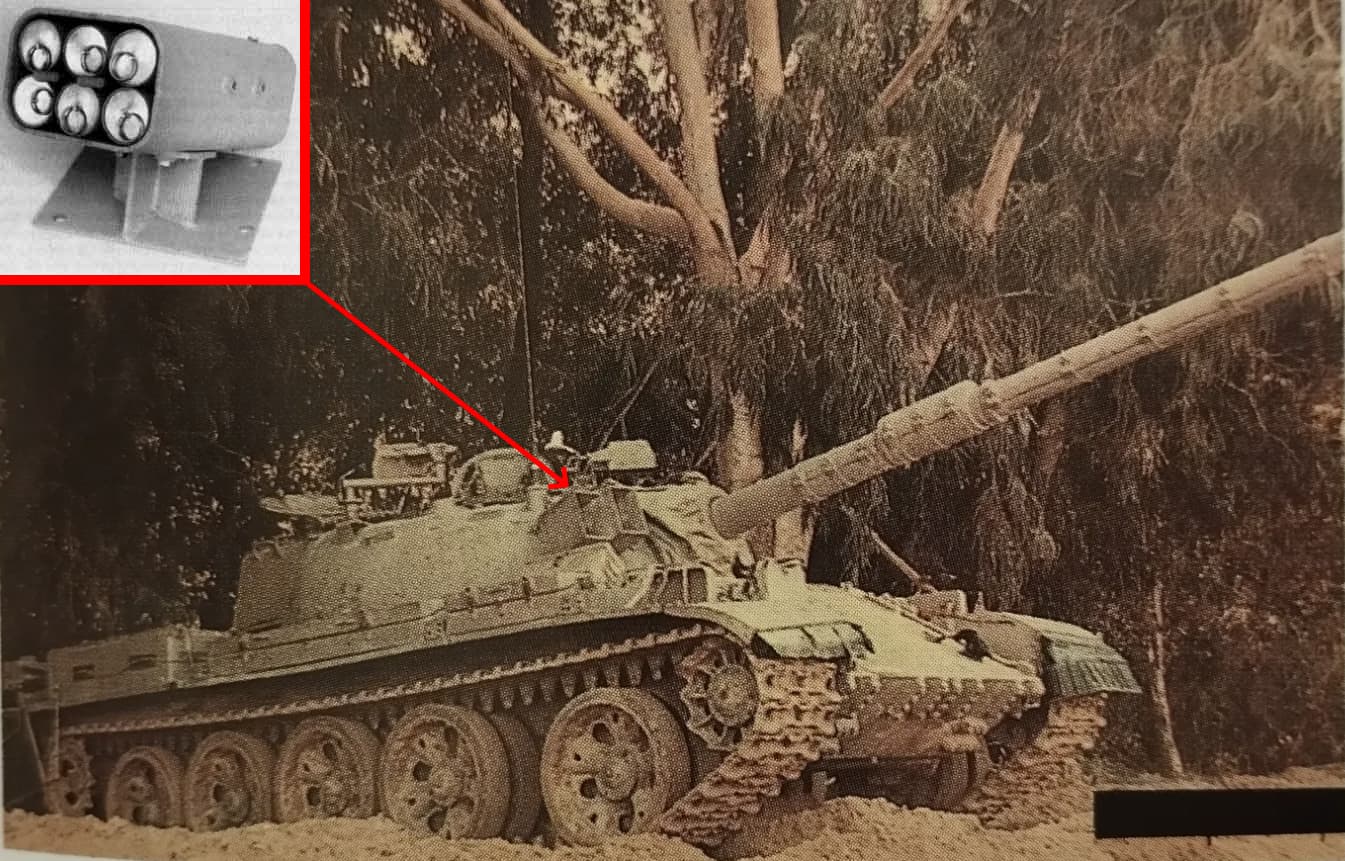
Internal Fuel placmentSmoke Charges:ㅤThe Samovar can deploy a large quantity of smoke charges. First, it features a quad-mount setup for IS-6 smoke dispensers, with each unit holding 6 smoke grenades for a total of 24 charges. Additionally, an externally mounted 60 mm mortar is fitted on the left side of the commander’s cupola, with its ammunition stored right next to it in a turret-mounted box (holding a couple dozen rounds).
An example of how IS-6 launchers are installed
■ - yellow stands for parameters that need further research (based on a single source or estimated)
General Info:
- Name: Samovar (Hull Prototype) / (אב-טיפוס תובה) סמובר
- Origin: Israel
- Manufacturer: IMI / Nimda / IDF Ordnance Corps
- Year: 1982
- Class: MBT (Medium Tank)
- Crew: 4 (commander, driver, gunner, and loader)
Dimensions:
- Length: 6.46 m
- Length w/gun facing forward: 8.99 m
- Height: 2.40 m (slightly higher)
- Width: 3.27 m
- Ground clearance: 0.43 m (slightly higher)
- Weight: 37,500 kg
Armaments:
- Main Armament: 1x 105 mm “Sharir” (M68)
- Secondary Armament: 1x coaxial 7.62mm, 2x pintle-mounted 7.62mm
- Ammo Storage
- 105mm: 43 rounds (1 in the chamber, 10 first-stage and 32 additional)
- In the case it retained 6 rounds in the turret: 49 total
- 7.62mm: 3,500 rounds (Confirmed 2,000 rounds)
- 105mm: 43 rounds (1 in the chamber, 10 first-stage and 32 additional)
- Ammo Types (105 mm)
- M111 “Hetz” APFSDS
- M152 HEATFS
- M156 HESH
- M416 Smoke Shell
- Turret horizontal limits: 360°
- Turret vertical limits: -5°/+18°
- Ammo Storage
- Stabilizer: ✓ (STP-2 “Tsyklon”)
- Laser-Rangefinder: ✓ (TL10-T)
- Optics
- Telescopic gunner sight:
- Low power: 3.5× magnification (offering a wider 18° field of view)
- High power: 7× magnification (offering a narrower 9° field of view)
- NV40 gunner NVG periscope: Image Intensifier Gen 2
- Field of view: 7.3°
- Magnification: x7.1
- Maximum detection rage of tank-sized target:
- In Moonlight conditions: 2700 m
- In Starlight conditions: 1300 m
- Telescopic gunner sight:
Protection:
- Hull protection (F/S/R): 100 / 80 / 20 mm
- Type: rolled homogeneous steel (RHA)
- Turret protection (F/S/R): 200 / 160 / 65 mm
- Type: Cast steel
- Smoke charges: 24x (4x IS-6 launchers, 2x per side, each with 6x smoke grenades)
- Additional: 60 mm mortar with a dozen more smoke grenades
Engine + Performance:
- Engine: Detroit Diesel 8V71T 8-cylinder diesel engine
- Transmission: Allison XTG-411-4
- Gears: 4 forward, 2 reverse.
- Horsepower: 609 hp
- Horsepower-to-Weight Ratio: 16.24 hp/t
- Speed
- Max. Forward: ~ 55 – 60 km/h
- Max. Reverse: ~11.5 – 12.6 km/h
- Suspension Type: Torsion bar
- Range: N/A
Sources:
Spoiler
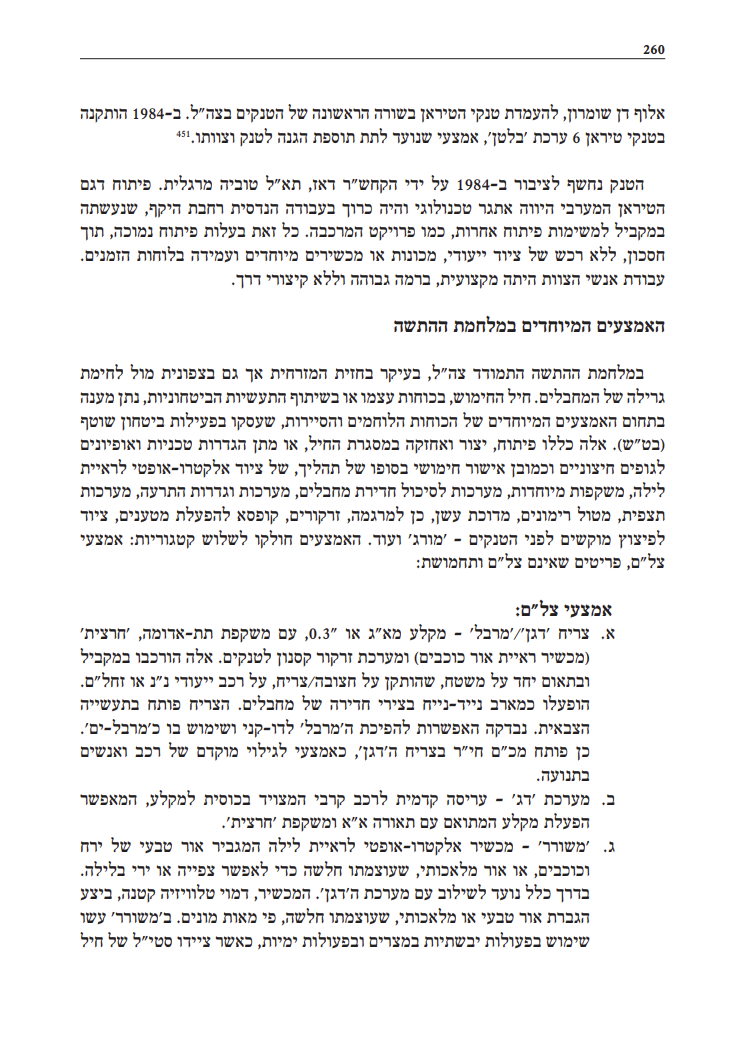
"תולדות חיל החימוש בשנים 1967–1985 "חיל החימוש כמכפיל הכוח
Eng: “The History of the Ordnance Corps, 1967–1985: The Ordnance Corps as a Force Multiplier”
PDF: https://www.himush.co.il/himush.co.il/originals/nisim11/hil-hacimos//toldot-hil-hcimos1967-1985.pdf
“Tiran Tanks” Pages 55–58

“Western Tiran – Samovar” Pages 258–260

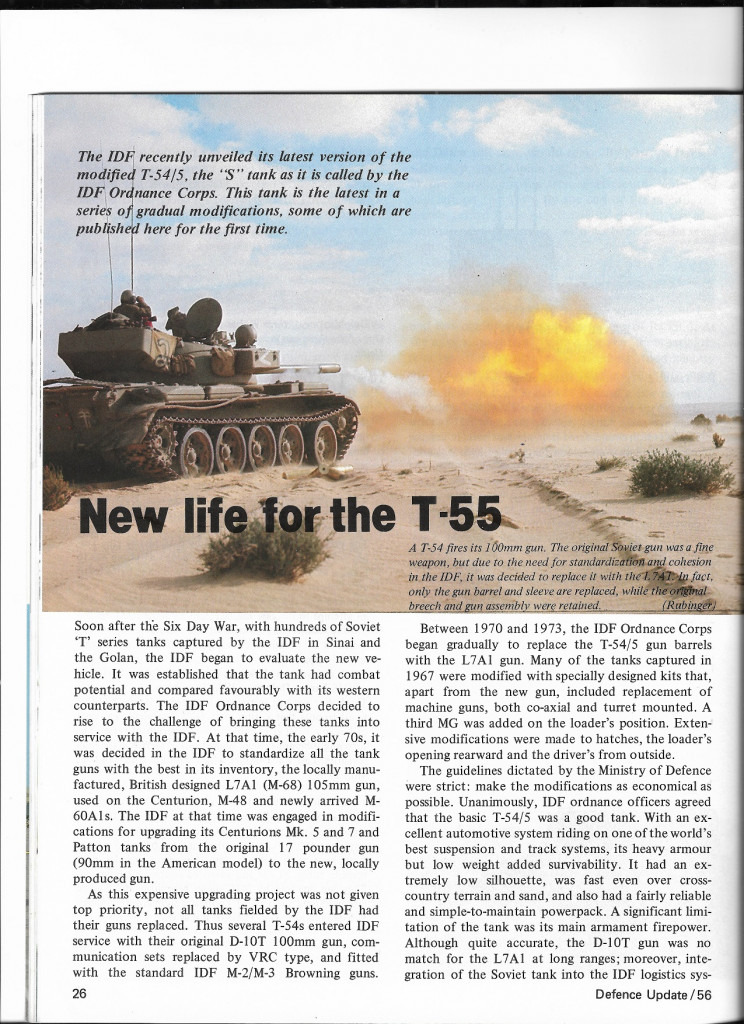
Defence Update magazine, Issue no. 56 (Year 1985)
“New life for Soviet T-55s” Pages 26–34

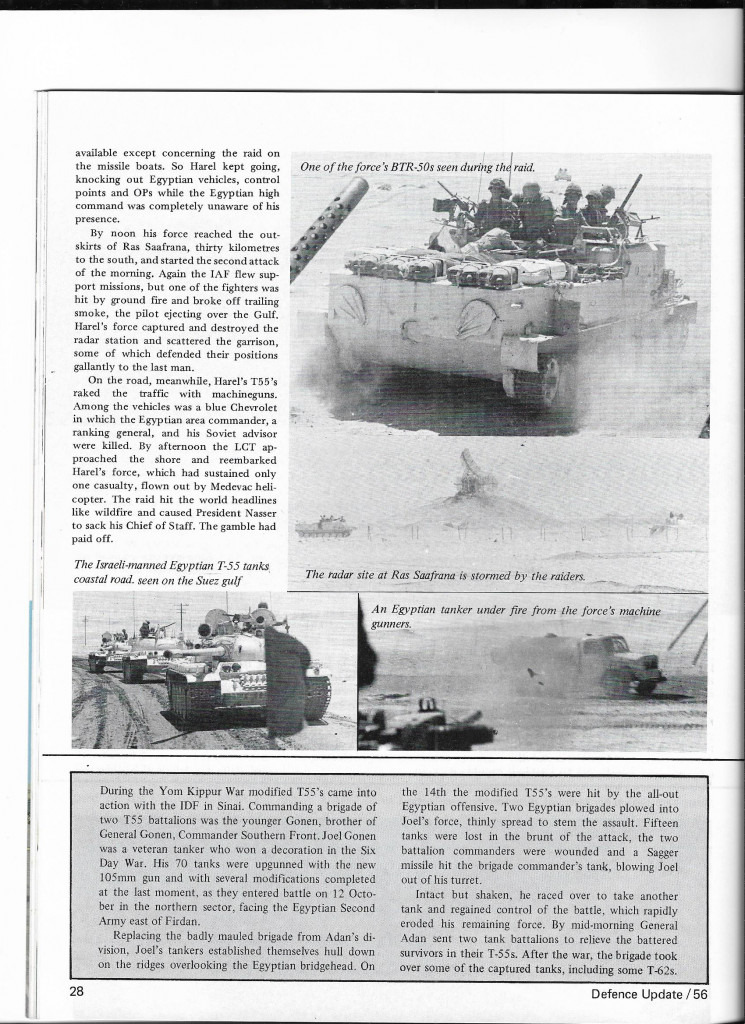
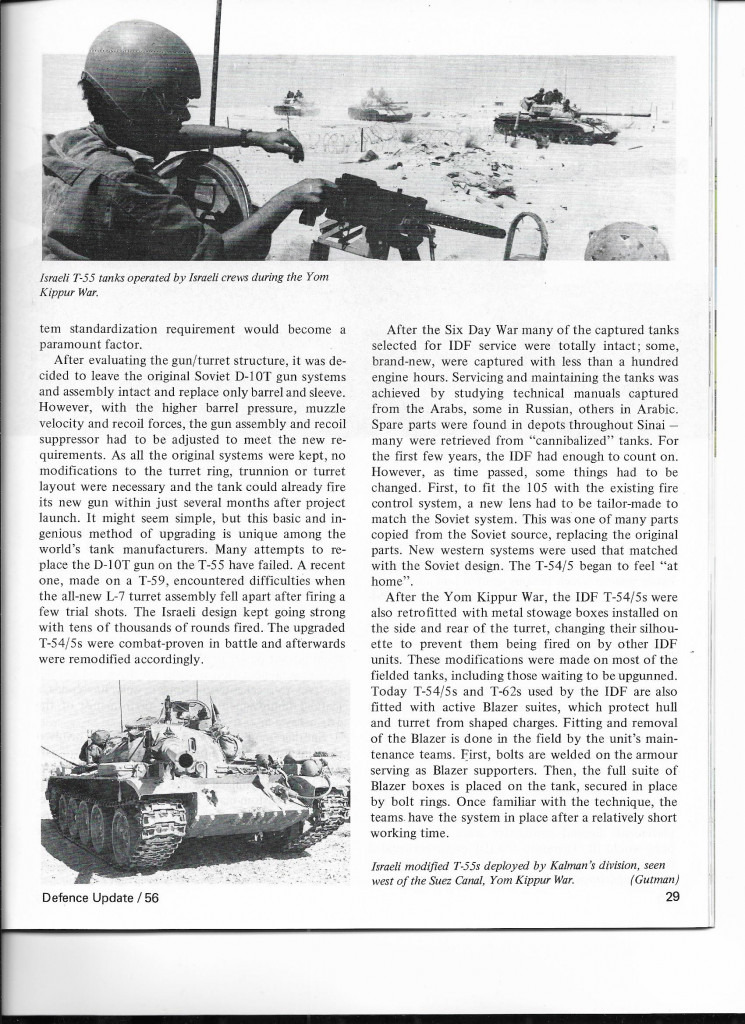
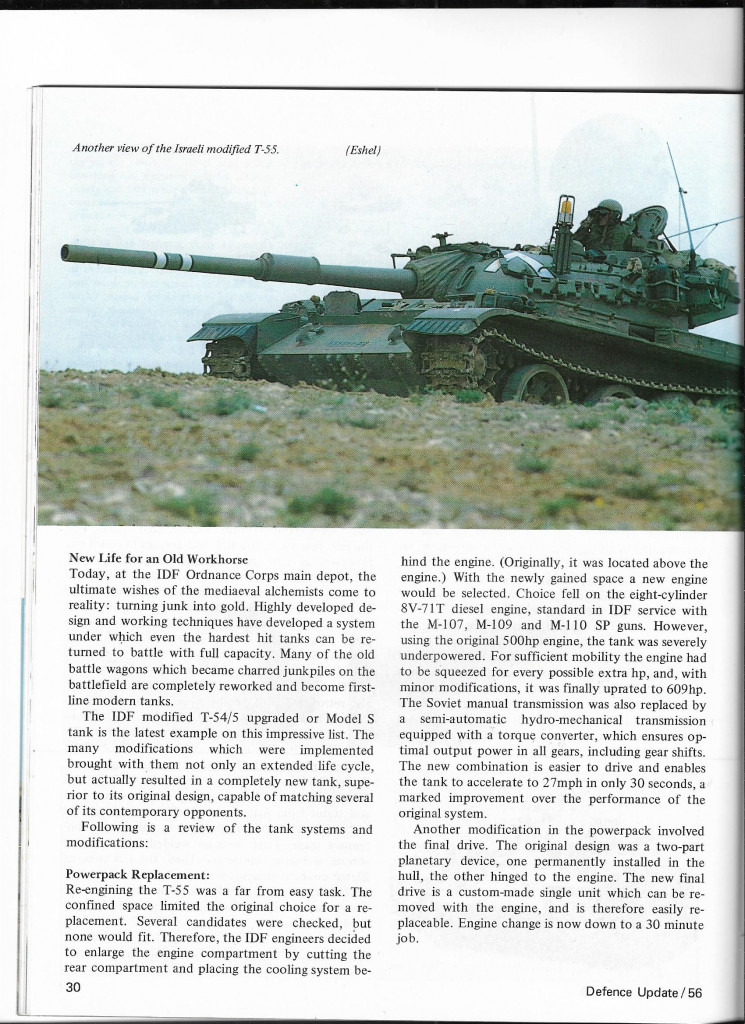
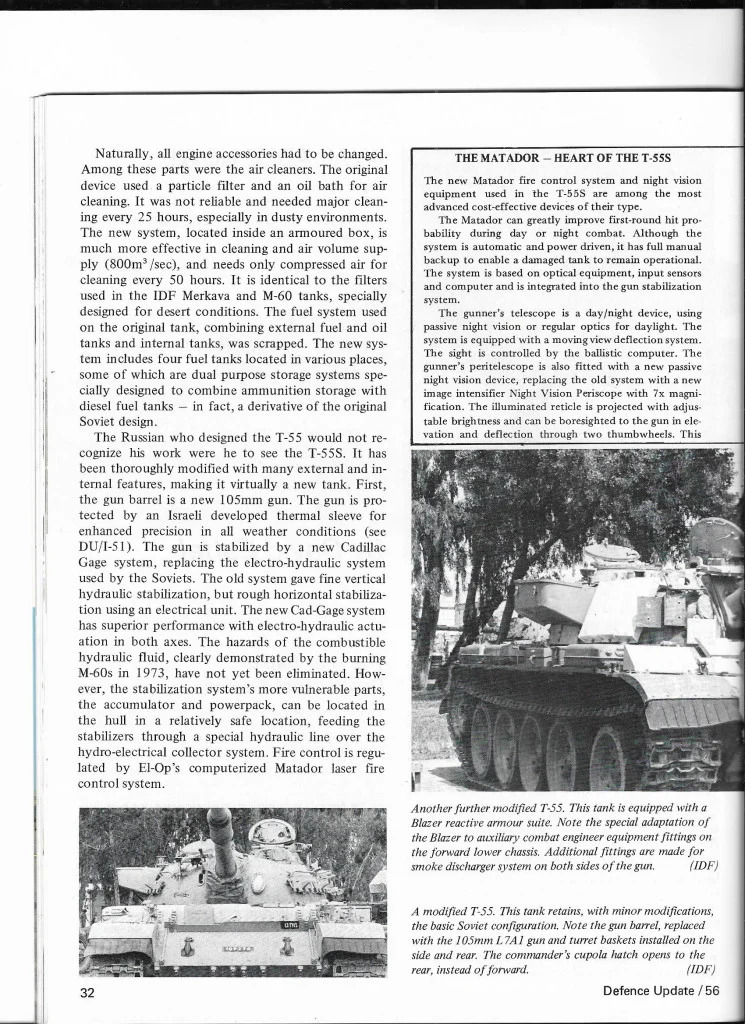
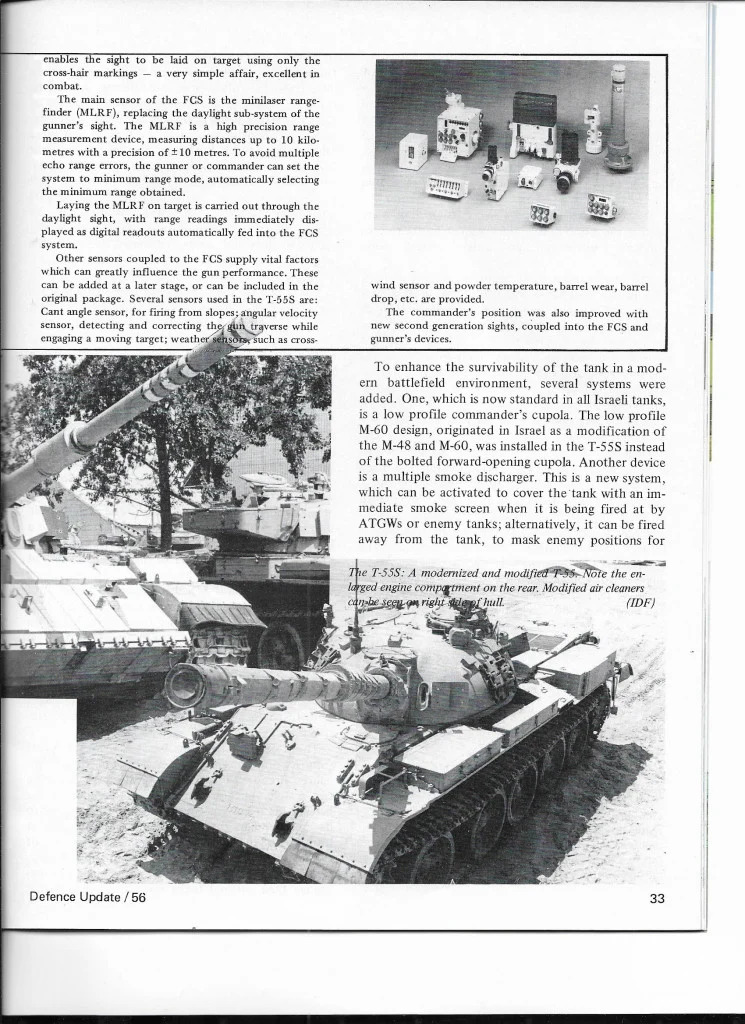
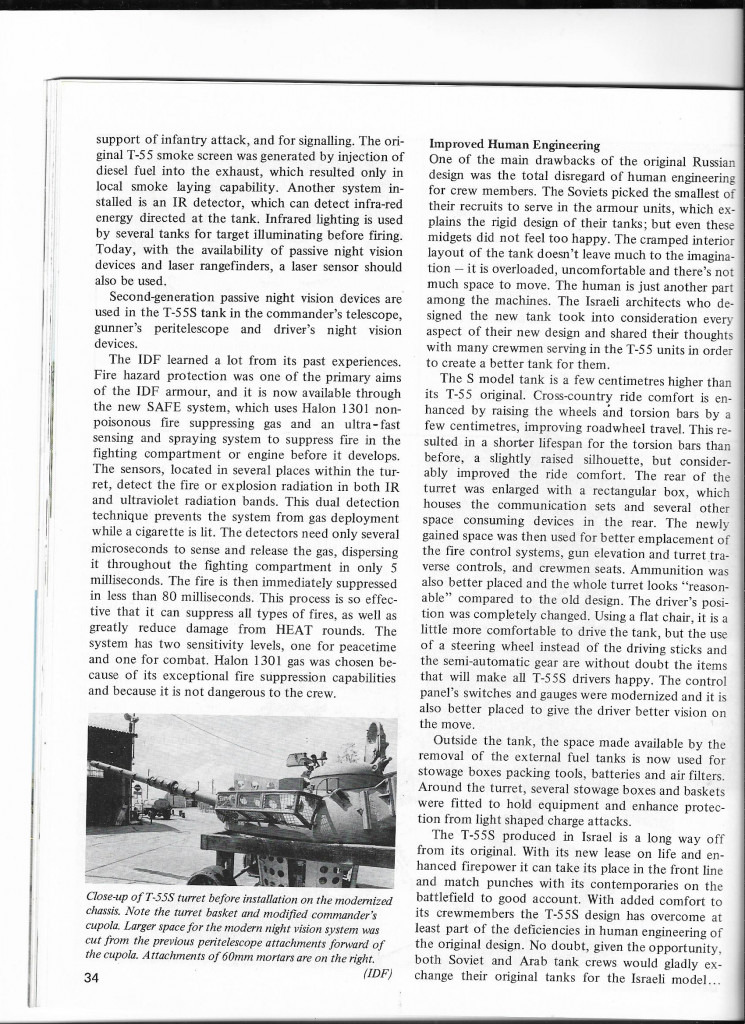
Michael Mass, IDF Armor Series No.8 “Achzarit Heavy APC” (Year 2014)
“From Tiran to Samovar” + “From Samovar to Achzarit” Pages 5–10
Defence Update magazine, Issue no. 36 (Year 1983)

Pages 11–12, 53–54


The Tankograd Gazette, Issue no. 9 (Year 2000)

“T-55S Samovar” Pages 12–14
(Note that the designation “T-55S” is unofficial)

British Defense Equipment Catalogue 1984–1985

“NV39/T, NV40” Page 355; “TL-10-T” Page 357
Jane’s Armoured Fighting Vehicle Retrofit Systems 1993-94
Confirmation of subsystems used on Samovar + Specifications
Archived Book: https://archive.org/details/JanesArmouredFightingVehicleRetrofitSystems199394/page/n491/mode/2up
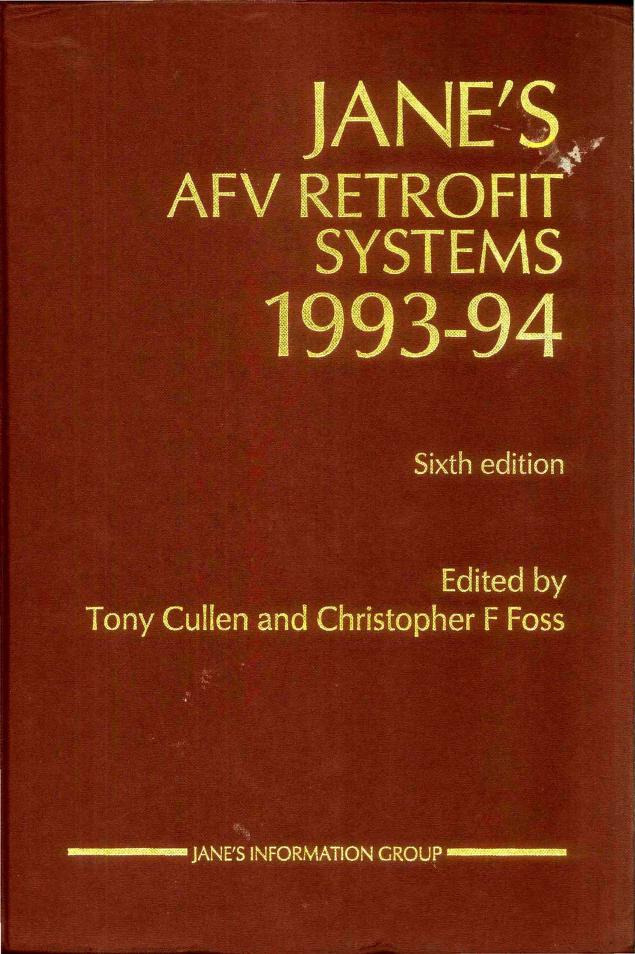
Page 393 (Astronautics FCS-30)

Page 466 (Avimo TL-10-T)

Page 511 (Avimo NV40)
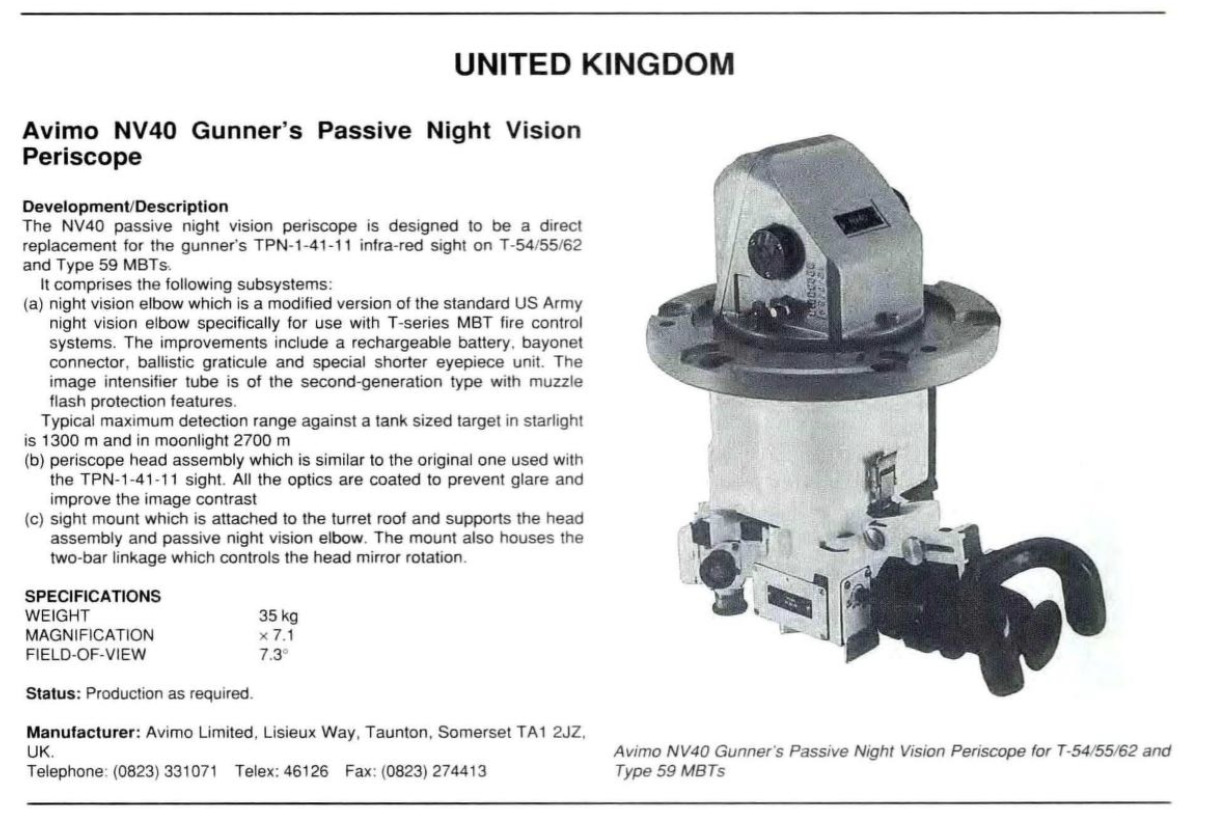
Note: Those systems match identically with sights showcased in Defence Update No.36, as well as in the History article of Ordnance Corps (on page 259) it is mentioned that Tirans post-1983 were equipped with “integrated laser rangefinder mounted on the Tiran gunner’s telescope, as well as a new passive periscope system featuring the NV40 for the gunner and NV39 for the driver, and a Fire Control System 3000”

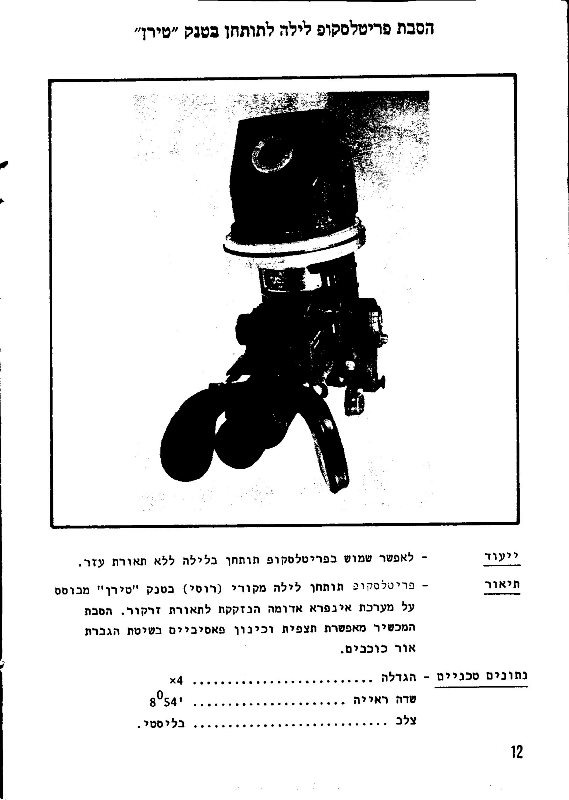
Ordnance Corps Objective (1979)
Source: https://www.himush.co.il/?item=37411§ion=669
"Objective: Allow the use of a gunner’s telescope at night without auxiliary lighting.
Description: Original (Russian) night gunner’s telescope on the “Tiran” tank is based on an infrared system that requires spotlight illumination. The device’s conversion allows for passive observation and targeting using the starlight amplification method."
Websites:
Purely for T-55 Specifications: Т-55 — Википедия
Tiran History Дают - бери. - Пещера злобного Буквоеда — LiveJournal
Tiran History - secondary Tiran series (1970)
Image Gallery (used + unused):
Spoiler
Samovar concept drawings (IDF)

Samovar HP
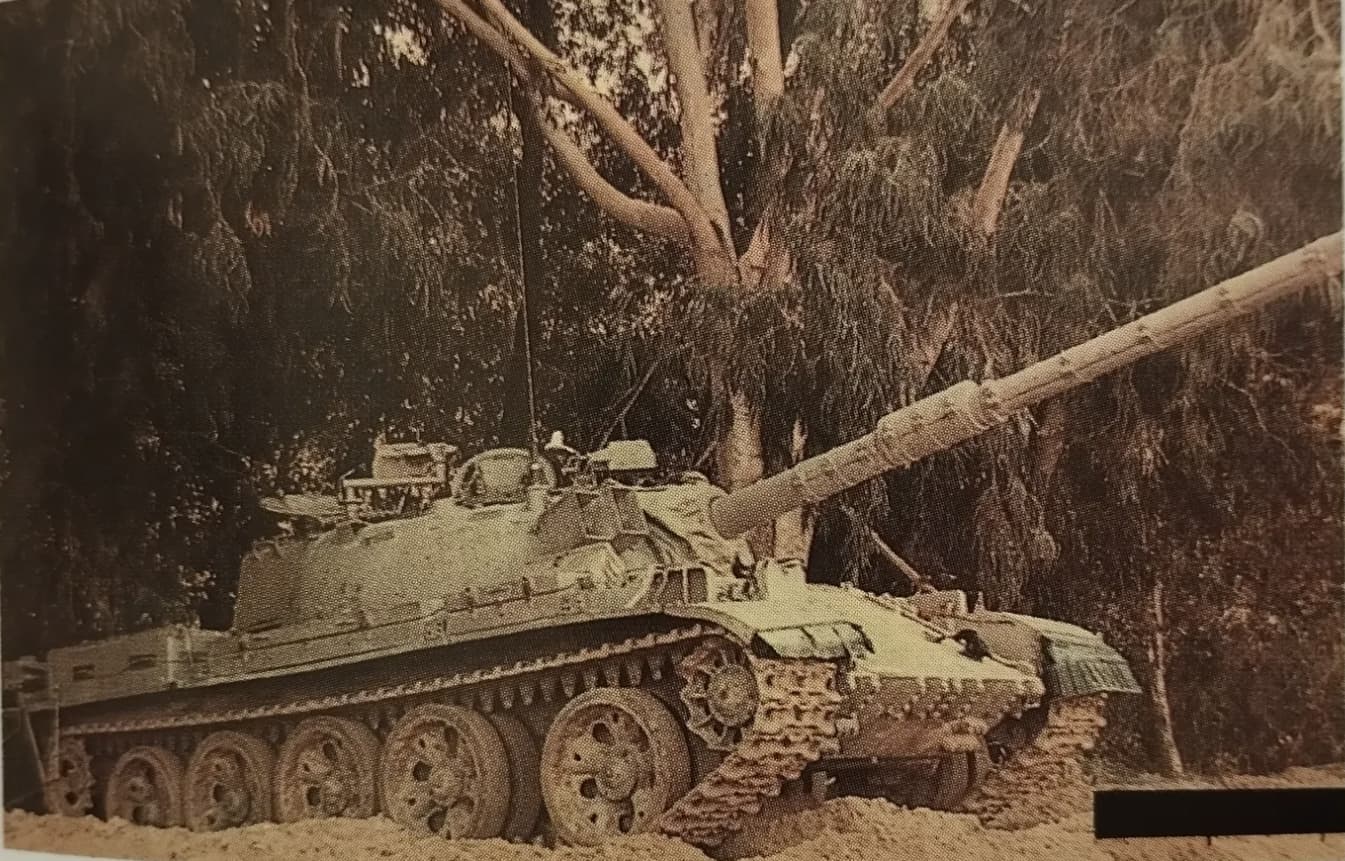


Samovar HP (First Prototype)
Note the differences of engine compartment
Samovar TP
Highly modified Turret, but utilized unmodified T-55 hull

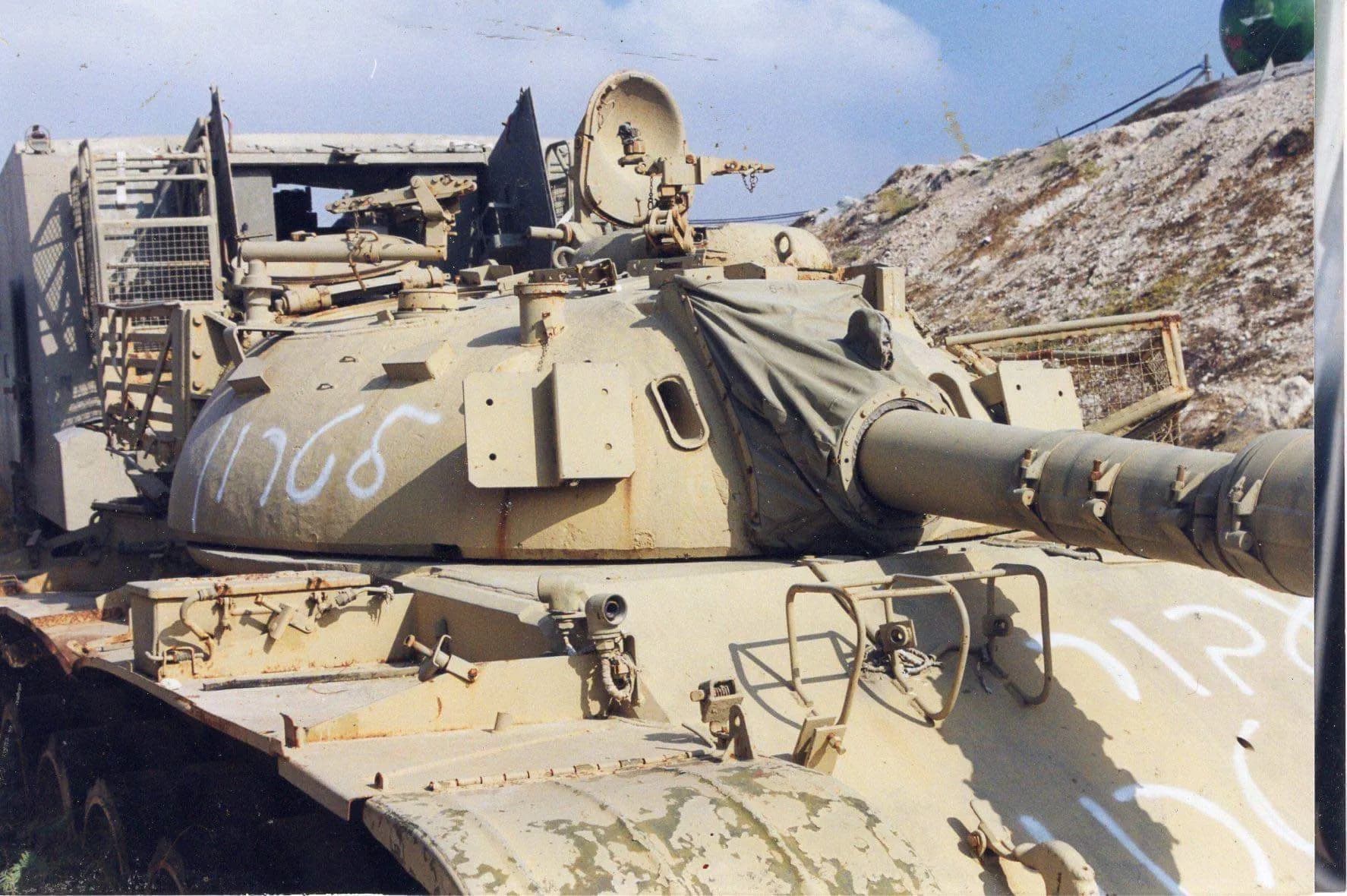
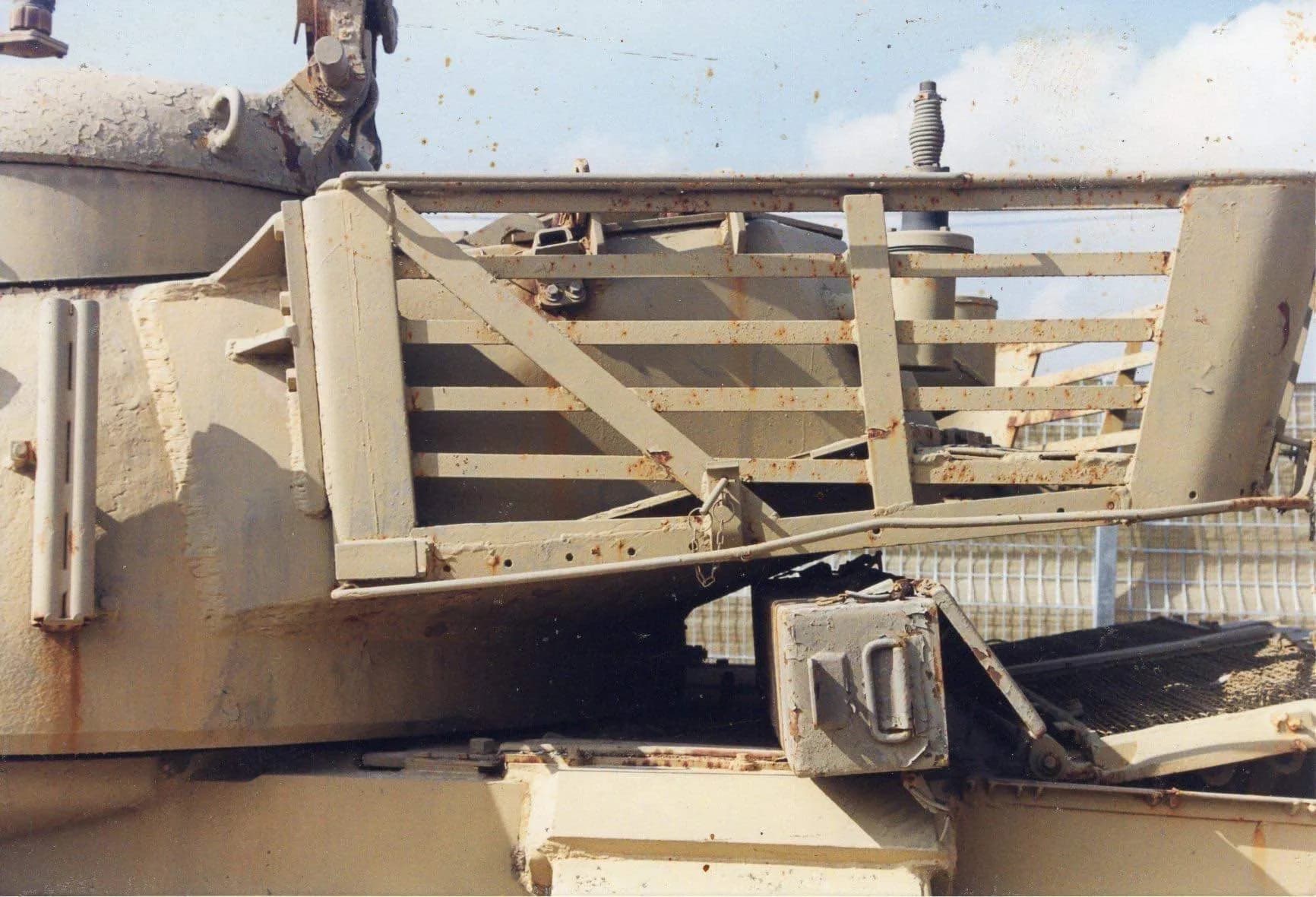
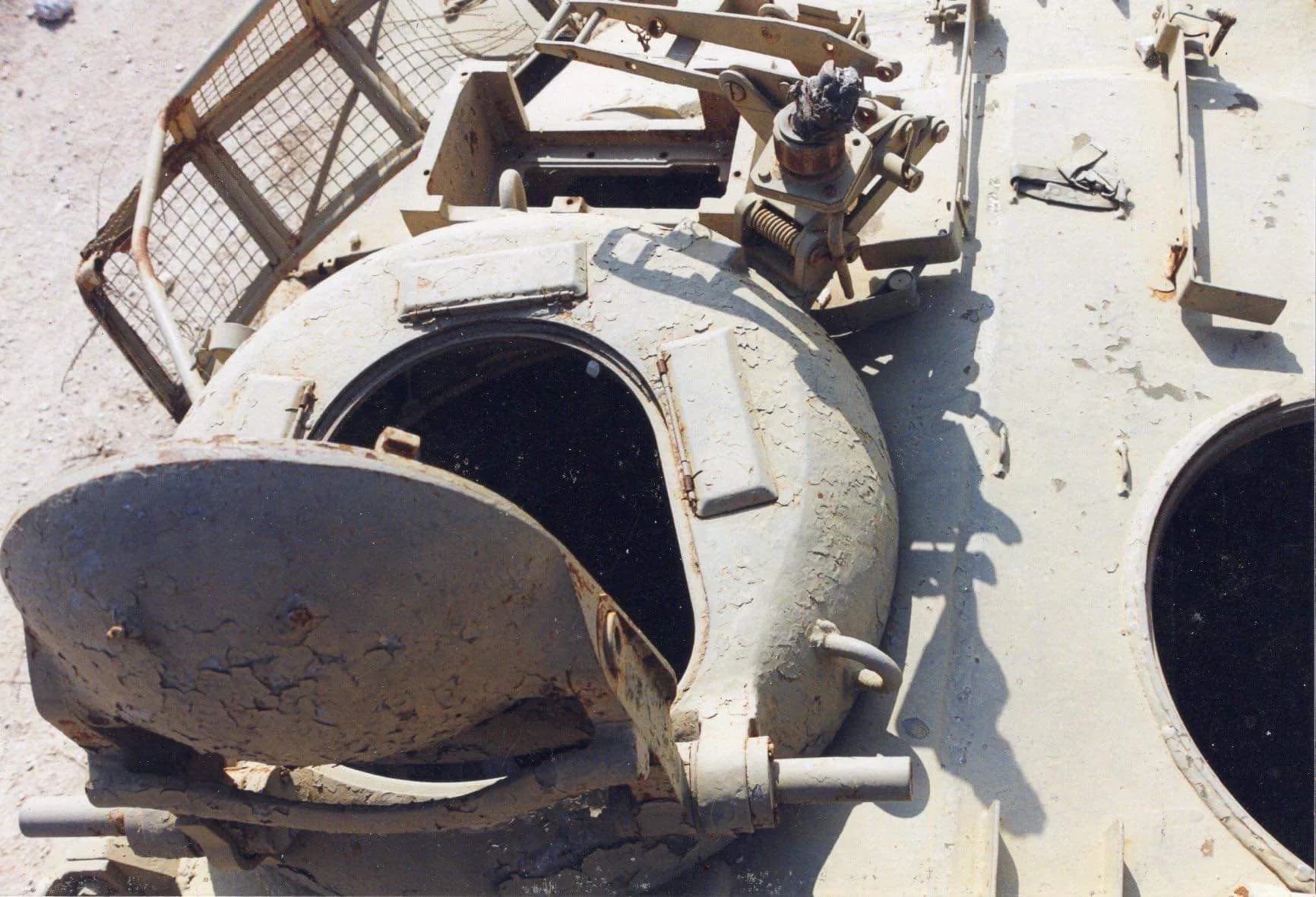
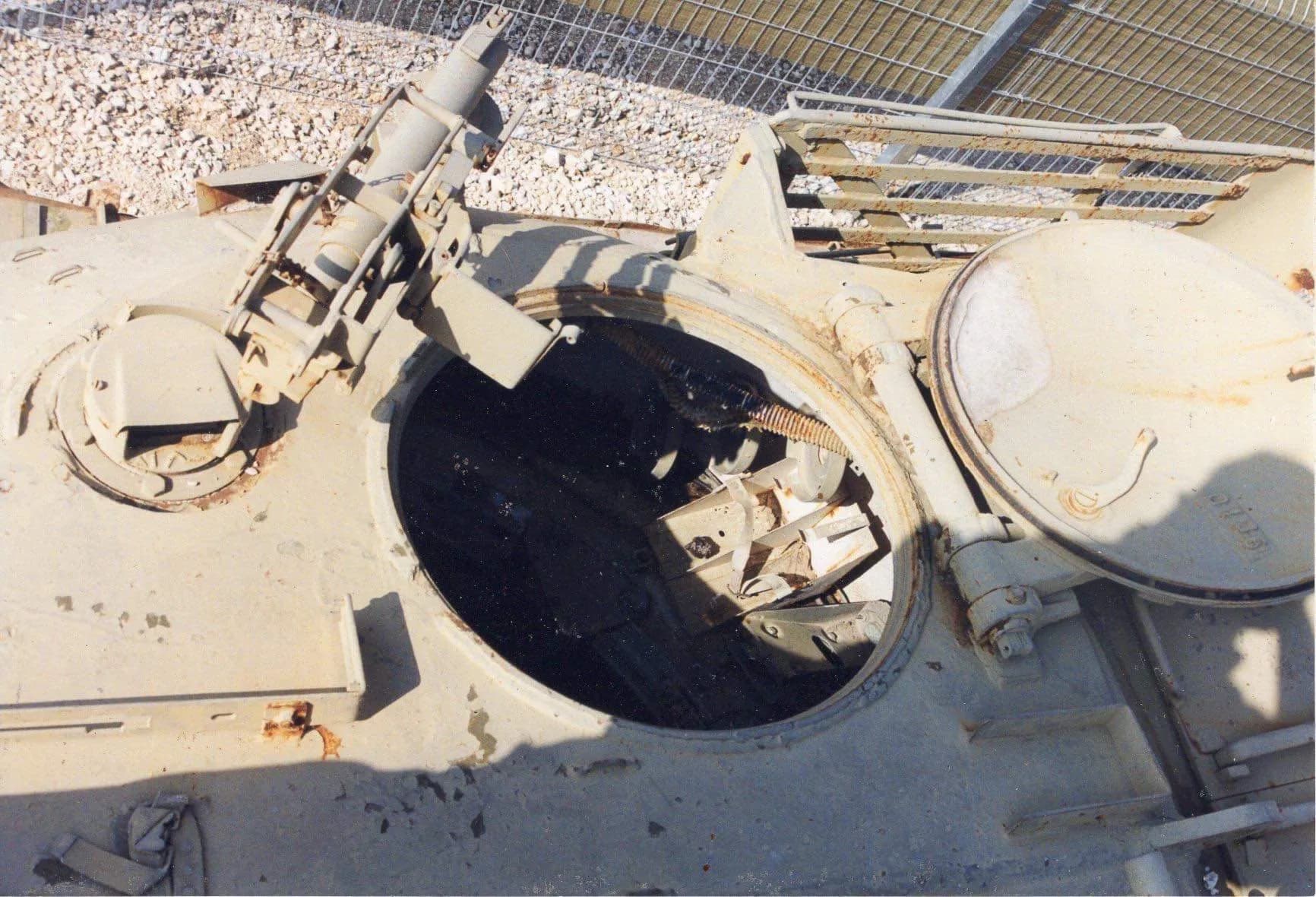
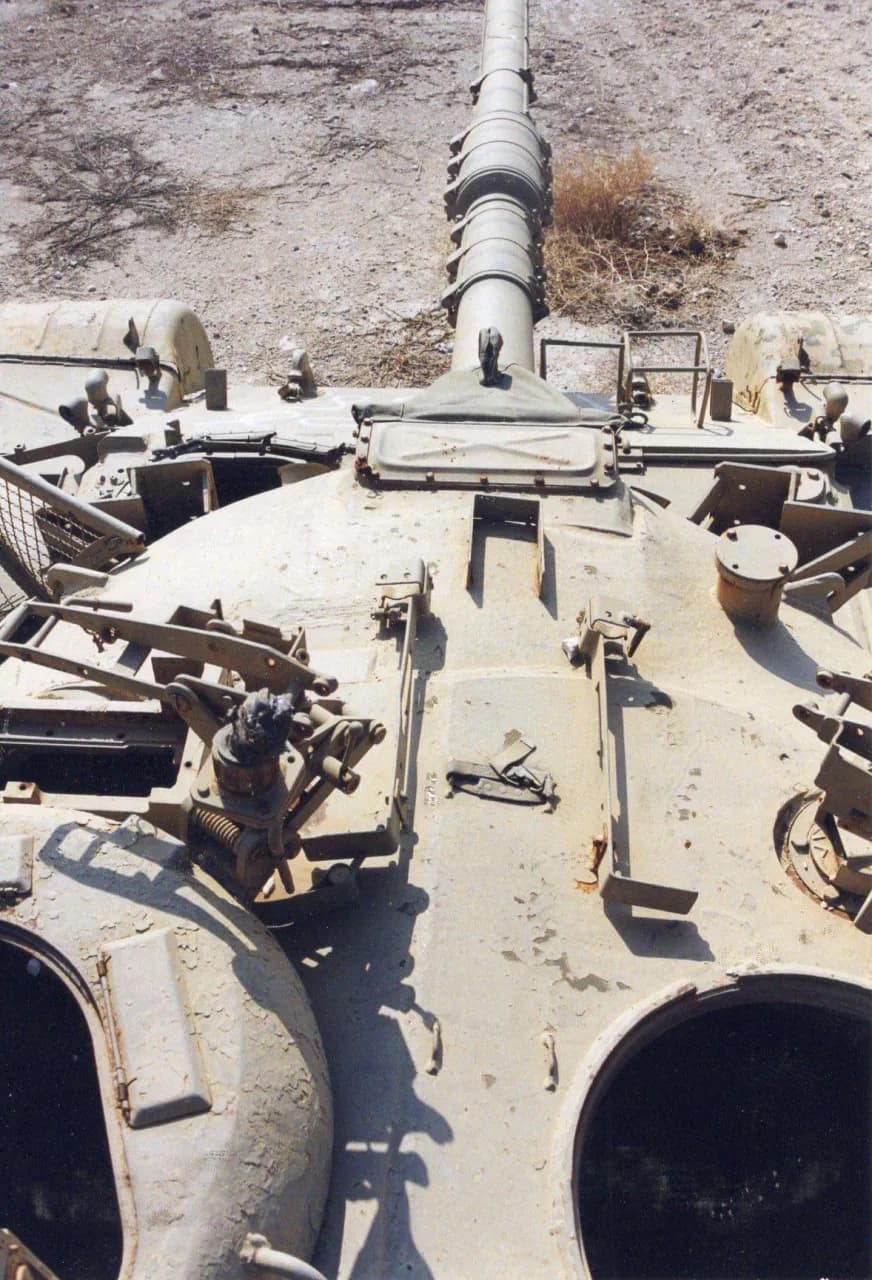
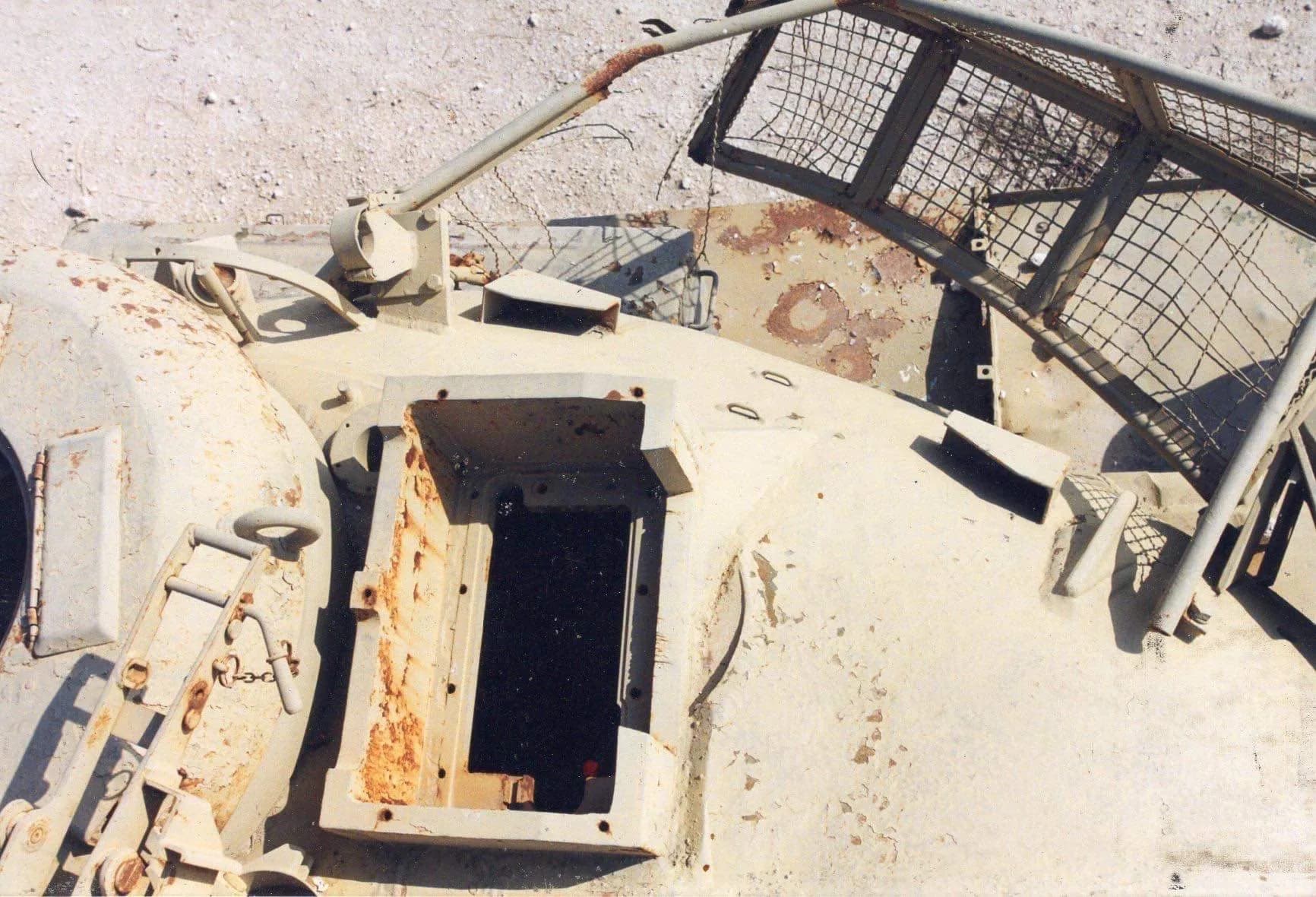
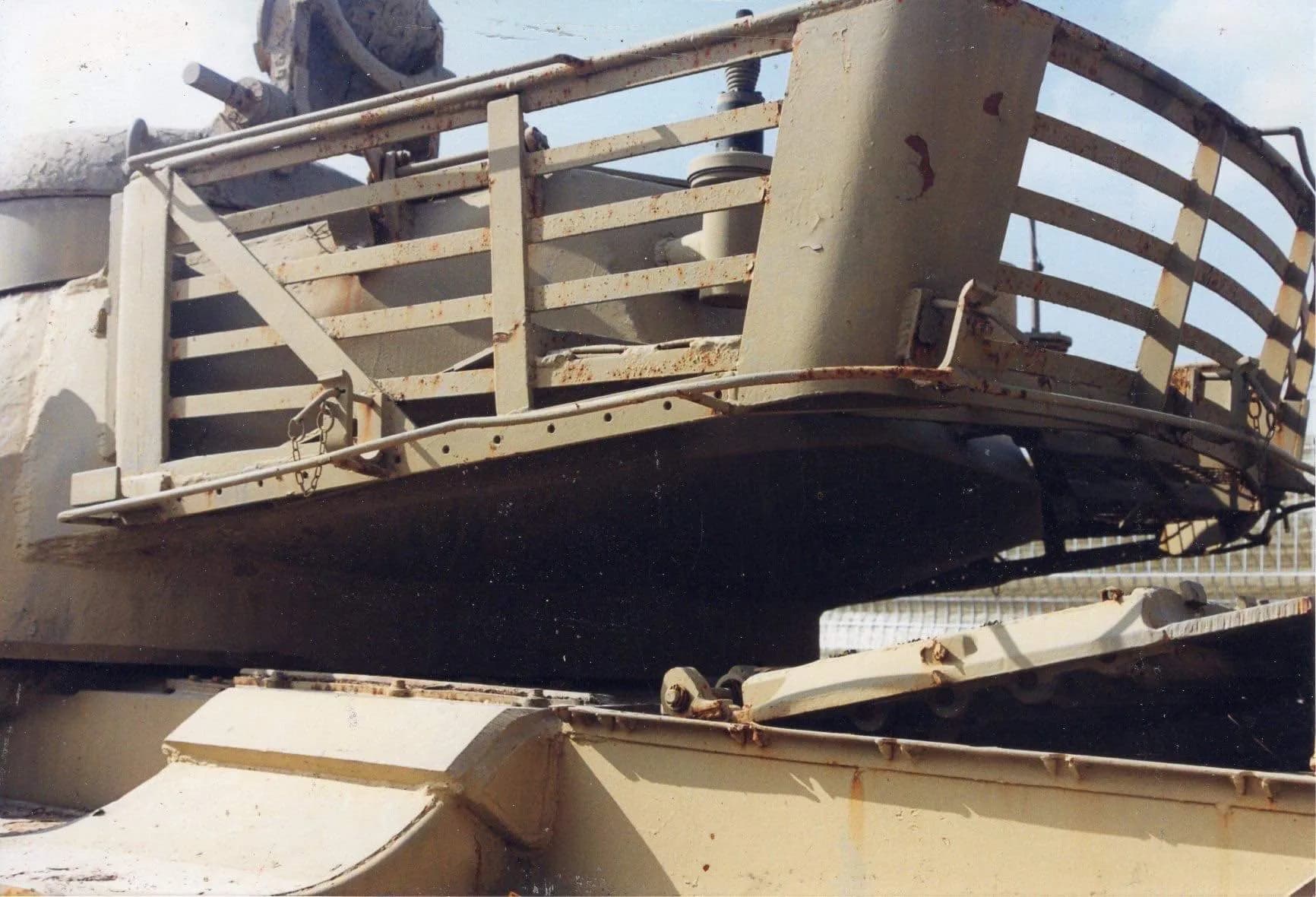
Final Words:
ㅤThe Samovar prototypes represent the final evolution of T-series tanks in IDF service. It was a highly promising project that achieved all of its initial development goals under a low budget, yet was cancelled without a chance to prove itself in combat, primarily due to further military budget cuts and a strategic decision to minimize the number of different MBT platforms in service. In the end, there was no single prototype combining all features, but rather separate prototypes focused on different aspects: one focused on the hull and powerpack, and another on the turret.
ㅤThe Samovar (Hull Prototype) would be an interesting addition. It retains the low silhouette, reliable stabilization, and excellent passive armor structure of the T-55, while integrating modern Western and domestic technologies. Its primary firepower comes from the 105 mm ‘Sharir’ cannon commonly used by the IDF, firing well-proven ammunition, most notably the M111 APFSDS. It also receives an integrated laser rangefinder with a ballistic computer, greatly improving first-round hit probability, as well as second-generation night vision equipment. The upgraded powerpack pushes the chassis to its limit with 609 hp, giving it theoretical top speeds of up to 55–60 km/h forward and 11–12 km/h in reverse. Additionally, it features a generous arrangement of smoke charges and pintle-mounted machine guns, which is highly distinctive for IDF armor.
ㅤThere are, however, a few drawbacks to consider. The raised engine deck creates the infamous “NATO hump,” which limits gun depression directly over the engine deck. Furthermore, judging by IDF concept drawings, the rear hull armor was reduced to 20 mm, meaning low-caliber guns and autocannons can disable the engine more easily from behind. Lastly, because it retained the original Soviet turret traverse and gun elevation mechanisms, traverse speeds remain slower compared to Western tanks like the M60 or Centurion, alongside the poor gun depression typical of Soviet MBTs.
ㅤOverall, the Samovar HP represents a significant upgrade over the baseline T-55. In terms of realistic Battle Rating (BR) placement in War Thunder, it would fit comfortably at 8.7 (0.3 higher than the standard T-55A) thanks to its superior mobility, reverse speed, and laser rangefinder.
ㅤBefore I finish, I would like to express my immense gratitude to people who helped me finding sources (since much of the information is contained in books I do not own) , as well as helping me to calculating the theoretical speed based on the available parameters, I certainly could not have managed that on my own!
- Researchable
- Premium
- Event
- Squadron
- I don’t know
- I voted no (first poll)
- I don’t know
- 8.3 (just like T-55A)
- 8.7
- 9.0
- 9.3 or higher
- Other
- I voted no (first poll)